Australia Anaesthesia Drug Market Summary
The australia anaesthesia drug market was estimated at USD 238 Million in 2025 and is projected to reach USD 280 Million by 2032, growing at a CAGR of 2.5% from 2026 to 2032.
Australia Anaesthesia Drug Market Year-wise Growth Rate and Key Drivers
This graph highlights how the Australia Anaesthesia Drug Market has steadily grown over the past five years, supported by major growth factors.
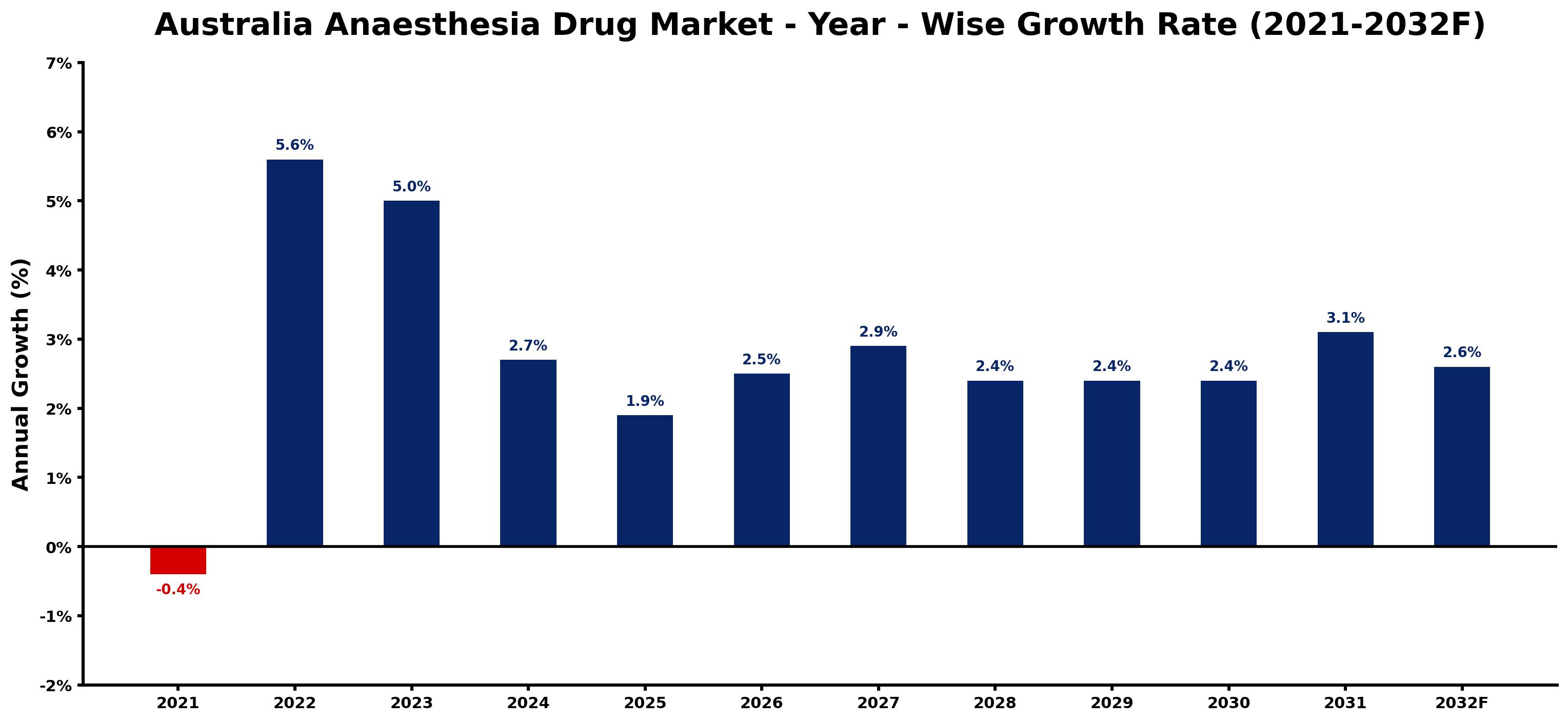
The table below presents the year wise growth rates along with the key drivers influencing the market
| Year | Growth Rate | Major Drivers |
| 2021 | -0.4% | Heightened scrutiny on opioid prescriptions led to decreased demand for anaesthesia drugs in surgical settings. |
| 2022 | 5.6% | New anaesthesia drug formulations catered to specific surgical procedures gained traction in hospitals. |
| 2023 | 5.0% | A surge in outpatient surgeries increased the demand for effective anaesthesia management solutions. |
| 2024 | 2.7% | Growing awareness about patient comfort during procedures drove innovations in anaesthesia technology. |
| 2025 | 1.9% | Hospital partnerships with pharmaceutical companies aimed at optimizing anaesthesia protocols became prevalent. |
| 2026 | 2.5% | The focus on personalized medicine prompted tailored anaesthetic approaches for diverse patient demographics. |
| 2027 | 2.9% | Technological advancements in monitoring systems enhanced patient safety during anaesthesia administration. |
| 2028 | 2.4% | Research breakthroughs in pain management led to the development of new anaesthesia drugs. |
| 2029 | 2.4% | Healthcare reforms emphasized improving surgical outcomes, resulting in higher anaesthesia drug utilization. |
| 2030 | 2.4% | Increased competition among providers stimulated innovation in anaesthesia service delivery methods. |
| 2031 | 3.1% | Collaborative studies between academia and industry improved anaesthesia drug efficacy and safety profiles. |
| 2032 | 2.6% | Sustainability trends in healthcare drove demand for eco-friendly anaesthesia practices and products. |
Note - Market size estimations and growth projections presented in this report are based on 6Wresearch's advanced forecasting approach, validated with industry datasets as of June 2026.
Australia Anaesthesia Drug Market Synopsis
The Australia Anaesthesia Drug Market is projected to reach 2.5% and witness significant growth during the forecast period (2026-2032). This growth is primarily attributed to the increasing number of surgical procedures, advancements in medical technology, and a rising aging population. Anaesthesia drugs play a crucial role in inducing and maintaining anesthesia during surgeries by blocking nerve impulses and inhibiting both consciousness and pain perception. The demand for innovative and effective anaesthesia drugs is underpinned by the growing trend towards minimally invasive surgeries, enhanced ambulatory care services, and the deployment of sophisticated anaesthesia monitoring devices.
Australia Anaesthesia Drug Market Growth Drivers
The dynamics in the Australia Anaesthesia Drug Market are characterized by several key drivers:
- The expanding healthcare sector is increasingly demanding safe and effective anaesthesia medications, particularly for various surgical procedures and pain management solutions. This demand is further propelled by a high volume of elective surgeries.
- An aging population presents a significant challenge as older patients typically require more surgical interventions, thus driving the need for a reliable supply of anaesthesia drugs.
- Emerging chronic diseases, which necessitate surgical interventions and pain management, are contributing to the continuous demand for anaesthesia solutions like inhalation agents, intravenous agents, and local anesthetics.
- Technological advancements in drug delivery systems and pharmacology are enhancing the efficacy and safety levels of anaesthesia drugs. Innovations in perioperative care protocols are also facilitating market growth.
- Moreover, the evolution of healthcare infrastructure and updated regulatory frameworks is supporting the growth trajectory of the anaesthesia drug market in Australia.
Australia Anaesthesia Drug Market Challenges and Restraints
Despite the promising growth prospects, the Australia Anaesthesia Drug Market faces notable challenges:
- Drug shortages pose a critical issue, as the consistent availability of essential anaesthesia drugs is vital for uninterrupted surgical operations and patient care.
- Strict regulatory compliance requirements present challenges for manufacturers in terms of ensuring the quality and safety of their products while adhering to complex guidelines.
- Patient safety remains a paramount concern, as adverse effects associated with anaesthesia drugs can lead to significant complications during and post-surgery.
- Market players must navigate the complex landscape of healthcare policies that can affect the reimbursement rates and availability of anaesthesia drugs.
- Additionally, competition among manufacturers can create pricing pressures, which may impact the commitment to innovation and quality in drug development.
Australia Anaesthesia Drug Market Government Investment and Initiatives
The Australian government plays a pivotal role in shaping the anaesthesia drug market through various investments and initiatives:
- Regulatory frameworks established by government agencies aim to ensure the safety, quality, and efficacy of anaesthesia drugs, which is essential for maintaining public health standards.
- Public spending on healthcare infrastructure has been increasing, allowing for enhanced surgical facilities equipped with the latest technology for administering anaesthesia.
- The government is also investing in research and development initiatives to promote innovation in anaesthesia drug formulations and delivery systems.
- Incentives, such as grants for pharmaceutical companies engaged in the development of new anaesthetic agents, encourage ongoing advancements within the industry.
- Collaboration between public and private sectors is fostering a conducive environment for the growth and development of safe anaesthesia practices across healthcare settings.
Australia Anaesthesia Drug Market Trends and Opportunities
Current trends in the Australia Anaesthesia Drug Market indicate promising opportunities for growth:
- The shift towards minimally invasive surgical procedures is creating a demand for specialized anaesthesia drugs that cater to these techniques, emphasizing the need for innovations in drug formulations.
- Ambulatory care services continue to expand, necessitating effective anaesthesia solutions that support outpatient procedures, presenting a unique opportunity for market players.
- Advancements in monitoring devices are leading to improved patient safety, with a growing focus on the development of smart anaesthesia systems that enhance precision and efficiency.
- Telemedicine and virtual care platforms are influencing anaesthesia practices, offering new avenues for consultation and pre-operative assessments that can optimize drug administration.
- The increasing emphasis on patient-centered care models drives the demand for anaesthesia drugs that minimize recovery time and enhance overall patient experience during surgical procedures.
Australia Anaesthesia Drug Market Latest Developments (May 2025 - June 2026)
In the period between May 2025 and June 2026, the Australia Anaesthesia Drug Market has seen several important developments:
- There has been a notable increase in collaborative research initiatives aimed at developing novel anaesthesia agents that provide better efficacy and reduce side effects.
- Regulatory bodies have introduced updated guidelines to streamline the approval process for new anaesthesia drugs, facilitating quicker market entry for innovative solutions.
- Investments in digital health have surged, leading to the integration of advanced analytics and machine learning in anaesthesia practices, enhancing patient outcomes through better drug management.
- Ongoing training programs and workshops have been implemented to improve the knowledge and skills of healthcare providers in using advanced anaesthesia techniques and medications.
- Prominent health organizations have initiated awareness campaigns focusing on the importance of safety in anaesthesia practices, further driving demand for safer and more effective anaesthesia solutions.
Australia Anaesthesia Drug Market - Key Attractiveness of the Report
- 10 Years of Market Numbers
- Historical Data Starting from 2022 to 2025
- Base Year: 2025
- Forecast Data until 2032
- Key Performance Indicators Impacting the Market
- Major Upcoming Developments and Projects
Key Highlights of the Report:
- Australia Anaesthesia Drug Market Outlook
- Market Size of Australia Anaesthesia Drug Market, 2025
- Forecast of Australia Anaesthesia Drug Market, 2032
- Historical Data and Forecast of Australia Anaesthesia Drug Revenues & Volume for the Period 2022-2032F
- Australia Anaesthesia Drug Market Trend Evolution
- Australia Anaesthesia Drug Market Drivers and Challenges
- Australia Anaesthesia Drug Price Trends
- Australia Anaesthesia Drug Porter's Five Forces
- Australia Anaesthesia Drug Industry Life Cycle
- Historical Data and Forecast of Australia Anaesthesia Drug Market Revenues & Volume By Type for the Period 2022-2032F
- Historical Data and Forecast of Australia Anaesthesia Drug Market Revenues & Volume By General? for the Period 2022-2032F
- Historical Data and Forecast of Australia Anaesthesia Drug Market Revenues & Volume By Local for the Period 2022-2032F
- Historical Data and Forecast of Australia Anaesthesia Drug Market Revenues & Volume By Routes of Administration for the Period 2022-2032F
- Historical Data and Forecast of Australia Anaesthesia Drug Market Revenues & Volume By Inhalation for the Period 2022-2032F
- Historical Data and Forecast of Australia Anaesthesia Drug Market Revenues & Volume By Injection for the Period 2022-2032F
- Historical Data and Forecast of Australia Anaesthesia Drug Market Revenues & Volume By Other for the Period 2022-2032F
- Historical Data and Forecast of Australia Anaesthesia Drug Market Revenues & Volume By Applications for the Period 2022-2032F
- Historical Data and Forecast of Australia Anaesthesia Drug Market Revenues & Volume By General Surgery for the Period 2022-2032F
- Historical Data and Forecast of Australia Anaesthesia Drug Market Revenues & Volume By Plastic Surgery for the Period 2022-2032F
- Historical Data and Forecast of Australia Anaesthesia Drug Market Revenues & Volume By Cosmetic Surgery for the Period 2022-2032F
- Historical Data and Forecast of Australia Anaesthesia Drug Market Revenues & Volume By Dental Surgery for the Period 2022-2032F
- Historical Data and Forecast of Australia Anaesthesia Drug Market Revenues & Volume By Other for the Period 2022-2032F
- Australia Anaesthesia Drug Import Export Trade Statistics
- Market Opportunity Assessment By Type
- Market Opportunity Assessment By Routes of Administration
- Market Opportunity Assessment By Applications
- Australia Anaesthesia Drug Top Companies Market Share
- Australia Anaesthesia Drug Competitive Benchmarking By Technical and Operational Parameters
- Australia Anaesthesia Drug Company Profiles
- Australia Anaesthesia Drug Key Strategic Recommendations






































