Australia Animal Feed Market Growth Rate
According to 6Wresearch internal database and industry insights, the Australia Animal Feed Market is projected to witness stable Market Growth, registering a compound annual growth rate (CAGR) of approximately 5.4% during the forecast period (2025–2031).
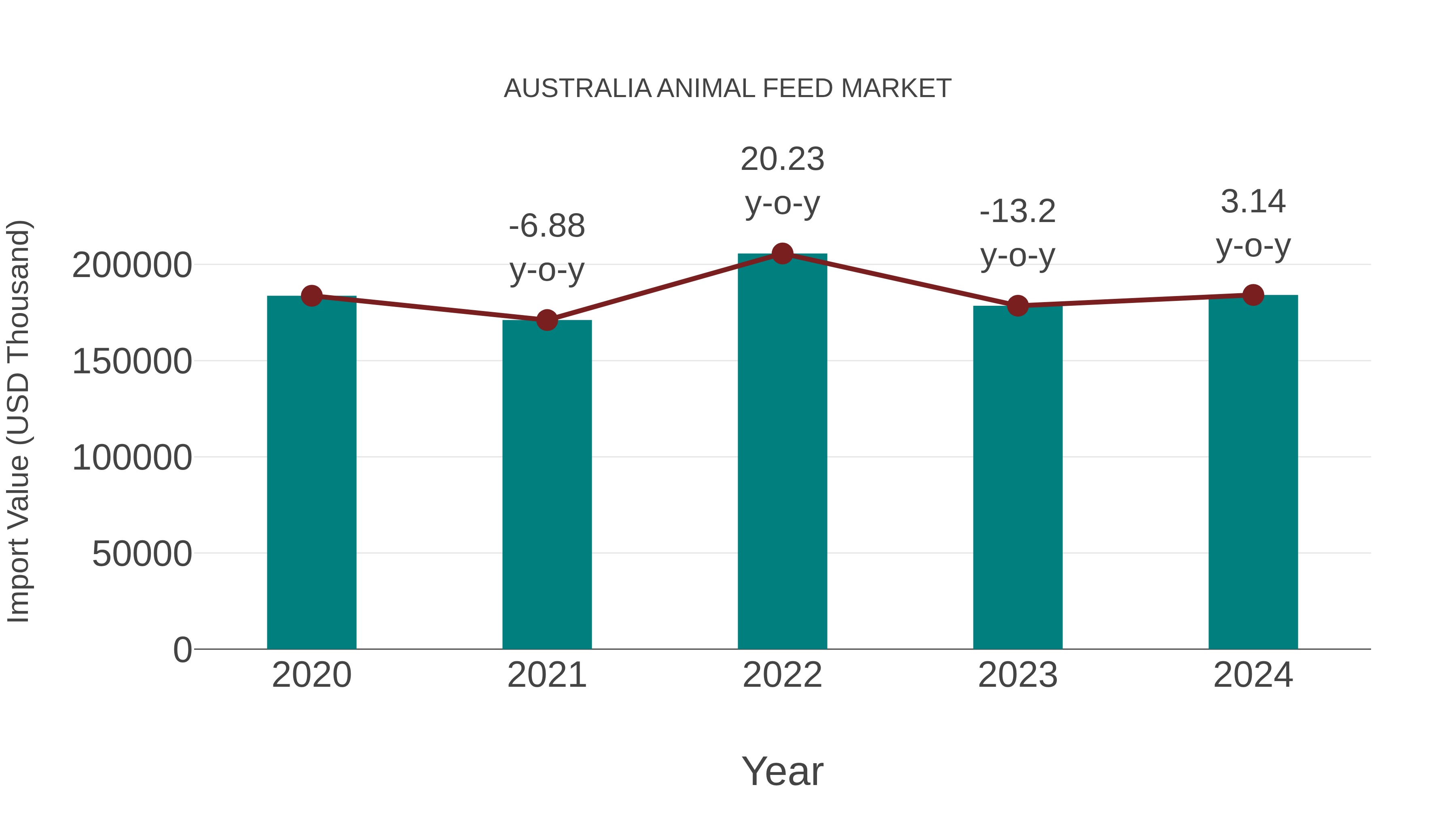
Australia Animal Feed Market: Import Trend Analysis
In the Australia animal feed market, the import trend showed a growth rate of 3.14% from 2023 to 2024, with a compound annual growth rate (CAGR) of 0.06% from 2020 to 2024. This indicates a modest but stable import momentum in the market, likely influenced by evolving demand patterns or trade policies during the period.
Australia Animal Feed Market Highlights
| Report Name | Australia Animal Feed Market |
| Forecast period | 2025-2031 |
| CAGR | 5.4% |
| Growing Sector | Ruminant Feed |
Five-Year Growth Trajectory of the Australia Animal Feed Market with Core Drivers
Below mentioned are the evaluation of year-wise growth rate along with key drivers:
| Years | Est. Annual Growth | Growth Drivers |
| 2020 | 1.7% | Due to logistical challenges, the export feed demand reduced. |
| 2021 | 2.8% | Feed production recovery with normalization in domestic agriculture. |
| 2022 | 3.9% | The feed mill utilization is increasing with the rising growth in beef and dairy exports. |
| 2023 | 4.7% | Increased focus on sustainable grazing and grain-fed systems. |
| 2024 | 5.2% | A rise in the use of precision nutrition and additive-based formulations. |
Topics Covered in the Australia Animal Feed Market Report
The Australia Animal Feed Market report comprehensively covers the market by Form, Species, and Type. The report provides an in-depth and data-driven analysis of Industry trends, growth opportunities, and key drivers, enabling stakeholders to align strategies with future growth prospects and enhance Market Size, Share, and Revenue across major livestock sectors.
Australia Animal Feed Market Synopsis
The Australia Animal Feed Market growth has been steadily boosting, influenced by several factors, such as the country’s strong livestock export industry and adoption of sustainable feed technologies. The animal feed production is on the rise, as there is a high demand for beef, dairy, poultry, and aquaculture products both domestically and internationally. Also, the feed conversion ratios have improved due to the rising adoption of precision livestock farming systems, enzyme supplementation, and probiotic integration.
Evaluation of Growth Drivers in the Australia Animal Feed Market
Below mentioned are some prominent drivers and their influence on market dynamics:
| Drivers | Primary Segments Affected | Why It Matters (Evidence) |
| Rising Export-Oriented Livestock Production | Pellets; Minerals & Enzymes | The feed consumption and quality standards is increasing due to a high beef and dairy export demand. |
| Technological Advancements in Feed Milling | Pellets; Vitamins & Probiotics | Automation and digital systems improve feed consistency and traceability. |
| Sustainable Feed Programs | Mash; Antioxidants | Promotion of low-carbon feed ingredients supports environmental targets. |
| Aquaculture Expansion | Crumbles; Protein Additives | Growth in fish farming increases demand for high-protein feed formulations. |
| Nutritional Awareness and Research | Pellets; Vitamins & Minerals | Continuous R&D improves animal health and production efficiency. |
The Australia Animal Feed Market is projected to expand at a CAGR of 5.4% from 2025 to 2031. The rising livestock production, expanding poultry and dairy farming and strong government support for agricultural sustainability are contributing to the market growth. An increase in the demand for high-quality meat, milk, and eggs is boosting feed consumption across different animal categories. Along with that, efficient feeding solutions that improve productivity and animal health are being adopted with the growing export of beef and dairy products. Additionally, the use of modern feed formulations enriched with enzymes, probiotics, and vitamins has been gaining momentum to enhance nutrient absorption. Lastly, efficiency and quality are being driven by the rising technological advancements in feed manufacturing, such as automation and precision nutrition.
Evaluation of Restraints in the Australia Animal Feed Market
Below mentioned are some major restraints and their influence on market dynamics:
| Restraints | Primary Segments Affected | What This Means (Evidence) |
| High Feed Ingredient Costs | All Forms & Types | Grain price volatility impacts production costs. |
| Climatic Challenges (Drought & Heat Stress) | Ruminants; Mash | Adverse weather limits feed crop availability and pasture quality. |
| Limited Domestic Additive Manufacturing | Probiotics; Enzymes | Reliance on imports raises input cost and supply risk. |
| Regulatory Compliance Costs | Feed Mills; Additives | Meeting biosecurity and sustainability regulations increases overheads. |
Australia Animal Feed Market Challenges
On the other hand, there are numerous challenges that can affect its growth, such as climatic unpredictability and feed ingredient price fluctuations. A heavy reliance on imported additives can be a major barrier to the Australia Animal Feed Market growth. Moreover, ensuring feed traceability across large rangelands remains difficult.
Australia Animal Feed Market Trends
Some emerging trends shaping the market landscape are:
- Sustainable Feed Formulation: Growing shift toward low-emission ingredients and alternative protein sources such as lupins and canola meal.
- Precision Livestock Nutrition: Increasing integration of data analytics and automation in feed mixing and delivery systems.
- Additive Diversification: Rising use of probiotics, enzymes, and organic acids to enhance feed digestibility and gut health.
- Feed Recycling Initiatives: Adoption of byproduct feed from food and beverage industries to reduce waste and costs.
Investment Opportunities in the Australia Animal Feed Industry
Some prominent investment opportunities in the market include:
- Aquafeed Production Units: High growth potential driven by the expansion of the domestic and export-oriented fishery sector.
- Sustainable Feed Ingredient Development: Opportunities in low-emission feed sources such as algae, canola meal, and insect proteins.
- Automation and Digital Feed Mills: Investments in AI-based precision feed formulation and smart manufacturing technologies.
Top 5 Leading Companies in the Australia Animal Feed Market
Some leading players operating in the market include:
1. Ridley Corporation Limited
| Company Name | Ridley Corporation Limited |
| Established Year | 1987 |
| Headquarters | Melbourne, Australia |
| Official Website | Click Here |
Ridley is a leading feed manufacturer offering customized nutrition solutions for poultry, ruminants, and aquaculture sectors.
2. GrainCorp Feeds
| Company Name | GrainCorp Feeds |
| Established Year | 1916 |
| Headquarters | Sydney, Australia |
| Official Website | Click Here |
Major supplier of feed ingredients and compound feeds, specializing in sustainable sourcing and quality assurance.
3. CopRice (SunRice Group)
| Company Name | CopRice (SunRice Group) |
| Established Year | 1960 |
| Headquarters | Leeton, New South Wales |
| Official Website | Click Here |
A leading integrated feed manufacturer producing cattle, sheep, equine, and dairy feed with sustainability focus.
4. Ingham’s Group Limited
| Company Name | Ingham’s Group Limited |
| Established Year | 1918 |
| Headquarters | Sydney, Australia |
| Official Website | Click Here |
A top poultry producer with vertically integrated feed manufacturing operations supporting performance nutrition.
5. Wellard Rural Exports
| Company Name | Wellard Rural Exports |
| Established Year | 1979 |
| Headquarters | Fremantle, Australia |
| Official Website | Click Here |
Specializes in livestock export feed systems and feedlot nutrition, with strong expertise in ruminant feed optimization.
Government Regulations Introduced in the Australia Animal Feed Market
According to Australian Government data, various initiatives have been introduced to strengthen the animal feed industry. This has happened through the Department of Agriculture, Fisheries and Forestry (DAFF). Also, to ensure feed traceability and push &D in eco-friendly feed ingredients and additives, various programmes and policies are issued, such as the National Feed Safety Program and the Sustainable Feed Innovation Grant (2024). Moreover, low-emission animal feeding systems are being promoted under the Agricultural Stewardship and Carbon Neutral Livestock Program. These initiatives collectively aim to improve feed safety, environmental performance, and competitiveness of domestic feed producers.
Future Insights of the Australia Animal Feed Market
The future of the Australia Animal Feed Market revenue profile will surge in the coming years, driven by rising livestock farming and improved feed production technologies. Additionally, need for nutritious and balanced animal feeds is likely to increase, as the demand for high-quality meat, dairy, and aquaculture products has continuously been increasing. Also, farmers are expected to adopt more sustainable and cost-effective feed ingredients, including organic and locally sourced materials.
Market Segmentation Analysis
The report offers a comprehensive study of the following market segments and their leading categories.
Pellets to Dominate the Market – By Form
According to Shivani Sharma, Senior Research Analyst, 6Wresearch, Pellets are expected to dominate the Australian Animal Feed Market due to their superior digestibility, ease of handling, and compatibility with automated feeding systems. Poultry and dairy farms across Queensland and New South Wales are major adopters of pelleted feed formats, ensuring efficient feeding and reduced waste.
Ruminants to Lead the Market – By Species
The Ruminants segment is projected to lead the market owing to Australia’s large cattle and dairy industry, which relies heavily on feed efficiency to maintain export competitiveness. Rising beef exports and dairy output across major states such as Victoria and Queensland are fueling the demand for high-performance ruminant feeds.
Probiotics and Enzymes to Dominate the Market – By Type
Among feed additives, Probiotics and Enzymes dominate due to their ability to improve digestion, nutrient absorption, and animal health. The shift toward antibiotic-free livestock production is further propelling the demand for enzyme-based and probiotic-enriched formulations.
Key Attractiveness of the Report
- 10 Years Market Numbers.
- Historical Data Starting from 2021 to 2024.
- Base Year: 2024.
- Forecast Data until 2031.
- Key Performance Indicators Impacting the Market.
- Major Upcoming Developments and Projects.
Key Highlights of the Report:
- Australia Animal Feed Market Outlook
- Market Size of Australia Animal Feed Market, 2025
- Forecast of Australia Animal Feed Market, 2032
- Historical Data and Forecast of Australia Animal Feed Revenues & Volume for the Period 2022 - 2032F
- Australia Animal Feed Market Trend Evolution
- Australia Animal Feed Market Drivers and Challenges
- Australia Animal Feed Price Trends
- Australia Animal Feed Porter's Five Forces
- Australia Animal Feed Industry Life Cycle
- Historical Data and Forecast of Australia Animal Feed Market Revenues & Volume By Form for the Period 2022 - 2032F
- Historical Data and Forecast of Australia Animal Feed Market Revenues & Volume By Pellets for the Period 2022 - 2032F
- Historical Data and Forecast of Australia Animal Feed Market Revenues & Volume By Crumbles for the Period 2022 - 2032F
- Historical Data and Forecast of Australia Animal Feed Market Revenues & Volume By Mash for the Period 2022 - 2032F
- Historical Data and Forecast of Australia Animal Feed Market Revenues & Volume By Others for the Period 2022 - 2032F
- Historical Data and Forecast of Australia Animal Feed Market Revenues & Volume By Species for the Period 2022 - 2032F
- Historical Data and Forecast of Australia Animal Feed Market Revenues & Volume By Poultry for the Period 2022 - 2032F
- Historical Data and Forecast of Australia Animal Feed Market Revenues & Volume By Ruminants for the Period 2022 - 2032F
- Historical Data and Forecast of Australia Animal Feed Market Revenues & Volume By Aqua for the Period 2022 - 2032F
- Historical Data and Forecast of Australia Animal Feed Market Revenues & Volume By Swine for the Period 2022 - 2032F
- Historical Data and Forecast of Australia Animal Feed Market Revenues & Volume By Others for the Period 2022 - 2032F
- Historical Data and Forecast of Australia Animal Feed Market Revenues & Volume By Type for the Period 2022 - 2032F
- Historical Data and Forecast of Australia Animal Feed Market Revenues & Volume By Acidifiers for the Period 2022 - 2032F
- Historical Data and Forecast of Australia Animal Feed Market Revenues & Volume By Probiotics for the Period 2022 - 2032F
- Historical Data and Forecast of Australia Animal Feed Market Revenues & Volume By Enzyme for the Period 2022 - 2032F
- Historical Data and Forecast of Australia Animal Feed Market Revenues & Volume By Antioxidants for the Period 2022 - 2032F
- Historical Data and Forecast of Australia Animal Feed Market Revenues & Volume By Antibiotics for the Period 2022 - 2032F
- Historical Data and Forecast of Australia Animal Feed Market Revenues & Volume By Vitamins for the Period 2022 - 2032F
- Historical Data and Forecast of Australia Animal Feed Market Revenues & Volume By Minerals for the Period 2022 - 2032F
- Historical Data and Forecast of Australia Animal Feed Market Revenues & Volume By Others for the Period 2022 - 2032F
- Australia Animal Feed Import Export Trade Statistics
- Market Opportunity Assessment By Form
- Market Opportunity Assessment By Species
- Market Opportunity Assessment By Type
- Australia Animal Feed Top Companies Market Share
- Australia Animal Feed Competitive Benchmarking By Technical and Operational Parameters
- Australia Animal Feed Company Profiles
- Australia Animal Feed Key Strategic Recommendations
Market Segmentation
The report provides a detailed analysis of the following market segments:
By Form
- Pellets
- Crumbles
- Mash
- Others
By Species
- Poultry
- Ruminants
- Aqua
- Swine
- Others
By Type
- Acidifiers
- Probiotics
- Enzyme
- Antioxidants
- Antibiotics
- Vitamins
- Minerals
- Others






































