Australia Anti-aging Products Market Size, Share & Growth Rate
The Australia Anti-aging Products Market was estimated at USD 169 Million in 2025 and is projected to reach USD 197 Million by 2032, growing at a CAGR of 2.2% from 2026 to 2032. This growth trajectory is largely driven by an increasing aging population, which has sparked a heightened awareness around skincare and wellness. Additionally, the rise in disposable incomes has empowered consumers to invest more in anti-aging solutions, fueling demand across diverse product categories.
Australia Anti-aging Products Market Year-wise Growth Rate and Key Drivers
This graph highlights how the Australia Anti-aging Products Market has steadily grown over the years, supported by major growth factors.
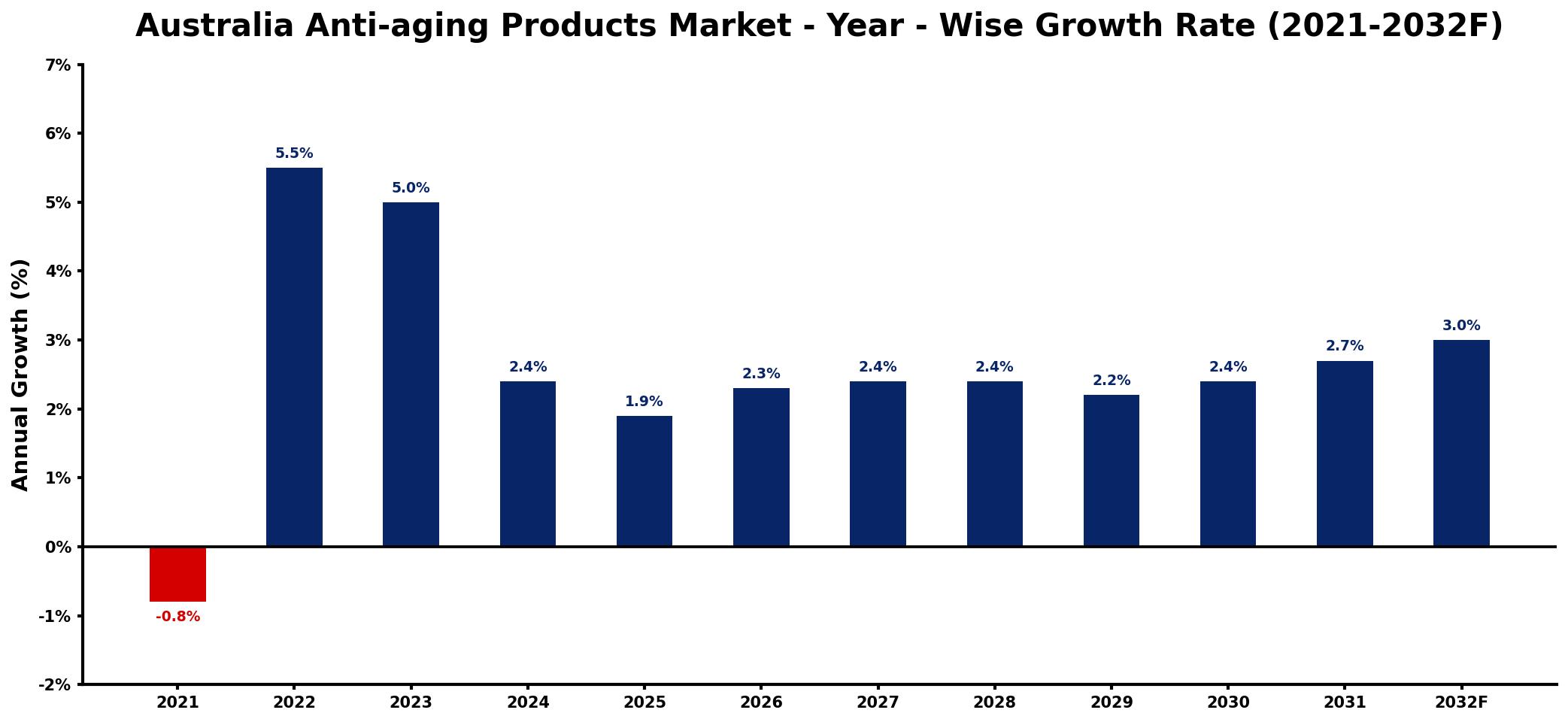
The table below presents the year‑wise growth rates along with the key drivers influencing the market
| Year | Growth Rate | Major Drivers |
| 2021 | -0.8% | decreased consumer spending on skincare |
| 2022 | 5.5% | rise in wellness tourism market |
| 2023 | 5.0% | growth of natural ingredient demand |
| 2024 | 2.4% | expansion of e-commerce platforms |
| 2025 | 1.9% | increased focus on holistic health |
| 2026 | 2.3% | surge in social media influence |
| 2027 | 2.4% | development of personalized skincare solutions |
| 2028 | 2.4% | growing popularity of subscription services |
| 2029 | 2.2% | enhanced awareness of self-care routines |
| 2030 | 2.4% | increase in investment in R&D |
| 2031 | 2.7% | rising demand from electronics |
| 2032 | 3.0% | growing collaboration with influencers |
Note: Market size estimations and growth projections presented in this report are based on 6Wresearch's proprietary forecasting methodology, utilizing the latest available industry data, government publications, and primary research inputs.
Australia Anti-aging Products Market Synopsis
In recent years, Australia has witnessed a surge in the consumption of anti-aging products, reflecting a cultural shift towards self-care and beauty. Consumers are increasingly seeking out formulations that incorporate innovative ingredients known for their effectiveness in addressing visible signs of aging.
As awareness of the benefits of skincare grows, the market has expanded to include not just topical treatments, but also dietary supplements and personalized regimens. This broad spectrum caters to a diverse consumer base, eager to explore holistic approaches to maintaining youthful vitality.
Australia Anti-aging Products Market Key Takeaways
- The market is witnessing robust growth driven by demographic trends and increased disposable income.
- Consumer awareness about skincare and wellness significantly influences purchasing decisions.
- Innovative ingredients such as retinol and hyaluronic acid are leading consumer preferences.
- Digital wellness platforms are emerging as important tools for personalized skincare regimens.
- Regulatory frameworks ensure product safety and efficacy, impacting market dynamics.
Evaluation of Restraints in Australia Anti-aging Products Market
Despite the promising growth of the anti-aging products market in Australia, several significant restraints hinder its potential. Scientific validation of product claims remains a critical issue; consumers often approach new anti-aging solutions with skepticism regarding their effectiveness and safety. Additionally, navigating stringent regulatory requirements poses challenges for companies attempting to bring innovative products to market, complicating the landscape for both established and emerging brands.
Australia Anti-aging Products Market Trends
Current trends indicate a shift towards products that combine science with natural ingredients, as consumers increasingly seek out safer, environmentally friendly options. The integration of technology in skincare routines, through the use of apps and digital platforms, is also shaping consumer engagement and education around product efficacy. Furthermore, there is growing interest in personalized skincare solutions that tailor treatments to individual skin types and concerns.
Australia Anti-aging Products Market Opportunities
The market is ripe with opportunities for innovative brands that can successfully address the evolving consumer demands for authenticity and efficacy. With a demographic that increasingly values wellness, companies that invest in research and development of unique formulations have the potential to capture significant market share. Additionally, the use of digital marketing strategies and social media to foster community engagement can drive brand loyalty and repeat purchases.
Government Initiatives in the Australia Anti-aging Products Market
The Australian government plays a crucial role in regulating the anti-aging products market, focusing on ensuring consumer safety and product integrity. Guidelines around product labeling and marketing claims are strictly enforced, promoting transparency and accuracy within the industry. Government initiatives also support research into the safety of active ingredients and efficacy testing, fostering consumer trust in the products available on the market.
Future Insights of the Australia Anti-aging Products Market
Looking ahead to 2026-2032, the Australia anti-aging products market is expected to evolve, influenced by continued advancements in cosmetic science and consumer preferences. There will likely be an increased emphasis on sustainability and ethical sourcing of ingredients, reflecting broader global trends. As technology continues to integrate into consumer lifestyles, the demand for personalized, data-driven skincare solutions is anticipated to grow, reshaping how products are marketed and sold.
Australia Anti-aging Products Market Latest Developments (2025 - 2026)
The anti-aging products market in Australia has seen significant movement recently, with several brands launching campaigns that emphasize the importance of transparency in ingredient sourcing and formulation. Innovations in packaging that emphasize sustainability are becoming more commonplace, aligning with consumer demands for environmentally friendly products. Additionally, the digital landscape continues to evolve, with an increase in online retail platforms offering personalized shopping experiences tailored to individual skin concerns.
Australia Anti-aging Products Market - Key Attractiveness of the Report
- 10 Years of Market Numbers
- Historical Data Starting from 2022 to 2025
- Base Year: 2025
- Forecast Data until 2032
- Key Performance Indicators Impacting the Market
- Major Upcoming Developments and Projects
Key Highlights of the Report:
- Australia Anti-aging Products Market Outlook
- Market Size of Australia Anti-aging Products Market, 2025
- Forecast of Australia Anti-aging Products Market, 2032
- Historical Data and Forecast of Australia Anti-aging Products Revenues & Volume for the Period 2022-2032F
- Australia Anti-aging Products Market Trend Evolution
- Australia Anti-aging Products Market Drivers and Challenges
- Australia Anti-aging Products Price Trends
- Australia Anti-aging Products Porter's Five Forces
- Australia Anti-aging Products Industry Life Cycle
- Historical Data and Forecast of Australia Anti-aging Products Market Revenues & Volume By Product for the Period 2022-2032F
- Historical Data and Forecast of Australia Anti-aging Products Market Revenues & Volume By Body Wash for the Period 2022-2032F
- Historical Data and Forecast of Australia Anti-aging Products Market Revenues & Volume By Body Moisturizer for the Period 2022-2032F
- Historical Data and Forecast of Australia Anti-aging Products Market Revenues & Volume By Eye Cream & Lotion for the Period 2022-2032F
- Historical Data and Forecast of Australia Anti-aging Products Market Revenues & Volume By Facial Cleanser for the Period 2022-2032F
- Historical Data and Forecast of Australia Anti-aging Products Market Revenues & Volume By Facial Mask for the Period 2022-2032F
- Historical Data and Forecast of Australia Anti-aging Products Market Revenues & Volume By Facial Serum for the Period 2022-2032F
- Historical Data and Forecast of Australia Anti-aging Products Market Revenues & Volume By Facial Cream & Lotion for the Period 2022-2032F
- Historical Data and Forecast of Australia Anti-aging Products Market Revenues & Volume By Distribution Channel for the Period 2022-2032F
- Historical Data and Forecast of Australia Anti-aging Products Market Revenues & Volume By Hypermarket & Supermarket for the Period 2022-2032F
- Historical Data and Forecast of Australia Anti-aging Products Market Revenues & Volume By Pharmacy & Drug Stores for the Period 2022-2032F
- Historical Data and Forecast of Australia Anti-aging Products Market Revenues & Volume By Specialty Store for the Period 2022-2032F
- Historical Data and Forecast of Australia Anti-aging Products Market Revenues & Volume By Online for the Period 2022-2032F
- Historical Data and Forecast of Australia Anti-aging Products Market Revenues & Volume By Others for the Period 2022-2032F
- Australia Anti-aging Products Import Export Trade Statistics
- Market Opportunity Assessment By Product
- Market Opportunity Assessment By Distribution Channel
- Australia Anti-aging Products Top Companies Market Share
- Australia Anti-aging Products Competitive Benchmarking By Technical and Operational Parameters
- Australia Anti-aging Products Company Profiles
- Australia Anti-aging Products Key Strategic Recommendations






































