Australia Aromatic Compounds Market Size, Share & Growth Rate
The Australia Aromatic Compounds Market was estimated at USD 138 Million in 2025 and is projected to reach USD 162 Million by 2032, growing at a CAGR of 2.3% from 2026 to 2032. This growth trajectory is significantly driven by the increasing demand for aromatic chemicals across petrochemical, pharmaceutical, and agrochemical sectors. As industries strive for enhanced product performance and sustainability, aromatic solvents like toluene and xylene are becoming indispensable in applications ranging from paints and coatings to adhesives.
Australia Aromatic Compounds Market Year-wise Growth Rate and Key Drivers
This graph highlights how the Australia Aromatic Compounds Market has steadily grown over the years, supported by major growth factors.
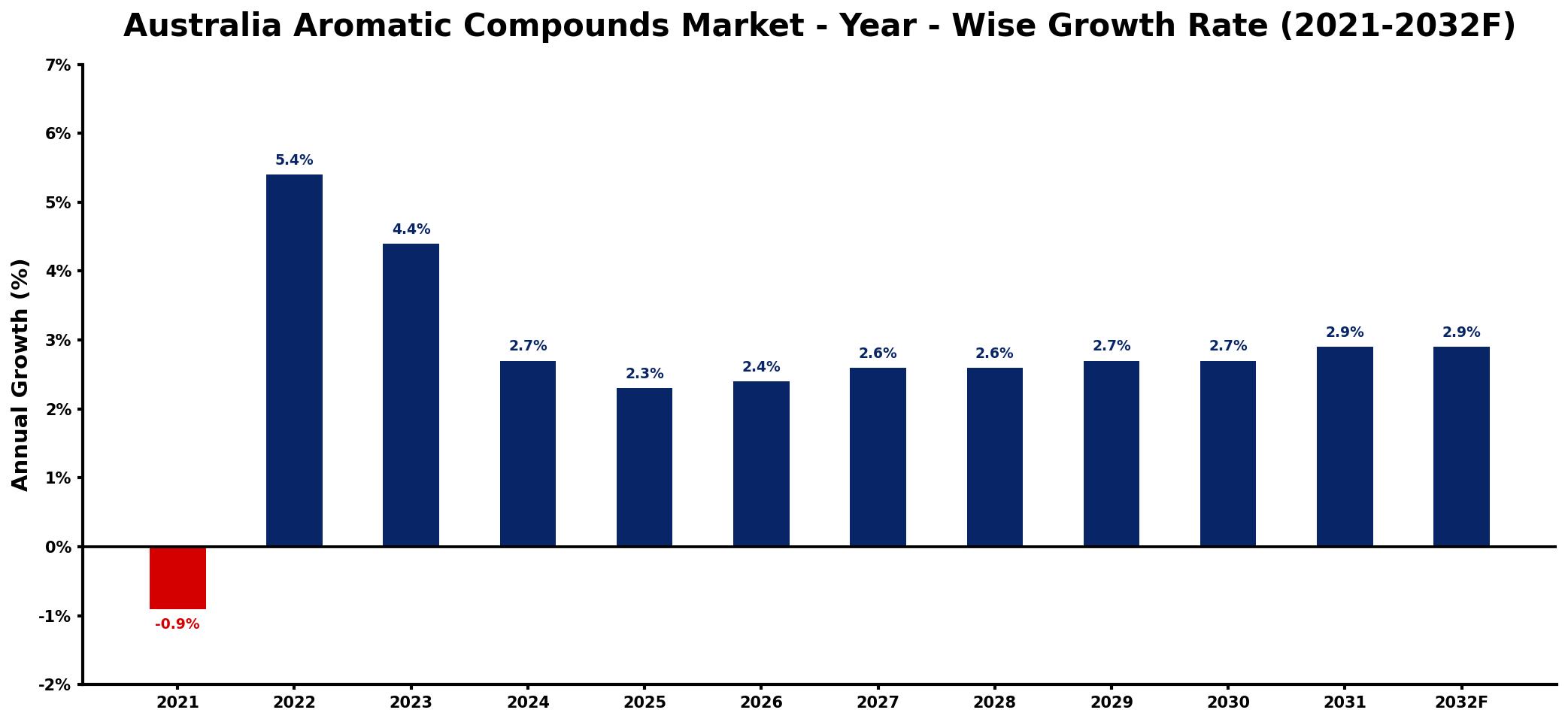
The table below presents the year‑wise growth rates along with the key drivers influencing the market
| Year | Growth Rate | Major Drivers |
| 2021 | -0.9% | decrease in industrial applications |
| 2022 | 5.4% | rise in consumer product demand |
| 2023 | 4.4% | expansion of fragrance industry |
| 2024 | 2.7% | increased investment in R&D |
| 2025 | 2.3% | growth in personal care sector |
| 2026 | 2.4% | surge in food flavoring usage |
| 2027 | 2.6% | enhanced regulatory support initiatives |
| 2028 | 2.6% | wider adoption in home products |
| 2029 | 2.7% | growing popularity of natural ingredients |
| 2030 | 2.7% | increased focus on sustainability practices |
| 2031 | 2.9% | expansion into emerging markets |
| 2032 | 2.9% | development of innovative applications |
Note: Market size estimations and growth projections presented in this report are based on 6Wresearch's proprietary forecasting methodology, utilizing the latest available industry data, government publications, and primary research inputs.
Australia Aromatic Compounds Market Synopsis
Recently, the Australian aromatic compounds market has gained momentum, fueled by robust industrial growth and escalating investments in chemical production. However, as regulatory landscapes evolve, businesses face pressure to innovate and adapt, signaling a pivotal shift in market dynamics. This transformation presents both challenges and opportunities as companies look to align with environmental standards while maximizing efficiency.
Looking ahead, the market is poised for steady growth, yet factors such as the volatility of raw material prices and competition from alternative substances could temper the enthusiasm. Nevertheless, advancements in chemical synthesis and a proactive governmental approach towards fostering innovation will likely ensure sustained market interest.
Australia Aromatic Compounds Market Key Takeaways
- The market is driven by industrial applications in petrochemicals, pharmaceuticals, and agrochemicals.
- Technological innovations in chemical synthesis are crucial for maintaining competitive advantage.
- Regulatory compliance is increasingly impacting production processes and product offerings.
- Volatility in raw material prices continues to pose challenges for manufacturers.
- There is a growing demand for specialty chemicals, presenting new avenues for investment.
Evaluation of Restraints in Australia Aromatic Compounds Market
The Australian aromatic compounds market faces several constraints that may impede growth. Chief among these is the volatility of raw material prices, which can dramatically affect profit margins and production costs. The ongoing competition from substitute products also poses a significant threat, as companies are compelled to invest in research and development to remain relevant. Additionally, the increasing emphasis on sustainability means that manufacturers must navigate stringent regulatory requirements, adding layers of complexity to their operations.
Australia Aromatic Compounds Market Trends
In recent years, the market has witnessed a surge in the adoption of sustainable practices, with companies actively seeking out greener alternatives to traditional aromatic solvents. This shift reflects a broader global trend toward sustainability and responsible chemical use. Furthermore, advancements in technology are paving the way for the development of high-performance specialty chemicals that cater to diverse applications, thereby enhancing the value proposition for end-users.
Australia Aromatic Compounds Market Opportunities
Opportunities abound in the Australia aromatic compounds market, particularly in the realms of innovation and application diversification. With a growing focus on specialty chemicals, companies that can develop tailored solutions for niche markets stand to gain significantly. Additionally, the push for sustainable products is fostering a new wave of investment into research and development initiatives aimed at creating safer and more environmentally friendly aromatic compounds.
Government Initiatives in the Australia Aromatic Compounds Market
The Australian government plays a pivotal role in shaping the aromatic compounds market through stringent regulatory frameworks designed to ensure the safety of chemicals. Policies are in place to govern production, handling, labeling, and disposal processes, thereby safeguarding both consumer health and environmental integrity. Moreover, the government encourages research and innovation, providing support for projects that aim to develop sustainable chemical alternatives.
Future Insights of the Australia Aromatic Compounds Market
From 2026 to 2032, the Australia aromatic compounds market is expected to evolve in response to ongoing industrial demands and regulatory pressures. As manufacturers adapt to emerging trends, there will likely be a greater emphasis on innovation and sustainability. This forward momentum will encourage investments in technology that aligns with consumer preferences for safer and eco-friendly products, ultimately shaping the future landscape of the market.
Australia Aromatic Compounds Market Latest Developments (2025 - 2026)
Recent industry directions indicate a robust focus on research and development in the aromatic compounds sector. Companies are increasingly investing in the creation of environmentally friendly solvents that comply with evolving regulatory standards. Furthermore, collaborative efforts between industry stakeholders and governmental bodies are paving the way for innovative solutions that address both market needs and sustainability goals.
Australia Aromatic Compounds Market - Key Attractiveness of the Report
- 10 Years of Market Numbers
- Historical Data Starting from 2022 to 2025
- Base Year: 2025
- Forecast Data until 2032
- Key Performance Indicators Impacting the Market
- Major Upcoming Developments and Projects
Key Highlights of the Report:
- Australia Aromatic Compounds Market Outlook
- Market Size of Australia Aromatic Compounds Market, 2025
- Forecast of Australia Aromatic Compounds Market, 2032
- Historical Data and Forecast of Australia Aromatic Compounds Revenues & Volume for the Period 2022-2032F
- Australia Aromatic Compounds Market Trend Evolution
- Australia Aromatic Compounds Market Drivers and Challenges
- Australia Aromatic Compounds Price Trends
- Australia Aromatic Compounds Porter's Five Forces
- Australia Aromatic Compounds Industry Life Cycle
- Historical Data and Forecast of Australia Aromatic Compounds Market Revenues & Volume By Type for the Period 2022-2032F
- Historical Data and Forecast of Australia Aromatic Compounds Market Revenues & Volume By Benzene for the Period 2022-2032F
- Historical Data and Forecast of Australia Aromatic Compounds Market Revenues & Volume By Xylene for the Period 2022-2032F
- Historical Data and Forecast of Australia Aromatic Compounds Market Revenues & Volume By Toluene for the Period 2022-2032F
- Historical Data and Forecast of Australia Aromatic Compounds Market Revenues & Volume By Application for the Period 2022-2032F
- Historical Data and Forecast of Australia Aromatic Compounds Market Revenues & Volume By Solvent for the Period 2022-2032F
- Historical Data and Forecast of Australia Aromatic Compounds Market Revenues & Volume By Additive for the Period 2022-2032F
- Historical Data and Forecast of Australia Aromatic Compounds Market Revenues & Volume By End-use for the Period 2022-2032F
- Historical Data and Forecast of Australia Aromatic Compounds Market Revenues & Volume By Packaging for the Period 2022-2032F
- Historical Data and Forecast of Australia Aromatic Compounds Market Revenues & Volume By Detergent And Dyes for the Period 2022-2032F
- Historical Data and Forecast of Australia Aromatic Compounds Market Revenues & Volume By Automobile for the Period 2022-2032F
- Historical Data and Forecast of Australia Aromatic Compounds Market Revenues & Volume By Electronic Devices for the Period 2022-2032F
- Historical Data and Forecast of Australia Aromatic Compounds Market Revenues & Volume By Medical Devices for the Period 2022-2032F
- Historical Data and Forecast of Australia Aromatic Compounds Market Revenues & Volume By Pharmaceuticals for the Period 2022-2032F
- Historical Data and Forecast of Australia Aromatic Compounds Market Revenues & Volume By Gasoline for the Period 2022-2032F
- Historical Data and Forecast of Australia Aromatic Compounds Market Revenues & Volume By Tire for the Period 2022-2032F
- Australia Aromatic Compounds Import Export Trade Statistics
- Market Opportunity Assessment By Type
- Market Opportunity Assessment By Application
- Market Opportunity Assessment By End-use
- Australia Aromatic Compounds Top Companies Market Share
- Australia Aromatic Compounds Competitive Benchmarking By Technical and Operational Parameters
- Australia Aromatic Compounds Company Profiles
- Australia Aromatic Compounds Key Strategic Recommendations






































