Australia Auto Parts And Accessories Market Size, Share & Growth Rate
The Australia Auto Parts And Accessories Market was estimated at USD 158 Million in 2025 and is projected to reach USD 186 Million by 2032, growing at a CAGR of 2.4% from 2026 to 2032. This growth trajectory reflects a robust demand for vehicle customization and performance enhancements as Australian consumers increasingly invest in personalizing their vehicles. The expanding fleet of older vehicles also underlines the necessity for reliable replacement parts, while ongoing innovations in automotive technology further stimulate market dynamics.
Australia Auto Parts And Accessories Market Year-wise Growth Rate and Key Drivers
This graph highlights how the Australia Auto Parts And Accessories Market has steadily grown over the years, supported by major growth factors.
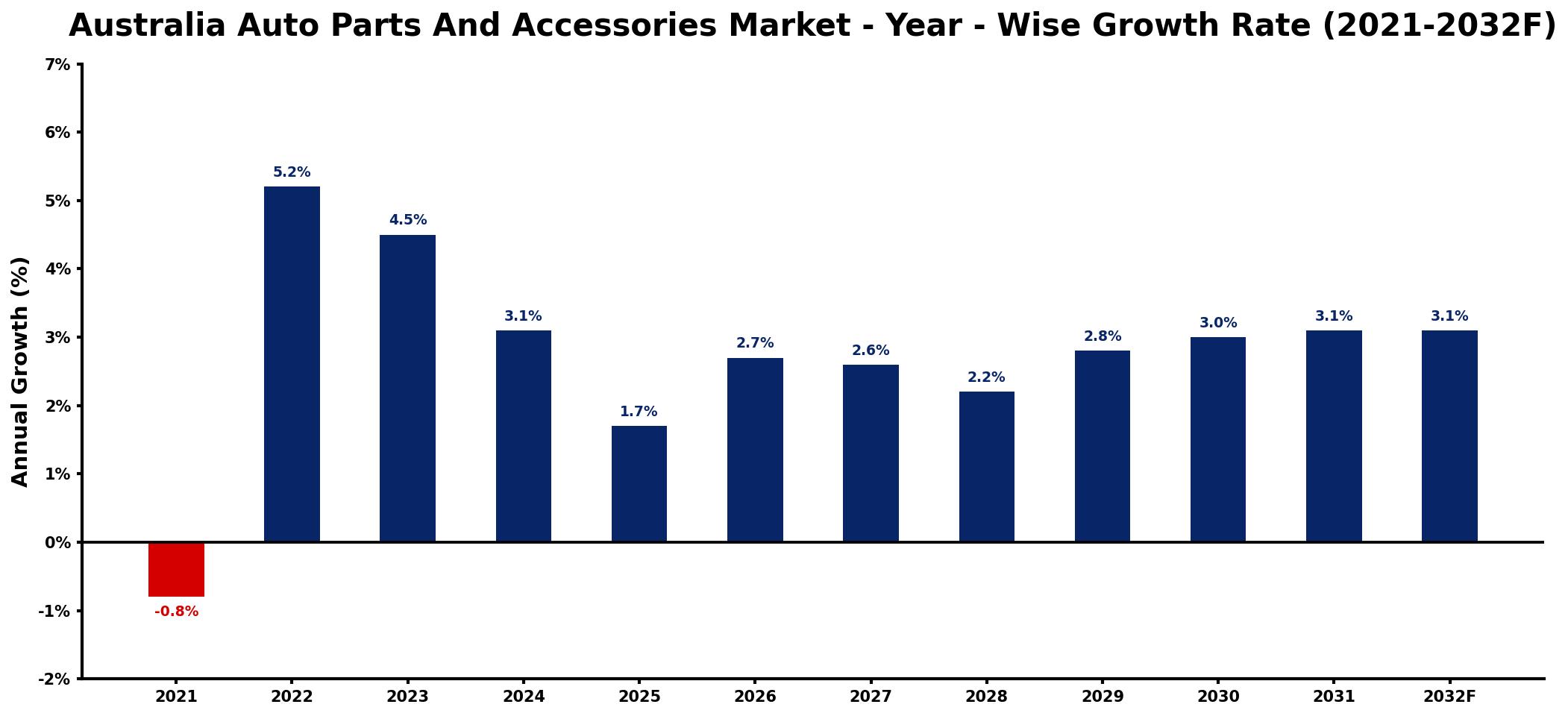
The table below presents the year‑wise growth rates along with the key drivers influencing the market
| Year | Growth Rate | Major Drivers |
| 2021 | -0.8% | Supply chain disruptions impacting availability |
| 2022 | 5.2% | Rising consumer demand for mobility |
| 2023 | 4.5% | Increased investment in electric vehicles |
| 2024 | 3.1% | Growth in online retail channels |
| 2025 | 1.7% | Expansion of aftermarket service offerings |
| 2026 | 2.7% | Technological advancements in manufacturing |
| 2027 | 2.6% | Higher focus on sustainability practices |
| 2028 | 2.2% | Rising popularity of vehicle customization |
| 2029 | 2.8% | Increased urbanization driving vehicle purchases |
| 2030 | 3.0% | growing commercial sector adoption |
| 2031 | 3.1% | Technological integration in vehicle systems |
| 2032 | 3.1% | increased overall sector activity |
Note: Market size estimations and growth projections presented in this report are based on 6Wresearch's proprietary forecasting methodology, utilizing the latest available industry data, government publications, and primary research inputs.
Australia Auto Parts And Accessories Market Synopsis
The most significant force shaping the Australia Auto Parts and Accessories Market right now is the growing consumer demand for vehicle customization. Australian consumers are increasingly drawn to aftermarket products that allow them to enhance performance, upgrade aesthetics, or incorporate new technologies into their vehicles.
Additionally, the rise in vehicle ownership across the nation bolsters market potential. With a substantial number of older vehicles on the road requiring maintenance and repair, the demand for reliable, high-quality auto parts continues to climb, driving sales within the aftermarket sector.
Australia Auto Parts And Accessories Market Key Takeaways
- The market is fueled by a strong trend towards vehicle personalization and enhancement.
- Growing vehicle ownership, particularly among older models, is a critical driver of replacement parts demand.
- Innovations in automotive technology, including electric and autonomous vehicles, create new opportunities for specialized parts.
- Government regulations support product quality and environmental sustainability within the aftermarket sector.
- Market players face challenges from online retail competition and evolving consumer preferences.
Evaluation of Restraints in Australia Auto Parts And Accessories Market
The Australia Auto Parts and Accessories Market contends with several restraints that can limit growth potential. Competition from online retailers has intensified, often leading to price wars that compromise profit margins. Additionally, supply chain disruptions have been a persistent issue, affecting the availability and timely delivery of essential auto parts. The necessity for product quality and compatibility with various vehicle models is paramount, as consumer trust hinges on these factors. Moreover, growing concerns over sustainability require market players to align with eco-friendly practices, which can add complexity to operations.
Australia Auto Parts And Accessories Market Trends
One prominent trend in the Australia Auto Parts and Accessories Market is the increasing integration of advanced technology into automotive components. Features such as smart technology and electronic enhancements are becoming standard, reflecting consumer preferences for high-tech solutions. Performance upgrades also remain a focal point as consumers seek not just aesthetic improvements but also enhanced functionality.
In addition, eco-friendly and sustainable product offerings are gaining traction, as consumers become more conscious of their environmental impact. This shift is prompting manufacturers to innovate and provide greener alternatives, catering to a growing demographic interested in sustainability.
Australia Auto Parts And Accessories Market Opportunities
The Australian Auto Parts and Accessories Market is ripe with opportunities for growth and investment. The expansion of electric and hybrid vehicles represents a significant avenue for specialized parts that cater to this evolving market. Additionally, as vehicle ownership rates continue to rise, coupled with a trend towards longer vehicle lifespans, there exists a substantial market for replacement parts. Furthermore, online retail channels are becoming increasingly important, presenting opportunities for businesses that can effectively harness digital platforms to reach consumers.
Government Initiatives in the Australia Auto Parts And Accessories Market
The Australian government actively supports the auto parts and accessories market through various policies aimed at promoting local manufacturing and ensuring high product standards. Regulatory frameworks ensure that products meet safety and environmental sustainability criteria, while initiatives encourage innovation within the sector. Furthermore, government programs aim to educate consumers about the importance of quality automotive aftermarket products, fostering a competitive landscape that benefits both consumers and industry players.
Future Insights of the Australia Auto Parts And Accessories Market
Looking ahead to the period between 2026 and 2032, the Australia Auto Parts and Accessories Market is expected to experience steady growth driven by continuing trends in vehicle customization and technological advancement. The increasing adoption of electric and hybrid vehicles will necessitate new parts and accessories, ensuring that the market adapts to meet these changing demands. As manufacturers and retailers invest in sustainable practices and products, they will likely find new opportunities to capture environmentally conscious consumers, shaping a dynamic and progressive market landscape.
Australia Auto Parts And Accessories Market Latest Developments (2025 - 2026)
Recent industry developments indicate a notable shift towards digital retail platforms, as more businesses capitalize on the growing trend of online shopping among consumers. Furthermore, collaborations between parts manufacturers and tech companies are emerging, enhancing the development of smart automotive solutions. Efforts to promote sustainable practices within the supply chain are gaining momentum, reflecting a collective industry commitment to environmental responsibility.
Australia Auto Parts And Accessories Market - Key Attractiveness of the Report
- 10 Years of Market Numbers
- Historical Data Starting from 2022 to 2025
- Base Year: 2025
- Forecast Data until 2032
- Key Performance Indicators Impacting the Market
- Major Upcoming Developments and Projects
Key Highlights of the Report:
- Australia Auto Parts And Accessories Market Outlook
- Market Size of Australia Auto Parts And Accessories Market, 2025
- Forecast of Australia Auto Parts And Accessories Market, 2032
- Historical Data and Forecast of Australia Auto Parts And Accessories Revenues & Volume for the Period 2022-2032F
- Australia Auto Parts And Accessories Market Trend Evolution
- Australia Auto Parts And Accessories Market Drivers and Challenges
- Australia Auto Parts And Accessories Price Trends
- Australia Auto Parts And Accessories Porter's Five Forces
- Australia Auto Parts And Accessories Industry Life Cycle
- Historical Data and Forecast of Australia Auto Parts And Accessories Market Revenues & Volume By Product for the Period 2022-2032F
- Historical Data and Forecast of Australia Auto Parts And Accessories Market Revenues & Volume By Driveline & Powertrain for the Period 2022-2032F
- Historical Data and Forecast of Australia Auto Parts And Accessories Market Revenues & Volume By Interiors & Exteriors for the Period 2022-2032F
- Historical Data and Forecast of Australia Auto Parts And Accessories Market Revenues & Volume By Electronics for the Period 2022-2032F
- Historical Data and Forecast of Australia Auto Parts And Accessories Market Revenues & Volume By Bodies & Chassis for the Period 2022-2032F
- Historical Data and Forecast of Australia Auto Parts And Accessories Market Revenues & Volume By Wheel & Tires for the Period 2022-2032F
- Historical Data and Forecast of Australia Auto Parts And Accessories Market Revenues & Volume By Others for the Period 2022-2032F
- Historical Data and Forecast of Australia Auto Parts And Accessories Market Revenues & Volume By Application for the Period 2022-2032F
- Historical Data and Forecast of Australia Auto Parts And Accessories Market Revenues & Volume By OEMs for the Period 2022-2032F
- Historical Data and Forecast of Australia Auto Parts And Accessories Market Revenues & Volume By Aftermarket for the Period 2022-2032F
- Australia Auto Parts And Accessories Import Export Trade Statistics
- Market Opportunity Assessment By Product
- Market Opportunity Assessment By Application
- Australia Auto Parts And Accessories Top Companies Market Share
- Australia Auto Parts And Accessories Competitive Benchmarking By Technical and Operational Parameters
- Australia Auto Parts And Accessories Company Profiles
- Australia Auto Parts And Accessories Key Strategic Recommendations






































