Australia Baby Prams and Strollers Market Size, Share & Growth Rate
The Australia Baby Prams and Strollers Market was estimated at USD 129 Million in 2025 and is projected to reach USD 150 Million by 2032, growing at a CAGR of 2.2% from 2026 to 2032. This growth trajectory is primarily fueled by an increasing number of urban families and a surge in outdoor activities involving young children. As parents seek mobility solutions that combine safety and convenience, the demand for innovative prams and strollers has significantly risen, reflecting a shift towards more adaptable and user-friendly designs.
Australia Baby Prams and Strollers Market Year-wise Growth Rate and Key Drivers
This graph highlights how the Australia Baby Prams and Strollers Market has steadily grown over the years, supported by major growth factors.
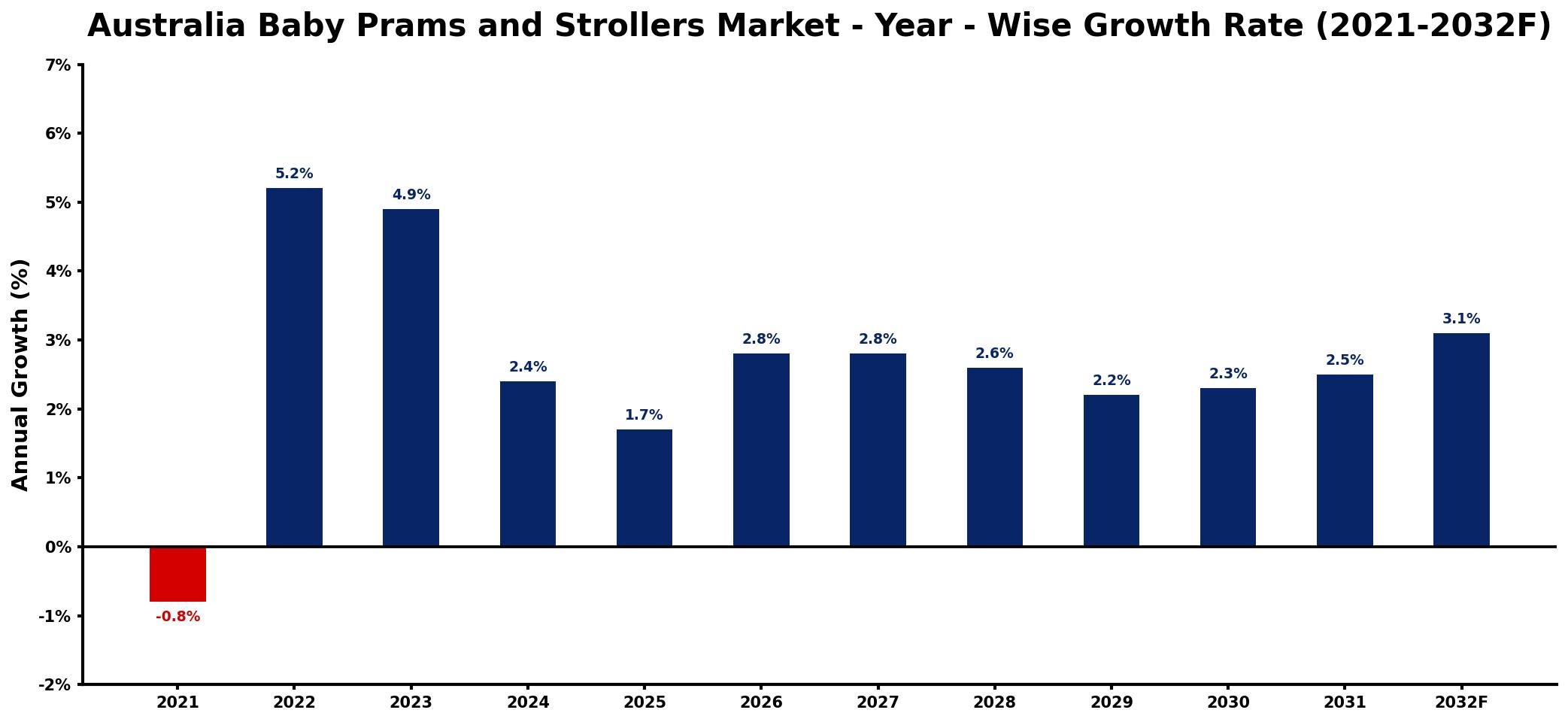
The table below presents the year‑wise growth rates along with the key drivers influencing the market
| Year | Growth Rate | Major Drivers |
| 2021 | -0.8% | Consumer spending on childcare products |
| 2022 | 5.2% | Increased online retail investments |
| 2023 | 4.9% | Rise in eco-friendly materials |
| 2024 | 2.4% | Growing urban population trends |
| 2025 | 1.7% | Expansion of family-oriented services |
| 2026 | 2.8% | Higher disposable income levels |
| 2027 | 2.8% | Innovations in safety features |
| 2028 | 2.6% | Demand for multifunctional designs |
| 2029 | 2.2% | Increased awareness of ergonomics |
| 2030 | 2.3% | Growth in health-conscious parenting |
| 2031 | 2.5% | Rising interest in premium options |
| 2032 | 3.1% | stronger distribution network expansion |
Note: Market size estimations and growth projections presented in this report are based on 6Wresearch's proprietary forecasting methodology, utilizing the latest available industry data, government publications, and primary research inputs.
Australia Baby Prams and Strollers Market Synopsis
In Australia, the growing trend towards outdoor lifestyles is shaping the baby prams and strollers market. Many families are now incorporating outdoor excursions into their routines, which increases the demand for durable and versatile prams that can handle various terrains.
Furthermore, parents are increasingly prioritizing safety features, leading to heightened expectations for ergonomic designs and lightweight materials in stroller construction. This reflects a broader trend of informed consumerism, where parents actively seek products that ensure the comfort and safety of their children.
Australia Baby Prams and Strollers Market Key Takeaways
- The market is driven by urbanization, increasing birth rates, and changing family lifestyles.
- Safety and ergonomic design are significant factors influencing consumer preferences.
- Product innovation, including modular systems and customization options, is pivotal for growth.
- Competition among brands creates challenges related to pricing and profit margins.
- Government regulations ensure product safety, impacting market dynamics.
Evaluation of Restraints in Australia Baby Prams and Strollers Market
Despite the favorable growth prospects, the Australia baby prams and strollers market faces several constraints. Intense competition from both local and international brands can lead to price wars, which pressure profit margins. Additionally, the rapid pace of technological advancements necessitates ongoing investments in product development, forcing manufacturers to innovate continually. As consumer preferences evolve with changing lifestyles, companies must design versatile and compact solutions that cater to the varying needs of parents, adding to the complexity of market dynamics.
Australia Baby Prams and Strollers Market Trends
Current trends in the Australia baby prams and strollers market include a growing emphasis on eco-friendly materials and sustainable manufacturing practices. Parents are increasingly aware of environmental impacts and are gravitating towards products that align with their values. Moreover, technological integration, such as smart features for monitoring and enhanced safety, is becoming more prevalent, reflecting the demand for modern, tech-savvy solutions.
Australia Baby Prams and Strollers Market Opportunities
Opportunities for growth in this market lie in the expansion of e-commerce channels and direct-to-consumer models, which offer greater access and convenience for consumers. Additionally, the development of multifunctional prams and strollers that adapt to various activities, from jogging to travel, presents a significant area for innovation and investment. Collaborations with tech companies to introduce smart features can also create new market segments and consumer interest.
Government Initiatives in the Australia Baby Prams and Strollers Market
The Australian government plays a vital role in ensuring the safety and quality of baby prams and strollers through stringent regulations and standards. Initiatives aimed at enhancing consumer awareness and education about safe usage practices further support market integrity. By collaborating with industry stakeholders, the government promotes high-quality standards, ensuring that products available to parents are reliable and safe for young children.
Future Insights of the Australia Baby Prams and Strollers Market
Looking forward to the period between 2026 and 2032, the Australia baby prams and strollers market is set to evolve considerably. With an anticipated increase in urban living, the demand for compact and portable designs will rise. Additionally, as safety standards tighten and consumer awareness grows, manufacturers will need to place greater emphasis on quality and innovation. The integration of technology into products will likely reshape consumer expectations, leading to more advanced and user-friendly stroller solutions.
Australia Baby Prams and Strollers Market Latest Developments (2025 - 2026)
In recent months, the industry has witnessed a surge in the introduction of high-tech strollers featuring connectivity options, such as mobile apps for tracking safety metrics and real-time adjustments. Manufacturers are also focusing on sustainability by incorporating biodegradable materials into their products. Collaborations between stroller designers and outdoor brands have become more common, aiming to develop versatile models that cater to active families.
Australia Baby Prams and Strollers Market - Key Attractiveness of the Report
- 10 Years of Market Numbers
- Historical Data Starting from 2022 to 2025
- Base Year: 2025
- Forecast Data until 2032
- Key Performance Indicators Impacting the Market
- Major Upcoming Developments and Projects
Key Highlights of the Report:
- Australia Baby Prams and Strollers Market Outlook
- Market Size of Australia Baby Prams and Strollers Market, 2025
- Forecast of Australia Baby Prams and Strollers Market, 2032
- Historical Data and Forecast of Australia Baby Prams and Strollers Revenues & Volume for the Period 2022-2032F
- Australia Baby Prams and Strollers Market Trend Evolution
- Australia Baby Prams and Strollers Market Drivers and Challenges
- Australia Baby Prams and Strollers Price Trends
- Australia Baby Prams and Strollers Porter's Five Forces
- Australia Baby Prams and Strollers Industry Life Cycle
- Historical Data and Forecast of Australia Baby Prams and Strollers Market Revenues & Volume By Product Type for the Period 2022-2032F
- Historical Data and Forecast of Australia Baby Prams and Strollers Market Revenues & Volume By Lightweight Strollers for the Period 2022-2032F
- Historical Data and Forecast of Australia Baby Prams and Strollers Market Revenues & Volume By Jogging Strollers for the Period 2022-2032F
- Historical Data and Forecast of Australia Baby Prams and Strollers Market Revenues & Volume By Standard Strollers for the Period 2022-2032F
- Historical Data and Forecast of Australia Baby Prams and Strollers Market Revenues & Volume By Double / Triple Strollers for the Period 2022-2032F
- Historical Data and Forecast of Australia Baby Prams and Strollers Market Revenues & Volume By Multi-Optional System Strollers for the Period 2022-2032F
- Historical Data and Forecast of Australia Baby Prams and Strollers Market Revenues & Volume By Age for the Period 2022-2032F
- Historical Data and Forecast of Australia Baby Prams and Strollers Market Revenues & Volume By 0 - 6 months for the Period 2022-2032F
- Historical Data and Forecast of Australia Baby Prams and Strollers Market Revenues & Volume By 6 - 12 months for the Period 2022-2032F
- Historical Data and Forecast of Australia Baby Prams and Strollers Market Revenues & Volume By 12 - 36 months for the Period 2022-2032F
- Historical Data and Forecast of Australia Baby Prams and Strollers Market Revenues & Volume By Sales Channel for the Period 2022-2032F
- Historical Data and Forecast of Australia Baby Prams and Strollers Market Revenues & Volume By BaBoutiques for the Period 2022-2032F
- Historical Data and Forecast of Australia Baby Prams and Strollers Market Revenues & Volume By Specialty Stores for the Period 2022-2032F
- Historical Data and Forecast of Australia Baby Prams and Strollers Market Revenues & Volume By Modern Trade for the Period 2022-2032F
- Historical Data and Forecast of Australia Baby Prams and Strollers Market Revenues & Volume By Departmental Stores for the Period 2022-2032F
- Historical Data and Forecast of Australia Baby Prams and Strollers Market Revenues & Volume By Mono-brand Stores for the Period 2022-2032F
- Historical Data and Forecast of Australia Baby Prams and Strollers Market Revenues & Volume By Online retailers for the Period 2022-2032F
- Historical Data and Forecast of Australia Baby Prams and Strollers Market Revenues & Volume By Other Sales Channel for the Period 2022-2032F
- Australia Baby Prams and Strollers Import Export Trade Statistics
- Market Opportunity Assessment By Product Type
- Market Opportunity Assessment By Age
- Market Opportunity Assessment By Sales Channel
- Australia Baby Prams and Strollers Top Companies Market Share
- Australia Baby Prams and Strollers Competitive Benchmarking By Technical and Operational Parameters
- Australia Baby Prams and Strollers Company Profiles
- Australia Baby Prams and Strollers Key Strategic Recommendations






































