Australia Bicycle Market Size Growth Rate
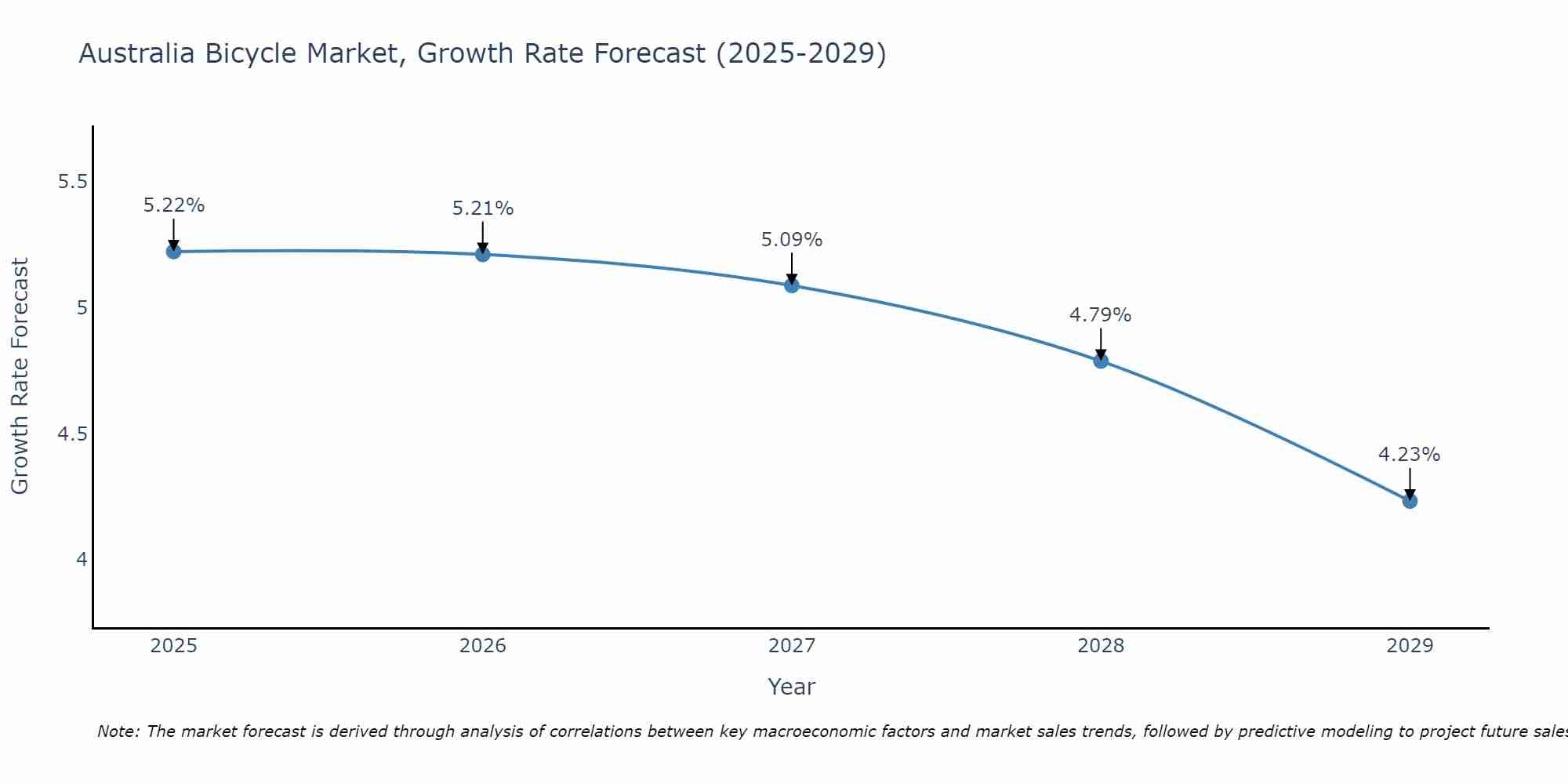
The Australia Bicycle Market could see a tapering of growth rates over 2025 to 2029. Although the growth rate starts strong at 5.22% in 2025, it steadily loses momentum, ending at 4.23% by 2029.
Australia Bicycle Market Overview
The bicycle market in Australia is influenced by consumer preferences for active lifestyles, eco-friendly transportation, and recreational cycling. Bicycles offer affordable, efficient, and sustainable mobility solutions for commuting, exercise, and leisure activities, driving their sales and usage in urban and rural areas.
Drivers of the market
The Australia Bicycle Market experiences growth driven by several factors, including the increasing focus on health and fitness, rising environmental consciousness, and the growing popularity of cycling as a sustainable transportation mode. Bicycles serve as versatile vehicles for commuting, recreation, exercise, and sports, appealing to a broad spectrum of consumers across age groups and lifestyles. The expanding network of cycling infrastructure, including bike lanes, paths, and shared trails, encourages bike usage and fosters market growth. Moreover, technological advancements in bicycle design, materials, and accessories cater to evolving consumer preferences and riding trends, further stimulating market expansion.
Challenges of the market
The Australia bicycle market faces challenges such as changing consumer preferences and competition from alternative modes of transportation. Adapting to urban infrastructure developments and addressing concerns regarding bike safety and accessibility are ongoing challenges for bicycle manufacturers and retailers.
Government Policy of the market
The bicycle market in Australia offers a wide range of bicycles for commuting, recreation, fitness, and competition. Government regulations ensure the safety, quality, and performance of bicycles, including standards for design, materials, and safety features. Compliance with these regulations is essential for bicycle manufacturers to meet industry standards and ensure rider safety. Additionally, government initiatives promoting cycling promotion, infrastructure development, and sustainable transportation may influence market dynamics in the Australia bicycle market, driving demand for innovative designs, eco-friendly materials, and personalized cycling experiences.
Key Highlights of the Report:
- Australia Bicycle Market Outlook
- Market Size of Australia Bicycle Market, 2024
- Forecast of Australia Bicycle Market, 2031
- Historical Data and Forecast of Australia Bicycle Revenues & Volume for the Period 2018 - 2031
- Australia Bicycle Market Trend Evolution
- Australia Bicycle Market Drivers and Challenges
- Australia Bicycle Price Trends
- Australia Bicycle Porter's Five Forces
- Australia Bicycle Industry Life Cycle
- Historical Data and Forecast of Australia Bicycle Market Revenues & Volume By Product for the Period 2018 - 2031
- Historical Data and Forecast of Australia Bicycle Market Revenues & Volume By Mountain Bikes for the Period 2018 - 2031
- Historical Data and Forecast of Australia Bicycle Market Revenues & Volume By Hybrid Bikes for the Period 2018 - 2031
- Historical Data and Forecast of Australia Bicycle Market Revenues & Volume By Road Bikes for the Period 2018 - 2031
- Historical Data and Forecast of Australia Bicycle Market Revenues & Volume By Cargo Bikes for the Period 2018 - 2031
- Historical Data and Forecast of Australia Bicycle Market Revenues & Volume By Others for the Period 2018 - 2031
- Historical Data and Forecast of Australia Bicycle Market Revenues & Volume By Technology for the Period 2018 - 2031
- Historical Data and Forecast of Australia Bicycle Market Revenues & Volume By Electric for the Period 2018 - 2031
- Historical Data and Forecast of Australia Bicycle Market Revenues & Volume By Conventional for the Period 2018 - 2031
- Historical Data and Forecast of Australia Bicycle Market Revenues & Volume By End-user for the Period 2018 - 2031
- Historical Data and Forecast of Australia Bicycle Market Revenues & Volume By Men for the Period 2018 - 2031
- Historical Data and Forecast of Australia Bicycle Market Revenues & Volume By Women for the Period 2018 - 2031
- Historical Data and Forecast of Australia Bicycle Market Revenues & Volume By Kids for the Period 2018 - 2031
- Historical Data and Forecast of Australia Bicycle Market Revenues & Volume By Distribution Channel for the Period 2018 - 2031
- Historical Data and Forecast of Australia Bicycle Market Revenues & Volume By Online for the Period 2018 - 2031
- Historical Data and Forecast of Australia Bicycle Market Revenues & Volume By Offline for the Period 2018 - 2031
- Australia Bicycle Import Export Trade Statistics
- Market Opportunity Assessment By Product
- Market Opportunity Assessment By Technology
- Market Opportunity Assessment By End-user
- Market Opportunity Assessment By Distribution Channel
- Australia Bicycle Top Companies Market Share
- Australia Bicycle Competitive Benchmarking By Technical and Operational Parameters
- Australia Bicycle Company Profiles
- Australia Bicycle Key Strategic Recommendations






































