Australia Blenders Market Summary
The australia blenders market was estimated at USD 190 Million in 2025 and is projected to reach USD 222 Million by 2032, growing at a CAGR of 2.3% from 2026 to 2032.
Australia Blenders Market Year-wise Growth Rate and Key Drivers
This graph highlights how the Australia Blenders Market has steadily grown over the past five years, supported by major growth factors.
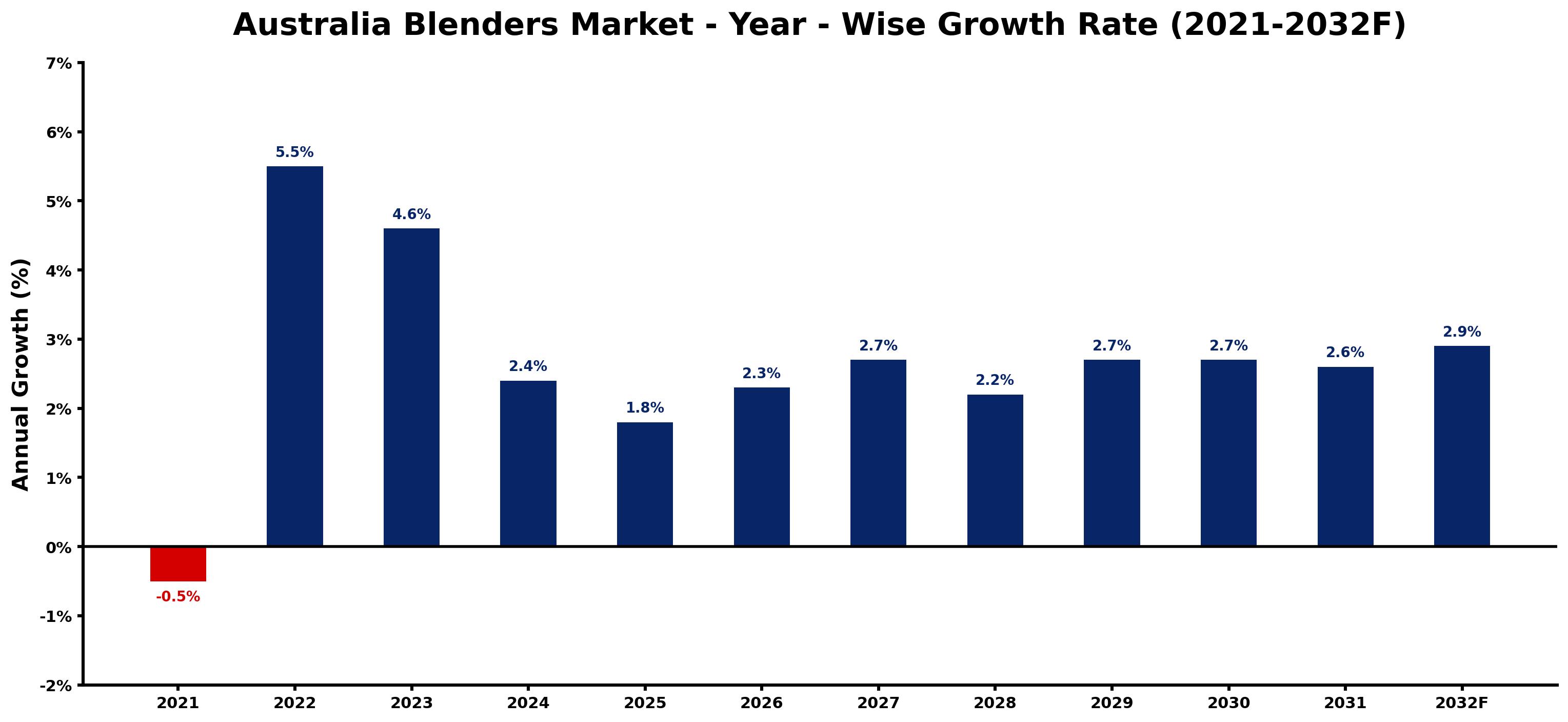
The table below presents the year wise growth rates along with the key drivers influencing the market
| Year | Growth Rate | Major Drivers |
| 2021 | -0.5% | Limited innovation in product features failed to capture consumer interest, leading to decreased sales in the blenders market. |
| 2022 | 5.5% | Innovation in smart technology integration attracted tech-savvy consumers to premium blender brands. |
| 2023 | 4.6% | Growing culinary trends emphasized smoothies and plant-based diets, boosting blender sales considerably. |
| 2024 | 2.4% | Retail expansions and online platforms enhanced accessibility to diverse blender options nationwide. |
| 2025 | 1.8% | Sustainability concerns prompted manufacturers to offer eco-friendly blender designs and materials. |
| 2026 | 2.3% | Frequent social media cooking challenges encouraged amateur chefs to invest in high-quality blenders. |
| 2027 | 2.7% | The rise of meal-prepping culture solidified blenders as essential kitchen appliances for busy households. |
| 2028 | 2.2% | Increased focus on nutritional supplements and meal replacements fueled demand for advanced blending solutions. |
| 2029 | 2.7% | Health-conscious lifestyles maintained momentum, with blenders seen as essential tools for wellness. |
| 2030 | 2.7% | Corporate wellness programs incorporated blenders into office kitchens, leading to bulk purchasing trends. |
| 2031 | 2.6% | Emerging brands focused on niche markets gained traction, diversifying the product landscape significantly. |
| 2032 | 2.9% | Consumer education on blending techniques and recipes enhanced user engagement, driving market growth. |
Note - Market size estimations and growth projections presented in this report are based on 6Wresearch's advanced forecasting approach, validated with industry datasets as of June 2026.
Australia Blenders Market Synopsis
The Australia Blenders Market is projected to reach 2.3% and witness significant growth during the forecast period (2026-2032). This market is characterized by a diverse range of products catering to varying consumer preferences, from budget-friendly options to high-end models equipped with advanced features. The escalating demand for kitchen appliances, particularly blenders, is driven by rapid technological innovation and an increasing emphasis on health-conscious eating habits.
Australia Blenders Market Growth Drivers
Several key factors are propelling the growth of the Australia Blenders Market. Firstly, the rising trend of home-cooked meals and healthy eating is significantly contributing to an uptick in blender usage. Consumers are actively seeking to prepare nutritious smoothies and meals at home, which has led to a growing preference for high-performance blenders capable of delivering consistent results.
- Increasing health awareness among Australians has resulted in a shift towards nutritious diets, further amplifying the demand for products such as blenders that facilitate easy preparation of healthy food and beverages.
- Technological advancements have led to the development of blenders with enhanced functionalities, including various speed settings, automatic programs, and self-cleaning features, making them more appealing to consumers.
- The convenience offered by personal smoothie makers has resonated well with on-the-go consumers, thereby broadening the market scope and creating new segments within the industry.
- The availability of a wide array of blender styles and brands increases competition and contributes to a healthy market environment, ensuring that consumers have access to diverse options catering to different needs.
- E-commerce platforms have made it easier for consumers to explore and purchase blenders, thus expanding market reach and fostering greater consumer engagement.
Australia Blenders Market Trends and Opportunities
The Australia Blenders Market is witnessing notable trends that present exciting opportunities for growth. As consumers continue to prioritize quality and efficiency, there is an increasing demand for blenders that not only offer performance but also integrate smart technology features. The trend towards sustainability is also influencing purchasing decisions, with consumers leaning towards eco-friendly products and brands that emphasize sustainable practices.
- Smart blenders embedded with IoT technology are gaining traction, allowing users to control their appliances remotely and streamline their culinary processes.
- The rise of social media and influencer marketing has propelled the visibility of various blender models, sparking consumer interest and driving sales.
- Health and wellness trends, such as plant-based diets, have led to increased consumption of smoothies and liquid diets, fostering demand for versatile blending appliances.
- The growing popularity of meal prepping among busy professionals has created a niche for blenders that efficiently process ingredients in one go, catering to consumers seeking convenience.
- Innovations in design, such as compact and portable blenders, are appealing to urban consumers with limited kitchen space, further driving market dynamics.
Australia Blenders Market Challenges and Restraints
While the Australia Blenders Market is poised for growth, it faces certain challenges that must be navigated. Economic fluctuations can impact consumer spending habits, leading to a shift towards lower-priced alternatives. Furthermore, a saturated market with numerous brands can complicate purchasing decisions and intensify price competition. Additionally, consumers may hesitate to invest in higher-end models without substantial proof of their value. These challenges necessitate strategic marketing and product differentiation to capture consumer interest effectively.
- Economic uncertainties can influence disposable income levels, potentially affecting the overall sales of blenders as consumers prioritize essential purchases.
- Intense competition among numerous brands can lead to price wars, impacting profit margins across the board and complicating market entry for new players.
- Consumer skepticism regarding the performance and durability of premium products can inhibit growth in segments targeted towards high-end users.
- The rapid pace of technological change requires companies to continually innovate, which can strain resources and slow down the product development cycle.
- Regulatory compliance regarding safety standards and energy efficiency can create barriers to entry, particularly for smaller manufacturers.
Australia Blenders Market Government Investment and Initiatives
The Australian government has been increasingly supportive of initiatives that promote healthy eating and sustainable living, which indirectly benefits the blenders market. Policies aimed at encouraging home cooking and the consumption of local produce bolster the market by promoting the use of kitchen appliances, including blenders. Public investment in health education programs emphasizes the importance of nutrition, further driving consumer interest in preparing meals at home, where quality blenders play a crucial role.
- Public health campaigns advocating for increased fruit and vegetable consumption align with the growing trend of smoothie preparation at home, enhancing blender sales.
- Incentives for businesses in the health and wellness sector can indirectly support the blenders market by fostering growth in complementary industries, such as organic food production.
- Government efforts to reduce food waste through initiatives encouraging home cooking can lead to increased utilization of kitchen gadgets, including blenders.
- Regulations that promote energy-efficient appliances can raise the bar for product development, compelling manufacturers to innovate and improve their offerings in the blenders market.
- Investment in research and development through grants or funding for local manufacturers can lead to enhanced product capabilities and market competitiveness.
Australia Blenders Market Latest Developments (May 2025 - June 2026)
The period from May 2025 to June 2026 reflects dynamic shifts in the Australia Blenders Market as manufacturers have begun integrating advanced technology into their products. There has been a notable increase in interest in smart appliances, with connectivity features becoming more prevalent in new models. Additionally, sustainability trends have prompted some companies to adopt eco-friendly materials and manufacturing processes, appealing to environmentally conscious consumers.
- An upswing in online sales channels has been observed, as companies prioritize direct-to-consumer models to enhance reach and engagement.
- The expansion of health-focused marketing campaigns has successfully captured consumer interest, leading to increased sales of high-performance blenders.
- Developments in energy-efficient technology have prompted several brands to innovate, complying with stringent energy regulations while enhancing product appeal.
- Collaborations with health and wellness influencers have emerged as a popular strategy, driving product visibility and encouraging consumer trust.
- Consumer feedback has played a crucial role in product development, with manufacturers increasingly adapting to preferences for customizable features and designs.
Australia Blenders Market - Key Attractiveness of the Report
- 10 Years of Market Numbers
- Historical Data Starting from 2022 to 2025
- Base Year: 2025
- Forecast Data until 2032
- Key Performance Indicators Impacting the Market
- Major Upcoming Developments and Projects
Q2: How are government initiatives influencing the market? Q3: What are some challenges faced by the Australia Blenders Market? Q4: What recent trends are shaping the future of the market?
Key Highlights of the Report:
- Australia Blenders Market Outlook
- Market Size of Australia Blenders Market, 2025
- Forecast of Australia Blenders Market, 2032
- Historical Data and Forecast of Australia Blenders Revenues & Volume for the Period 2022-2032
- Australia Blenders Market Trend Evolution
- Australia Blenders Market Drivers and Challenges
- Australia Blenders Price Trends
- Australia Blenders Porter's Five Forces
- Australia Blenders Industry Life Cycle
- Historical Data and Forecast of Australia Blenders Market Revenues & Volume By Types for the Period 2022-2032
- Historical Data and Forecast of Australia Blenders Market Revenues & Volume By Hand Blenders for the Period 2022-2032
- Historical Data and Forecast of Australia Blenders Market Revenues & Volume By Single-Serve Blenders for the Period 2022-2032
- Historical Data and Forecast of Australia Blenders Market Revenues & Volume By Full-Size Blenders for the Period 2022-2032
- Historical Data and Forecast of Australia Blenders Market Revenues & Volume By Applications for the Period 2022-2032
- Historical Data and Forecast of Australia Blenders Market Revenues & Volume By Commercial for the Period 2022-2032
- Historical Data and Forecast of Australia Blenders Market Revenues & Volume By Household for the Period 2022-2032
- Australia Blenders Import Export Trade Statistics
- Market Opportunity Assessment By Types
- Market Opportunity Assessment By Applications
- Australia Blenders Top Companies Market Share
- Australia Blenders Competitive Benchmarking By Technical and Operational Parameters
- Australia Blenders Company Profiles
- Australia Blenders Key Strategic Recommendations






































