Australia Concrete Aggregate Market: Import Trend Analysis
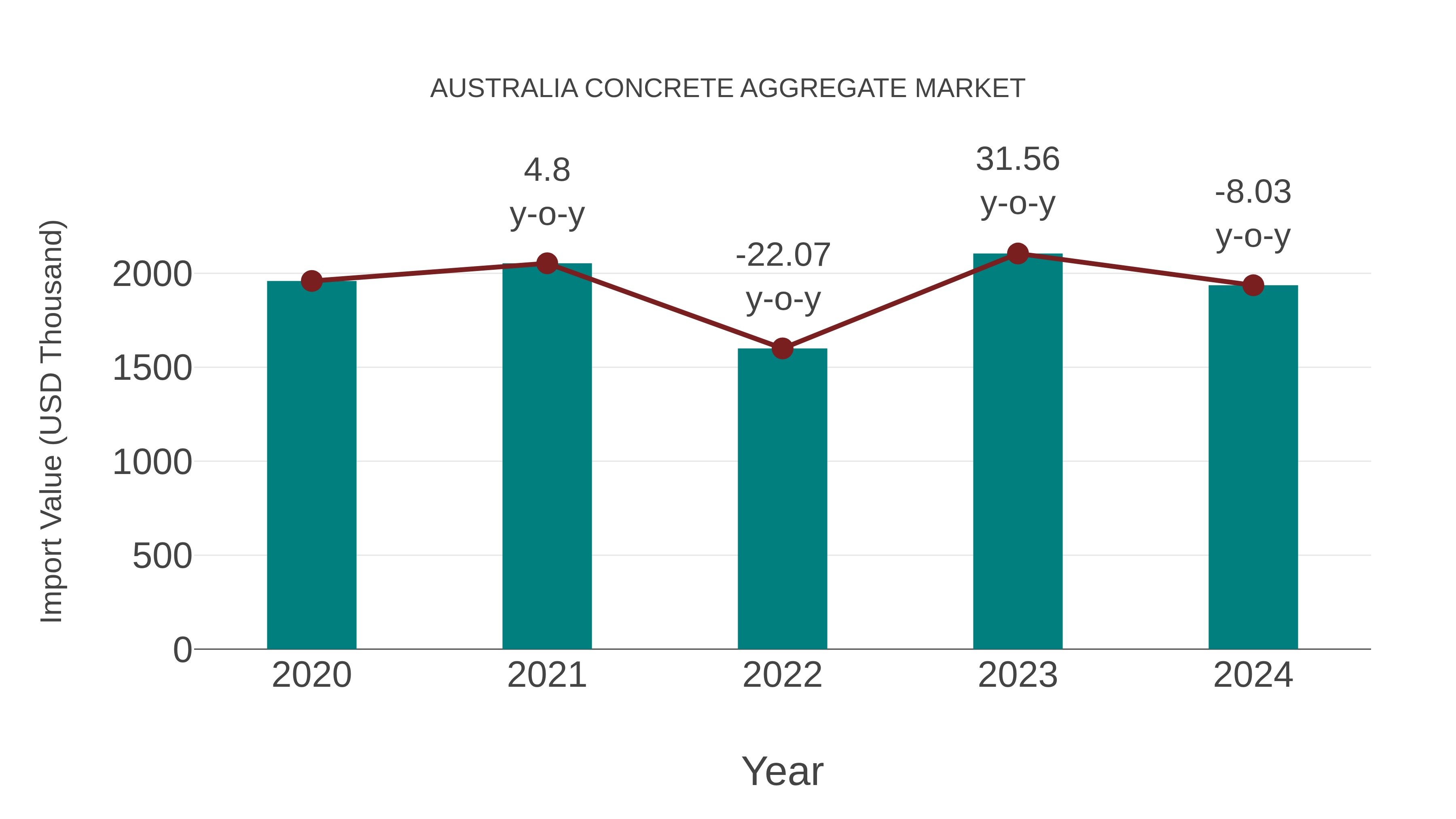
In the Australia concrete aggregate market, the import trend experienced a decline from 2023 to 2024, with a growth rate of -8.03%. The compound annual growth rate (CAGR) for imports between 2020 and 2024 stood at -0.29%. This decline could be attributed to shifting demand patterns or changes in trade policies impacting market stability.
Australia Concrete Aggregate Market Overview
The Australia Concrete Aggregate market is witnessing steady growth, propelled by the ongoing infrastructure development projects and construction activities across the country. Concrete aggregate, comprising sand, gravel, crushed stone, and other materials, is a key component of concrete used in various construction applications, including buildings, roads, bridges, and dams. Factors such as population growth, urbanization, and investments in infrastructure are driving the demand for concrete aggregate in Australia. Moreover, the availability of abundant natural resources and the emergence of recycled aggregates are contributing to market expansion.
Drivers of the market
In Australia, the Concrete Aggregate market is experiencing robust growth, driven by the booming construction sector and infrastructure development projects across the country. Concrete aggregates, including sand, gravel, and crushed stone, are essential components of concrete mixtures used in various construction applications. Factors such as population growth, urbanization, and government investments in infrastructure projects are driving the demand for concrete aggregates. Moreover, the focus on sustainable construction practices and the recycling of construction waste are further fueling market growth.
Challenges of the market
The Australia Concrete Aggregate market faces challenges related to environmental sustainability, as the extraction and processing of natural aggregates can have significant ecological impacts, including habitat destruction and landscape alteration. This necessitates the development of sustainable sourcing practices and the promotion of alternative materials such as recycled aggregates. Additionally, transportation costs and logistical challenges associated with delivering aggregates to remote construction sites in Australia vast geography can impact market dynamics. Furthermore, fluctuating demand from the construction sector and regulatory uncertainties pose further challenges for market stability.
Government Policy of the market
Government policies in Australia related to infrastructure development, urban planning, and environmental conservation impact the Concrete Aggregate market. Regulations governing quarrying operations, land use, and environmental protection influence the availability and extraction of aggregates for concrete production. Additionally, standards and specifications set by government agencies and industry bodies ensure the quality and suitability of aggregates used in construction projects. Government-funded infrastructure projects and initiatives aimed at promoting sustainable construction practices may drive demand for high-quality aggregates in Australia.
Key Highlights of the Report:
- Australia Concrete Aggregate Market Outlook
- Market Size of Australia Concrete Aggregate Market, 2025
- Forecast of Australia Concrete Aggregate Market, 2032
- Historical Data and Forecast of Australia Concrete Aggregate Revenues & Volume for the Period 2022-2032F
- Australia Concrete Aggregate Market Trend Evolution
- Australia Concrete Aggregate Market Drivers and Challenges
- Australia Concrete Aggregate Price Trends
- Australia Concrete Aggregate Porter's Five Forces
- Australia Concrete Aggregate Industry Life Cycle
- Historical Data and Forecast of Australia Concrete Aggregate Market Revenues & Volume By Production for the Period 2022-2032F
- Historical Data and Forecast of Australia Concrete Aggregate Market Revenues & Volume By Natural for the Period 2022-2032F
- Historical Data and Forecast of Australia Concrete Aggregate Market Revenues & Volume By Artificial for the Period 2022-2032F
- Historical Data and Forecast of Australia Concrete Aggregate Market Revenues & Volume By Processed for the Period 2022-2032F
- Historical Data and Forecast of Australia Concrete Aggregate Market Revenues & Volume By Glass Ceramics for the Period 2022-2032F
- Historical Data and Forecast of Australia Concrete Aggregate Market Revenues & Volume By Manufactured Marbles for the Period 2022-2032F
- Historical Data and Forecast of Australia Concrete Aggregate Market Revenues & Volume By Bulk Density for the Period 2022-2032F
- Historical Data and Forecast of Australia Concrete Aggregate Market Revenues & Volume By ASTM C33 for the Period 2022-2032F
- Historical Data and Forecast of Australia Concrete Aggregate Market Revenues & Volume By mechanical properties for the Period 2022-2032F
- Historical Data and Forecast of Australia Concrete Aggregate Market Revenues & Volume By Abrasive power for the Period 2022-2032F
- Historical Data and Forecast of Australia Concrete Aggregate Market Revenues & Volume By Particle Size for the Period 2022-2032F
- Historical Data and Forecast of Australia Concrete Aggregate Market Revenues & Volume By Fine Aggregates for the Period 2022-2032F
- Historical Data and Forecast of Australia Concrete Aggregate Market Revenues & Volume By Coarse Aggregate for the Period 2022-2032F
- Australia Concrete Aggregate Import Export Trade Statistics
- Market Opportunity Assessment By Production
- Market Opportunity Assessment By Bulk Density
- Market Opportunity Assessment By mechanical properties
- Market Opportunity Assessment By Particle Size
- Australia Concrete Aggregate Top Companies Market Share
- Australia Concrete Aggregate Competitive Benchmarking By Technical and Operational Parameters
- Australia Concrete Aggregate Company Profiles
- Australia Concrete Aggregate Key Strategic Recommendations






































