Australia Dehydrated Culture Media Market: Import Trend Analysis
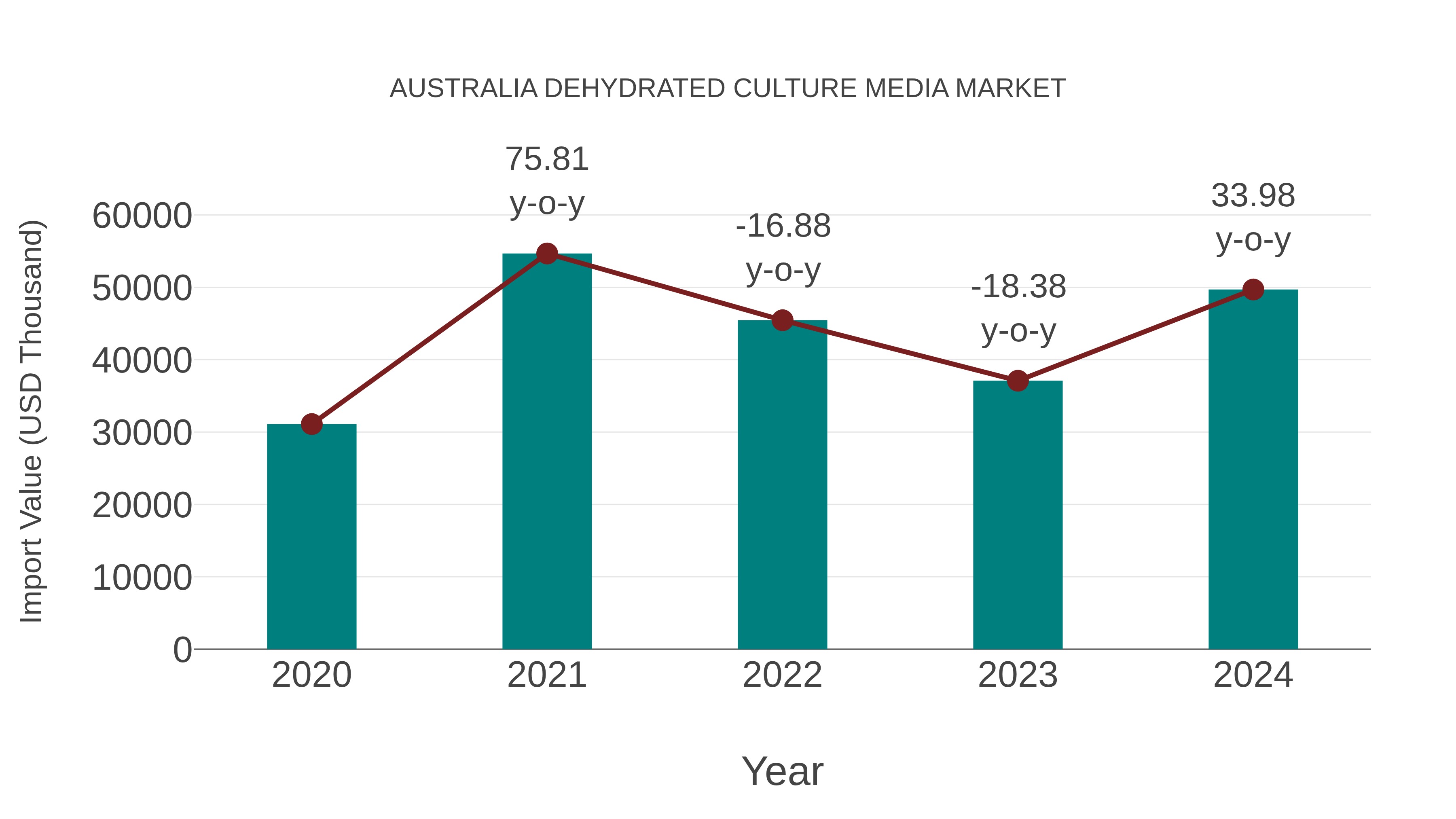
Australia`s import trend for dehydrated culture media in 2024 exhibited significant growth, with a 33.98% increase from the previous year. The compound annual growth rate (CAGR) for the period 2020-2024 stood at 12.43%. This import momentum can be attributed to a notable demand shift towards high-quality culture media products, reflecting a stable market environment that supported steady growth in imports.
Australia Dehydrated Culture Media Market Highlights
| Report Name | Australia Dehydrated Culture Media Market |
| Forecast period | 2025-2031 |
| CAGR | 7.8% |
| Growing Sector | Biotechnology and Pharmaceutical |
Topics Covered in the Australia Dehydrated Culture Media Market Report
The Australia Dehydrated Culture Media Market report thoroughly covers the market by type and by end-user. The market report provides an unbiased and detailed analysis of the ongoing market trends, opportunities/high growth areas, and market drivers which would help the stakeholders to devise and align their market strategies according to the current and future market dynamics.
Australia Dehydrated Culture Media Market Synopsis
The Australia Dehydrated Culture Media Market is expanding rapidly, driven by the expansion of the healthcare and pharmaceutical industries, rising need for microbiological testing in food and beverage production, and advances in biotechnology research. Dehydrated culture medium, which are required for cultivating and identifying microorganisms in laboratories, are crucial in microbiology, clinical diagnostics, and research. Additionally, the market is witnessing a shift towards more sustainable and environmentally friendly practices, with manufacturers exploring the use of recyclable and biodegradable packaging materials to reduce environmental impact.
According to 6Wresearch, the Australia Dehydrated Culture Media Market size is expected to grow at a significant CAGR of 7.8% during the forecast period 2025-2031. Several major forces are propelling Australia's Dehydrated Culture Media Market forward. For instance, the increased emphasis on research and development operations in the pharmaceutical and biotechnology sectors is driving up demand for dehydrated culture media, since these businesses rely largely on it for a variety of laboratory applications. In addition, the increasing prevalence of infectious diseases, as well as the need for reliable and speedy microbiological testing, are boosting the use of dehydrated culture media in clinical diagnostics. Furthermore, the rising food and beverage industry, combined with strict food safety standards, is driving up demand for dehydrated culture media for microbiological testing.
Additionally, the Australia Dehydrated Culture Media industry is experiencing its own set of trends that reflect the growing needs and technological advancements in laboratory and clinical settings. The demand for dehydrated culture media is on the rise due to the increasing focus on research and development activities in the fields of microbiology, pharmaceuticals, and food safety. This surge is propelled by the growing interest in understanding microbial cultures and their impact on various industries. Furthermore, the shift towards automation in laboratory processes has created a demand for high-quality, standardized culture media that ensure reproducibility and reliability in results.
Australia Dehydrated Culture Media Industry: Leading Players
Prominent corporations like Thermo Fisher Scientific Inc., Merck KGaA, BD (Becton, Dickinson and Company), HiMedia Laboratories, and bioMérieux SA are among the top participants in the Australia Dehydrated Culture Media market. These businesses now command substantial market share.
Dehydrated Culture Media Market in Australia: Government Regulations
Australia's government laws on dehydrated culture media are mostly concerned with import requirements and biosecurity protocols. In an effort to reduce the risks involved in importing dehydrated and pre-sterilized microbiological medium, the Department of Agriculture, Water, and the Environment has been evaluating and updating the import requirements for these goods. Furthermore, particularbiosecurity protocols are implemented to manage potential hazards associated with specific biological constituents found in dehydrated culture media.
Future Insights of the Australia Dehydrated Culture Media Market:
The growing need for microbiological testing solutions across many industries has created a huge opportunity for growth and innovation in the dehydrated culture medium market in Australia. To succeed in the parched culture media industry, one must work together, invest in technology, and prioritise quality and regulatory compliance in order to overcome obstacles like price competitiveness and adoption restrictions.
Market Segmentation by Type
According to Dhaval, Research Manager, 6Wresearch, the Semi-Composite Medium segment is poised to experience robust growth in the Australia Dehydrated Culture Media Market, fuelled by its performance benefits, customization options, and suitability for diverse applications across industries.
Market Segmentation by End-User
“Biotechnology and Pharmaceutical industries” will see maximum growth, due the need for diagnostic testing in healthcare settings and the growing demand for microbiological testing solutions in pharmaceutical research and development are major drivers driving these segments' potential growth.
Key Attractiveness of the Report
- 10 Years Market Numbers.
- Historical Data Starting from 2021 to 2024.
- Base Year: 2024
- Forecast Data until 2031.
- Key Performance Indicators Impacting the Market.
- Major Upcoming Developments and Projects.
Key Highlights of the Report:
- Australia Dehydrated Culture Media Market Outlook
- Market Size of Australia Dehydrated Culture Media Market, 2025
- Forecast of Australia Dehydrated Culture Media Market, 2032
- Historical Data and Forecast of Australia Dehydrated Culture Media Revenues & Volume for the Period 2022-2032F
- Australia Dehydrated Culture Media Market Trend Evolution
- Australia Dehydrated Culture Media Market Drivers and Challenges
- Australia Dehydrated Culture Media Price Trends
- Australia Dehydrated Culture Media Porter's Five Forces
- Australia Dehydrated Culture Media Industry Life Cycle
- Historical Data and Forecast of Australia Dehydrated Culture Media Market Revenues & Volume By Type for the Period 2022-2032F
- Historical Data and Forecast of Australia Dehydrated Culture Media Market Revenues & Volume By Natural Medium for the Period 2022-2032F
- Historical Data and Forecast of Australia Dehydrated Culture Media Market Revenues & Volume By Mixed Medium for the Period 2022-2032F
- Historical Data and Forecast of Australia Dehydrated Culture Media Market Revenues & Volume By Semi-Composite Medium for the Period 2022-2032F
- Historical Data and Forecast of Australia Dehydrated Culture Media Market Revenues & Volume By End-User for the Period 2022-2032F
- Historical Data and Forecast of Australia Dehydrated Culture Media Market Revenues & Volume By Hospitals for the Period 2022-2032F
- Historical Data and Forecast of Australia Dehydrated Culture Media Market Revenues & Volume By Diagnostic centers for the Period 2022-2032F
- Historical Data and Forecast of Australia Dehydrated Culture Media Market Revenues & Volume By Biotechnology & Pharmaceutical Industries for the Period 2022-2032F
- Historical Data and Forecast of Australia Dehydrated Culture Media Market Revenues & Volume By Academic and Research Institutes for the Period 2022-2032F
- Historical Data and Forecast of Australia Dehydrated Culture Media Market Revenues & Volume By Others for the Period 2022-2032F
- Australia Dehydrated Culture Media Import Export Trade Statistics
- Market Opportunity Assessment By Type
- Market Opportunity Assessment By End-User
- Australia Dehydrated Culture Media Top Companies Market Share
- Australia Dehydrated Culture Media Competitive Benchmarking By Technical and Operational Parameters
- Australia Dehydrated Culture Media Company Profiles
- Australia Dehydrated Culture Media Key Strategic Recommendations
Market Covered
The report offers a comprehensive study of the subsequent market segments:
By Type
- Natural Medium,
- Mixed Medium,
- Semi-Composite Medium
By End-User
- Hospitals,
- Diagnostic Centres,
- Biotechnology & Pharmaceutical Industries,
- Academic And Research Institutes,
- Others






































