Australia Disinfectant Market: Import Trend Analysis
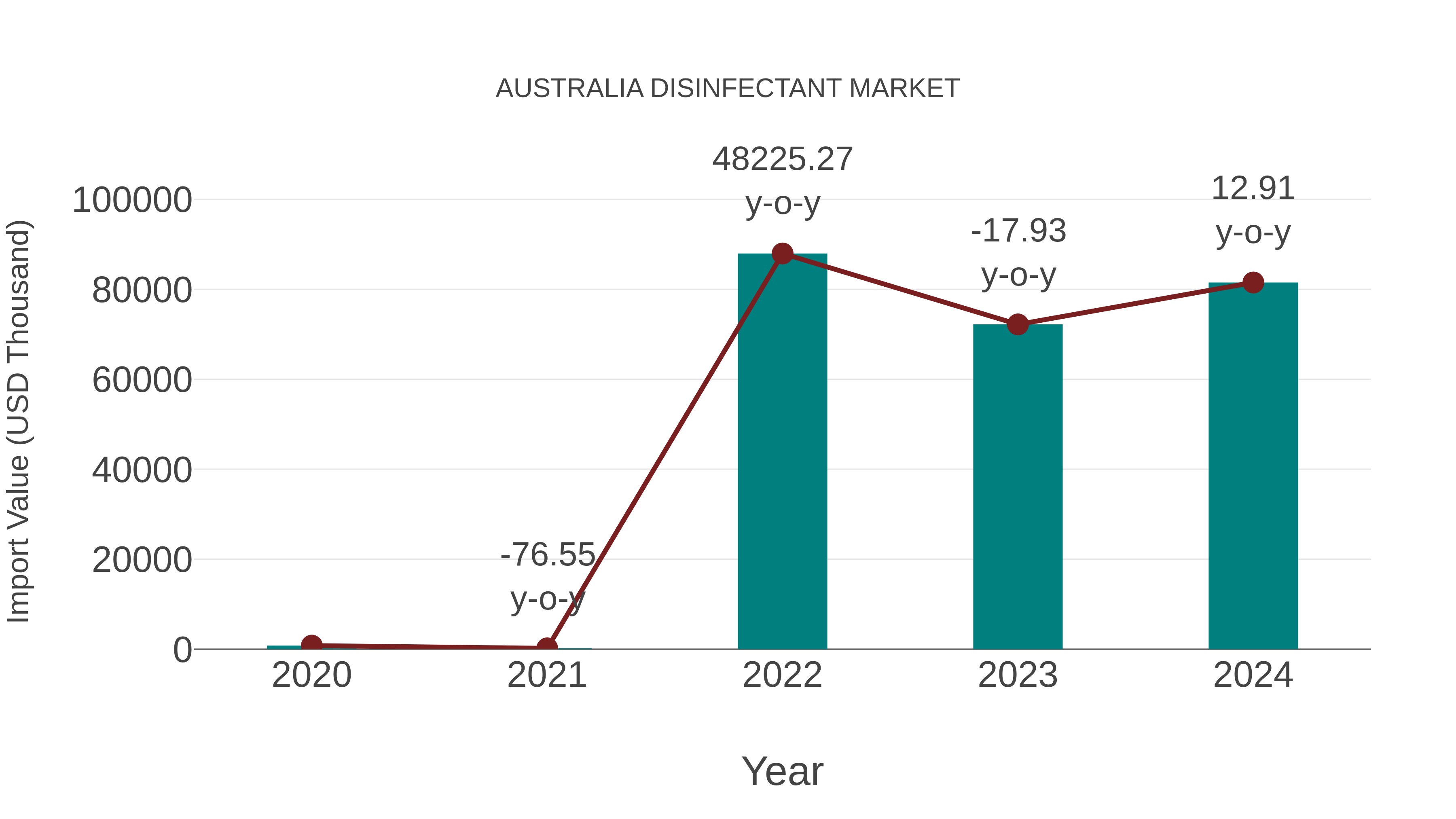
In the Australia disinfectant market, the import trend showed significant growth, with a 12.91% increase from 2023 to 2024. The compound annual growth rate (CAGR) for imports during the period 2020-2024 stood at 220.13%. This surge in imports can be attributed to heightened demand for disinfectant products due to the global pandemic, reflecting a shift in consumer behavior towards increased hygiene practices.
Australia Disinfectant Market Overview
The disinfectant market in Australia is experiencing steady growth driven by increasing awareness of hygiene and sanitation. The demand for disinfectant products, including sprays, wipes, and hand sanitizers, has surged due to the COVID-19 pandemic, emphasizing the importance of cleanliness in households, healthcare facilities, and public spaces. Key players in the Australian disinfectant market are focusing on product innovation, eco-friendly formulations, and strategic partnerships to cater to evolving consumer preferences for effective and sustainable disinfection solutions. Government regulations and initiatives promoting health and safety standards are also influencing market dynamics. The market is expected to continue expanding as consumers prioritize cleanliness and germ protection, presenting opportunities for new entrants and existing companies to capitalize on the growing demand for disinfectant products in Australia.
Australia Disinfectant Market Trends
The disinfectant market in Australia is experiencing a surge in demand due to the ongoing COVID-19 pandemic. Consumers are increasingly focusing on hygiene and sanitation, leading to a rise in sales of disinfectant products across various sectors such as healthcare, household, and commercial establishments. There is a growing preference for eco-friendly and sustainable disinfectant solutions, driving manufacturers to innovate and introduce products that are effective yet environmentally friendly. The market is also witnessing a shift towards online purchasing channels as consumers seek convenient and contactless shopping options. With the emphasis on cleanliness and sanitation expected to continue in the post-pandemic era, the disinfectant market in Australia is projected to maintain steady growth with a focus on product efficacy, sustainability, and convenience.
Australia Disinfectant Market Challenges
In the Australian disinfectant market, some of the key challenges faced include increasing competition among manufacturers and brands, stringent regulations around ingredients and labeling requirements, shifting consumer preferences towards more natural and eco-friendly products, and the ongoing threat of counterfeit products. Additionally, the COVID-19 pandemic has led to a surge in demand for disinfectant products, putting pressure on supply chains and leading to shortages in some cases. Manufacturers also need to constantly innovate and develop new formulations to stay ahead of the competition and meet evolving consumer expectations for efficacy, safety, and sustainability. Overall, navigating these challenges requires companies in the Australian disinfectant market to be agile, compliant with regulations, and responsive to changing market trends.
Australia Disinfectant Market Investment Opportunities
The Australia disinfectant market presents several investment opportunities for both domestic and international investors. With the increasing focus on hygiene and cleanliness due to the ongoing COVID-19 pandemic, the demand for disinfectant products is expected to remain high. Investing in innovative disinfectant formulations that offer effective and long-lasting protection against a broad spectrum of pathogens could yield significant returns. Additionally, there is potential for growth in eco-friendly and sustainable disinfectant solutions to cater to the rising consumer preference for environmentally conscious products. Collaborating with local manufacturers or distributors to penetrate the Australian market and leveraging digital marketing strategies to reach a wider audience could also be lucrative investment avenues in the disinfectant sector.
Australia Disinfectant Market Government Policy
In Australia, the disinfectant market is regulated by the Australian Pesticides and Veterinary Medicines Authority (APVMA) under the Agricultural and Veterinary Chemicals Code Act 1994. Disinfectants are considered pesticides under this act and must be registered with the APVMA before they can be sold or used in Australia. The APVMA ensures that disinfectants meet safety and efficacy standards through a rigorous registration process. Additionally, the Australian Competition and Consumer Commission (ACCC) monitors disinfectant products to prevent false or misleading claims about their effectiveness. Overall, government policies in Australia aim to ensure that disinfectant products are safe, effective, and accurately labeled to protect consumers and the environment.
Australia Disinfectant Market Future Outlook
The Australia disinfectant market is expected to witness steady growth in the coming years, driven by increasing awareness about hygiene and sanitation due to the ongoing COVID-19 pandemic. The demand for disinfectant products is likely to remain strong across various sectors including healthcare, hospitality, and household segments. Additionally, the rising focus on infection prevention and control measures in public spaces and workplaces will further propel market growth. Manufacturers are anticipated to introduce innovative and sustainable disinfection solutions to meet the evolving consumer preferences for environmentally friendly products. Government regulations and initiatives promoting cleanliness and sanitation practices are also expected to contribute to the market expansion. Overall, the Australia disinfectant market is poised for continued growth and opportunities for market players in the foreseeable future.
Key Highlights of the Report:
- Australia Disinfectant Market Outlook
- Market Size of Australia Disinfectant Market,2025
- Forecast of Australia Disinfectant Market, 2032
- Historical Data and Forecast of Australia Disinfectant Revenues & Volume for the Period 2022-2032F
- Australia Disinfectant Market Trend Evolution
- Australia Disinfectant Market Drivers and Challenges
- Australia Disinfectant Price Trends
- Australia Disinfectant Porter's Five Forces
- Australia Disinfectant Industry Life Cycle
- Historical Data and Forecast of Australia Disinfectant Market Revenues & Volume By Product Type for the Period 2022-2032F
- Historical Data and Forecast of Australia Disinfectant Market Revenues & Volume By Alcoholbased for the Period 2022-2032F
- Historical Data and Forecast of Australia Disinfectant Market Revenues & Volume By Hydrogen Peroxide for the Period 2022-2032F
- Historical Data and Forecast of Australia Disinfectant Market Revenues & Volume By Quaternary Ammonium Compounds for the Period 2022-2032F
- Historical Data and Forecast of Australia Disinfectant Market Revenues & Volume By Application for the Period 2022-2032F
- Historical Data and Forecast of Australia Disinfectant Market Revenues & Volume By Surface Cleaning for the Period 2022-2032F
- Historical Data and Forecast of Australia Disinfectant Market Revenues & Volume By Wound Care for the Period 2022-2032F
- Historical Data and Forecast of Australia Disinfectant Market Revenues & Volume By Industrial Cleaning for the Period 2022-2032F
- Historical Data and Forecast of Australia Disinfectant Market Revenues & Volume By End Use for the Period 2022-2032F
- Historical Data and Forecast of Australia Disinfectant Market Revenues & Volume By Healthcare for the Period 2022-2032F
- Historical Data and Forecast of Australia Disinfectant Market Revenues & Volume By Pharmaceuticals for the Period 2022-2032F
- Historical Data and Forecast of Australia Disinfectant Market Revenues & Volume By Foodservice for the Period 2022-2032F
- Historical Data and Forecast of Australia Disinfectant Market Revenues & Volume By Form for the Period 2022-2032F
- Historical Data and Forecast of Australia Disinfectant Market Revenues & Volume By Liquid for the Period 2022-2032F
- Historical Data and Forecast of Australia Disinfectant Market Revenues & Volume By Gel for the Period 2022-2032F
- Historical Data and Forecast of Australia Disinfectant Market Revenues & Volume By Spray for the Period 2022-2032F
- Historical Data and Forecast of Australia Disinfectant Market Revenues & Volume By Distribution Channel for the Period 2022-2032F
- Historical Data and Forecast of Australia Disinfectant Market Revenues & Volume By Online Retail for the Period 2022-2032F
- Historical Data and Forecast of Australia Disinfectant Market Revenues & Volume By Offline Retail for the Period 2022-2032F
- Historical Data and Forecast of Australia Disinfectant Market Revenues & Volume By B2B Sales for the Period 2022-2032F
- Australia Disinfectant Import Export Trade Statistics
- Market Opportunity Assessment By Product Type
- Market Opportunity Assessment By Application
- Market Opportunity Assessment By End Use
- Market Opportunity Assessment By Form
- Market Opportunity Assessment By Distribution Channel
- Australia Disinfectant Top Companies Market Share
- Australia Disinfectant Competitive Benchmarking By Technical and Operational Parameters
- Australia Disinfectant Company Profiles
- Australia Disinfectant Key Strategic Recommendations






































