Australia Electric Locomotives Market Size, Share & Growth Rate
The Australia Electric Locomotives Market was estimated at USD 241 Million in 2025 and is projected to reach USD 284 Million by 2032, growing at a CAGR of 2.4% from 2026 to 2032. This steady growth trajectory is fueled by a significant push towards sustainable transportation solutions, aligning with Australia's environmental goals. Coupled with government initiatives aimed at enhancing public transport infrastructure, the demand for electric locomotives is increasingly robust, driven by technological advancements that further bolster efficiency and reduce operational costs.
Australia Electric Locomotives Market Year-wise Growth Rate and Key Drivers
This graph highlights how the Australia Electric Locomotives Market has steadily grown over the years, supported by major growth factors.
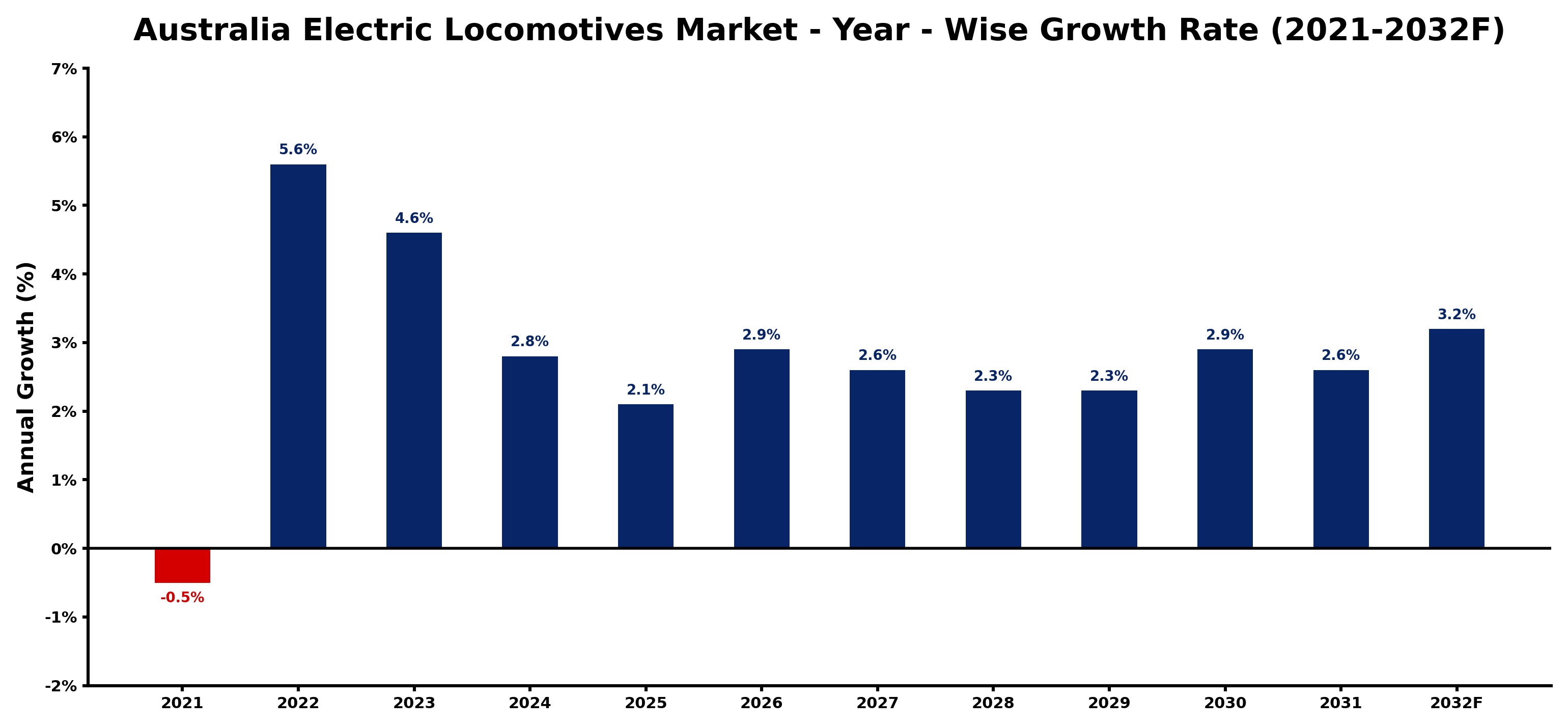
The table below presents the year‑wise growth rates along with the key drivers influencing the market
| Year | Growth Rate | Major Drivers |
| 2021 | -0.5% | Rising electricity demand across industries |
| 2022 | 5.6% | Increasing smart city development projects |
| 2023 | 4.6% | Increasing adoption of advanced technologies |
| 2024 | 2.8% | Expansion of commercial construction activities |
| 2025 | 2.1% | Rising electricity demand across industries |
| 2026 | 2.9% | Expansion of commercial construction activities |
| 2027 | 2.6% | Increasing industrial infrastructure investments |
| 2028 | 2.3% | Rapid growth in telecom and data center sectors |
| 2029 | 2.3% | Increasing industrial infrastructure investments |
| 2030 | 2.9% | Rising electricity demand across industries |
| 2031 | 2.6% | Government infrastructure modernization initiatives |
| 2032 | 3.2% | Expansion of commercial construction activities |
Note - Market size estimations and growth projections presented in this report are based on 6Wresearch's advanced forecasting approach, validated with industry datasets as of June 2026.
Australia Electric Locomotives Market Synopsis
As Australia focuses on mitigating its carbon footprint, the electric locomotives market is experiencing a transformative phase. Recent investments in electrification projects across various rail networks highlight a national commitment to integrating cleaner technologies in public transportation.
This dynamic market landscape is shaped not only by environmental considerations but also by the operational efficiencies offered by electric locomotives. Features like regenerative braking and energy-efficient propulsion systems are making these trains increasingly appealing to operators, leading to an overall shift from traditional diesel options.
Australia Electric Locomotives Market Key Takeaways
- Significant investments are being made in electrification projects across Australia, indicating a robust market growth potential.
- The demand for electric locomotives is largely driven by sustainability goals and governmental infrastructure enhancements.
- Technological advancements in electric train systems enhance operational efficiency and lower lifecycle costs.
- Regulatory support, including incentives and subsidies, plays a crucial role in accelerating market penetration of electric locomotives.
- Challenges related to the initial electrification costs and grid reliability, particularly in rural areas, remain pertinent issues to navigate.
Evaluation of Restraints in Australia Electric Locomotives Market
Despite the optimistic outlook for electric locomotives, the market faces tangible restraints that must be addressed for sustained growth. The most pressing challenge is the high initial investment associated with electrification infrastructure. Upgrading existing lines or developing new electrified segments can impose significant financial burdens on operators. Moreover, issues related to grid capacity and reliability often hinder electrification in remote regions, where logistical and economic factors complicate project feasibility. Addressing these restraints through innovative financing and technology solutions will be vital for unlocking the full potential of the market.
Australia Electric Locomotives Market Trends
Several key trends are shaping the Australia Electric Locomotives Market. Notably, the integration of smart technologies such as predictive maintenance and real-time data analytics is gaining traction, allowing operators to optimize performance and reduce downtime. Furthermore, an increasing number of partnerships between public and private sectors to share the financial burden of electrification projects is emerging as a significant trend, fostering a collaborative approach to infrastructure development. Finally, a growing consumer demand for greener transport options is prompting operators to prioritize electric solutions over traditional diesel alternatives.
Australia Electric Locomotives Market Opportunities
The market presents numerous opportunities, particularly as Australia continues to focus on sustainable urban mobility. With government commitments to reduce emissions and enhance public transport systems, there is potential for increased funding and subsidies to support electric locomotive initiatives. Furthermore, the advancement of battery technology may open new avenues for enhancing the operational range and efficiency of electric trains, making them even more viable alternatives. The potential for electric locomotives in freight transportation also represents an underexplored market segment that could yield significant growth.
Government Initiatives in the Australia Electric Locomotives Market
The Australian government has implemented various policies and initiatives to drive the adoption of electric locomotives. Incentives and subsidies aimed at promoting electric trains for both passenger and freight services are essential parts of a broader strategy to reduce transportation sector emissions. Investment in electrified rail networks is being prioritized to support the transition to cleaner transport solutions, ensuring that infrastructure keeps pace with market demand. This proactive governmental stance illustrates a commitment to fostering sustainable mobility solutions across the country.
Future Insights of the Australia Electric Locomotives Market
Looking ahead to 2026-2032, the Australia Electric Locomotives Market is poised for substantial evolution. As electrification projects expand and operational efficiencies improve, electric locomotives will become increasingly indispensable in both passenger and freight transport. Emerging technologies and government backing will likely catalyze innovation, leading to enhancements in locomotives' performance and sustainability. This positive trajectory signals a future where electric trains not only play a crucial role in reducing emissions but also contribute to the modernization of Australia's railway infrastructure.
Australia Electric Locomotives Market Latest Developments (May 2025 - June 2026)
Recent developments in the Australia Electric Locomotives Market indicate a notable push towards innovative technologies and infrastructure upgrades. Various projects are underway focusing on expanding electrified rail networks, which aim to enhance operational capabilities and support environmental goals. Additionally, industry stakeholders are actively exploring new partnerships to leverage funding for electrification initiatives, demonstrating a commitment to advancing sustainable transport solutions across the region.
Australia Electric Locomotives Market - Key Attractiveness of the Report
- 10 Years of Market Numbers
- Historical Data Starting from 2022 to 2025
- Base Year: 2025
- Forecast Data until 2032
- Key Performance Indicators Impacting the Market
- Major Upcoming Developments and Projects
Key Highlights of the Report:
- Australia Electric Locomotives Market Outlook
- Market Size of Australia Electric Locomotives Market, 2025
- Forecast of Australia Electric Locomotives Market, 2032
- Historical Data and Forecast of Australia Electric Locomotives Revenues & Volume for the Period 2022-2032F
- Australia Electric Locomotives Market Trend Evolution
- Australia Electric Locomotives Market Drivers and Challenges
- Australia Electric Locomotives Price Trends
- Australia Electric Locomotives Porter's Five Forces
- Australia Electric Locomotives Industry Life Cycle
- Historical Data and Forecast of Australia Electric Locomotives Market Revenues & Volume By Energy Transfer for the Period 2022-2032F
- Historical Data and Forecast of Australia Electric Locomotives Market Revenues & Volume By Overhead Lines for the Period 2022-2032F
- Historical Data and Forecast of Australia Electric Locomotives Market Revenues & Volume By Third Rail for the Period 2022-2032F
- Historical Data and Forecast of Australia Electric Locomotives Market Revenues & Volume By On-board Energy Storage for the Period 2022-2032F
- Historical Data and Forecast of Australia Electric Locomotives Market Revenues & Volume By Technology for the Period 2022-2032F
- Historical Data and Forecast of Australia Electric Locomotives Market Revenues & Volume By IGBT Module for the Period 2022-2032F
- Historical Data and Forecast of Australia Electric Locomotives Market Revenues & Volume By GTO Thyristor for the Period 2022-2032F
- Historical Data and Forecast of Australia Electric Locomotives Market Revenues & Volume By SiC Module for the Period 2022-2032F
- Historical Data and Forecast of Australia Electric Locomotives Market Revenues & Volume By Traction Units for the Period 2022-2032F
- Historical Data and Forecast of Australia Electric Locomotives Market Revenues & Volume By AC Traction Units for the Period 2022-2032F
- Historical Data and Forecast of Australia Electric Locomotives Market Revenues & Volume By DC Traction Units for the Period 2022-2032F
- Historical Data and Forecast of Australia Electric Locomotives Market Revenues & Volume By Multi System Units for the Period 2022-2032F
- Historical Data and Forecast of Australia Electric Locomotives Market Revenues & Volume By Application for the Period 2022-2032F
- Historical Data and Forecast of Australia Electric Locomotives Market Revenues & Volume By Passenger Transport for the Period 2022-2032F
- Historical Data and Forecast of Australia Electric Locomotives Market Revenues & Volume By Freight Transport for the Period 2022-2032F
- Australia Electric Locomotives Import Export Trade Statistics
- Market Opportunity Assessment By Energy Transfer
- Market Opportunity Assessment By Technology
- Market Opportunity Assessment By Traction Units
- Market Opportunity Assessment By Application
- Australia Electric Locomotives Top Companies Market Share
- Australia Electric Locomotives Competitive Benchmarking By Technical and Operational Parameters
- Australia Electric Locomotives Company Profiles
- Australia Electric Locomotives Key Strategic Recommendations






































