Australia Electronic Dictionary Market Size, Share & Growth Rate
The Australia Electronic Dictionary Market was estimated at USD 91 Million in 2025 and is projected to reach USD 107 Million by 2032, growing at a CAGR of 2.3% from 2026 to 2032. This growth trajectory reflects a significant shift towards digital resources as a preferred medium for language learning and reference. Factors such as the increasing penetration of mobile devices and the evolving landscape of educational technologies are further amplifying the adoption of electronic dictionaries across diverse demographics in Australia.
Australia Electronic Dictionary Market Year-wise Growth Rate and Key Drivers
This graph highlights how the Australia Electronic Dictionary Market has steadily grown over the years, supported by major growth factors.
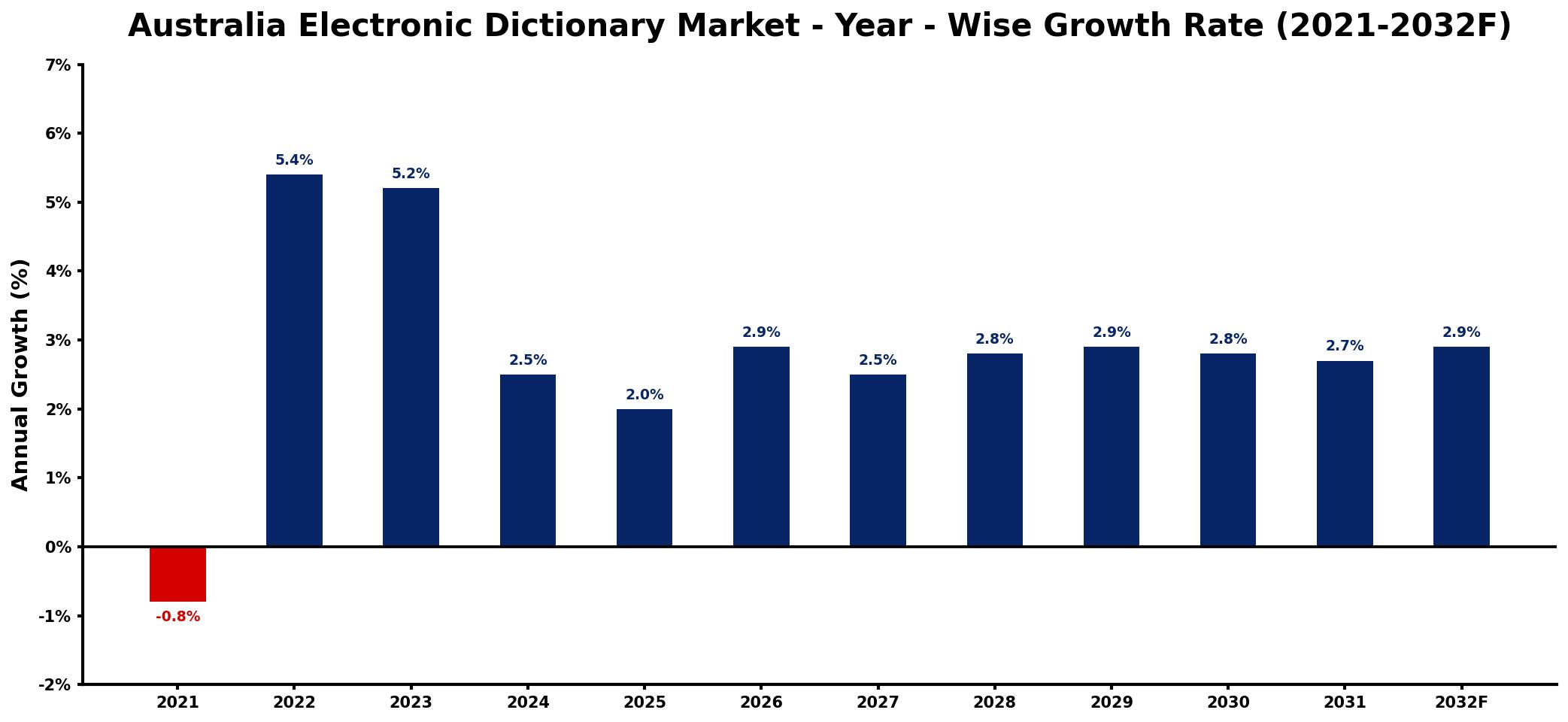
The table below presents the year‑wise growth rates along with the key drivers influencing the market
| Year | Growth Rate | Major Drivers |
| 2021 | -0.8% | Shift towards digital learning solutions |
| 2022 | 5.4% | Rising demand for language tools |
| 2023 | 5.2% | Increased adoption of mobile applications |
| 2024 | 2.5% | Expansion of online education platforms |
| 2025 | 2.0% | Growth in global language markets |
| 2026 | 2.9% | Surge in personalized learning technologies |
| 2027 | 2.5% | Investment in educational technology startups |
| 2028 | 2.8% | Emergence of AI-powered language services |
| 2029 | 2.9% | Growing interest in remote learning |
| 2030 | 2.8% | Advancements in interactive learning methods |
| 2031 | 2.7% | Popularity of language learning communities |
| 2032 | 2.9% | Development of multilingual support services |
Note: Market size estimations and growth projections presented in this report are based on 6Wresearch's proprietary forecasting methodology, utilizing the latest available industry data, government publications, and primary research inputs.
Australia Electronic Dictionary Market Synopsis
Australia's rich multicultural landscape has created a vibrant demand for language resources, including electronic dictionaries. Educational institutions are increasingly integrating these tools into their curricula, enhancing language acquisition and proficiency among students.
Moreover, professionals and language enthusiasts are turning to digital dictionaries for real-time translation and language support. The appeal lies in their ease of use and comprehensive databases that provide quick access to linguistic resources, catering to the needs of a diverse user base.
Australia Electronic Dictionary Market Key Takeaways
- The market is experiencing steady growth fueled by the digital transformation in education.
- Technological advancements, such as mobile accessibility, are reshaping user interaction with electronic dictionaries.
- Consumer preferences are shifting towards integrated language learning solutions that offer offline functionality.
- Investment in language preservation initiatives is driving the development of dictionaries featuring indigenous languages.
- Government policies are increasingly supporting digital literacy, enhancing the relevance of electronic dictionaries in educational settings.
Evaluation of Restraints in Australia Electronic Dictionary Market
Despite promising growth, the Australia Electronic Dictionary Market encounters several restraints. The rapid rise of free online dictionary services and translation applications is shifting consumer preferences away from traditional electronic dictionaries. This trend necessitates a reevaluation of product features to maintain market relevance. To survive in a crowded market, manufacturers face the challenge of innovating and incorporating value-added functionalities that resonate with modern users, such as adaptive learning tools and enhanced user interfaces.
Australia Electronic Dictionary Market Trends
A notable trend is the increasing integration of artificial intelligence in electronic dictionaries, facilitating personalized language learning experiences. Additionally, there is a rising interest in dictionaries that support indigenous languages, reflecting a broader movement towards cultural preservation. The convergence of technology and education is fostering a demand for interactive dictionaries that engage users through gamification and multimedia resources.
Australia Electronic Dictionary Market Opportunities
Opportunities abound for companies willing to innovate and adapt. By focusing on niche markets, such as indigenous language dictionaries or specialized professional resources, businesses can capture underserved segments. Partnerships with educational institutions to develop tailored solutions may further drive growth. Moreover, leveraging advancements in voice recognition technology can enhance user engagement and satisfaction, presenting an avenue for differentiation in a competitive landscape.
Government Initiatives in the Australia Electronic Dictionary Market
Government policies in Australia are increasingly supportive of digital literacy initiatives, aiming to elevate language education standards. Investments in digital learning resources for schools and libraries are pivotal in shaping the landscape of electronic dictionaries. Moreover, funding for programs that focus on the preservation of indigenous languages is fostering a robust demand for resources that cater to these communities, further propelling the market forward.
Future Insights of the Australia Electronic Dictionary Market
Looking ahead to 2026-2032, the Australia Electronic Dictionary Market is poised for significant transformation. As technological advancements continue to permeate the educational sector, electronic dictionaries will likely evolve into comprehensive learning platforms that integrate multiple languages and learning styles. The emphasis on cultural preservation, coupled with government support, will further drive the creation of diverse, user-centric dictionaries that address the needs of a changing demographic.
Australia Electronic Dictionary Market Latest Developments (2025 - 2026)
Recent developments indicate a growing trend towards collaborative platforms for electronic dictionaries that enhance user engagement and accessibility. With an increasing focus on gamification and interactive features, companies are exploring partnerships with educational institutions to integrate these dictionaries into formal education. Additionally, investment in new technologies to support voice recognition and real-time translation continues to expand the potential applications of electronic dictionaries in both personal and professional contexts.
Australia Electronic Dictionary Market - Key Attractiveness of the Report
- 10 Years of Market Numbers
- Historical Data Starting from 2022 to 2025
- Base Year: 2025
- Forecast Data until 2032
- Key Performance Indicators Impacting the Market
- Major Upcoming Developments and Projects
Key Highlights of the Report:
- Australia Electronic Dictionary Market Outlook
- Market Size of Australia Electronic Dictionary Market, 2025
- Forecast of Australia Electronic Dictionary Market, 2032
- Historical Data and Forecast of Australia Electronic Dictionary Revenues & Volume for the Period 2022-2032F
- Australia Electronic Dictionary Market Trend Evolution
- Australia Electronic Dictionary Market Drivers and Challenges
- Australia Electronic Dictionary Price Trends
- Australia Electronic Dictionary Porter's Five Forces
- Australia Electronic Dictionary Industry Life Cycle
- Historical Data and Forecast of Australia Electronic Dictionary Market Revenues & Volume By Application for the Period 2022-2032F
- Historical Data and Forecast of Australia Electronic Dictionary Market Revenues & Volume By Educational Institutions for the Period 2022-2032F
- Historical Data and Forecast of Australia Electronic Dictionary Market Revenues & Volume By Corporate for the Period 2022-2032F
- Historical Data and Forecast of Australia Electronic Dictionary Market Revenues & Volume By Government for the Period 2022-2032F
- Historical Data and Forecast of Australia Electronic Dictionary Market Revenues & Volume By Household for the Period 2022-2032F
- Historical Data and Forecast of Australia Electronic Dictionary Market Revenues & Volume By Others for the Period 2022-2032F
- Australia Electronic Dictionary Import Export Trade Statistics
- Market Opportunity Assessment By Application
- Australia Electronic Dictionary Top Companies Market Share
- Australia Electronic Dictionary Competitive Benchmarking By Technical and Operational Parameters
- Australia Electronic Dictionary Company Profiles
- Australia Electronic Dictionary Key Strategic Recommendations






































