Australia Fitness Equipment Market: Import Trend Analysis
In the Australia fitness equipment market, the import trend showed an 18.59% growth rate from 2023 to 2024, with a compound annual growth rate (CAGR) of -3.07% from 2020 to 2024. The negative CAGR indicates a challenging market environment possibly influenced by shifting consumer preferences or trade policies, impacting the market`s stability during this period.
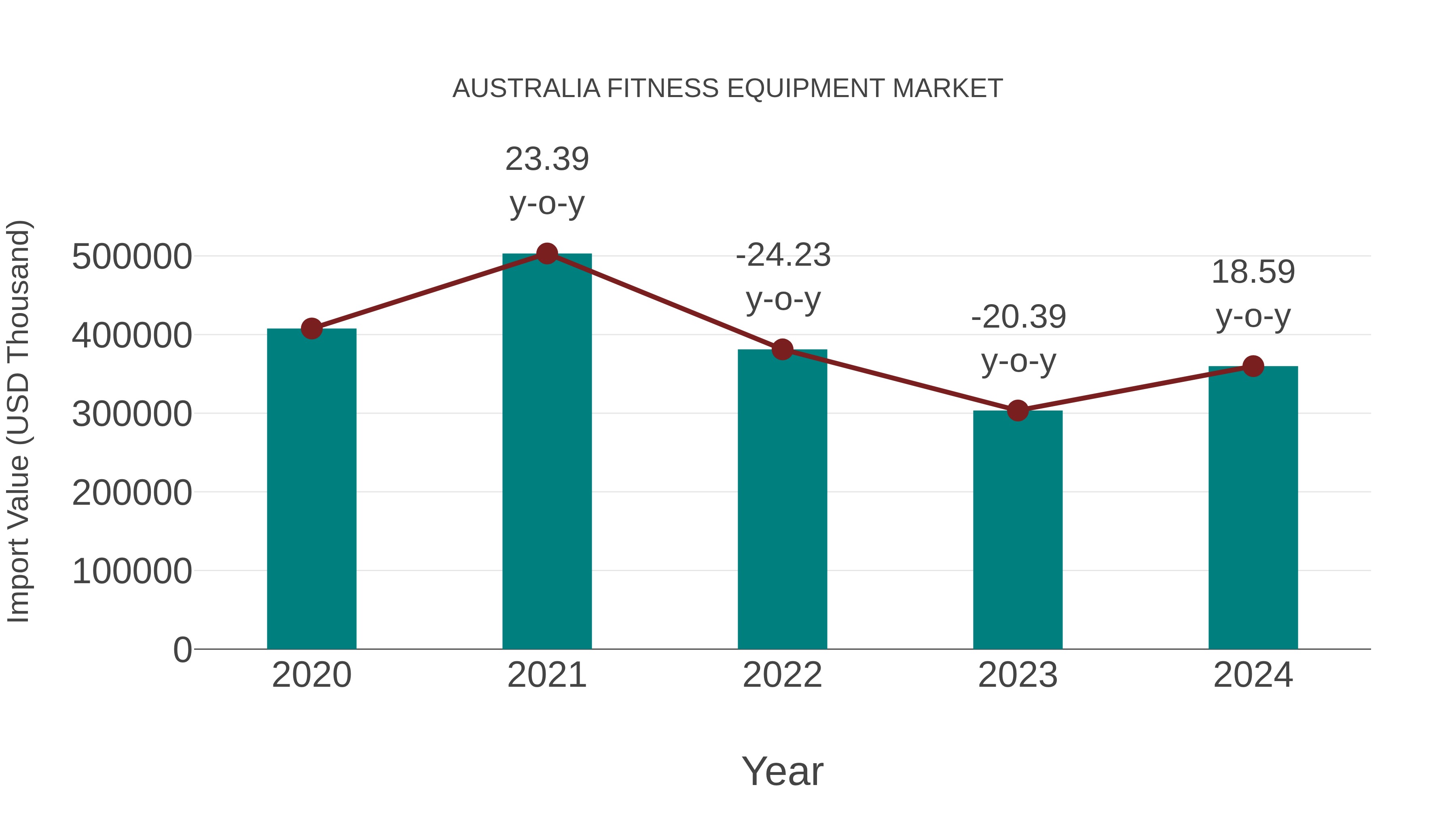
Australia Fitness Equipment Market Growth Rate
According to 6Wresearch internal database and industry insights, the Australia Fitness Equipment Market is growing at a compound annual growth rate (CAGR) of 6.35% during the forecast period (2026-2032).
Topics Covered in the Australia Fitness Equipment Market Report
The report thoroughly covers the market by types of fitness equipment and end-users. The report provides an unbiased and detailed analysis of ongoing market trends, opportunities/high growth areas, and market drivers, which would help stakeholders devise and align their market strategies according to the current and future market dynamics.
Australia Fitness Equipment Market Highlights
| Report Name | Australia Fitness Equipment Market |
| Forecast period | 2026-2032 |
| CAGR | 6.35% |
| Growing Sector |
Health Clubs/Gyms |
Australia Fitness Equipment Market Synopsis
The Australia Fitness Equipment Market will experience strong market growth as home consumers and health clubs; gyms are showing increasing demand for fitness products. Australians are spending more money on fitness equipment as they want to improve their health and physical fitness according to the rising trend of health and wellness dedication. The market expansion is driven by government policies that support fitness and well-being together with the rising consumer disposable income.
Evaluation of Growth Drivers in the Australia Fitness Equipment Market
Below mentioned are some growth drivers and their impact on market dynamics:
| Drivers | Primary Segments Affected | Why It Matters |
| Government Initiatives | Fitness Equipment Sales, Health Clubs | Promotes health and wellness, encouraging fitness investments. |
| Rising Health Consciousness | Home Consumer, Health Club/Gym | More individuals seek fitness solutions for personal health. |
| E-Commerce Growth | All Segments | Expands accessibility to a variety of fitness equipment. |
| Increasing Gym Memberships | Health Club/Gym, Strength Equipment | Increases demand for commercial-grade fitness equipment. |
| Technological Advancements | Cardiovascular Equipment, Strength Training | Makes fitness experiences enhanced through innovative features |
The Australia Fitness Equipment Market is projected to expand at a CAGR of 6.35% during the forecast period of 2026-2032. The Australia Fitness Equipment Market identifies two primary drivers that contribute to health awareness among Australians who opt to exercise and prioritize their well-being through fitness activities. Home gyms and fitness equipment have become increasingly popular as people find these solutions easy and more convenient. The market experiences growth through technological advancements, which include smart equipment that contains tracking capabilities. The demand for fitness equipment across different consumer groups sees an increase as government programs that promote physical activity and health grow together with gyms and fitness centers.
Evaluation of Restraints in the Australia Fitness Equipment Market
Below mentioned are some major restraints and their influence on market dynamics:
| Restraints | Primary Segments Affected | What This Means |
| High Equipment Costs | Home Consumer, Health Clubs | Limits accessibility for price-sensitive consumers and restricts equipment adoption. |
| Limited Space in Homes | Home Consumer | Restricts adoption of larger fitness equipment in small or crowded living spaces. |
| Economic Downturns | All Segments | Lowers consumer spending on non-essential products like fitness equipment during downturns. |
| Intense Competition | All Segments | Makes more pressure on smaller players thus, lowering profitability and overall market share. |
| Product Durability Concerns | Home Consumer, Health Clubs | It basically leads to dissatisfaction and decreases repeat purchases if equipment is prone to failure |
Australia Fitness Equipment Market Challenges
The Australia Fitness Equipment Market faces challenges as high equipment costs make it difficult for budget-conscious consumers to purchase fitness equipment. Homeowners in urban areas need to avoid buying large machines as their homes do not provide sufficient space. Economic downturns lead to decreased consumer spending for nonessential products which include fitness equipment. International brands create intense competition that forces local companies to compete while product durability issues result in customer dissatisfaction which decreases repeat sales and blocks market expansion.
Australia Fitness Equipment Market Trends
Some major trends contributing to the Australia Fitness Equipment Market Growth are:
- Sustainable Fitness Solutions: There is an increasing demand among consumers of Australia for green and energy efficient equipment made from recycled materials or energy-efficient machines
- Health-Conscious Fitness Equipment: There is a growing demand among consumers for fitness equipment that supports healthier lifestyles, such as ergonomic designs and smart features that track performance.
- Technological Advancements in Equipment: Growing tech advancements such as Bluetooth connectivity, virtual coaching, and real-time tracking increases consumer experience.
Investment Opportunities in the Australia Fitness Equipment Market
Here are some investment opportunities in the Australia Fitness Equipment Industry:
- Expansion of Online Sales Channels: Launching or partnering with e-commerce platforms to improve access to fitness equipment and meet consumer demand.
- Sustainable Equipment Production: Making of eco-friendly fitness products will significantly contribute to market growth as consumers are becoming more eco-conscious.
- Smart Fitness Equipment: The growing tech- savvy consumer base is increasing the market expansion by providing personalized experiences to enhance fitness results.
Top 5 Leading Players in the Australia Fitness Equipment Market
Here are some top companies contributing to Australia Fitness Equipment Market Share:
1. Technogym Australia
| Company Name | Technogym Australia |
|---|---|
| Established Year | 1983 |
| Headquarters | Sydney, New South Wales |
| Official Website | Click Here |
Technogym is the premier provider of high-end, digitally integrated fitness solutions in the Australian market. As the official supplier to the Olympic Games and many high-performance sporting institutes across the country, Technogym dominates the premium commercial and hotel gym sectors.
2. Life Fitness Australia
| Company Name | Life Fitness Australia |
|---|---|
| Established Year | 1997 |
| Headquarters | Mulgrave, Victoria |
| Official Website | Click Here |
Life Fitness is a cornerstone of the Australian commercial fitness landscape, serving as the primary equipment partner for many of the nation’s largest "Big Box" gym chains and local council leisure centers. Their portfolio, which includes brands like Hammer Strength and Cybex, is highly regarded for its durability and biomechanical precision.
3. Matrix Fitness (Johnson Health Tech Australia)
| Company Name | Matrix Fitness (Johnson Health Tech Australia) |
|---|---|
| Established Year | 1975 |
| Headquarters | Braeside, Victoria |
| Official Website | Click Here |
Matrix Fitness has rapidly expanded its footprint in Australia by offering high-design, versatile equipment for both commercial and residential use. Known for their "Ultra" and "Versa" series, Matrix is a favorite among the growing boutique studio and luxury apartment gym segments.
4. Peloton Interactive Australia
| Company Name | Peloton Interactive Australia |
|---|---|
| Established Year | 2021 |
| Headquarters | Sydney, New South Wales (Global HQ: New York, USA) |
| Official Website | Click Here |
Since its high-profile entry into the Australian market, Peloton has become the dominant force in the "Connected Home Fitness" category. Despite the post-pandemic shift back to gyms, Peloton maintains a loyal subscriber base in Australia’s major urban centers like Melbourne and Brisbane.
5. Fleet Fitness
| Company Name | Fleet Fitness |
|---|---|
| Established Year | 1988 |
| Headquarters | Balcatta, Western Australia |
| Official Website | Click Here |
Fleet Fitness is a major Australian-owned player, specializing in the wholesale distribution, rental, and servicing of high-quality fitness equipment. They hold a unique position in the market by offering flexible "Rent-to-Buy" and corporate leasing models that appeal to mining camps, schools, and regional hospitals across Australia.
Government Regulations Introduced in the Australia Fitness Equipment Market
According to the Australian government data, the government has made programs which improve physical fitness and overall health of participants. The Australian Sports Commission (ASC) operates programs which encourage people to engage in physical activities. This increased activity leads to higher demand for fitness equipment in the market. The Product Safety Australia organization implements strict rules which require fitness equipment to meet international safety standards, thereby protecting customers. The industry sector follows two paths as their efforts directly lead to market expansion while they maintain customer protection standards.
Future Insights of the Australia Fitness Equipment Market
The Australia Fitness Equipment Market will continue to grow as its future outlook remains positive. The market demand will increase as Australians develop greater health awareness and fitness equipment manufacturers keep creating new technological products. The increasing number of gyms and fitness centers together with e-commerce platform expansion will create higher demand for fitness products. The market will experience continuous growth in the upcoming years as government programs that promote fitness will create a market environment that supports growth.
Market Segmentation Analysis
The report offers a comprehensive study of the subsequent market segments and their leading categories.
Cardiovascular Training Equipment to Dominate the Market – By Type
According to Guneet Kaur, Senior Research Analyst at 6Wresearch, cardiovascular training equipment is the fastest-growing segment in the market due to its high demand for home fitness setups. Treadmills, ellipticals, and exercise bikes are highly popular for their versatility and effectiveness in personal fitness routines.
Home Consumer to Dominate the Market – By End-Users
The home consumer segment is leading the market by fastest end user segment. As more individuals are investing in home fitness solutions due to increasing focus on convenience and personalized workouts, consumers are preferring for home-based equipment such as stationary bikes and strength training machines.
Key attractiveness of the report
- 10 Years Market Numbers
- Historical Data Starting from 2022 to 2025
- Base Year: 2025
- Forecast Data until 2032
- Key Performance Indicators Impacting the Market
- Major Upcoming Developments and Projects
Key Highlights of the Report:
- Australia Fitness Equipment Market Outlook
- Market Size of Australia Fitness Equipment Market
- Forecast of Australia Fitness Equipment Market, 2032
- Historical Data and Forecast of Australia Fitness Equipment Revenues & Volume for the Period 2022 - 2032
- Australia Fitness Equipment Market Trend Evolution
- Australia Fitness Equipment Market Drivers and Challenges
- Australia Fitness Equipment Price Trends
- Australia Fitness Equipment Porter's Five Forces
- Australia Fitness Equipment Industry Life Cycle
- Historical Data and Forecast of Australia Fitness Equipment Market Revenues & Volume By Type for the Period 2022 - 2032
- Historical Data and Forecast of Australia Fitness Equipment Market Revenues & Volume By Cardiovascular Training Equipment for the Period 2022 - 2032
- Historical Data and Forecast of Australia Fitness Equipment Market Revenues & Volume By Strength Training Equipment for the Period 2022 - 2032
- Historical Data and Forecast of Australia Fitness Equipment Market Revenues & Volume By Other Equipment for the Period 2022 - 2032
- Historical Data and Forecast of Australia Fitness Equipment Market Revenues & Volume By End-users for the Period 2022 - 2032
- Historical Data and Forecast of Australia Fitness Equipment Market Revenues & Volume By Home consumer for the Period 2022 - 2032
- Historical Data and Forecast of Australia Fitness Equipment Market Revenues & Volume By Health club/gym for the Period 2022 - 2032
- Historical Data and Forecast of Australia Fitness Equipment Market Revenues & Volume By Other commercial user for the Period 2022 - 2032
- Australia Fitness Equipment Import Export Trade Statistics
- Market Opportunity Assessment By Type
- Market Opportunity Assessment By End-users
- Australia Fitness Equipment Top Companies Market Share
- Australia Fitness Equipment Competitive Benchmarking By Technical and Operational Parameters
- Australia Fitness Equipment Company Profiles
- Australia Fitness Equipment Key Strategic Recommendations
Market Covered
The report offers a comprehensive study of the subsequent market segments:
By Type
- Cardiovascular Training Equipment
- Strength Training Equipment
- Other Equipment
By End-Users
- Home Consumer
- Health Club/Gym
- Other Commercial User






































