Australia Functional Apparel Market Size, Share & Growth Rate
The Australia Functional Apparel Market was estimated at USD 95 Million in 2025 and is projected to reach USD 111 Million by 2032, growing at a CAGR of 2.2% from 2026 to 2032. This growth trajectory is fueled by the rising awareness of health and wellness among Australian consumers, who are increasingly opting for apparel that enhances their performance and comfort during various activities. Additionally, advancements in textile technologies and sustainable practices are driving innovation and attracting a broader audience to functional clothing.
Australia Functional Apparel Market Year-wise Growth Rate and Key Drivers
This graph highlights how the Australia Functional Apparel Market has steadily grown over the years, supported by major growth factors.
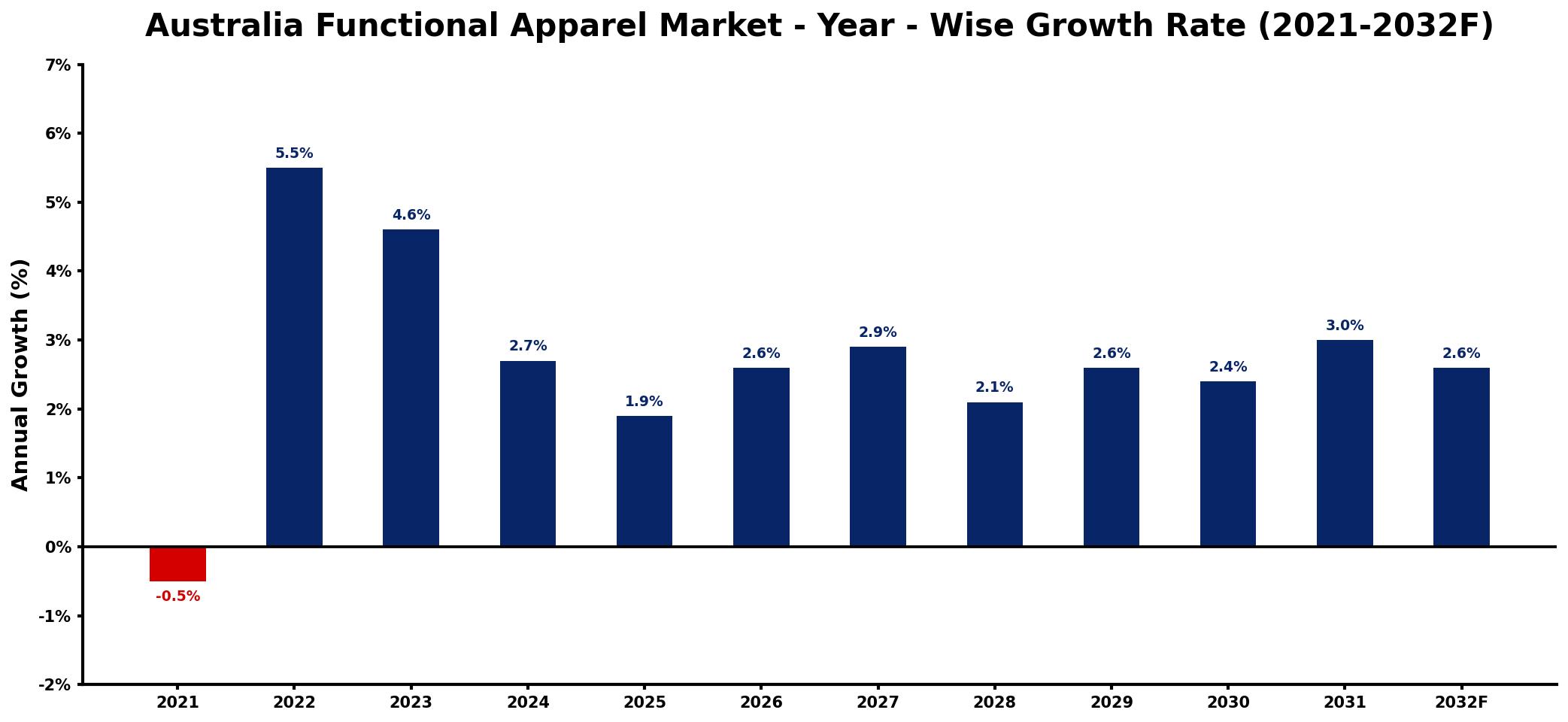
The table below presents the year‑wise growth rates along with the key drivers influencing the market
| Year | Growth Rate | Major Drivers |
| 2021 | -0.5% | decrease in consumer spending |
| 2022 | 5.5% | rise in health consciousness trends |
| 2023 | 4.6% | growing popularity of athleisure |
| 2024 | 2.7% | increased investment in innovation |
| 2025 | 1.9% | expansion of online retail channels |
| 2026 | 2.6% | surge in sustainability initiatives |
| 2027 | 2.9% | enhanced technological advancements integration |
| 2028 | 2.1% | growth in eco-friendly materials usage |
| 2029 | 2.6% | increased focus on performance enhancement |
| 2030 | 2.4% | rising demand for customization options |
| 2031 | 3.0% | rising export shipment volumes |
| 2032 | 2.6% | strengthening international trade flows |
Note: Market size estimations and growth projections presented in this report are based on 6Wresearch's proprietary forecasting methodology, utilizing the latest available industry data, government publications, and primary research inputs.
Australia Functional Apparel Market Synopsis
One of the key demand drivers in the Australia Functional Apparel Market is the notable increase in outdoor recreational activities. As Australians prioritize active lifestyles, the need for versatile clothing that offers features such as moisture-wicking and UV protection is becoming more apparent. This shift is reflected in a growing segment of consumers who actively seek functional apparel for sports and outdoor adventures.
On the supply side, manufacturers are responding to this trend by integrating innovative materials and designs that not only enhance performance but also align with consumer values of sustainability. Eco-friendly textiles and ethically produced garments are increasingly becoming a focal point for brands aiming to capture the environmentally conscious consumer's attention.
Australia Functional Apparel Market Key Takeaways
- The market is witnessing a significant shift towards sustainable and performance-driven apparel.
- Outdoor activities and sports participation are primary drivers of demand for functional clothing.
- Technological advancements in fabrics are enhancing product offerings and consumer appeal.
- Consumer education regarding the benefits of functional apparel remains a critical challenge.
- Regulatory frameworks are encouraging innovation in sustainable practices within the industry.
Evaluation of Restraints in Australia Functional Apparel Market
A key restraint in the Australia Functional Apparel Market is the limited consumer awareness regarding the advanced features of functional clothing. Many potential buyers may not fully understand the benefits associated with moisture-wicking, temperature regulation, and other specialized characteristics. Furthermore, perceptions that functional apparel may lack style or be priced above traditional options hinder broader market penetration. This, combined with fierce competition from established apparel brands, presents challenges for functional apparel manufacturers aiming to expand their market presence.
Australia Functional Apparel Market Trends
The current landscape of the Australia Functional Apparel Market is being shaped by several key trends. There is an increasing demand for multi-functional garments that seamlessly transition between various activities, catering to the busy lifestyles of consumers. Additionally, the rise of e-commerce is facilitating greater access to functional apparel, allowing brands to reach niche markets more effectively. Sustainability is also at the forefront, with consumers gravitating towards brands that prioritize eco-friendly practices in production and packaging.
Australia Functional Apparel Market Opportunities
Genuine growth opportunities lie in expanding product lines that cater to specific consumer segments, such as athleisure and professional workwear that incorporates functional attributes. As more Australians embrace active lifestyles and prioritize wellness, there is considerable potential for brands to innovate and create specialized apparel. Additionally, collaborations between manufacturers and technology firms can pave the way for groundbreaking products that leverage smart textiles, positioning companies at the forefront of the market.
Government Initiatives in the Australia Functional Apparel Market
The Australian government has implemented various initiatives aimed at promoting sustainability within the textile industry. Regulatory agencies, such as the Australia Competition and Consumer Commission (ACCC), ensure product safety and compliance with labeling requirements for functional garments. Furthermore, government support for innovation in textile manufacturing and eco-friendly practices encourages manufacturers to develop new products that align with both consumer demands and environmental standards.
Future Insights of the Australia Functional Apparel Market
Looking ahead, the Australia Functional Apparel Market is poised for continued expansion. By 2032, we anticipate a significant increase in consumer adoption of functional apparel, driven by ongoing trends in health and wellness. Brands that effectively communicate the benefits of functional clothing and prioritize sustainability will likely lead the market. Furthermore, as technology continues to advance, the introduction of innovative materials and features will further entice consumers to invest in high-performance apparel.
Australia Functional Apparel Market Latest Developments (2025 - 2026)
Recent developments in the Australia Functional Apparel Market highlight a surge in brands focusing on the integration of smart textiles and wearable technologies. This emerging trend is fostering partnerships between fashion companies and tech innovators, leading to products that provide real-time performance monitoring. Moreover, sustainability initiatives are increasingly becoming central to brand strategies, with manufacturers actively adopting environmentally friendly practices across their supply chains.
Australia Functional Apparel Market - Key Attractiveness of the Report
- 10 Years of Market Numbers
- Historical Data Starting from 2022 to 2025
- Base Year: 2025
- Forecast Data until 2032
- Key Performance Indicators Impacting the Market
- Major Upcoming Developments and Projects
Key Highlights of the Report:
- Australia Functional Apparel Market Outlook
- Market Size of Australia Functional Apparel Market, 2025
- Forecast of Australia Functional Apparel Market, 2032
- Historical Data and Forecast of Australia Functional Apparel Revenues & Volume for the Period 2022-2032F
- Australia Functional Apparel Market Trend Evolution
- Australia Functional Apparel Market Drivers and Challenges
- Australia Functional Apparel Price Trends
- Australia Functional Apparel Porter's Five Forces
- Australia Functional Apparel Industry Life Cycle
- Historical Data and Forecast of Australia Functional Apparel Market Revenues & Volume By Product Type for the Period 2022-2032F
- Historical Data and Forecast of Australia Functional Apparel Market Revenues & Volume By Sportswear for the Period 2022-2032F
- Historical Data and Forecast of Australia Functional Apparel Market Revenues & Volume By Activewear for the Period 2022-2032F
- Historical Data and Forecast of Australia Functional Apparel Market Revenues & Volume By Protective Clothing for the Period 2022-2032F
- Historical Data and Forecast of Australia Functional Apparel Market Revenues & Volume By Others for the Period 2022-2032F
- Historical Data and Forecast of Australia Functional Apparel Market Revenues & Volume By Application for the Period 2022-2032F
- Historical Data and Forecast of Australia Functional Apparel Market Revenues & Volume By Sports Industry for the Period 2022-2032F
- Historical Data and Forecast of Australia Functional Apparel Market Revenues & Volume By Outdoor Clothing for the Period 2022-2032F
- Historical Data and Forecast of Australia Functional Apparel Market Revenues & Volume By Healthcare sector for the Period 2022-2032F
- Historical Data and Forecast of Australia Functional Apparel Market Revenues & Volume By Distribution Channel for the Period 2022-2032F
- Historical Data and Forecast of Australia Functional Apparel Market Revenues & Volume By Offline Store for the Period 2022-2032F
- Historical Data and Forecast of Australia Functional Apparel Market Revenues & Volume By Online Store for the Period 2022-2032F
- Australia Functional Apparel Import Export Trade Statistics
- Market Opportunity Assessment By Product Type
- Market Opportunity Assessment By Application
- Market Opportunity Assessment By Distribution Channel
- Australia Functional Apparel Top Companies Market Share
- Australia Functional Apparel Competitive Benchmarking By Technical and Operational Parameters
- Australia Functional Apparel Company Profiles
- Australia Functional Apparel Key Strategic Recommendations






































