Australia Gas Sensors Market Size, Share & Growth Rate
The Australia Gas Sensors Market was estimated at USD 173 Million in 2025 and is projected to reach USD 204 Million by 2032, growing at a CAGR of 2.4% from 2026 to 2032. This steady growth trajectory is driven by escalating industrial safety regulations, a heightened emphasis on environmental monitoring, and the expanding application of smart building technologies. As industries evolve and integrate more complex systems, the demand for efficient and reliable gas sensors will inevitably increase, particularly in sectors such as oil & gas, healthcare, and manufacturing.
Australia Gas Sensors Market Year-wise Growth Rate and Key Drivers
This graph highlights how the Australia Gas Sensors Market has steadily grown over the years, supported by major growth factors.
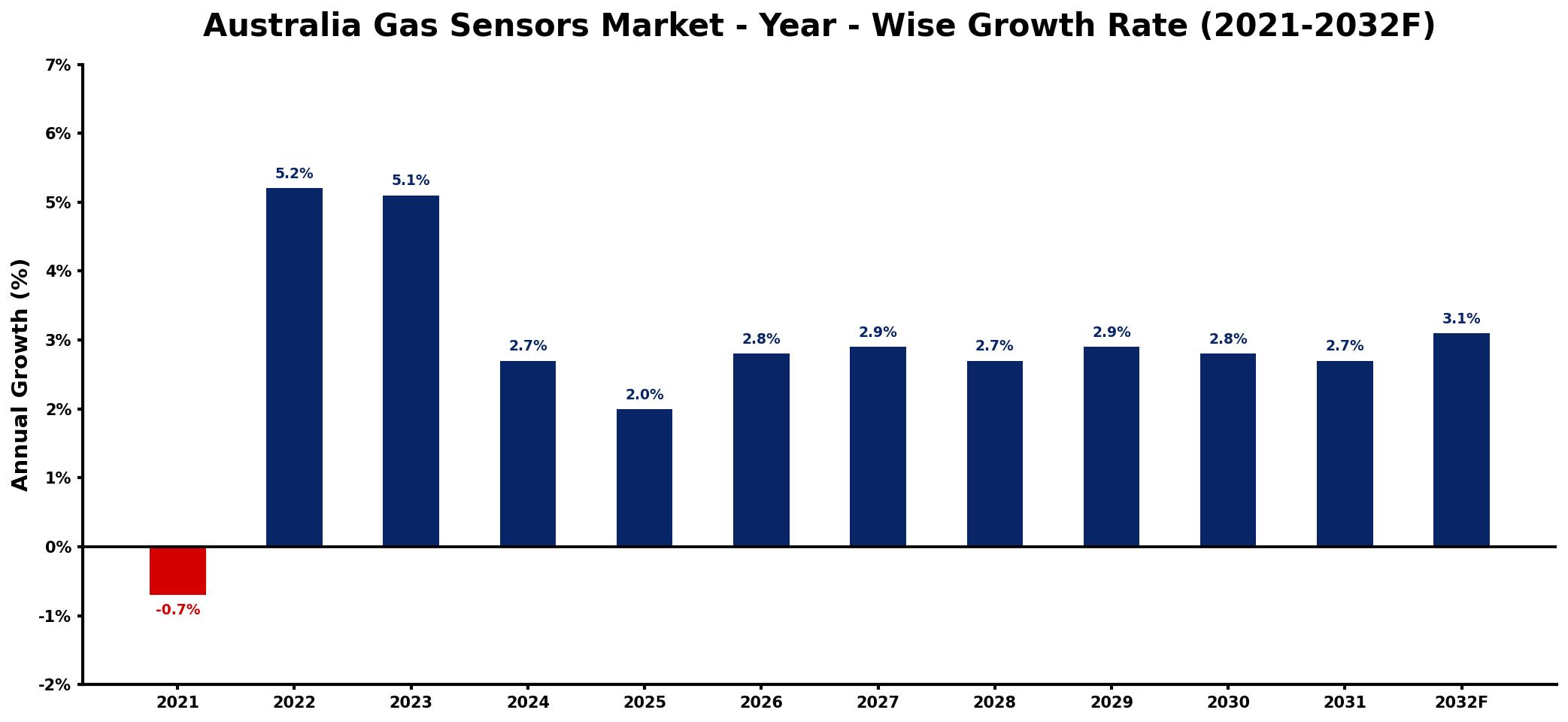
The table below presents the year‑wise growth rates along with the key drivers influencing the market
| Year | Growth Rate | Major Drivers |
| 2021 | -0.7% | decrease in industrial investments |
| 2022 | 5.2% | rise in environmental regulations |
| 2023 | 5.1% | increased focus on safety standards |
| 2024 | 2.7% | growing adoption of automation technologies |
| 2025 | 2.0% | expansion of energy efficiency initiatives |
| 2026 | 2.8% | increased funding for research projects |
| 2027 | 2.9% | surge in public health awareness |
| 2028 | 2.7% | development of smart city infrastructure |
| 2029 | 2.9% | growing demand for emissions monitoring |
| 2030 | 2.8% | increased integration of IoT solutions |
| 2031 | 2.7% | increased domestic production output |
| 2032 | 3.1% | enhanced regulatory compliance requirements |
Note: Market size estimations and growth projections presented in this report are based on 6Wresearch's proprietary forecasting methodology, utilizing the latest available industry data, government publications, and primary research inputs.
Australia Gas Sensors Market Synopsis
The primary force shaping the Australia Gas Sensors Market today is stringent regulatory frameworks aimed at enhancing workplace safety and environmental compliance. With rising concerns surrounding air quality and health risks, the market is experiencing a significant uptick in demand for innovative gas monitoring solutions.
Additionally, advancements in sensor technology, such as miniaturization and the integration of Internet of Things (IoT) capabilities, are transforming how data is collected and analyzed. This evolution supports real-time monitoring, thereby improving decision-making processes across various applications.
Australia Gas Sensors Market Key Takeaways
- The market is projected to grow steadily with a CAGR of 2.4%, reaching USD 204 Million by 2032.
- Stringent government regulations significantly influence market demand, particularly in industrial settings.
- Technological advancements in sensor miniaturization and connectivity are enhancing application performance.
- The healthcare sector is increasingly adopting gas sensors for air quality monitoring and patient safety.
- Environmental monitoring applications are being prioritized in response to rising pollution concerns.
Evaluation of Restraints in Australia Gas Sensors Market
Despite the favorable growth landscape, the Australia Gas Sensors Market faces specific limitations that could hinder its progression. Issues surrounding sensor accuracy and the need for regular calibration can deter potential users, particularly in critical applications where precision is paramount. Furthermore, environmental factors such as temperature and humidity can affect sensor performance and longevity. Addressing these challenges through innovative designs and robust maintenance protocols is crucial for enhancing user confidence and overall market acceptance.
Australia Gas Sensors Market Trends
A notable trend within the Australia Gas Sensors Market is the increasing incorporation of AI and machine learning algorithms into gas monitoring systems. These technologies allow for improved predictive maintenance and anomaly detection, providing users with deeper insights into air quality and gas emissions. Furthermore, the shift towards sustainable practices is prompting industries to invest in more sophisticated gas sensors, further solidifying their commitment to environmental stewardship and compliance with regulations.
Australia Gas Sensors Market Opportunities
There are substantial growth opportunities in the Australia Gas Sensors Market, particularly in the realm of IoT integration and smart city developments. As urbanization continues to rise, the demand for intelligent environmental monitoring solutions will grow. Companies that invest in R&D to create multifunctional sensors that can seamlessly connect with existing building management systems will find themselves at a competitive advantage. Additionally, new applications in the automotive sector, focusing on emissions control, present further avenues for expansion.
Government Initiatives in the Australia Gas Sensors Market
The Australian government is actively involved in regulating the gas sensors market to ensure that public health and environmental standards are met. Initiatives may include the establishment of strict product testing and certification standards to enhance reliability and safety. Additionally, government bodies are expected to promote research and development in sensor technologies, facilitating advancements that align with emerging environmental challenges. Public spending on infrastructure improvements, particularly in urban areas, is also likely to boost demand for sophisticated gas monitoring solutions.
Future Insights of the Australia Gas Sensors Market
Looking ahead to the period from 2026 to 2032, the Australia Gas Sensors Market is set to evolve significantly. Driven by continued technological advancements and a growing regulatory environment, market players will need to adapt to increasingly complex customer demands. The push for sustainability will foster innovations that emphasize energy efficiency and reduced environmental impact. As real-time monitoring becomes the norm, companies that leverage data analytics and AI will be well-positioned to thrive in this dynamic market landscape.
Australia Gas Sensors Market Latest Developments (2025 - 2026)
Recent developments in the Australia Gas Sensors Market reflect a strong focus on enhancing sensor technologies and improving user accessibility. Industry stakeholders are increasingly pursuing collaborative research initiatives aimed at creating next-generation gas sensors that can operate in challenging environments. Additionally, the rise of smart building initiatives is catalyzing investments in integrated solutions, enabling seamless monitoring of air quality across various applications.
Australia Gas Sensors Market - Key Attractiveness of the Report
- 10 Years of Market Numbers
- Historical Data Starting from 2022 to 2025
- Base Year: 2025
- Forecast Data until 2032
- Key Performance Indicators Impacting the Market
- Major Upcoming Developments and Projects
Key Highlights of the Report:
- Australia Gas Sensors Market Outlook
- Market Size of Australia Gas Sensors Market, 2025
- Forecast of Australia Gas Sensors Market, 2032
- Historical Data and Forecast of Australia Gas Sensors Revenues & Volume for the Period 2022-2032F
- Australia Gas Sensors Market Trend Evolution
- Australia Gas Sensors Market Drivers and Challenges
- Australia Gas Sensors Price Trends
- Australia Gas Sensors Porter's Five Forces
- Australia Gas Sensors Industry Life Cycle
- Historical Data and Forecast of Australia Gas Sensors Market Revenues & Volume By Product for the Period 2022-2032F
- Historical Data and Forecast of Australia Gas Sensors Market Revenues & Volume By Hydrogen for the Period 2022-2032F
- Historical Data and Forecast of Australia Gas Sensors Market Revenues & Volume By Ammonia for the Period 2022-2032F
- Historical Data and Forecast of Australia Gas Sensors Market Revenues & Volume By Hydrogen Sulfide for the Period 2022-2032F
- Historical Data and Forecast of Australia Gas Sensors Market Revenues & Volume By Methyl Mercaptan Sensor for the Period 2022-2032F
- Historical Data and Forecast of Australia Gas Sensors Market Revenues & Volume By NOx Sensor for the Period 2022-2032F
- Historical Data and Forecast of Australia Gas Sensors Market Revenues & Volume By Carbon Monoxide Sensor for the Period 2022-2032F
- Historical Data and Forecast of Australia Gas Sensors Market Revenues & Volume By Carbon Dioxide Sensor for the Period 2022-2032F
- Historical Data and Forecast of Australia Hydrogen Gas Sensors Market Revenues & Volume By Oxygen/Lambda Sensor for the Period 2022-2032F
- Historical Data and Forecast of Australia Gas Sensors Market Revenues & Volume By Technology for the Period 2022-2032F
- Historical Data and Forecast of Australia Gas Sensors Market Revenues & Volume By Infrared for the Period 2022-2032F
- Historical Data and Forecast of Australia Gas Sensors Market Revenues & Volume By Catalytic for the Period 2022-2032F
- Historical Data and Forecast of Australia Gas Sensors Market Revenues & Volume By Photo-Ionization Detector for the Period 2022-2032F
- Historical Data and Forecast of Australia Gas Sensors Market Revenues & Volume By Solid State/MOS for the Period 2022-2032F
- Historical Data and Forecast of Australia Gas Sensors Market Revenues & Volume By Semiconductor for the Period 2022-2032F
- Historical Data and Forecast of Australia Gas Sensors Market Revenues & Volume By Electrochemical for the Period 2022-2032F
- Australia Gas Sensors Import Export Trade Statistics
- Market Opportunity Assessment By Product
- Market Opportunity Assessment By Technology
- Australia Gas Sensors Top Companies Market Share
- Australia Gas Sensors Competitive Benchmarking By Technical and Operational Parameters
- Australia Gas Sensors Company Profiles
- Australia Gas Sensors Key Strategic Recommendations






































