Australia Hair Care Market: Import Trend Analysis
In the Australia hair care market, the import trend showed a notable growth rate of 9.12% from 2023 to 2024, with a compound annual growth rate (CAGR) of 6.13% from 2020 to 2024. This import momentum can be attributed to shifting consumer preferences towards premium hair care products, indicating a sustained demand shift towards higher quality imports in the market.
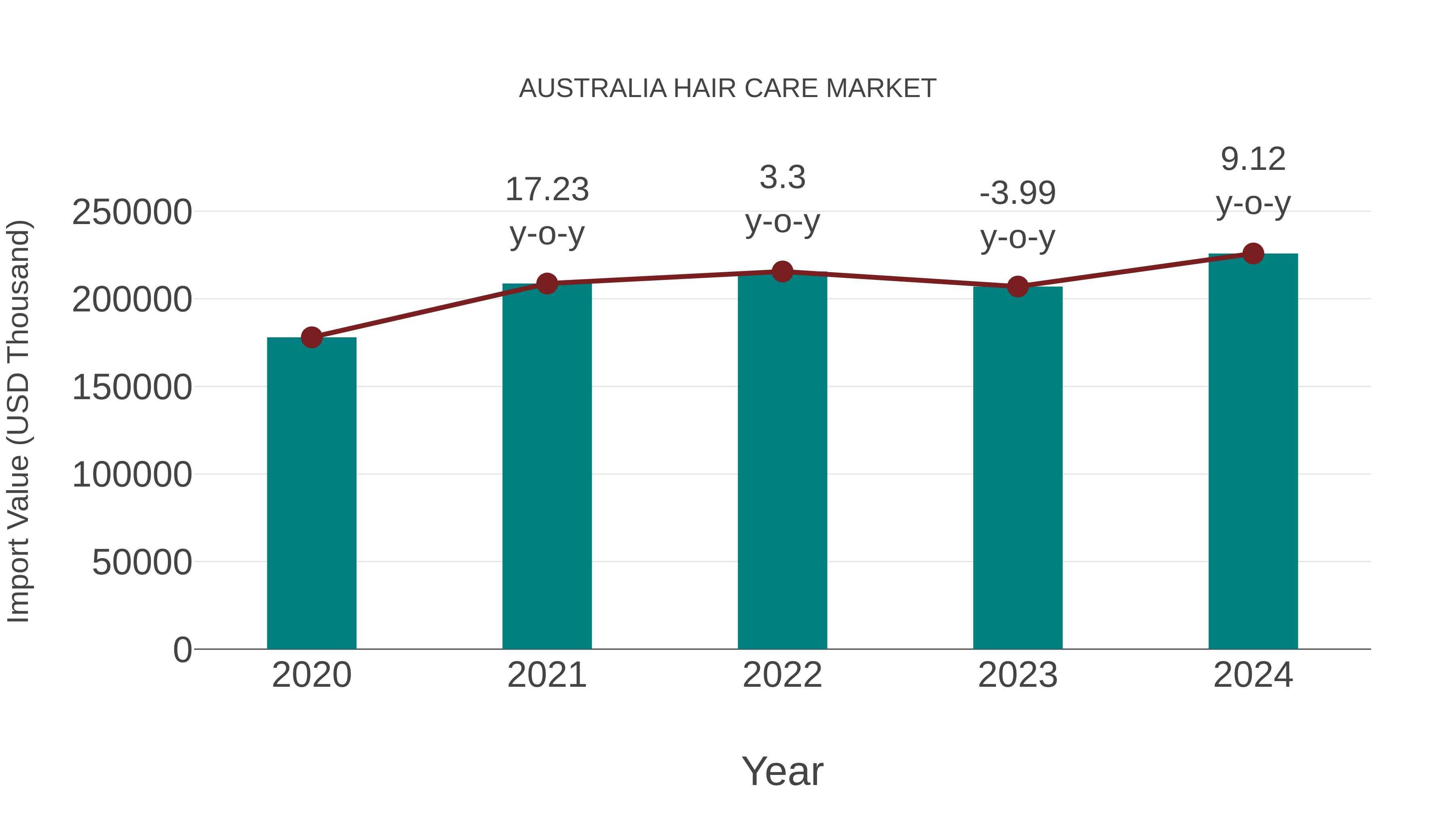
Australia Hair Care Market Growth Rate
According to 6Wresearch internal database and industry insights, the Australia Hair Care Market is predicted to expand at a significant compound annual growth rate (CAGR) of 6.9% during the forecast period 2025-2031, driven by focus on Scalp Health, Technological Advancements, Brand Competition and Innovation.
Topics Covered in the Australia Hair Care Market Report
The Australia Hair Care Market report thoroughly covers the market by Type, Product Type, and Distribution Channel. The report provides a detailed analysis of ongoing market trends, opportunities/high-growth areas, and market drivers that will help stakeholders devise and align strategies according to current and future market dynamics.
Australia Hair Care Market Highlights
| Report Name | Australia Hair Care Market |
| Forecast Period | 2025-2031 |
| CAGR | 6.9% |
| Growing Sector | Online retail |
Topics Covered in the Australia Hair Care Market Report
The Australia Hair Care Market report thoroughly covers the market by Product Type and by Distribution channel. The market report provides an unbiased and detailed analysis of the ongoing market trends, opportunities/high growth areas, and market drivers which would help the stakeholders to devise and align their market strategies according to the current and future market dynamics.
Australia Hair Care Market Synopsis
The Australia Hair Care Market growth is estimated to surge in the coming years, and this is due to rising consumer awareness around hair care, alongside growing demand for natural, organic, and plant-based hair products. There is an increasing disposable income and the trend towards premium and specialized hair care solutions, which are propelling market growth. Along with this, advancements in hair care product formulations and the rise of e-commerce have expanded consumer access to a wide range of products and services.
Evaluation of Growth Drivers in the Australia Hair Care Market
Below are some prominent drivers and their influence on the market dynamics:
| Drivers | Primary Segments Affected | Why it Matters |
| Increase in Consumer Awareness | By Product Type (Shampoo, Hair Color, Conditioner) | The demand for high-quality and specialized products is increasing as consumers are becoming more informed about hair care. |
| Demand for Natural and Organic Products | By Product Type (Shampoo, Conditioner, Hair Oil) | The demand for organic and natural hair care solutions is on the rise as consumers prefer for chemical-free products. |
| Rise in Online Shopping | By Distribution Channel (Online Stores, Direct Selling) | Online platforms provide convenience, driving growth in the retail sector. |
| Focus on Sustainable Packaging | By Product Type (Hair Care Products) | With growing environmental concerns, sustainable packaging increases interest in eco-friendly brands. |
| Expansion of Premium Hair Care Products | By Product Type (Hair Styling Products, Hair Oil, Hair Gel) | Consumers are inclination toward premium products for better quality and targeted solutions like hair growth and repair. |
The Australia Hair Care Market is projected to grow at a CAGR of 6.9% during the forecast period (2026–2032), driven by the demand for natural, organic products, the increasing popularity of premium hair care solutions, and the ongoing trend of e-commerce expansion. Besides this, the rise in disposable incomes, as well as greater access to a variety of hair care brands through both retail and online channels, has expanded consumer choices and encouraged product experimentation. Innovations in hair care formulations, focusing on specific needs like damage repair and hair growth, are likely to leave a positive influence on the Australia Hair Care Market growth.
Evaluation of Restraints in the Australia Hair Care Market
Below are some prominent restraints and their influence on the market dynamics:
| Challenges | Primary Segments Affected | Why it Matters |
| High Competition | By Product Type (Shampoo, Hair Color, Hair Styling Products) | With numerous local and international brands, there is high pricing pressure and differentiation challenges. |
| Price Sensitivity | By Product Type (Premium Hair Care Products) | There is a growing demand for premium products, which may be inhibited by price sensitivity. |
| Supply Chain and Distribution Challenges | By Distribution Channel (Online Stores, Hypermarkets) | Logistic issues in global supply chains may affect product availability. |
| Allergic Reactions to Ingredients | By Product Type (Shampoo, Hair Color) | The use of certain chemicals in hair products can result in allergic reactions, negatively affecting market demand. |
Australia Hair Care Market Challenges
Despite the positive outlook for the Australia Hair Care Market, here are some major challenges that need to be addressed. Such as high competition, price sensitivity, and potential allergic reactions to certain hair care ingredients. Furthermore, the market may experience logistical and supply chain issues as demand grows, which affect both product availability and costs. Overcoming these issues will require innovative product differentiation, effective supply chain management, and increased consumer education.
Australia Hair Care Market Trends
Below mentioned are some major trends that are influencing the Australia Hair Care Market growth:
- Increase in Demand for Natural and Organic Products: Consumers prefer organic hair care solutions, as they look for natural alternatives that are gentler on the hair and scalp.
- Sustainability Focus: Brands are now investing in packaging innovations, such as recyclable and eco-friendly materials, to cater environmentally conscious consumer in the country.
- Customization of Hair Care Solutions: Personalized hair care products are being designed to address specific needs (e.g., hair growth, color care, damage repair).
Investment Opportunities in the Australia Hair Care Market
Below mentioned are some key investment opportunities:
- Product Innovation: Developing new products such as hair growth solutions, vegan shampoos, and hair colorants with less chemical content, present prominent opportunity for new investors.
- Expansion in Online Retail: The expanding e-commerce platforms create significant opportunities for expanding sales through online platforms, offering convenience and access to a wide variety of products.
- Premium Product Development: There is a rise in the development of premium products that are targeting niche needs like hair loss treatments, anti-aging solutions, and scalp care.
Top 5 Leading Players in the Australia Hair Care Market
Below is the list of prominent companies leading the Australia Hair Care Market:
1. Unilever
| Company Name | Unilever |
|---|---|
| Established Year | 1929 |
| Headquarters | Sydney, Australia |
| Official Website | Click Here |
Unilever offers a wide range of hair care products under brands like Dove, TRESemmé, and Sunsilk, catering to both premium and mass-market segments.
2. Procter & Gamble (P&G)
| Company Name | Procter & Gamble (P&G) |
|---|---|
| Established Year | 1837 |
| Headquarters | Sydney, Australia |
| Official Website | Click Here |
P&G’s hair care portfolio includes popular brands such as Pantene, Herbal Essences, and Head & Shoulders, offering products across various segments.
3. L'Oréal
| Company Name | L'Oréal |
|---|---|
| Established Year | 1909 |
| Headquarters | Paris, France (Australia Office: Sydney) |
| Official Website | Click Here |
L'Oréal is a major player in the Australian hair care market, with a strong focus on premium hair care solutions and a commitment to innovation.
4. Shiseido
| Company Name | Shiseido |
|---|---|
| Established Year | 1872 |
| Headquarters | Tokyo, Japan (Australia Office: Melbourne) |
| Official Website | Click Here |
Shiseido offers high-quality hair care solutions with a focus on premium products, scalp care, and anti-aging formulations.
5. The Body Shop
| Company Name | The Body Shop |
|---|---|
| Established Year | 1976 |
| Headquarters | Sydney, Australia |
| Official Website | Click Here |
The Body Shop specializes in eco-friendly and natural hair care products, offering a wide range of shampoos, conditioners, and hair treatments.
Government Rules Introduced in the Australia Hair Care Market
According to Australian government data, here are some regulatory frameworks that focus on product safety and environmental standards for cosmetics and personal care products. Such authorities and schemes are, the Australian Competition and Consumer Commission (ACCC) and the National Industrial Chemicals Notification and Assessment Scheme (NICNAS), which enforce labeling laws to ensure consumer protection as well as oversee the safety of chemicals used in hair care products. These government actions support market transparency and make sure that hair care products are safe for consumers.
Future Insights of the Australia Hair Care Market
The Australia Hair Care Market share is estimated to increase in the coming years as it will be driven by some major factors, such as innovations in product formulations, an increase in the demand for natural and organic products, and the rise in online shopping. There is a rising shift toward premium products, as well as a focus on sustainability and eco-friendly packaging, which is likely to improve the market’s potential. Aside from that, advancements in personalized hair care solutions and the growing trend of scalp health will present new opportunities for market expansion.
Market Segmentation Analysis
The report offers a comprehensive study of the following market segments and their leading categories:
By Type – Product to Lead the Market
The Product category is projected to lead, driven by the growing variety of hair care products including shampoos, conditioners, hair oils, and styling products that cater to specific consumer needs.
By Product Type – Shampoo to Lead the Market
According to Harshita, Senior Research Analyst, 6Wresearch, the Shampoo category is likely to lead the market, with consumers are having a strong demand for cleansing and nourishing solutions across various hair types.
By Distribution Channel – Online Stores to Lead the Market
Online Stores are likely to lead the distribution landscape. This growth is supported by a rise of e-commerce and increased preference for shopping convenience among consumers.
Key Attractiveness of the Report
- 10 Years of Market Numbers
- Historical Data Starting from 2022 to 2025
- Base Year: 2025
- Forecast Data until 2032
- Key Performance Indicators Impacting the Market
- Major Upcoming Developments and Projects
Key Highlights of the Report:
- Australia Hair Care Market Overview
- Australia Hair Care Market Outlook
- Market Size of Australia Hair Care Market, 2025
- Forecast of Australia Hair Care Market, 2032
- Historical Data and Forecast of Australia Hair Care Revenues & Volume for the Period 2022-2032
- Australia Hair Care Market Trend Evolution
- Australia Hair Care Market Drivers and Challenges
- Australia Hair Care Price Trends
- Australia Hair Care Porter's Five Forces
- Australia Hair Care Industry Life Cycle
- Historical Data and Forecast of Australia Hair Care Market Revenues & Volume By Type for the Period 2022-2032
- Historical Data and Forecast of Australia Hair Care Market Revenues & Volume By Product for the Period 2022-2032
- Historical Data and Forecast of Australia Hair Care Market Revenues & Volume By Services for the Period 2022-2032
- Historical Data and Forecast of Australia Hair Care Market Revenues & Volume By Product Type for the Period 2022-2032
- Historical Data and Forecast of Australia Hair Care Market Revenues & Volume By Shampoo for the Period 2022-2032
- Historical Data and Forecast of Australia Hair Care Market Revenues & Volume By Hair Colour for the Period 2022-2032
- Historical Data and Forecast of Australia Hair Care Market Revenues & Volume By Conditioner for the Period 2022-2032
- Historical Data and Forecast of Australia Hair Care Market Revenues & Volume By Hair Styling Product for the Period 2022-2032
- Historical Data and Forecast of Australia Hair Care Market Revenues & Volume By Hair Oil for the Period 2022-2032
- Historical Data and Forecast of Australia Hair Care Market Revenues & Volume By Hair Spray for the Period 2022-2032
- Historical Data and Forecast of Australia Hair Care Market Revenues & Volume By Hair Gel for the Period 2022-2032
- Historical Data and Forecast of Australia Hair Care Market Revenues & Volume By Others for the Period 2022-2032
- Historical Data and Forecast of Australia Hair Care Market Revenues & Volume By Distribution Channel for the Period 2022-2032
- Historical Data and Forecast of Australia Hair Care Market Revenues & Volume By Online Stores for the Period 2022-2032
- Historical Data and Forecast of Australia Hair Care Market Revenues & Volume By Hypermarkets for the Period 2022-2032
- Historical Data and Forecast of Australia Hair Care Market Revenues & Volume By Direct Selling for the Period 2022-2032
- Australia Hair Care Import Export Trade Statistics
- Market Opportunity Assessment By Type
- Market Opportunity Assessment By Product Type
- Market Opportunity Assessment By Distribution Channel
- Australia Hair Care Top Companies Market Share
- Australia Hair Care Competitive Benchmarking By Technical and Operational Parameters
- Australia Hair Care Company Profiles
- Australia Hair Care Key Strategic Recommendations
Market Covered
The report offers a comprehensive study of the subsequent market segments:
By Type
- Product
- Services
By Product Type
- Shampoo
- Hair Color
- Conditioner
- Hair Styling Product
- Hair Oil
- Hair Spray
- Hair Gel
- Others
By Distribution Channel
- Online Stores
- Hypermarkets
- Direct Selling






































