Australia Lighting equipment Market Summary
The australia lighting equipment market was estimated at USD 245 Million in 2025 and is projected to reach USD 288 Million by 2032, growing at a CAGR of 2.9% from 2026 to 2032.
Australia Lighting equipment Market Year-wise Growth Rate and Key Drivers
This graph highlights how the Australia Lighting equipment Market has steadily grown over the past five years, supported by major growth factors.
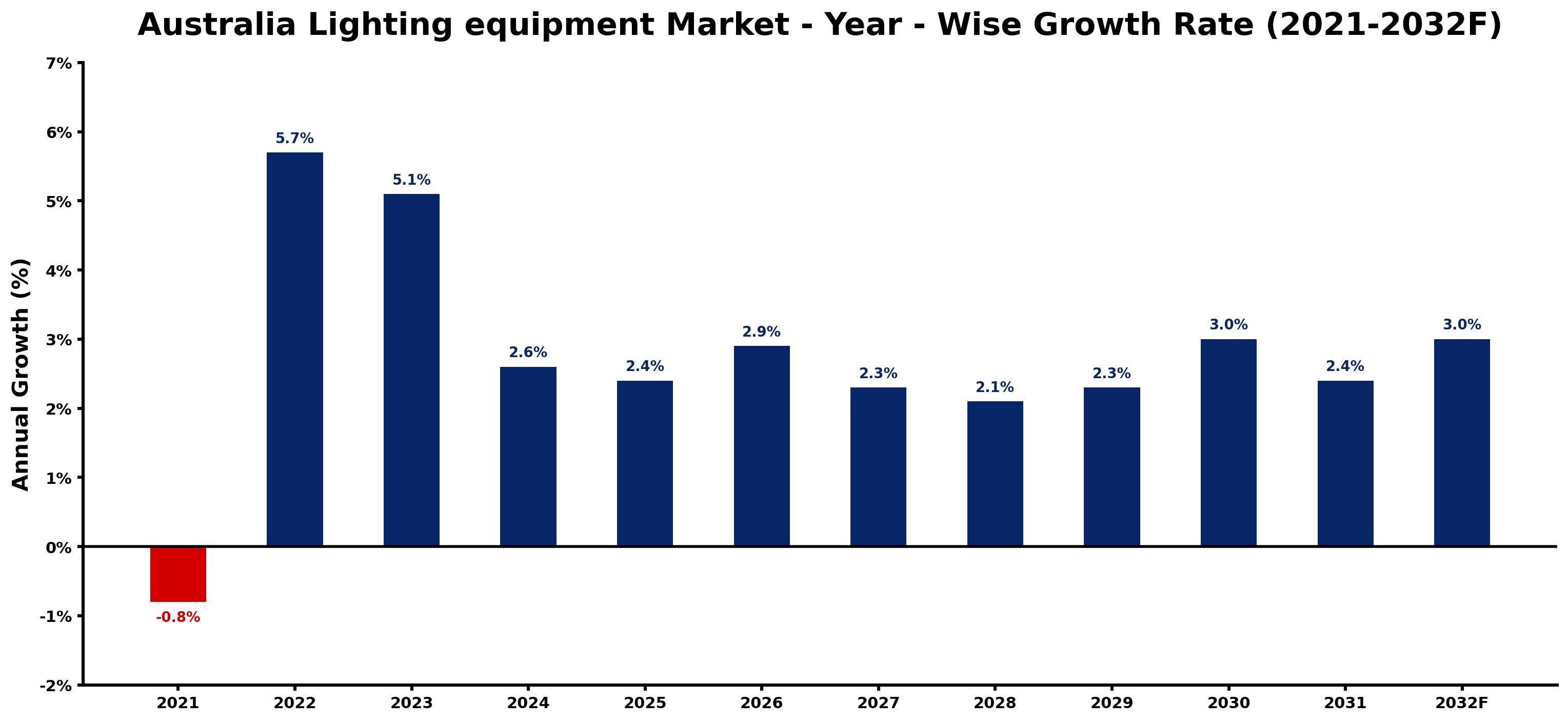
The table below presents the year wise growth rates along with the key drivers influencing the market
| Year | Growth Rate | Major Drivers |
| 2021 | -0.8% | Supply chain disruptions resulted in higher costs and limited availability of key components, hindering market growth. |
| 2022 | 5.7% | Increased awareness of energy efficiency shifted preferences towards LED technology integration. |
| 2023 | 5.1% | Corporate sustainability goals fueled investments in smart lighting solutions and automation. |
| 2024 | 2.6% | Architectural innovations in urban developments highlighted the importance of aesthetic lighting designs. |
| 2025 | 2.4% | Construction activity rebounded, necessitating advanced lighting systems for new infrastructure projects. |
| 2026 | 2.9% | Technological advancements in IoT and connectivity transformed traditional lighting into smart ecosystems. |
| 2027 | 2.3% | The hospitality sector's revival emphasized unique lighting experiences to enhance guest satisfaction. |
| 2028 | 2.1% | Expansion of renewable energy initiatives drove interest in solar-powered lighting solutions. |
| 2029 | 2.3% | Population growth in urban areas increased the demand for efficient public lighting systems. |
| 2030 | 3.0% | Regulatory shifts toward sustainable building practices influenced lighting product certifications and standards. |
| 2031 | 2.4% | Emerging trends in remote work necessitated innovative home office lighting solutions. |
| 2032 | 3.0% | Educational institutions prioritized advanced lighting for improved learning environments and productivity. |
Note - Market size estimations and growth projections presented in this report are based on 6Wresearch's advanced forecasting approach, validated with industry datasets as of June 2026.
Australia Lighting equipment Market Synopsis
The Australia Lighting equipment Market is projected to reach 2.9% and witness significant growth during the forecast period (2026-2032). This market encompasses a diverse array of lighting fixtures, lamps, and accessories tailored for residential, commercial, and industrial applications. As the emphasis on energy efficiency and design aesthetics intensifies, these lighting solutions are poised to enhance illumination quality and visual comfort across various environments.
Australia Lighting equipment Market Growth Drivers
The growth trajectory of the Australia lighting equipment market is significantly influenced by several driving factors, including:
- The rapid pace of urbanization, which necessitates the development of new residential and commercial properties, thereby increasing the demand for modern lighting solutions.
- Advancements in lighting technologies, particularly LED innovations, which offer energy efficiency and longer lifespan, are becoming increasingly appealing to consumers and businesses alike.
- The expanding construction industry that is keen on integrating energy-efficient lighting solutions into new building projects.
- Government initiatives encouraging the adoption of energy-efficient technologies are fostering a favorable environment for market growth.
- The rising consumer awareness regarding the benefits of sustainable lighting options is propelling demand for innovative and eco-friendly products.
Australia Lighting equipment Market Challenges and Restraints
While the Australia lighting equipment market is set for growth, several challenges may hinder its progress:
- The rapid evolution of technology, particularly in LED and smart lighting solutions, presents a challenge to manufacturers to continuously innovate and invest in research and development.
- Manufacturers face pressure to meet stringent sustainability requirements, including product lifecycle management and compliance with environmental regulations aimed at reducing carbon emissions.
- Fluctuations in market demand, influenced by economic conditions and changing consumer preferences, necessitate responsive strategies from producers to remain competitive.
- The significant capital investment required for new technology adoption and infrastructure improvements can be a barrier for smaller companies in the market.
- The complexity of integrating advanced technologies into existing systems may deter some businesses from upgrading their lighting solutions.
Australia Lighting equipment Market Trends and Opportunities
In the evolving landscape of the Australia lighting equipment market, several trends and opportunities are emerging:
- The focus on smart lighting solutions is gaining traction as consumers and businesses seek to leverage technology for improved energy management and user control.
- There is a noticeable shift towards sustainable and eco-friendly lighting products, correlating with global trends towards environmental responsibility.
- Advancements in connectivity options, such as IoT-enabled lighting, are paving the way for enhanced functionality and customization in lighting applications.
- Architectural lighting is becoming a critical aspect of design, driving demand for aesthetically pleasing and innovative lighting fixtures.
- The growth in the hospitality and retail sectors is fueling the need for unique lighting solutions to enhance customer experiences and brand aesthetics.
Australia Lighting equipment Market Government Investment and Initiatives
Government policies in Australia play a crucial role in shaping the landscape of the lighting equipment market. These policies focus on promoting energy efficiency through various initiatives:
- Implementation of energy efficiency standards that manufacturers must comply with to ensure their products are environmentally friendly and energy-saving.
- Incentives for businesses and households to transition towards LED and other energy-efficient lighting options, reducing overall environmental impact.
- Public spending on infrastructure projects often includes provisions for modern lighting systems that adhere to energy efficiency guidelines.
- Regulatory frameworks around product labeling facilitate informed consumer choices regarding energy consumption and performance.
- Support for research and development in sustainable lighting technologies through grants and funding for innovative projects within the industry.
Australia Lighting equipment Market Latest Developments (May 2025 - June 2026)
Recent developments in the Australia lighting equipment market have focused on technological advancements and shifts toward sustainability. Manufacturers are increasingly investing in R&D to enhance product performance, particularly in the realm of smart lighting and connectivity. Additionally, collaborations between technology firms and lighting manufacturers are emerging to drive innovation in smart lighting solutions. Sustainability initiatives are also gaining momentum, with several manufacturers adopting eco-friendly practices in their production processes. Furthermore, public awareness campaigns highlighting the benefits of energy-efficient lighting options are becoming more prevalent, influencing consumer purchasing decisions.
Australia Lighting equipment Market - Key Attractiveness of the Report
- 10 Years of Market Numbers
- Historical Data Starting from 2022 to 2025
- Base Year: 2025
- Forecast Data until 2032
- Key Performance Indicators Impacting the Market
- Major Upcoming Developments and Projects
Key Highlights of the Report:
- Australia Lighting equipment Market Outlook
- Market Size of Australia Lighting equipment Market, 2025
- Forecast of Australia Lighting equipment Market, 2032
- Historical Data and Forecast of Australia Lighting equipment Revenues & Volume for the Period 2022-2032F
- Australia Lighting equipment Market Trend Evolution
- Australia Lighting equipment Market Drivers and Challenges
- Australia Lighting equipment Price Trends
- Australia Lighting equipment Porter's Five Forces
- Australia Lighting equipment Industry Life Cycle
- Historical Data and Forecast of Australia Lighting equipment Market Revenues & Volume By ?Application for the Period 2022-2032F
- Historical Data and Forecast of Australia Lighting equipment Market Revenues & Volume By General Purpose Lighting for the Period 2022-2032F
- Historical Data and Forecast of Australia Lighting equipment Market Revenues & Volume By Vehicle/Automobile Lighting for the Period 2022-2032F
- Historical Data and Forecast of Australia Lighting equipment Market Revenues & Volume By Backlighting for the Period 2022-2032F
- Historical Data and Forecast of Australia Lighting equipment Market Revenues & Volume By Others? for the Period 2022-2032F
- Historical Data and Forecast of Australia Lighting equipment Market Revenues & Volume By Technology for the Period 2022-2032F
- Historical Data and Forecast of Australia Lighting equipment Market Revenues & Volume By Conventional Lighting/Non-Environment Friendly Lighting for the Period 2022-2032F
- Historical Data and Forecast of Australia Lighting equipment Market Revenues & Volume By Environment Friendly Lighting for the Period 2022-2032F
- Historical Data and Forecast of Australia Lighting equipment Market Revenues & Volume By SSL (Solid State Lighting) for the Period 2022-2032F
- Historical Data and Forecast of Australia Lighting equipment Market Revenues & Volume By LED (Light Emitting Diodes) for the Period 2022-2032F
- Historical Data and Forecast of Australia Lighting equipment Market Revenues & Volume By OLED (Organic Light Emitting Diodes) for the Period 2022-2032F
- Historical Data and Forecast of Australia Lighting equipment Market Revenues & Volume By PLED (Polymer Light Emitting Diodes)? for the Period 2022-2032F
- Historical Data and Forecast of Australia Lighting equipment Market Revenues & Volume By ?End Users for the Period 2022-2032F
- Historical Data and Forecast of Australia Lighting equipment Market Revenues & Volume By Industrial for the Period 2022-2032F
- Historical Data and Forecast of Australia Lighting equipment Market Revenues & Volume By Commercial for the Period 2022-2032F
- Historical Data and Forecast of Australia Lighting equipment Market Revenues & Volume By Others? for the Period 2022-2032F
- Australia Lighting equipment Import Export Trade Statistics
- Market Opportunity Assessment By ?Application
- Market Opportunity Assessment By Technology
- Market Opportunity Assessment By ?End Users
- Australia Lighting equipment Top Companies Market Share
- Australia Lighting equipment Competitive Benchmarking By Technical and Operational Parameters
- Australia Lighting equipment Company Profiles
- Australia Lighting equipment Key Strategic Recommendations






































