Australia Managed Services Market Size & Growth Rate (2026-2032)
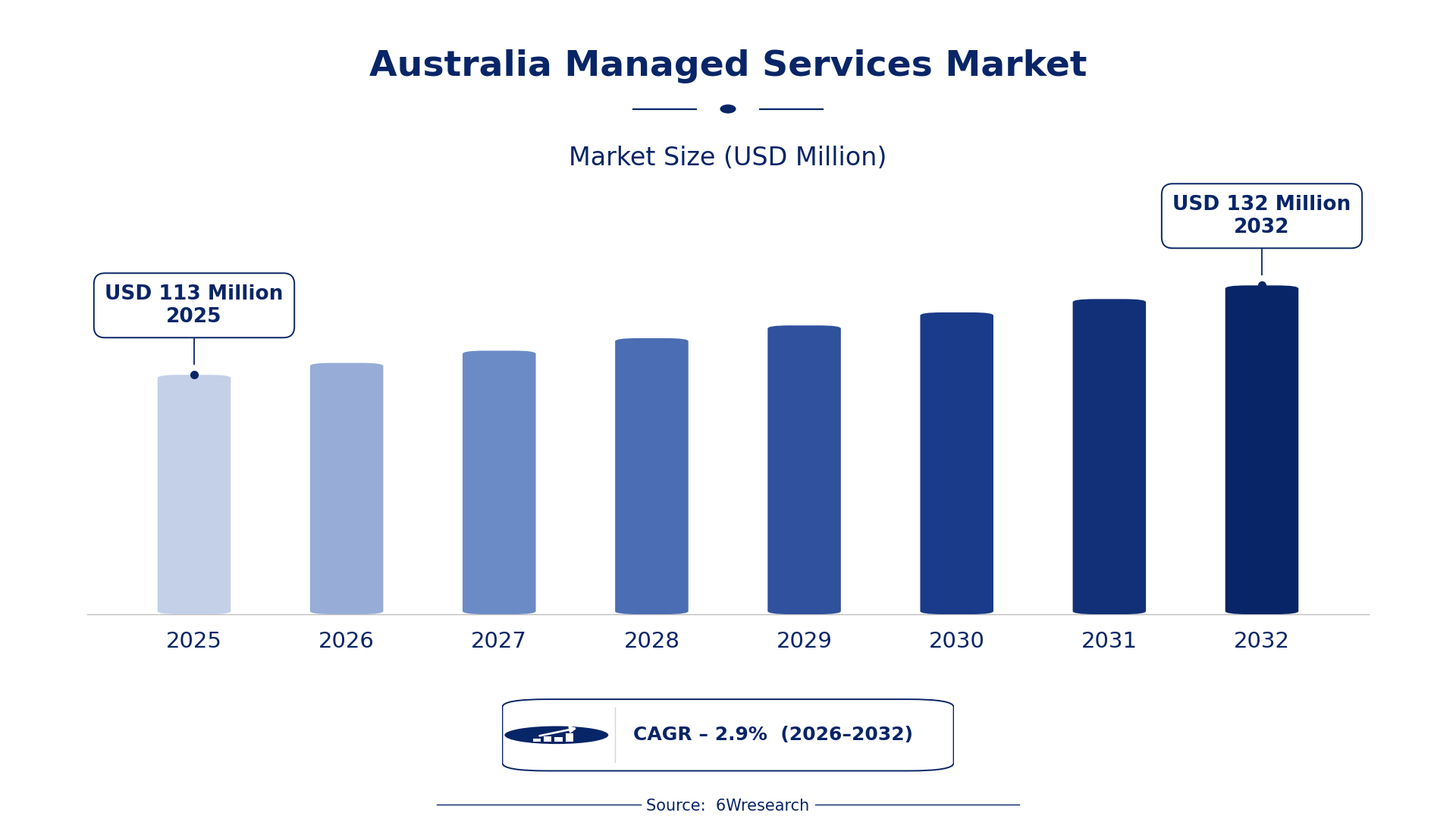
The Australia Managed Services Market was estimated at USD 113 Million in 2025 and is projected to reach USD 132 Million by 2032, growing at a CAGR of 2.9% from 2026 to 2032.
Australia Managed Services Market Synopsis
The increasing adoption of cloud computing is currently the strongest force shaping the Australia Managed Services Market. Organizations are recognizing the benefits of outsourcing their IT operations, enabling them to focus on core business activities while ensuring efficient service delivery.
As businesses face rising operational complexities and cyber threats, managed service providers (MSPs) are stepping in to offer tailored solutions. This shift not only optimizes operational efficiency but also addresses the growing demand for robust cybersecurity and IT infrastructure management.
Australia Managed Services Market Year-wise Growth Rate and Key Drivers
This graph illustrates the annual growth rates of the Australia Managed Services Market from 2021 to 2032, highlighting a steady upward trajectory and projected expansion over the forecast period.
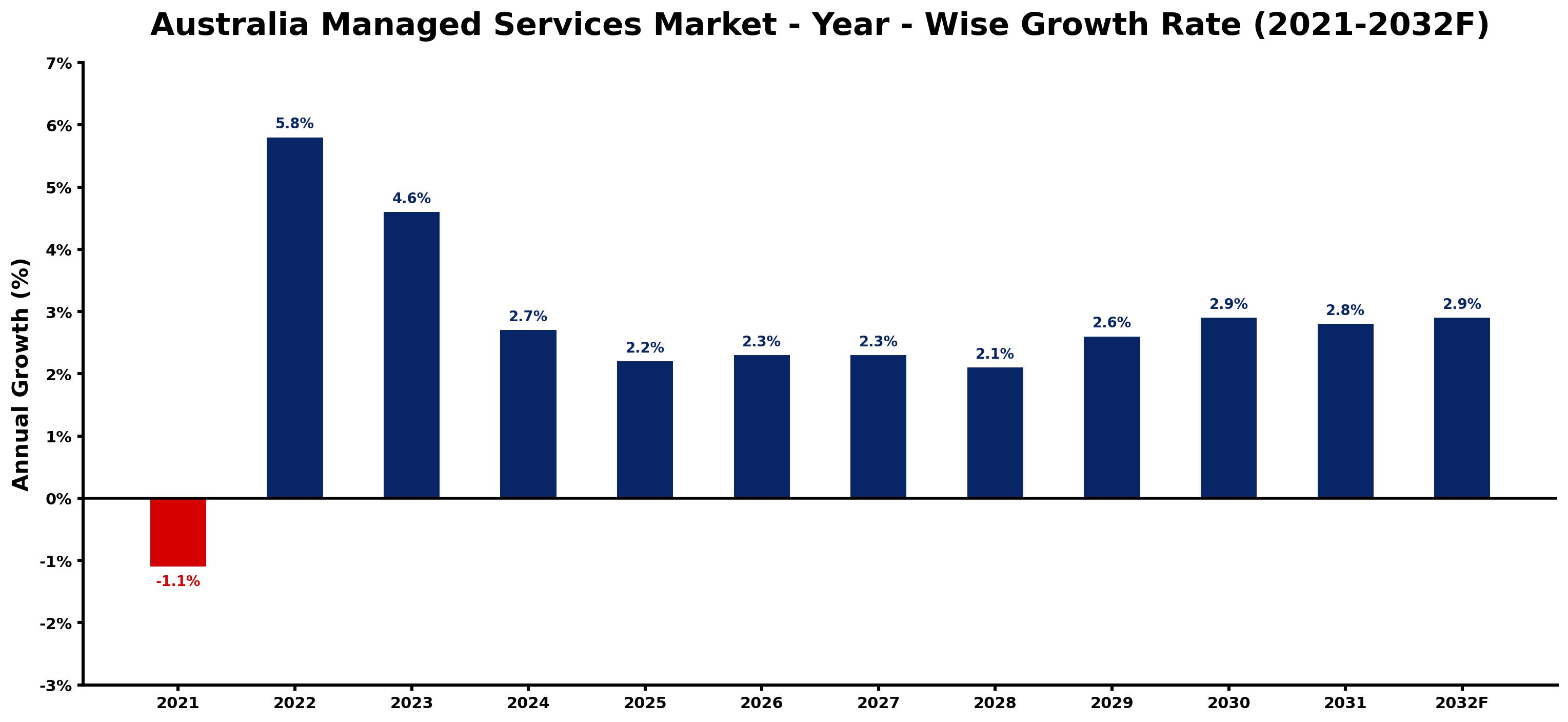
The table below presents the year‑wise growth rates along with the key drivers influencing the market
| Year | Growth Rate | Major Drivers |
| 2021 | -1.1% | COVID-19 lockdowns limited IT service demand in Australia |
| 2022 | 5.8% | Increased adoption of remote work driving IT support needs. |
| 2023 | 4.6% | Rise in SMEs opting for cloud-managed services solutions. |
| 2024 | 2.7% | Government incentives for small business tech upgrades. |
| 2025 | 2.2% | Focus on cybersecurity regulations spurring managed services demand. |
| 2026 | 2.3% | Growth of health sector digitalization boosting managed service contracts. |
| 2027 | 2.3% | Emergence of AI integration in business operations increasing outsourcing. |
| 2028 | 2.1% | Increased compliance regulations boosting demand for managed solutions. |
| 2029 | 2.6% | Expanding digital payment systems requiring enhanced IT support. |
| 2030 | 2.9% | Rising e-commerce trends driving managed logistics services needs. |
| 2031 | 2.8% | Local tech ecosystems fostering collaboration in managed services. |
| 2032 | 2.9% | Growing interest in sustainability prompting managed infrastructure services. |
Note: Market size estimations and growth projections presented in this report are based on 6Wresearch's proprietary forecasting methodology, utilizing the latest available industry data, government publications, and primary research inputs.
Australia Managed Services Market Key Takeaways
Below are some of the specific key takeaways from the market, including:
- The market is driven by the increasing need for efficient IT operations and cost optimization.
- Cloud computing adoption is a primary catalyst for growth in managed services.
- Market players are facing challenges due to pricing pressures and commoditization of services.
- Cybersecurity concerns are pushing organizations to seek managed services solutions.
- Government initiatives are shaping the regulatory environment for managed services.
Evaluation of Restraints in Australia Managed Services Market
The Australia Managed Services Market is grappling with several restraints that hinder its growth potential. Pricing pressures are a primary concern, as increased competition leads to commoditization of services. This trend forces providers to lower prices, affecting profit margins. on top of that, the rapid pace of technological advancements, particularly in artificial intelligence and automation, demands continuous investment in skills and infrastructure from service providers. Additionally, compliance with service level agreements (SLAs) and meeting evolving customer expectations poses ongoing challenges for many MSPs.
Australia Managed Services Market Trends
Several trends are currently shaping the Australia Managed Services Market. The shift towards remote work has accelerated the demand for cloud-based solutions and IT support services. Organizations are increasingly prioritizing cybersecurity, driving MSPs to enhance their offerings in this area. on top of that, the integration of automation tools within managed services is becoming more prevalent, streamlining operations and reducing manual intervention.
Australia Managed Services Market Opportunities
Looking ahead, the Australia Managed Services Market presents several growth opportunities. The continued expansion of cloud infrastructure offers a fertile ground for service providers to develop innovative solutions. Additionally, organizations looking to enhance operational efficiency and reduce costs are likely to increase their reliance on managed services. The focus on cybersecurity presents a lucrative avenue for MSPs to differentiate themselves through specialized offerings.
Government Initiatives in the Australia Managed Services Market
Government policy in Australia plays a crucial role in shaping the Managed Services Market. Regulatory frameworks around data protection, privacy, and industry standards are becoming more stringent, influencing how managed service providers operate. Public-sector priorities are increasingly aligned with digital transformation initiatives, which creates demand for managed services as organizations seek to modernize their operations.
- A recent initiative includes a regulatory framework introduced in 2025 mandating stricter compliance for data privacy among managed service providers.
- Currently, the government is overseeing a national digital infrastructure upgrade programme aimed at enhancing cybersecurity measures across all sectors.
- There are plans for a public-private partnership expected to roll out by 2028 to improve access to advanced IT solutions for small and medium enterprises.
- The Australia Cyber Security Centre (ACSC) is actively providing guidance to MSPs to ensure compliance with evolving security standards.
Future Insights of the Australia Managed Services Market
From 2026 to 2032, the Australia Managed Services Market is set to evolve significantly. As organizations increasingly prioritize digital transformation, the demand for managed services will likely rise. The growing complexity of IT environments will necessitate more robust solutions, pushing businesses to seek out specialized providers. Additionally, as cyber threats continue to escalate, the focus on cybersecurity within managed services will expand, presenting a substantial opportunity for growth.
Australia Managed Services Market Latest Developments
In the past year, the Australia Managed Services Market has experienced notable activity as providers adapt to new challenges and opportunities. The ongoing shift towards cloud solutions and enhanced cybersecurity measures has prompted many providers to upgrade their service offerings.
- A leading regional operator launched a new cybersecurity suite in early 2025, aimed at small to medium enterprises, enhancing their ability to fend off cyber threats.
- A major technology vendor is currently rolling out an AI-driven analytics platform that assists managed service providers in optimizing their service delivery and operations.
- A partnership between two prominent MSPs began in mid-2025, focusing on joint solutions for data compliance and security protocols.
- There is a planned expansion of a cloud service delivery network expected to begin in the second half of 2026, aimed at improving service accessibility for businesses across Australia.
Australia Managed Services Market - Key Attractiveness of the Report
- 10 Years of Market Numbers
- Historical Data Starting from 2022 to 2025
- Base Year: 2025
- Forecast Data until 2032
- Key Performance Indicators Impacting the Market
- Major Upcoming Developments and Projects
Key Highlights of the Report:
- Australia Managed Services Market Outlook
- Market Size of Australia Managed Services Market, 2025
- Forecast of Australia Managed Services Market, 2032
- Historical Data and Forecast of Australia Managed Services Revenues & Volume for the Period 2022-2032F
- Australia Managed Services Market Trend Evolution
- Australia Managed Services Market Drivers and Challenges
- Australia Managed Services Price Trends
- Australia Managed Services Porter's Five Forces
- Australia Managed Services Industry Life Cycle
- Historical Data and Forecast of Australia Managed Services Market Revenues & Volume By Service Type for the Period 2022-2032F
- Historical Data and Forecast of Australia Managed Services Market Revenues & Volume By Managed Security Services for the Period 2022-2032F
- Historical Data and Forecast of Australia Managed Services Market Revenues & Volume By Managed Network Services for the Period 2022-2032F
- Historical Data and Forecast of Australia Managed Services Market Revenues & Volume By Managed Data Center and IT Infrastructure Services for the Period 2022-2032F
- Historical Data and Forecast of Australia Managed Services Market Revenues & Volume By Managed Communication and Collaboration Services for the Period 2022-2032F
- Historical Data and Forecast of Australia Managed Services Market Revenues & Volume By Managed Mobility Services for the Period 2022-2032F
- Historical Data and Forecast of Australia Managed Services Market Revenues & Volume By Managed Information Services for the Period 2022-2032F
- Historical Data and Forecast of Australia Managed Services Market Revenues & Volume By Deployment Type for the Period 2022-2032F
- Historical Data and Forecast of Australia Managed Services Market Revenues & Volume By Cloud for the Period 2022-2032F
- Historical Data and Forecast of Australia Managed Services Market Revenues & Volume By On-Premises for the Period 2022-2032F
- Historical Data and Forecast of Australia Managed Services Market Revenues & Volume By Organization Size for the Period 2022-2032F
- Historical Data and Forecast of Australia Managed Services Market Revenues & Volume By Small and Medium-sized Enterprises (SMEs) for the Period 2022-2032F
- Historical Data and Forecast of Australia Managed Services Market Revenues & Volume By Large Enterprises for the Period 2022-2032F
- Historical Data and Forecast of Australia Managed Services Market Revenues & Volume By Vertical for the Period 2022-2032F
- Historical Data and Forecast of Australia Managed Services Market Revenues & Volume By BFSI for the Period 2022-2032F
- Historical Data and Forecast of Australia Managed Services Market Revenues & Volume By IT and Telecom for the Period 2022-2032F
- Historical Data and Forecast of Australia Managed Services Market Revenues & Volume By Retail and Consumer Goods for the Period 2022-2032F
- Historical Data and Forecast of Australia Managed Services Market Revenues & Volume By Manufacturing for the Period 2022-2032F
- Historical Data and Forecast of Australia Managed Services Market Revenues & Volume By Government for the Period 2022-2032F
- Historical Data and Forecast of Australia Managed Services Market Revenues & Volume By Healthcare and Life Sciences for the Period 2022-2032F
- Historical Data and Forecast of Australia Managed Services Market Revenues & Volume By Energy and Utilities for the Period 2022-2032F
- Historical Data and Forecast of Australia Managed Services Market Revenues & Volume By Media and Entertainment for the Period 2022-2032F
- Australia Managed Services Import Export Trade Statistics
- Market Opportunity Assessment By Service Type
- Market Opportunity Assessment By Deployment Type
- Market Opportunity Assessment By Organization Size
- Market Opportunity Assessment By Vertical
- Australia Managed Services Top Companies Market Share
- Australia Managed Services Competitive Benchmarking By Technical and Operational Parameters
- Australia Managed Services Company Profiles
- Australia Managed Services Key Strategic Recommendations






































