Australia Methyl Cellulose Market: Import Trend Analysis
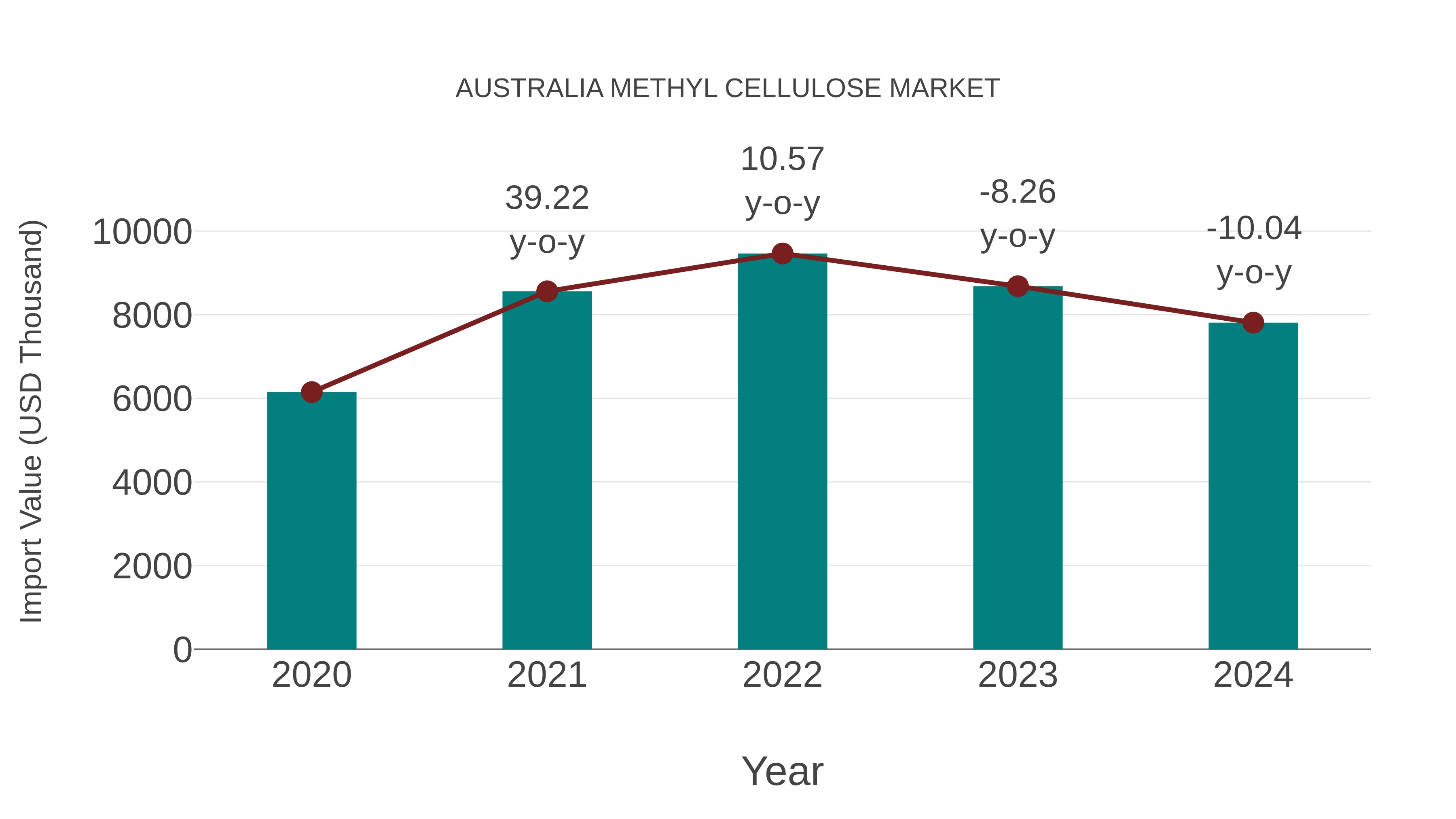
Australia`s import trend for methyl cellulose in 2024 experienced a decline, with a growth rate of -10.04% compared to the previous year. However, the compound annual growth rate (CAGR) for the period 2020-2024 stood at a positive 6.17%. This decline in import momentum in 2024 could be attributed to shifting demand patterns or changes in market dynamics impacting Australia`s methyl cellulose sector.
Australia Methyl Cellulose Market Overview
The Australia methyl cellulose market is experiencing steady growth driven by its versatile applications across various industries such as food and beverages, pharmaceuticals, construction, and personal care. Methyl cellulose, a derivative of cellulose, is widely used as a thickener, stabilizer, and emulsifier in food products, as well as in pharmaceutical formulations due to its non-toxic and hypoallergenic properties. In the construction industry, methyl cellulose is utilized in dry mix mortars, tile adhesives, and plasters for better workability and water retention. The increasing demand for natural and sustainable ingredients in consumer products is further fueling the market growth. Key players in the Australia methyl cellulose market include Shin-Etsu Chemical Co., Ltd., DowDuPont Inc., Ashland Global Holdings Inc., and LOTTE Fine Chemical.
Australia Methyl Cellulose Market Trends
Currently, the Australia methyl cellulose market is experiencing growth driven by several key trends. One major trend is the increasing demand for methyl cellulose in the food industry, particularly in gluten-free products as a thickening agent and stabilizer. Additionally, the construction sector is driving demand for methyl cellulose in Australia due to its use in dry mix mortars and cement-based products for its water retention properties and improved workability. The pharmaceutical industry is also contributing to the growth of the market with the use of methyl cellulose in various formulations such as ophthalmic solutions and oral medications. Sustainability and eco-friendly solutions are becoming more important in the market, leading to a rising interest in plant-based methyl cellulose products. Overall, the Australia methyl cellulose market is poised for continued growth in various sectors.
Australia Methyl Cellulose Market Challenges
In the Australian methyl cellulose market, some challenges faced include increasing competition from alternative products, fluctuating prices of raw materials, and regulatory changes impacting the industry. The demand for eco-friendly and sustainable products has led to the development of substitutes that offer similar functionalities as methyl cellulose, posing a threat to market share. Additionally, the volatility in the prices of key raw materials used in the production of methyl cellulose can impact profit margins and overall competitiveness. Moreover, regulatory changes related to environmental standards and safety regulations can require adjustments to manufacturing processes and formulations, increasing operational complexities for industry players. Adapting to these challenges by investing in research and development for innovative products and maintaining strong relationships with suppliers and regulatory bodies will be crucial for sustaining growth in the Australian methyl cellulose market.
Australia Methyl Cellulose Market Investment Opportunities
In the Australia methyl cellulose market, there are several investment opportunities worth considering. With the growing demand for methyl cellulose in industries such as construction, pharmaceuticals, and food & beverages, investing in companies involved in the production and distribution of methyl cellulose could be lucrative. Additionally, there is increasing interest in eco-friendly and sustainable products, making investments in companies that focus on environmentally-friendly production processes and packaging materials a promising avenue. Another potential opportunity lies in research and development of new applications for methyl cellulose, as its versatility and unique properties make it a valuable ingredient in various industries. Overall, investing in the Australia methyl cellulose market offers potential for growth and innovation in both traditional and emerging sectors.
Australia Methyl Cellulose Market Government Policy
The Australian government has not implemented specific policies targeting the methyl cellulose market. However, regulations regarding product safety, labeling, and manufacturing standards set by agencies such as the Australian Competition and Consumer Commission (ACCC) and the Therapeutic Goods Administration (TGA) apply to methyl cellulose products. Additionally, the Australian Pesticides and Veterinary Medicines Authority (APVMA) oversees the registration and regulation of agricultural and veterinary chemicals, including those containing methyl cellulose. Companies operating in the methyl cellulose market in Australia are required to comply with these regulations to ensure consumer safety and product quality. Overall, while there are no direct policies addressing the methyl cellulose market, existing regulations in related areas help govern the industry in Australia.
Australia Methyl Cellulose Market Future Outlook
The future outlook for the Australia methyl cellulose market appears promising, with steady growth anticipated in the coming years. The increasing demand for methyl cellulose in various industries such as food and beverages, pharmaceuticals, construction, and personal care is expected to drive market expansion. Additionally, the growing awareness regarding the benefits of methyl cellulose, such as its ability to act as a thickening agent, stabilizer, and emulsifier in various applications, is likely to further boost market demand. Factors such as technological advancements, product innovations, and the emphasis on sustainable and eco-friendly ingredients are also anticipated to contribute to the market`s positive outlook. Overall, the Australia methyl cellulose market is forecasted to experience sustained growth and offer lucrative opportunities for market players in the foreseeable future.
Key Highlights of the Report:
- Australia Methyl Cellulose Market Outlook
- Market Size of Australia Methyl Cellulose Market,2025
- Forecast of Australia Methyl Cellulose Market, 2032
- Historical Data and Forecast of Australia Methyl Cellulose Revenues & Volume for the Period 2022-2032F
- Australia Methyl Cellulose Market Trend Evolution
- Australia Methyl Cellulose Market Drivers and Challenges
- Australia Methyl Cellulose Price Trends
- Australia Methyl Cellulose Porter's Five Forces
- Australia Methyl Cellulose Industry Life Cycle
- Historical Data and Forecast of Australia Methyl Cellulose Market Revenues & Volume By Type for the Period 2022-2032F
- Historical Data and Forecast of Australia Methyl Cellulose Market Revenues & Volume By Powder for the Period 2022-2032F
- Historical Data and Forecast of Australia Methyl Cellulose Market Revenues & Volume By Granules for the Period 2022-2032F
- Historical Data and Forecast of Australia Methyl Cellulose Market Revenues & Volume By Liquid for the Period 2022-2032F
- Historical Data and Forecast of Australia Methyl Cellulose Market Revenues & Volume By Application for the Period 2022-2032F
- Historical Data and Forecast of Australia Methyl Cellulose Market Revenues & Volume By Pharmaceuticals for the Period 2022-2032F
- Historical Data and Forecast of Australia Methyl Cellulose Market Revenues & Volume By Food Additives for the Period 2022-2032F
- Historical Data and Forecast of Australia Methyl Cellulose Market Revenues & Volume By Coatings for the Period 2022-2032F
- Historical Data and Forecast of Australia Methyl Cellulose Market Revenues & Volume By End Use for the Period 2022-2032F
- Historical Data and Forecast of Australia Methyl Cellulose Market Revenues & Volume By Construction for the Period 2022-2032F
- Historical Data and Forecast of Australia Methyl Cellulose Market Revenues & Volume By Personal Care for the Period 2022-2032F
- Historical Data and Forecast of Australia Methyl Cellulose Market Revenues & Volume By Paper & Textiles for the Period 2022-2032F
- Historical Data and Forecast of Australia Methyl Cellulose Market Revenues & Volume By Purity Level for the Period 2022-2032F
- Historical Data and Forecast of Australia Methyl Cellulose Market Revenues & Volume By High Purity for the Period 2022-2032F
- Historical Data and Forecast of Australia Methyl Cellulose Market Revenues & Volume By Industrial Grade for the Period 2022-2032F
- Historical Data and Forecast of Australia Methyl Cellulose Market Revenues & Volume By Low Purity for the Period 2022-2032F
- Historical Data and Forecast of Australia Methyl Cellulose Market Revenues & Volume By Manufacturing Process for the Period 2022-2032F
- Historical Data and Forecast of Australia Methyl Cellulose Market Revenues & Volume By Etherification for the Period 2022-2032F
- Historical Data and Forecast of Australia Methyl Cellulose Market Revenues & Volume By Hydroxypropylation for the Period 2022-2032F
- Historical Data and Forecast of Australia Methyl Cellulose Market Revenues & Volume By Others for the Period 2022-2032F
- Australia Methyl Cellulose Import Export Trade Statistics
- Market Opportunity Assessment By Type
- Market Opportunity Assessment By Application
- Market Opportunity Assessment By End Use
- Market Opportunity Assessment By Purity Level
- Market Opportunity Assessment By Manufacturing Process
- Australia Methyl Cellulose Top Companies Market Share
- Australia Methyl Cellulose Competitive Benchmarking By Technical and Operational Parameters
- Australia Methyl Cellulose Company Profiles
- Australia Methyl Cellulose Key Strategic Recommendations






































