Australia Motors and Generators Market Summary
The australia motors and generators market was estimated at USD 199 Million in 2025 and is projected to reach USD 234 Million by 2032, growing at a CAGR of 2.6% from 2026 to 2032.
Australia Motors and Generators Market Year-wise Growth Rate and Key Drivers
This graph highlights how the Australia Motors and Generators Market has steadily grown over the past five years, supported by major growth factors.
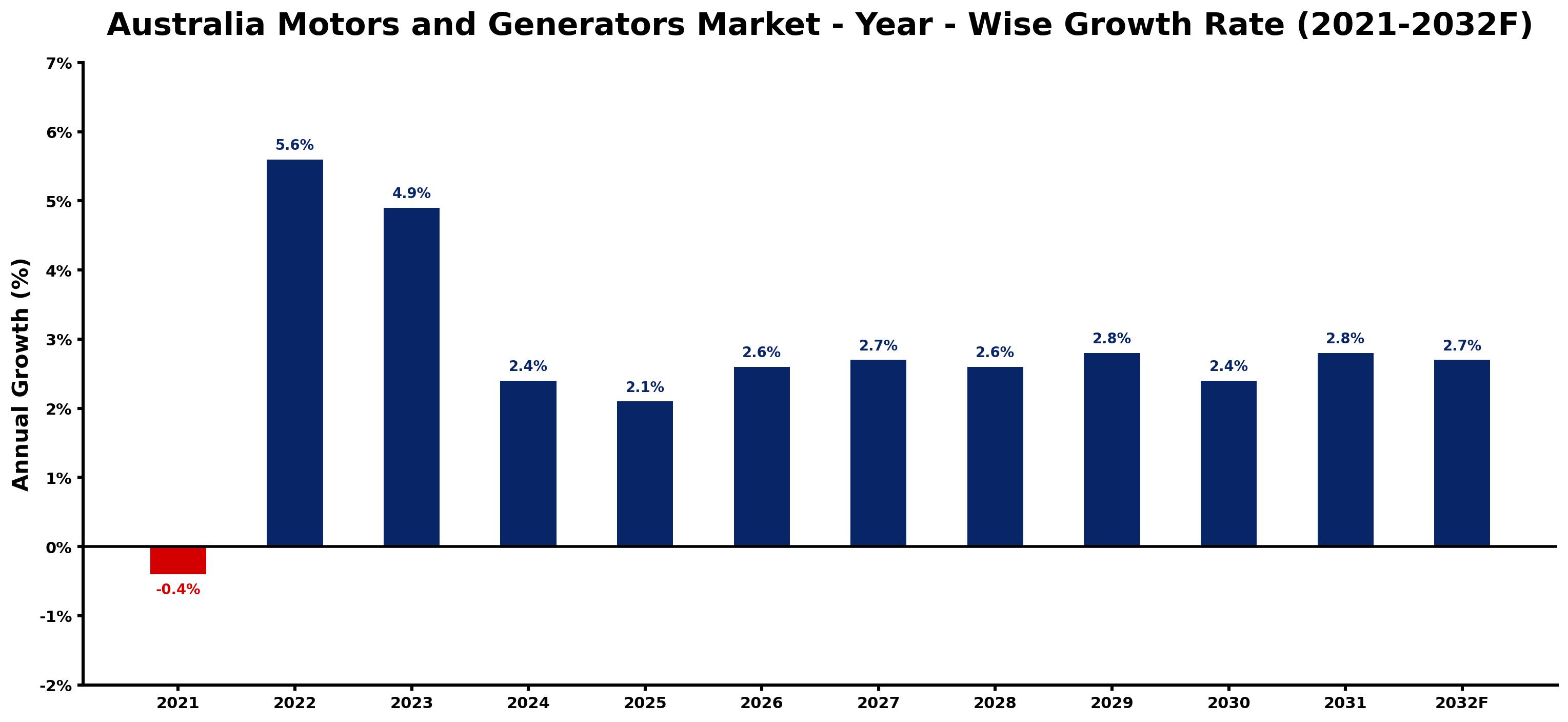
The table below presents the year wise growth rates along with the key drivers influencing the market
| Year | Growth Rate | Major Drivers |
| 2021 | -0.4% | Supply chain disruptions hindered manufacturing capabilities, leading to decreased availability of motors and generators. |
| 2022 | 5.6% | Shifts toward renewable energy sources impact generator market dynamics significantly. |
| 2023 | 4.9% | Technological innovations in efficiency enhance product appeal to industrial users. |
| 2024 | 2.4% | Rural electrification initiatives expand demand for affordable generator solutions. |
| 2025 | 2.1% | Increased focus on sustainability prompts manufacturers to innovate cleaner products. |
| 2026 | 2.6% | Construction boom in urban areas drives higher motor demand across sectors. |
| 2027 | 2.7% | Collaborations with tech firms yield smart motors featuring IoT capabilities. |
| 2028 | 2.6% | Focus on energy independence encourages investment in backup generator systems. |
| 2029 | 2.8% | Aging infrastructure necessitates modernization, boosting the motors and generators market. |
| 2030 | 2.4% | Climate change initiatives promote alternative energy solutions and motor efficiency. |
| 2031 | 2.8% | Emerging industries, like EVs, create new opportunities for motor manufacturers. |
| 2032 | 2.7% | Strong competition leads to price optimization, making solutions more accessible. |
Note - Market size estimations and growth projections presented in this report are based on 6Wresearch's advanced forecasting approach, validated with industry datasets as of June 2026.
Australia Motors and Generators Market Synopsis
The Australia Motors and Generators Market is projected to reach 2.6% and witness significant growth during the forecast period (2026-2032). This expansion is primarily driven by the increasing demand for reliable power solutions across key sectors, including mining, manufacturing, and construction. The push for energy-efficient electric motors, coupled with the adoption of generators powered by renewable energy sources, is substantially influencing the market landscape. Additionally, government initiatives aimed at promoting sustainable energy practices and advancing industrial automation are further bolstering demand in this sector.
Australia Motors and Generators Market Growth Drivers
Several factors are contributing to the growth of the Australia Motors and Generators Market. Firstly, the ongoing infrastructure projects across the nation are creating a substantial need for high-quality power solutions. This is particularly evident in the mining sector, where heavy equipment relies on robust motors and generators to operate efficiently.
- The rise in industrial expansion is catalyzing demand for technologically advanced motors, especially as businesses seek to enhance operational efficiency and reduce energy wastage.
- The renewable energy sector, particularly wind and hydroelectric power, is a significant contributor to the motors and generators market, necessitating the use of sophisticated generators.
- Ongoing technological advancements are driving innovation in motor designs, focusing on improving energy efficiency and reducing environmental impact.
- Heightened awareness regarding environmental sustainability has prompted industries to shift towards eco-friendly motor solutions, thus influencing market growth.
- Government initiatives supporting renewable energy and industrial automation are key growth drivers, aligning industry objectives with national energy policies.
Australia Motors and Generators Market Challenges and Restraints
Despite the robust growth potential, the Australia Motors and Generators Market faces significant challenges that could impede its progress. A primary concern is the fluctuation in raw material costs, which directly affects production expenses and pricing strategies.
- Supply chain disruptions have become increasingly common, impacting the availability of essential components needed for manufacturing motors and generators.
- The demand for energy-efficient motors necessitates substantial investment in advanced technologies, which can be prohibitive for smaller manufacturers.
- Increased competition from international manufacturers poses challenges for local companies, potentially affecting market share and pricing dynamics.
- Regulatory compliance regarding energy efficiency standards can add additional pressure on manufacturers to enhance their operations.
- Technological advancements require ongoing research and development funding, which may strain financial resources, particularly for smaller firms.
Australia Motors and Generators Market Trends and Opportunities
The Australia Motors and Generators Market is witnessing significant trends that present various opportunities for future growth. The shift towards industrial automation is a pivotal trend likely to shape the market in the coming years.
- Investment in renewable energy projects is gaining momentum, promoting the development of innovative generators that harness natural resources.
- The increasing emphasis on energy-efficient motor solutions aligns with global sustainability goals, creating new avenues for product development.
- Government policies encouraging local manufacturing and research in electrical motor technology provide a favorable environment for market players.
- Collaborative ventures among manufacturers, technology providers, and government bodies could enhance the overall capabilities of the market.
- As industries increasingly focus on reducing carbon footprints, there are opportunities for companies to innovate with hybrid and electric motor solutions.
Australia Motors and Generators Market Government Investment and Initiatives
The Australian government plays a pivotal role in fostering the development of the motors and generators market through various investment initiatives and policy frameworks. Recognizing the importance of energy efficiency, government regulations are implemented to encourage manufacturers to adopt advanced technologies that minimize energy consumption.
- Grants and funding opportunities are provided to support local manufacturing initiatives aimed at enhancing the capabilities of motor and generator production.
- Public spending on infrastructure projects is consistently prioritized, creating demand for reliable motors and generators across various sectors.
- Policies promoting renewable energy adoption are crucial, setting standards that drive the development of efficient generators.
- Incentives for research and development in electrical motor technology position Australia as a leader in motor innovation.
- Trade regulations aimed at maintaining competitive pricing and quality control bolster the market's stability and appeal.
Australia Motors and Generators Market Latest Developments (May 2025 - June 2026)
The motors and generators market in Australia is currently undergoing a dynamic transformation, influenced by various factors and trends observed from May 2025 to June 2026. The shift towards renewable energy continues to gain traction, with industry stakeholders focusing on advanced solutions to support this transition.
- Increased investment in R&D has resulted in innovative motor designs that cater to modern energy efficiency standards.
- Collaborative projects aimed at integrating automation with traditional manufacturing processes are becoming more prevalent.
- Battling supply chain challenges, companies are exploring vertical integration to secure the supply of critical components.
- Government policies encouraging sustainable practices have reinforced commitments among manufacturers to reduce environmental impact.
- Awareness campaigns promoting the benefits of energy-efficient solutions have gained popularity, influencing decision-making across industrial sectors.
Australia Motors and Generators Market - Key Attractiveness of the Report
- 10 Years of Market Numbers
- Historical Data Starting from 2022 to 2025
- Base Year: 2025
- Forecast Data until 2032
- Key Performance Indicators Impacting the Market
- Major Upcoming Developments and Projects
Key Highlights of the Report:
- Australia Motors and Generators Market Outlook
- Market Size of Australia Motors and Generators Market, 2025
- Forecast of Australia Motors and Generators Market, 2032
- Historical Data and Forecast of Australia Motors and Generators Revenues & Volume for the Period 2022-2032F
- Australia Motors and Generators Market Trend Evolution
- Australia Motors and Generators Market Drivers and Challenges
- Australia Motors and Generators Price Trends
- Australia Motors and Generators Porter's Five Forces
- Australia Motors and Generators Industry Life Cycle
- Historical Data and Forecast of Australia Motors and Generators Market Revenues & Volume By Type for the Period 2022-2032F
- Historical Data and Forecast of Australia Motors and Generators Market Revenues & Volume By Motor Manufacturing for the Period 2022-2032F
- Historical Data and Forecast of Australia Motors and Generators Market Revenues & Volume By Generator Manufacturing for the Period 2022-2032F
- Historical Data and Forecast of Australia Motors and Generators Market Revenues & Volume By End-User for the Period 2022-2032F
- Historical Data and Forecast of Australia Motors and Generators Market Revenues & Volume By Industrial for the Period 2022-2032F
- Historical Data and Forecast of Australia Motors and Generators Market Revenues & Volume By Commercial for the Period 2022-2032F
- Historical Data and Forecast of Australia Motors and Generators Market Revenues & Volume By Residential for the Period 2022-2032F
- Australia Motors and Generators Import Export Trade Statistics
- Market Opportunity Assessment By Type
- Market Opportunity Assessment By End-User
- Australia Motors and Generators Top Companies Market Share
- Australia Motors and Generators Competitive Benchmarking By Technical and Operational Parameters
- Australia Motors and Generators Company Profiles
- Australia Motors and Generators Key Strategic Recommendations






































