Australia Narrow Woven Fabrics Market Summary
The australia narrow woven fabrics market was estimated at USD 174 Million in 2025 and is projected to reach USD 205 Million by 2032, growing at a CAGR of 2.3% from 2026 to 2032.
Australia Narrow Woven Fabrics Market Year-wise Growth Rate and Key Drivers
This graph highlights how the Australia Narrow Woven Fabrics Market has steadily grown over the past five years, supported by major growth factors.
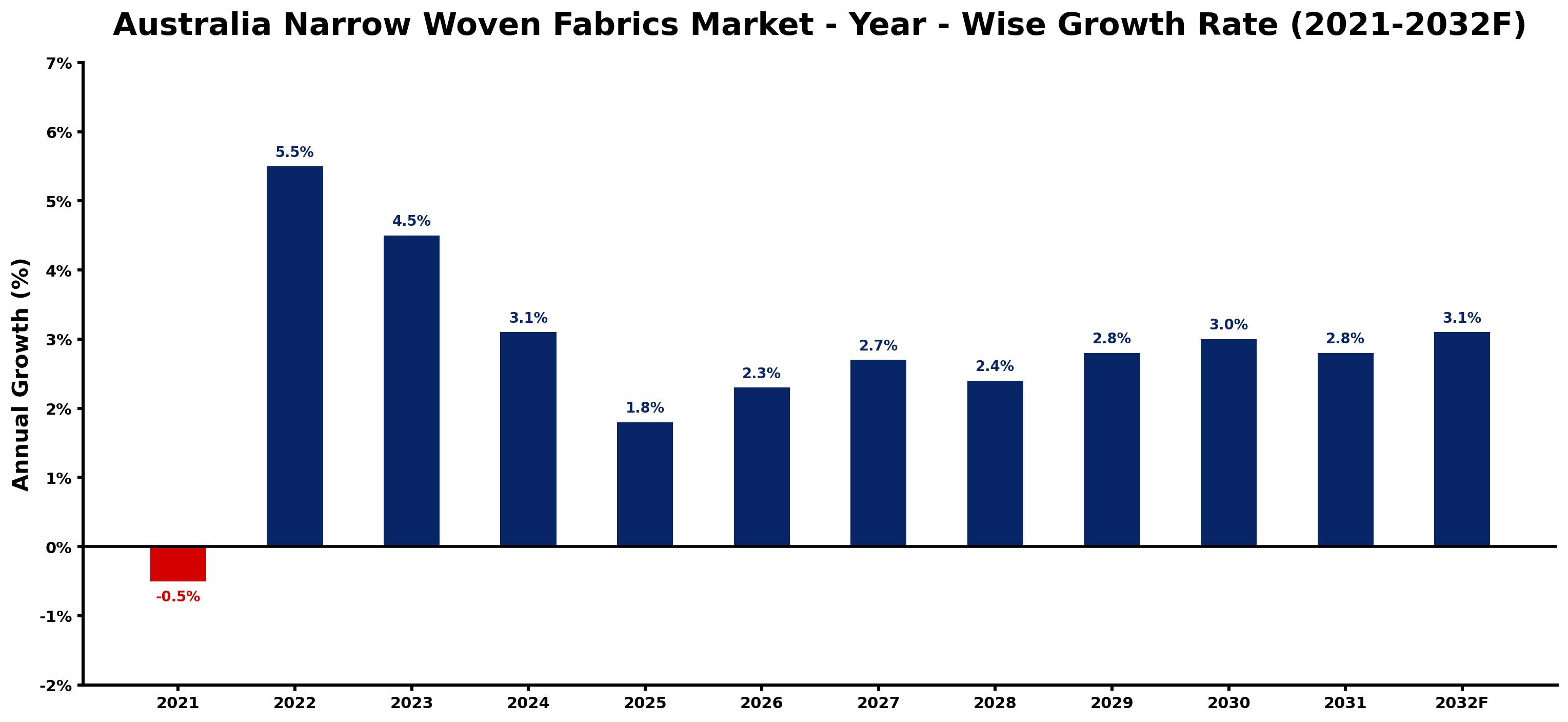
The table below presents the year wise growth rates along with the key drivers influencing the market
| Year | Growth Rate | Major Drivers |
| 2021 | -0.5% | Supply chain disruptions due to pandemicrelated restrictions hindered fabric availability and limited production capabilities. |
| 2022 | 5.5% | Consumer awareness shifted towards eco-friendly options, prompting brands to adapt strategies. |
| 2023 | 4.5% | Local manufacturing capabilities gained traction, reducing reliance on international supply chains. |
| 2024 | 3.1% | E-commerce platforms enhanced accessibility, allowing niche fabric businesses to thrive. |
| 2025 | 1.8% | Technological advancements enabled innovative weaving techniques, attracting new market entrants. |
| 2026 | 2.3% | Collaborations between designers and fabric manufacturers produced unique, limited-edition textiles. |
| 2027 | 2.7% | Increasing interest in home textiles led to rising sales of decorative woven products. |
| 2028 | 2.4% | The fashion industry embraced regional artistry, boosting demand for traditional woven fabrics. |
| 2029 | 2.8% | Consumer preferences shifted towards multifunctional fabrics, merging comfort with durability. |
| 2030 | 3.0% | Investment in smart textiles opened up new applications for narrow woven products. |
| 2031 | 2.8% | Sustainability certifications became critical, influencing purchasing decisions among conscientious consumers. |
| 2032 | 3.1% | Global market connections expanded, positioning Australian fabrics as premium options internationally. |
Note - Market size estimations and growth projections presented in this report are based on 6Wresearch's advanced forecasting approach, validated with industry datasets as of June 2026.
Australia Narrow Woven Fabrics Market Synopsis
The Australia Narrow Woven Fabrics Market is projected to reach 2.3% and witness significant growth during the forecast period (2026-2032). This market encompasses various industries, with notable applications in automotive, industrial, and fashion sectors. The use of narrow woven fabrics in products such as seat belts, straps, medical textiles, and safety gear underscores their essential role in enhancing safety and functionality across multiple domains.
Australia Narrow Woven Fabrics Market Growth Drivers
The growth of the Australia Narrow Woven Fabrics Market is primarily driven by several key factors:
- Increasing applications in the automotive industry, particularly in the production of seat belts and safety harnesses, which are critical for passenger safety.
- The expanding healthcare sector, where narrow woven fabrics are used in medical bandages and protective clothing, highlights their importance in patient safety and care.
- Advancements in textile engineering are leading to the development of high-performance fabrics that offer improved durability and adaptability for diverse applications.
- The rise of eco-conscious consumers is fostering demand for sustainable fabrics, driving innovation in eco-friendly narrow woven materials.
- The growing trend of customization in the fashion industry further accelerates the demand for unique and versatile narrow woven fabrics for garment manufacturing.
Australia Narrow Woven Fabrics Market Challenges and Restraints
Despite the positive growth trends, the Australia Narrow Woven Fabrics Market faces several challenges:
- High production costs associated with specialized manufacturing techniques and materials can limit profitability for local producers.
- Dependence on imported raw materials for fabric production poses risks related to supply chain disruptions and fluctuating prices.
- Market instability arises from demand fluctuations in key sectors such as automotive and apparel, making it difficult for manufacturers to maintain consistent output.
- The presence of synthetic alternatives that are often less expensive can hinder market growth for natural woven fabrics.
- Increasing operational costs due to sustainability requirements compel businesses to invest in eco-friendly alternatives, creating financial pressure on manufacturers.
Australia Narrow Woven Fabrics Market Investment Opportunities
The Australia Narrow Woven Fabrics Market presents a range of investment opportunities driven by innovation and demand across various applications:
- Investment in high-performance woven fabrics such as flame-resistant and stretchable materials is anticipated to attract interest, especially within the automotive and industrial sectors.
- Opportunities for development of sustainable textiles are on the rise, with manufacturers increasingly exploring recycled and organic materials to meet consumer expectations.
- The growth of the apparel sector offers avenues for investment in specialty woven fabrics that deliver both functionality and aesthetic appeal.
- Technological advancements in manufacturing processes create opportunities for companies to innovate and reduce production costs, enhancing competitive advantage.
- Collaborations with research institutions can lead to breakthroughs in textile engineering, paving the way for next-generation narrow woven fabrics.
Australia Narrow Woven Fabrics Market Government Investment and Initiatives
The Australian government plays a pivotal role in shaping the narrow woven fabrics market by implementing various policies and initiatives:
- Regulatory frameworks governing the textile industry ensure that high quality and safety standards are maintained, particularly for fabrics used in medical and industrial applications.
- Environmental sustainability policies encourage the use of recycled and organic materials, supporting the transition to more eco-friendly production methods.
- Public spending on healthcare and transportation infrastructure stimulates demand for narrow woven fabrics, particularly in safety and protective applications.
- Incentives for research and development in textile innovation seek to bolster the domestic manufacturing capabilities, aiming for reduced reliance on imported materials.
- Trade regulations are in place to control the importation of fabric materials, ensuring that domestic manufacturers can compete effectively against international suppliers.
Australia Narrow Woven Fabrics Market Latest Developments (May 2025 - June 2026)
Recent developments within the Australia Narrow Woven Fabrics Market, spanning from May 2025 to June 2026, indicate a trend towards innovation and sustainability:
- Growing partnerships between textile manufacturers and technology firms have led to advancements in fabric durability and functionality.
- Increased investment in eco-friendly production processes reflects the industry's shift toward sustainability, with many companies adopting greener practices and materials.
- A surge in demand for high-performance fabrics has prompted manufacturers to focus on developing specialized products for various applications, from automotive to healthcare.
- Public policy initiatives aimed at supporting local textile industries are becoming more pronounced, enhancing the competitive landscape for domestic manufacturers.
- The rise of online platforms for custom fabric ordering is reshaping customer engagement, allowing for greater flexibility and personalization in product offerings.
Australia Narrow Woven Fabrics Market - Key Attractiveness of the Report
- 10 Years of Market Numbers
- Historical Data Starting from 2022 to 2025
- Base Year: 2025
- Forecast Data until 2032
- Key Performance Indicators Impacting the Market
- Major Upcoming Developments and Projects
Key Highlights of the Report:
- Australia Narrow Woven Fabrics Market Outlook
- Market Size of Australia Narrow Woven Fabrics Market, 2025
- Forecast of Australia Narrow Woven Fabrics Market, 2032
- Historical Data and Forecast of Australia Narrow Woven Fabrics Revenues & Volume for the Period 2022-2032F
- Australia Narrow Woven Fabrics Market Trend Evolution
- Australia Narrow Woven Fabrics Market Drivers and Challenges
- Australia Narrow Woven Fabrics Price Trends
- Australia Narrow Woven Fabrics Porter's Five Forces
- Australia Narrow Woven Fabrics Industry Life Cycle
- Historical Data and Forecast of Australia Narrow Woven Fabrics Market Revenues & Volume By Type for the Period 2022-2032F
- Historical Data and Forecast of Australia Narrow Woven Fabrics Market Revenues & Volume By Polyester for the Period 2022-2032F
- Historical Data and Forecast of Australia Narrow Woven Fabrics Market Revenues & Volume By Nylon for the Period 2022-2032F
- Historical Data and Forecast of Australia Narrow Woven Fabrics Market Revenues & Volume By PP for the Period 2022-2032F
- Historical Data and Forecast of Australia Narrow Woven Fabrics Market Revenues & Volume By Applications for the Period 2022-2032F
- Historical Data and Forecast of Australia Narrow Woven Fabrics Market Revenues & Volume By Garments for the Period 2022-2032F
- Historical Data and Forecast of Australia Narrow Woven Fabrics Market Revenues & Volume By Home Furnishing for the Period 2022-2032F
- Historical Data and Forecast of Australia Narrow Woven Fabrics Market Revenues & Volume By Other for the Period 2022-2032F
- Australia Narrow Woven Fabrics Import Export Trade Statistics
- Market Opportunity Assessment By Type
- Market Opportunity Assessment By Applications
- Australia Narrow Woven Fabrics Top Companies Market Share
- Australia Narrow Woven Fabrics Competitive Benchmarking By Technical and Operational Parameters
- Australia Narrow Woven Fabrics Company Profiles
- Australia Narrow Woven Fabrics Key Strategic Recommendations






































