Australia Optical Instrument And Lens Market Size, Share & Growth Rate
The Australia Optical Instrument And Lens Market was estimated at USD 181 Million in 2025 and is projected to reach USD 213 Million by 2032, growing at a CAGR of 2.4% from 2026 to 2032. This growth trajectory is fueled by heightened investments in healthcare and advanced imaging technologies, which are increasingly critical in areas such as medical diagnostics and consumer electronics. Furthermore, the expanding field of astronomy and advancements in augmented and virtual reality applications significantly contribute to the market's momentum.
Australia Optical Instrument And Lens Market Year-wise Growth Rate and Key Drivers
This graph highlights how the Australia Optical Instrument And Lens Market has steadily grown over the years, supported by major growth factors.
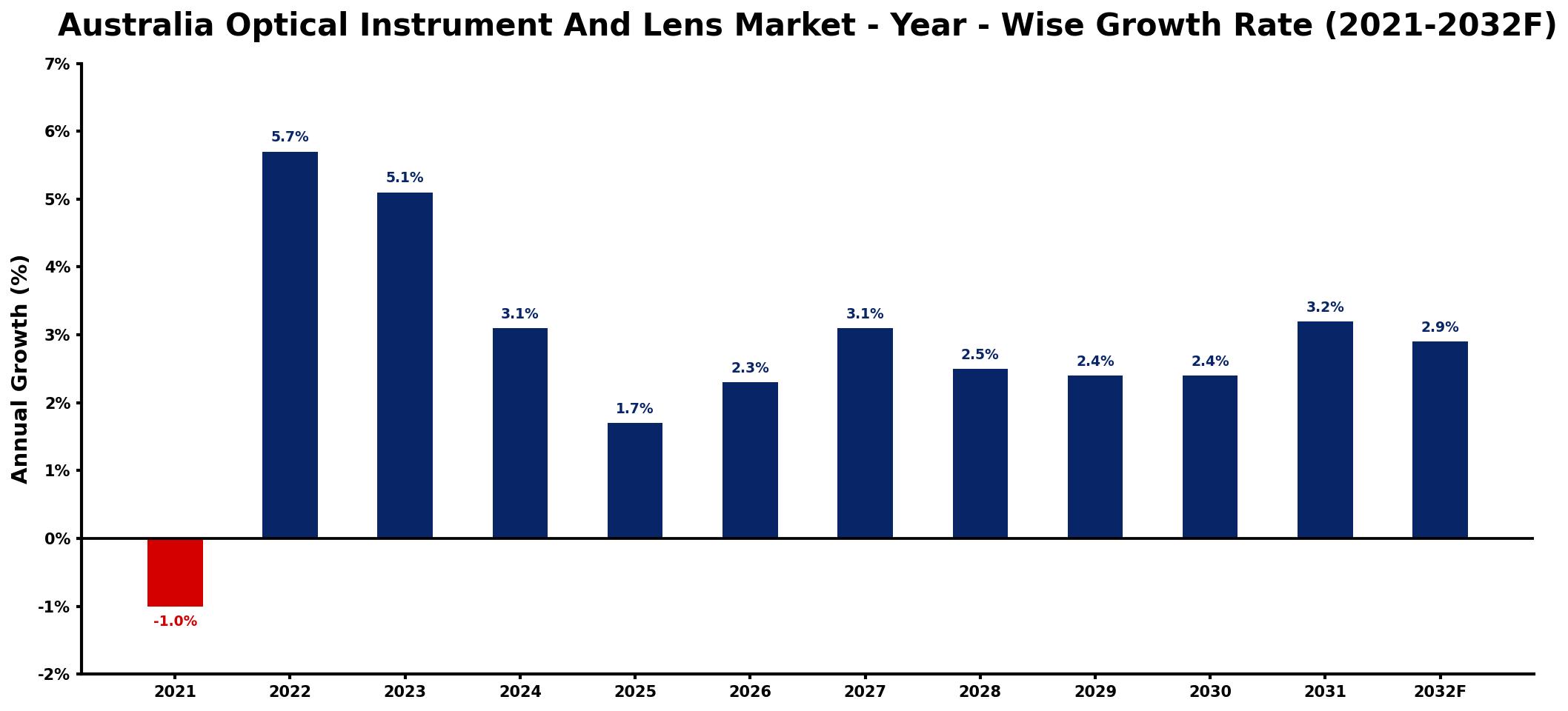
The table below presents the year‑wise growth rates along with the key drivers influencing the market
| Year | Growth Rate | Major Drivers |
| 2021 | -1.0% | decrease in consumer spending |
| 2022 | 5.7% | rise in technological advancements |
| 2023 | 5.1% | increased pharmaceutical industry usage |
| 2024 | 3.1% | growing demand for innovations |
| 2025 | 1.7% | expansion of e-commerce platforms |
| 2026 | 2.3% | surge in preventive healthcare focus |
| 2027 | 3.1% | enhanced consumer awareness campaigns |
| 2028 | 2.5% | growth in aging population services |
| 2029 | 2.4% | increased adoption of telehealth solutions |
| 2030 | 2.4% | expanding healthcare application demand |
| 2031 | 3.2% | strengthening international trade flows |
| 2032 | 2.9% | increased collaboration among industries |
Note: Market size estimations and growth projections presented in this report are based on 6Wresearch's proprietary forecasting methodology, utilizing the latest available industry data, government publications, and primary research inputs.
Australia Optical Instrument And Lens Market Synopsis
The most potent force shaping the Australia Optical Instrument And Lens Market today is the surging demand for high-precision optical devices across multiple sectors. The healthcare industry's reliance on cutting-edge imaging technologies, combined with defense and aerospace advancements, is propelling growth and innovation.
Additionally, the consumer electronics market's appetite for sophisticated optical solutions fosters a competitive landscape where quality and technological advancements are paramount. This convergence of sectors is not only driving demand but also catalyzing collaborative efforts between industries to develop tailored optical solutions.
Australia Optical Instrument And Lens Market Key Takeaways
- Significant growth in the healthcare sector is driving demand for advanced imaging equipment.
- The rise of augmented reality (AR) and virtual reality (VR) is creating new applications for optical lenses.
- Challenges in local manufacturing capacities present both hurdles and opportunities for innovation.
- Government support for precision manufacturing is fostering research and development in optical technologies.
- Import reliance for critical components continues to affect local manufacturers competitiveness.
Evaluation of Restraints in Australia Optical Instrument And Lens Market
The Australia Optical Instrument And Lens Market grapples with substantial challenges primarily stemming from the dominance of global brands and limited domestic manufacturing capabilities. Local companies often find it difficult to compete against well-established international players, particularly in areas of precision manufacturing and advanced optical technologies. The investment required for research and development is considerable, which poses a significant barrier for small and medium-sized enterprises looking to innovate and enter the market. Moreover, the heavy reliance on imports for essential components exacerbates costs and complicates supply chain dynamics, increasing the vulnerability of local manufacturers to global market fluctuations.
Australia Optical Instrument And Lens Market Trends
Several noteworthy trends are shaping the Australia Optical Instrument And Lens Market. A prominent shift towards miniaturization is evident, as consumers demand compact, high-performance optical solutions in devices ranging from smartphones to wearables. Furthermore, the integration of smart technologies into optical instruments—enabling features like real-time data processing and enhanced user interfaces—significantly boosts their functionality. Enhanced focus on sustainability is also emerging, prompting manufacturers to explore eco-friendly materials and energy-efficient production processes, which align with broader societal values around environmental responsibility.
Australia Optical Instrument And Lens Market Opportunities
With the optical instrument and lens market in Australia expanding, several promising investment opportunities are emerging. There is a growing need for precision optics manufacturing, particularly in specialized segments such as medical imaging and defense applications. Additionally, the burgeoning sectors of augmented reality (AR) and virtual reality (VR) present attractive avenues for development, promising substantial returns on investment. Custom lens solutions tailored to specific applications are increasingly sought after, allowing local firms to carve niches within the broader market and attract strategic partnerships.
Government Initiatives in the Australia Optical Instrument And Lens Market
The Australian government actively supports the optical instrument and lens market through various initiatives designed to foster innovation and competitiveness in precision manufacturing. Grants and subsidies are available for research programs focused on advancements in medical imaging and defense technologies. Regulatory frameworks are in place to ensure compliance with international optical standards, enhancing the quality and reliability of domestic production. Furthermore, government-backed incentives encourage collaborations between academic institutions and industry players, promoting knowledge transfer and technological advancement.
Future Insights of the Australia Optical Instrument And Lens Market
Looking forward to the period from 2026 to 2032, the Australia Optical Instrument And Lens Market is poised for steady growth, driven by continued advancements in technology and increasing demand across various sectors. The focus on improving optical performance, coupled with innovations in materials and manufacturing processes, will likely reshape the competitive landscape. Additionally, as Australia continues to invest in healthcare, space research, and defense, the market will benefit from enhanced research capabilities and a robust pipeline of cutting-edge products that meet evolving consumer and professional needs.
Australia Optical Instrument And Lens Market Latest Developments (2025 - 2026)
Recent developments in the Australia Optical Instrument And Lens Market indicate a robust shift towards integrating smart technologies within optical devices. Companies are increasingly exploring collaborations to enhance research and development capabilities, particularly focusing on AR and VR applications. Additionally, there is a noticeable movement towards sustainability in manufacturing practices, with many firms adopting eco-friendly materials and processes. These trends highlight the industrys adaptability and its commitment to meeting the future needs of both consumers and professionals in various sectors.
Australia Optical Instrument And Lens Market - Key Attractiveness of the Report
- 10 Years of Market Numbers
- Historical Data Starting from 2022 to 2025
- Base Year: 2025
- Forecast Data until 2032
- Key Performance Indicators Impacting the Market
- Major Upcoming Developments and Projects
Key Highlights of the Report:
- Australia Optical Instrument And Lens Market Outlook
- Market Size of Australia Optical Instrument And Lens Market, 2025
- Forecast of Australia Optical Instrument And Lens Market, 2032
- Historical Data and Forecast of Australia Optical Instrument And Lens Revenues & Volume for the Period 2022-2032F
- Australia Optical Instrument And Lens Market Trend Evolution
- Australia Optical Instrument And Lens Market Drivers and Challenges
- Australia Optical Instrument And Lens Price Trends
- Australia Optical Instrument And Lens Porter's Five Forces
- Australia Optical Instrument And Lens Industry Life Cycle
- Historical Data and Forecast of Australia Optical Instrument And Lens Market Revenues & Volume By Product for the Period 2022-2032F
- Historical Data and Forecast of Australia Optical Instrument And Lens Market Revenues & Volume By Binoculars for the Period 2022-2032F
- Historical Data and Forecast of Australia Optical Instrument And Lens Market Revenues & Volume By Microscopes for the Period 2022-2032F
- Historical Data and Forecast of Australia Optical Instrument And Lens Market Revenues & Volume By Telescopes for the Period 2022-2032F
- Historical Data and Forecast of Australia Optical Instrument And Lens Market Revenues & Volume By Others for the Period 2022-2032F
- Historical Data and Forecast of Australia Optical Instrument And Lens Market Revenues & Volume By Category for the Period 2022-2032F
- Historical Data and Forecast of Australia Optical Instrument And Lens Market Revenues & Volume By Optical Instruments for the Period 2022-2032F
- Historical Data and Forecast of Australia Optical Instrument And Lens Market Revenues & Volume By Interchangeable Camera Lenses for the Period 2022-2032F
- Historical Data and Forecast of Australia Optical Instrument And Lens Market Revenues & Volume By Application for the Period 2022-2032F
- Historical Data and Forecast of Australia Optical Instrument And Lens Market Revenues & Volume By Medical for the Period 2022-2032F
- Historical Data and Forecast of Australia Optical Instrument And Lens Market Revenues & Volume By Astronomy for the Period 2022-2032F
- Historical Data and Forecast of Australia Optical Instrument And Lens Market Revenues & Volume By Commercial for the Period 2022-2032F
- Historical Data and Forecast of Australia Optical Instrument And Lens Market Revenues & Volume By Defense for the Period 2022-2032F
- Historical Data and Forecast of Australia Optical Instrument And Lens Market Revenues & Volume By Others for the Period 2022-2032F
- Australia Optical Instrument And Lens Import Export Trade Statistics
- Market Opportunity Assessment By Product
- Market Opportunity Assessment By Category
- Market Opportunity Assessment By Application
- Australia Optical Instrument And Lens Top Companies Market Share
- Australia Optical Instrument And Lens Competitive Benchmarking By Technical and Operational Parameters
- Australia Optical Instrument And Lens Company Profiles
- Australia Optical Instrument And Lens Key Strategic Recommendations






































