Australia Optical Instruments Market Summary
The australia optical instruments market was estimated at USD 83 Million in 2025 and is projected to reach USD 97 Million by 2032, growing at a CAGR of 2.8% from 2026 to 2032.
Australia Optical Instruments Market Year-wise Growth Rate and Key Drivers
This graph highlights how the Australia Optical Instruments Market has steadily grown over the past five years, supported by major growth factors.
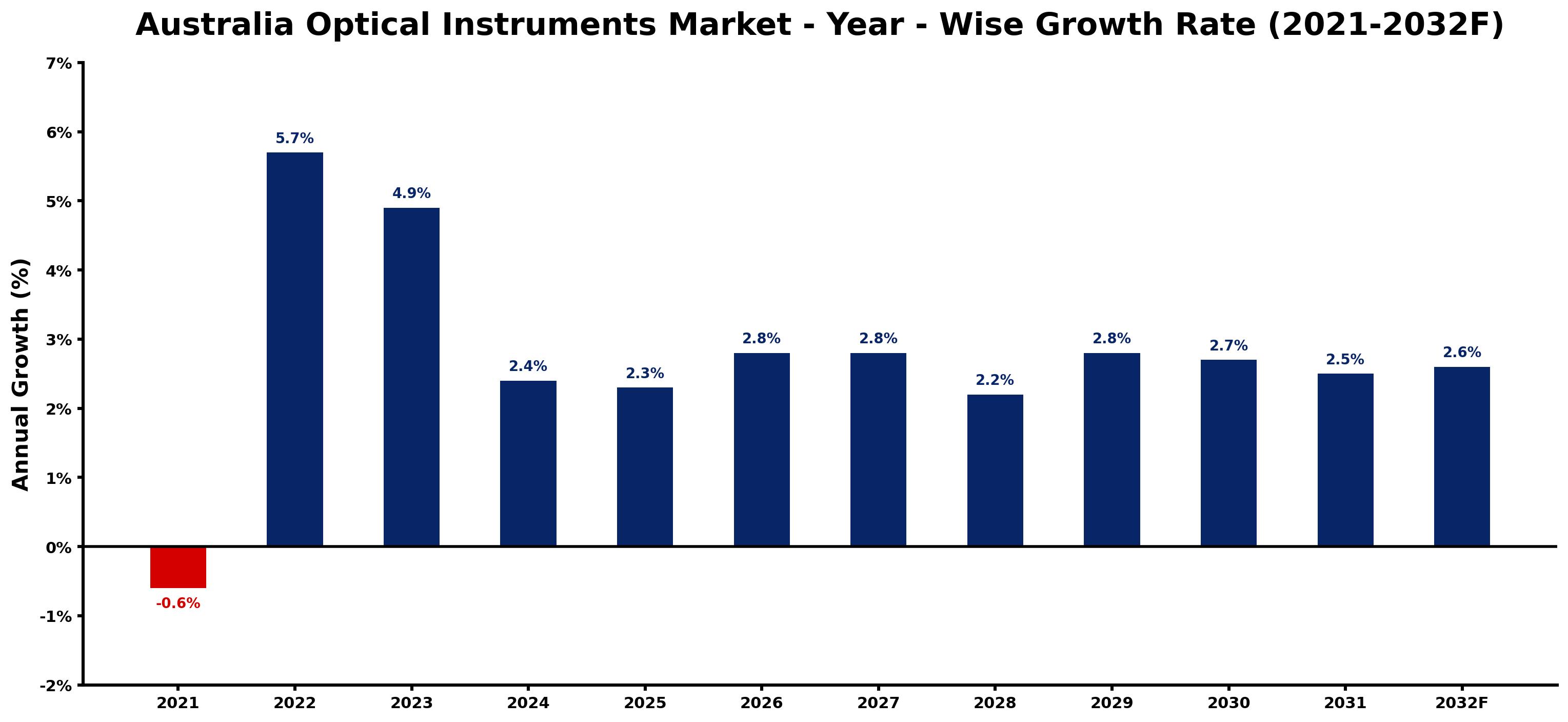
The table below presents the year wise growth rates along with the key drivers influencing the market
| Year | Growth Rate | Major Drivers |
| 2021 | -0.6% | Lingering pandemic effects limited retail foot traffic, suppressing sales of optical instruments across Australia. |
| 2022 | 5.7% | Increased consumer interest in high-quality visuals boosts demand for optical solutions. |
| 2023 | 4.9% | Technological innovations enhance precision in the production of optical instruments. |
| 2024 | 2.4% | The expanding e-commerce sector necessitates improved optical quality for product displays. |
| 2025 | 2.3% | Emerging applications in healthcare drive investment in optical imaging technologies. |
| 2026 | 2.8% | Corporate budgets prioritize optical instruments for enhanced operational efficiency benefits. |
| 2027 | 2.8% | Sustainability trends push optical companies toward eco-friendly manufacturing processes. |
| 2028 | 2.2% | Rising interest in augmented reality creates new markets for optical device integration. |
| 2029 | 2.8% | Educational institutions increasingly adopt advanced optics for immersive learning experiences. |
| 2030 | 2.7% | The demand for personalized eyecare solutions leads to innovation in optical products. |
| 2031 | 2.5% | Technological collaborations enhance the quality and variety of optical instruments available. |
| 2032 | 2.6% | Global competition encourages continuous improvement and diversification in the optical sector. |
Note - Market size estimations and growth projections presented in this report are based on 6Wresearch's advanced forecasting approach, validated with industry datasets as of June 2026.
Australia Optical Instruments Market Synopsis
The Australia Optical Instruments Market is projected to reach 2.8% and witness significant growth during the forecast period (2026-2032). This growth is primarily driven by increasing applications in healthcare, research, and industrial sectors. The demand for products such as microscopes, telescopes, and ophthalmic instruments is rising due to advancements in optical technology and a heightened investment in scientific research. Furthermore, the evolution of digital imaging and automation technologies is shaping the trajectory of the industry.
Australia Optical Instruments Market Growth Drivers
The growth of the Australia Optical Instruments Market can be attributed to several key factors:
- The healthcare sector's adoption of advanced imaging technologies is significantly driving the demand for optical instruments. Enhanced medical diagnostics and surgical procedures rely on high-quality optical devices.
- In the telecommunications industry, optical instruments are crucial for fiber optics and high-bandwidth communication systems, contributing to the market's expansion.
- The defense and aerospace sectors require high-precision optical components, further propelling market growth through sophisticated applications.
- Research and development investments in optical innovations are continuously introducing new technologies and applications, creating a favorable environment for market expansion.
- The integration of automation and digital imaging technology in industrial applications enhances efficiency and opens new avenues for optical instrument utilization.
Australia Optical Instruments Market Challenges and Restraints
Despite the apparent growth potential, the Australia Optical Instruments Market faces certain challenges:
- The industry's heavy reliance on imports poses a significant challenge, as fluctuations in international supply chains can impact availability and pricing of critical optical instruments.
- High costs associated with advanced optical instruments create barriers for local buyers, especially for emerging businesses that may lack the capital for investment in cutting-edge technologies.
- The rapid pace of optical technology advancements necessitates ongoing investment in research and development, which can strain resources for smaller firms.
- Precision engineering requirements for the manufacturing and assembly of optical instruments can lead to higher production costs, limiting competitiveness.
- Market participants must navigate a complex regulatory environment that mandates compliance with stringent safety and performance standards.
Australia Optical Instruments Market Investment Opportunities
Investment opportunities within the Australia Optical Instruments Market are robust, fueled by several key sectors:
- Healthcare innovation continues to drive investment as institutions seek advanced imaging systems and ophthalmic devices, leveraging new technologies to improve patient outcomes.
- The burgeoning demand for optical instruments in defense applications is generating avenues for investment, particularly in high-precision optics for surveillance and reconnaissance.
- Scientific research funding is increasingly prioritizing optical advancements, offering opportunities for partnerships and grants aimed at developing new optical technologies.
- Government initiatives aimed at fostering innovation in optical instrument production can yield financial incentives and support for local manufacturers.
- The growth in automation across industries creates demand for optical sensing and imaging technologies, inviting ventures focused on developing precision optical devices.
Australia Optical Instruments Market Government Investment and Initiatives
The regulatory landscape surrounding the Australia Optical Instruments Market is shaped by government policies that promote safety and innovation:
- The Australian Competition and Consumer Commission (ACCC) ensures that all optical devices meet stringent quality and performance standards, aiming to protect consumer interests.
- Medical optical instruments such as ophthalmic devices are required to receive approval from the Therapeutic Goods Administration (TGA) before they can be marketed, ensuring safety and efficacy.
- Import regulations are in place to prevent substandard optical instruments from entering the market, emphasizing the importance of quality in this sector.
- Significant government investments focus on enhancing research capabilities, particularly in medical and space research, which often incorporates advanced optical technologies.
- Various grants and funding programs are available to support the development of innovative optical instruments, fostering growth in local manufacturing capabilities.
Australia Optical Instruments Market Latest Developments (May 2025 - June 2026)
The period from May 2025 to June 2026 has witnessed notable developments in the Australia Optical Instruments Market, reflecting the dynamic nature of the sector:
- Increased collaborations between universities and industry have emerged, focusing on R&D initiatives aimed at advancing optical technology applications.
- Emerging startups are leveraging advancements in artificial intelligence to enhance the functionality of optical instruments, fostering innovation across various applications.
- Government announcements regarding funding for space exploration initiatives are likely to increase demand for high-performance optical instruments designed for aerospace applications.
- There has been a noticeable shift towards sustainable production practices among manufacturers, with many seeking to minimize their environmental impact.
- Conferences and exhibitions have highlighted significant strides in optical imaging technology, showcasing local innovations that are set to influence future market trends.
Australia Optical Instruments Market - Key Attractiveness of the Report
- 10 Years of Market Numbers
- Historical Data Starting from 2022 to 2025
- Base Year: 2025
- Forecast Data until 2032
- Key Performance Indicators Impacting the Market
- Major Upcoming Developments and Projects
Key Highlights of the Report:
- Australia Optical Instruments Market Outlook
- Market Size of Australia Optical Instruments Market, 2025
- Forecast of Australia Optical Instruments Market, 2032
- Historical Data and Forecast of Australia Optical Instruments Revenues & Volume for the Period 2022-2032F
- Australia Optical Instruments Market Trend Evolution
- Australia Optical Instruments Market Drivers and Challenges
- Australia Optical Instruments Price Trends
- Australia Optical Instruments Porter's Five Forces
- Australia Optical Instruments Industry Life Cycle
- Historical Data and Forecast of Australia Optical Instruments Market Revenues & Volume By Types for the Period 2022-2032F
- Historical Data and Forecast of Australia Optical Instruments Market Revenues & Volume By Microscopes for the Period 2022-2032F
- Historical Data and Forecast of Australia Optical Instruments Market Revenues & Volume By Contact Lenses for the Period 2022-2032F
- Historical Data and Forecast of Australia Optical Instruments Market Revenues & Volume By Binoculars for the Period 2022-2032F
- Historical Data and Forecast of Australia Optical Instruments Market Revenues & Volume By Camera Lenses for the Period 2022-2032F
- Historical Data and Forecast of Australia Optical Instruments Market Revenues & Volume By Telescopes for the Period 2022-2032F
- Historical Data and Forecast of Australia Optical Instruments Market Revenues & Volume By Applications for the Period 2022-2032F
- Historical Data and Forecast of Australia Optical Instruments Market Revenues & Volume By Commercial for the Period 2022-2032F
- Historical Data and Forecast of Australia Optical Instruments Market Revenues & Volume By Residential for the Period 2022-2032F
- Historical Data and Forecast of Australia Optical Instruments Market Revenues & Volume By Industrial for the Period 2022-2032F
- Historical Data and Forecast of Australia Optical Instruments Market Revenues & Volume By Defense and surveillance for the Period 2022-2032F
- Australia Optical Instruments Import Export Trade Statistics
- Market Opportunity Assessment By Types
- Market Opportunity Assessment By Applications
- Australia Optical Instruments Top Companies Market Share
- Australia Optical Instruments Competitive Benchmarking By Technical and Operational Parameters
- Australia Optical Instruments Company Profiles
- Australia Optical Instruments Key Strategic Recommendations






































