Australia Paper bags and sacks packaging Market Summary
The australia paper bags and sacks packaging market was estimated at USD 167 Million in 2025 and is projected to reach USD 196 Million by 2032, growing at a CAGR of 3.0% from 2026 to 2032.
Australia Paper bags and sacks packaging Market Year-wise Growth Rate and Key Drivers
This graph highlights how the Australia Paper bags and sacks packaging Market has steadily grown over the past five years, supported by major growth factors.
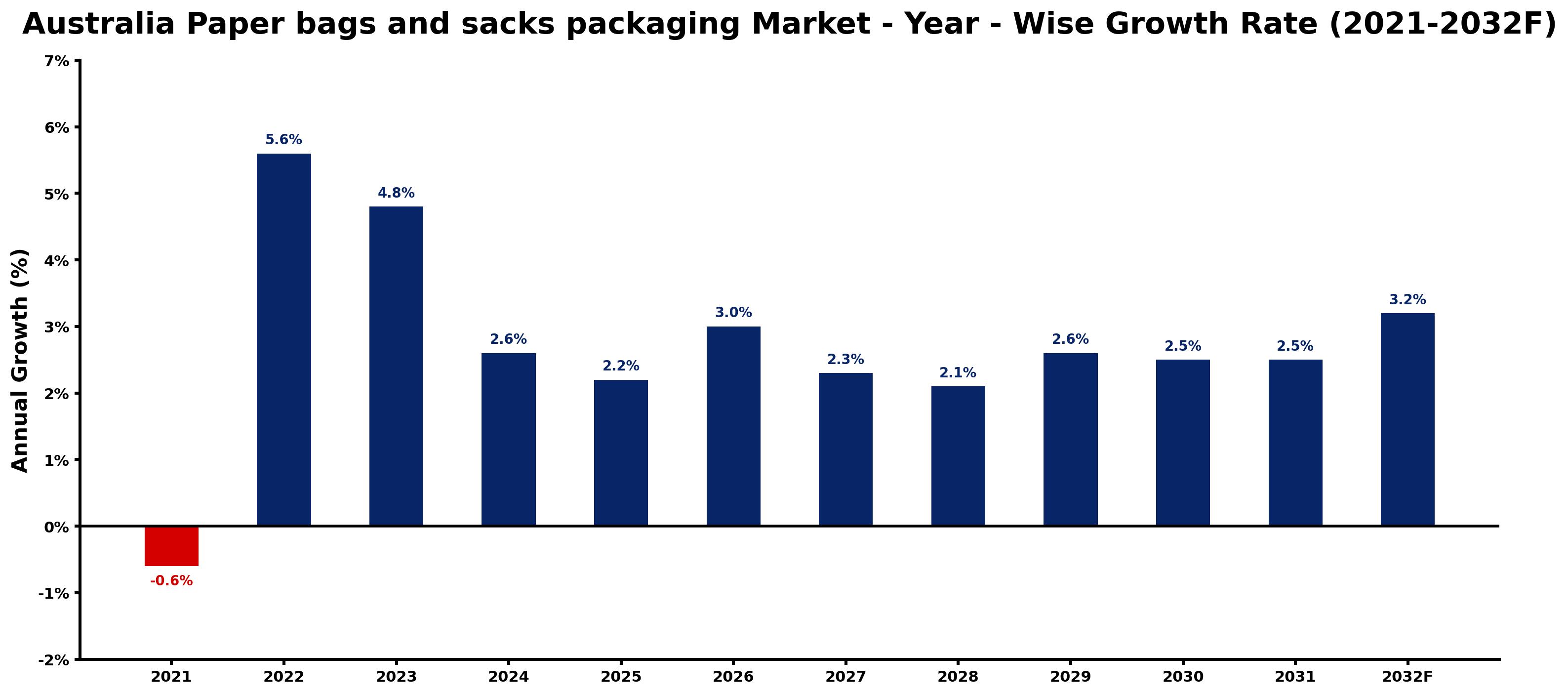
The table below presents the year wise growth rates along with the key drivers influencing the market
| Year | Growth Rate | Major Drivers |
| 2021 | -0.6% | Sustained shifts towards digital alternatives diminished consumer reliance on traditional paper packaging solutions. |
| 2022 | 5.6% | Retailers increasingly sought sustainable packaging suppliers amidst growing environmental awareness campaigns. |
| 2023 | 4.8% | Major brands transitioned to paper bags, enhancing their eco-friendly product lines significantly. |
| 2024 | 2.6% | E-commerce growth spurred demand for innovative paper packaging solutions for shipping and delivery. |
| 2025 | 2.2% | Local businesses began adopting paper sacks, emphasizing community support and sustainability values. |
| 2026 | 3.0% | Rising production costs for plastics prompted manufacturers to pivot toward biodegradable alternatives. |
| 2027 | 2.3% | Corporate sustainability goals became essential as companies aimed for carbon neutrality by 2030. |
| 2028 | 2.1% | Collaborations between paper manufacturers and retailers led to customized sustainable packaging solutions. |
| 2029 | 2.6% | Increased awareness of ocean pollution pushed for further reductions in plastic usage nationwide. |
| 2030 | 2.5% | Urbanization trends created new opportunities for paper packaging in metropolitan supermarket chains. |
| 2031 | 2.5% | Innovative technologies improved paper bag durability, making them viable for heavy-duty packaging. |
| 2032 | 3.2% | Circular economy practices gained traction, influencing packaging design and recycling initiatives nationwide. |
Note - Market size estimations and growth projections presented in this report are based on 6Wresearch's advanced forecasting approach, validated with industry datasets as of June 2026.
Australia Paper bags and sacks packaging Market Synopsis
The Australia Paper bags and sacks packaging Market is projected to reach 3.0% and witness significant growth during the forecast period (2026-2032). This growth is primarily driven by increasing consumer preferences for sustainable and biodegradable packaging solutions. The evolving regulatory landscape aimed at reducing plastic usage is influencing businesses in the food and retail sectors to adopt paper-based packaging alternatives. The market is characterized by a robust shift towards environmentally friendly options, although it faces challenges related to cost and competition from plastic products.
Australia Paper bags and sacks packaging Market Growth Drivers
The Australia Paper bags and sacks packaging Market is experiencing growth driven by several key factors:
- The transition towards eco-friendly packaging solutions is largely being propelled by stringent government regulations that restrict plastic usage. This has led businesses to seek alternatives like paper bags and sacks.
- Increased environmental awareness among consumers is pushing retailers and food service providers to prioritize sustainable packaging. This societal shift is critical in fostering market demand.
- The food and retail industries are significant contributors to the demand for paper-based packaging, as they replace plastic options to align with consumer preferences for sustainability.
- Innovations in paper technology, including moisture-resistant and durable designs, are enhancing the appeal of paper packaging as a viable alternative to plastic.
- Growing global initiatives aimed at reducing waste and promoting recycling bolster the usage of paper bags and sacks, further driving market growth.
Australia Paper bags and sacks packaging Market Challenges and Restraints
While the Australia Paper bags and sacks packaging Market is on an upward trajectory, several challenges threaten its progress:
- Rising raw material costs present a significant challenge, as paper production is often more expensive than plastic alternatives. This can deter businesses from making the switch to more sustainable options.
- Competition from established plastic packaging solutions poses a substantial barrier, as many distributors and retailers still favor plastic for its lower cost and convenience.
- Environmental regulations supporting biodegradable alternatives create pressure on traditional paper manufacturers, necessitating investment in sustainable practices and materials.
- Consumer education regarding the benefits and environmental impacts of paper packaging is crucial, as a lack of awareness may hinder market growth.
- Market volatility in raw material supply can affect production consistency and pricing strategies for paper packaging manufacturers.
Australia Paper bags and sacks packaging Market Investment Opportunities
The Australia Paper bags and sacks packaging Market presents various opportunities for investment and growth:
- The regulatory push towards reducing plastic waste creates an attractive environment for businesses to invest in biodegradable paper materials and technologies.
- Entrepreneurs can leverage the demand for innovative packaging designs that enhance durability without compromising sustainability, thus creating niche market segments.
- Collaboration with governmental initiatives focused on waste reduction can provide financial incentives to businesses transitioning to paper solutions.
- Investments in supply chain improvements and sustainable sourcing of raw materials can enhance competitiveness and appeal to environmentally conscious consumers.
- Research and development in advanced paper manufacturing processes can result in enhanced product offerings that meet the increasing demands of various industries.
Australia Paper bags and sacks packaging Market Government Investment and Initiatives
The Australian government plays a pivotal role in supporting the growth of the paper bags and sacks packaging market through various policies and initiatives:
- The National Waste Policy Action Plan places a significant emphasis on reducing plastic waste, directing funds towards sustainable packaging development, including paper-based solutions.
- Government regulations under the Packaging Covenant encourage manufacturers to adopt sustainable practices, ensuring that raw materials are sourced responsibly.
- Incentives for research in alternative materials bolster the innovation landscape within the paper packaging sector, aiding advancements in eco-friendly solutions.
- Public spending on recycling infrastructure and education initiatives enhances the overall market environment, promoting the benefits of paper over plastic.
- Regulatory frameworks facilitate compliance with environmental safety standards, ensuring that both domestic manufacturers and importers adhere to sustainable practices.
Australia Paper bags and sacks packaging Market Latest Developments (May 2025 - June 2026)
Recent developments in the Australia Paper bags and sacks packaging Market reflect a continual shift towards sustainability and innovation:
- There has been a notable increase in collaborations between industry players and environmental organizations to promote biodegradable packaging solutions across retail and food sectors.
- Technological advancements in paper production have emerged, emphasizing moisture-resistant and tear-proof qualities, broadening the applicability of paper packaging.
- Consumer awareness campaigns initiated by governmental and non-governmental organizations have successfully heightened public understanding of the environmental impacts of packaging choices.
- Several local municipalities have adopted stricter regulations regarding plastic packaging, further incentivizing businesses to enhance their paper packaging offerings.
- Investment in research initiatives aimed at developing alternative cellulose sources for paper production has gained momentum, contributing to sustainable growth in the sector.
Australia Paper bags and sacks packaging Market - Key Attractiveness of the Report
- 10 Years of Market Numbers
- Historical Data Starting from 2022 to 2025
- Base Year: 2025
- Forecast Data until 2032
- Key Performance Indicators Impacting the Market
- Major Upcoming Developments and Projects
Key Highlights of the Report:
- Australia Paper bags and sacks packaging Market Outlook
- Market Size of Australia Paper bags and sacks packaging Market, 2025
- Forecast of Australia Paper bags and sacks packaging Market, 2032
- Historical Data and Forecast of Australia Paper bags and sacks packaging Revenues & Volume for the Period 2022-2032F
- Australia Paper bags and sacks packaging Market Trend Evolution
- Australia Paper bags and sacks packaging Market Drivers and Challenges
- Australia Paper bags and sacks packaging Price Trends
- Australia Paper bags and sacks packaging Porter's Five Forces
- Australia Paper bags and sacks packaging Industry Life Cycle
- Historical Data and Forecast of Australia Paper bags and sacks packaging Market Revenues & Volume By Product for the Period 2022-2032F
- Historical Data and Forecast of Australia Paper bags and sacks packaging Market Revenues & Volume By Flat Paper Bag for the Period 2022-2032F
- Historical Data and Forecast of Australia Paper bags and sacks packaging Market Revenues & Volume By Multi-wall Paper Sacks for the Period 2022-2032F
- Historical Data and Forecast of Australia Paper bags and sacks packaging Market Revenues & Volume By Other for the Period 2022-2032F
- Historical Data and Forecast of Australia Paper bags and sacks packaging Market Revenues & Volume By Application for the Period 2022-2032F
- Historical Data and Forecast of Australia Paper bags and sacks packaging Market Revenues & Volume By Food & Beverage for the Period 2022-2032F
- Historical Data and Forecast of Australia Paper bags and sacks packaging Market Revenues & Volume By Pharmaceutical for the Period 2022-2032F
- Historical Data and Forecast of Australia Paper bags and sacks packaging Market Revenues & Volume By Retail for the Period 2022-2032F
- Historical Data and Forecast of Australia Paper bags and sacks packaging Market Revenues & Volume By Construction for the Period 2022-2032F
- Historical Data and Forecast of Australia Paper bags and sacks packaging Market Revenues & Volume By Chemicals for the Period 2022-2032F
- Historical Data and Forecast of Australia Paper bags and sacks packaging Market Revenues & Volume By Others for the Period 2022-2032F
- Australia Paper bags and sacks packaging Import Export Trade Statistics
- Market Opportunity Assessment By Product
- Market Opportunity Assessment By Application
- Australia Paper bags and sacks packaging Top Companies Market Share
- Australia Paper bags and sacks packaging Competitive Benchmarking By Technical and Operational Parameters
- Australia Paper bags and sacks packaging Company Profiles
- Australia Paper bags and sacks packaging Key Strategic Recommendations






































