Australia Peer-to-peer (P2P) lending Market Size, Share & Growth Rate
The Australia Peer-to-peer (P2P) lending Market was estimated at USD 223 Million in 2025 and is projected to reach USD 262 Million by 2032, growing at a CAGR of 2.3% from 2026 to 2032. This growth trajectory is primarily fueled by a rising preference for alternative lending solutions, which offer individuals and small businesses quicker access to funds compared to traditional banking methods. Furthermore, the increasing integration of digital technologies and the evolving regulatory framework are reinforcing consumer confidence in P2P platforms, enhancing their appeal in the Australian financial landscape.
Australia Peer-to-peer (P2P) lending Market Year-wise Growth Rate and Key Drivers
This graph highlights how the Australia Peer-to-peer (P2P) lending Market has steadily grown over the years, supported by major growth factors.
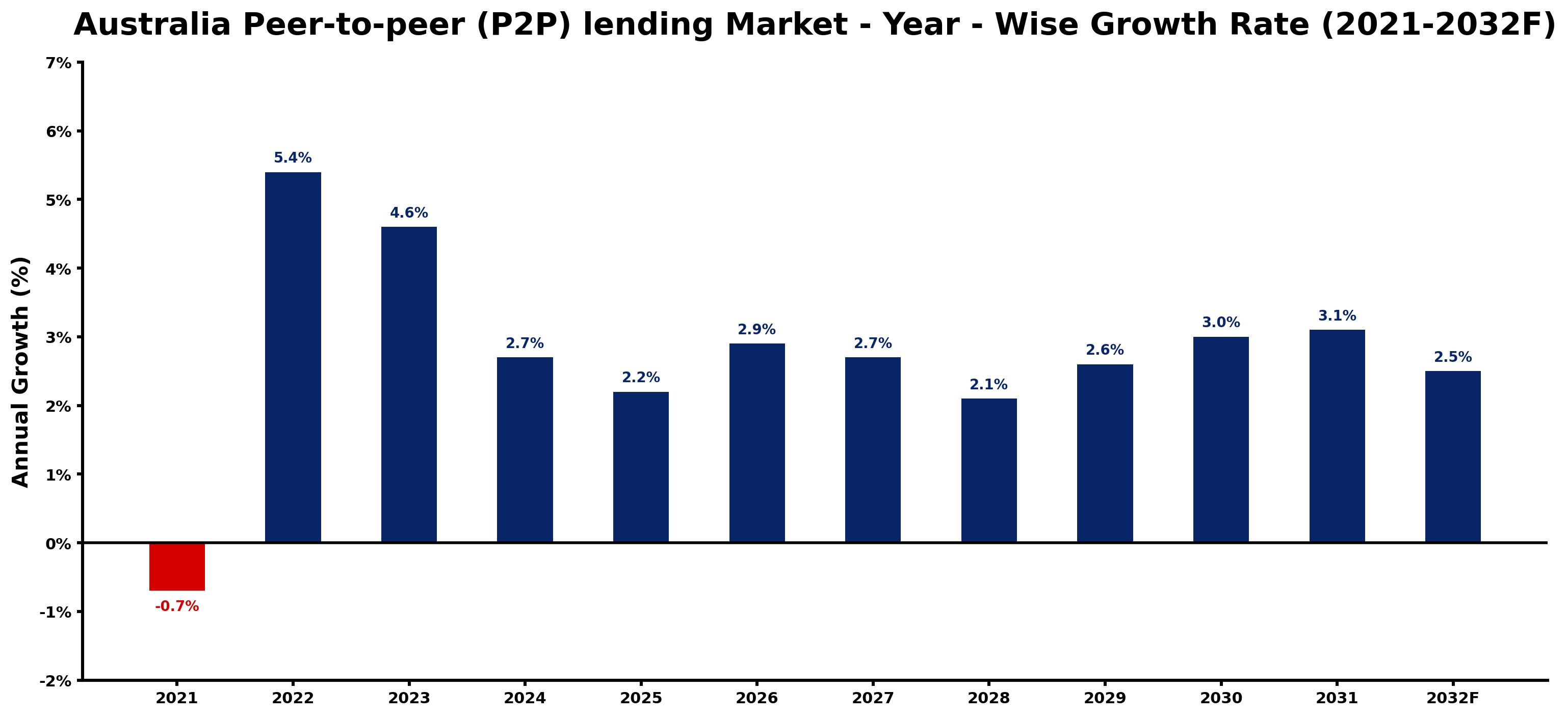
The table below presents the year‑wise growth rates along with the key drivers influencing the market
| Year | Growth Rate | Major Drivers |
| 2021 | -0.7% | Rapid growth in telecom and data center sectors |
| 2022 | 5.4% | Expansion of manufacturing activities |
| 2023 | 4.6% | Increasing industrial infrastructure investments |
| 2024 | 2.7% | Increasing adoption of advanced technologies |
| 2025 | 2.2% | Expansion of transportation and logistics networks |
| 2026 | 2.9% | Government infrastructure modernization initiatives |
| 2027 | 2.7% | Expansion of commercial construction activities |
| 2028 | 2.1% | Increasing industrial infrastructure investments |
| 2029 | 2.6% | Government infrastructure modernization initiatives |
| 2030 | 3.0% | Growing renewable energy integration projects |
| 2031 | 3.1% | Growing renewable energy integration projects |
| 2032 | 2.5% | Expansion of manufacturing activities |
Note - Market size estimations and growth projections presented in this report are based on 6Wresearch’s advanced forecasting approach, validated with industry datasets as of June 2026.
Australia Peer-to-peer (P2P) lending Market Synopsis
The Australian P2P lending market has experienced notable momentum in recent years, driven by the democratization of credit access and technological advancements. However, as we look toward the future, this sector is poised for further transformation, with innovative platforms emerging to meet evolving consumer demands.
While the current landscape is vibrant, it is equally crucial to recognize the challenges stemming from regulatory changes and heightened competition. Navigating these complexities will be essential for stakeholders aiming to leverage the market's potential and maintain sustainable growth.
Australia Peer-to-peer (P2P) lending Market Key Takeaways
- The market is expected to grow steadily, with an estimated value of USD 262 Million by 2032.
- Technological advancements, including blockchain integration, are enhancing the efficiency of P2P lending platforms.
- Regulatory frameworks are evolving to protect consumers, which is critical for gaining trust in the P2P lending ecosystem.
- There is a marked increase in financial inclusion for individuals and small businesses that previously faced barriers in traditional lending.
- Competitive pressures from traditional banks and other fintech companies continue to shape the market dynamics.
Evaluation of Restraints in Australia Peer-to-peer (P2P) lending Market
Despite its growth potential, the P2P lending market in Australia faces significant challenges that could hinder its progression. Evolving regulatory requirements can impact operational models, complicating compliance for new and existing platforms. Additionally, the prevalence of loan defaults and instances of fraud necessitates rigorous risk assessment mechanisms, which can be resource-intensive. As competition intensifies, especially from traditional banks that are adapting to the digital landscape, P2P lenders must innovate to differentiate their offerings and maintain market share.
Australia Peer-to-peer (P2P) lending Market Trends
Several trends are shaping the Australian P2P lending market. The rise of AI-driven lending platforms is revolutionizing how loans are assessed and approved, allowing for faster processing times and improved risk management. Additionally, there is a growing emphasis on user experience, with many platforms investing in seamless digital interfaces to attract and retain customers. Blockchain technology is also gaining traction, promoting transparency and reducing operational inefficiencies in lending processes.
Australia Peer-to-peer (P2P) lending Market Opportunities
Investment opportunities within the Australian P2P lending market are abundant. As demand for quicker and more accessible credit solutions continues to rise, there is significant room for the development of secure, technology-driven lending platforms. Innovative products that cater to underserved segments, particularly small businesses and individuals with limited access to traditional credit, can help capture untapped market share. Furthermore, the incorporation of regulatory support for digital finance initiatives could fortify the market's stability and attractiveness to investors.
Government Initiatives in the Australia Peer-to-peer (P2P) lending Market
The Australian government has implemented various policies and initiatives to support the P2P lending industry. The Australian Securities and Investments Commission (ASIC) plays a pivotal role in regulating the market, ensuring compliance with financial services laws while protecting consumers from predatory lending practices. Additionally, policies that promote innovation in fintech are encouraging the emergence of alternative financing solutions, fostering a more competitive lending environment. Interest rate caps and anti-money laundering regulations further support the integrity of the market.
Future Insights of the Australia Peer-to-peer (P2P) lending Market
Looking ahead to the period between 2026 and 2032, the Australian P2P lending market is expected to embrace significant changes driven by technological innovation and evolving consumer expectations. The emphasis on financial inclusion will likely persist, with platforms expanding their offerings to cater to a broader audience. Increased regulatory clarity will also pave the way for enhanced trust in P2P lending solutions, potentially attracting a wider array of investors. As competition heightens, successful players will be those who can adeptly navigate the market's complexities while delivering superior value to their customers.
Australia Peer-to-peer (P2P) lending Market Latest Developments (May 2025 - June 2026)
In recent months, the Australian P2P lending sector has experienced a notable shift, with platforms increasingly focusing on user-centric innovations and risk management strategies. Several fintech companies are exploring partnerships with established banks to leverage their infrastructure while expanding their reach. Regulatory authorities have also been proactive in refining guidelines to enhance transparency and consumer protection, which is expected to foster a more robust lending environment.
Australia Peer-to-peer (P2P) lending Market - Key Attractiveness of the Report
- 10 Years of Market Numbers
- Historical Data Starting from 2022 to 2025
- Base Year: 2025
- Forecast Data until 2032
- Key Performance Indicators Impacting the Market
- Major Upcoming Developments and Projects
Key Highlights of the Report:
- Australia Peer-to-peer (P2P) lending Market Outlook
- Market Size of Australia Peer-to-peer (P2P) lending Market, 2025
- Forecast of Australia Peer-to-peer (P2P) lending Market, 2032
- Historical Data and Forecast of Australia Peer-to-peer (P2P) lending Revenues & Volume for the Period 2022-2032F
- Australia Peer-to-peer (P2P) lending Market Trend Evolution
- Australia Peer-to-peer (P2P) lending Market Drivers and Challenges
- Australia Peer-to-peer (P2P) lending Price Trends
- Australia Peer-to-peer (P2P) lending Porter's Five Forces
- Australia Peer-to-peer (P2P) lending Industry Life Cycle
- Historical Data and Forecast of Australia Peer-to-peer (P2P) lending Market Revenues & Volume By Business Model for the Period 2022-2032F
- Historical Data and Forecast of Australia Peer-to-peer (P2P) lending Market Revenues & Volume By Alternate Marketplace Lending for the Period 2022-2032F
- Historical Data and Forecast of Australia Peer-to-peer (P2P) lending Market Revenues & Volume By Traditional Lending for the Period 2022-2032F
- Historical Data and Forecast of Australia Peer-to-peer (P2P) lending Market Revenues & Volume By Type for the Period 2022-2032F
- Historical Data and Forecast of Australia Peer-to-peer (P2P) lending Market Revenues & Volume By Consumer Lending for the Period 2022-2032F
- Historical Data and Forecast of Australia Peer-to-peer (P2P) lending Market Revenues & Volume By Business Lending for the Period 2022-2032F
- Historical Data and Forecast of Australia Peer-to-peer (P2P) lending Market Revenues & Volume By End User for the Period 2022-2032F
- Historical Data and Forecast of Australia Peer-to-peer (P2P) lending Market Revenues & Volume By Consumer Credit Loans for the Period 2022-2032F
- Historical Data and Forecast of Australia Peer-to-peer (P2P) lending Market Revenues & Volume By Small Business Loans for the Period 2022-2032F
- Historical Data and Forecast of Australia Peer-to-peer (P2P) lending Market Revenues & Volume By Student Loans for the Period 2022-2032F
- Historical Data and Forecast of Australia Peer-to-peer (P2P) lending Market Revenues & Volume By Real Estate Loans for the Period 2022-2032F
- Australia Peer-to-peer (P2P) lending Import Export Trade Statistics
- Market Opportunity Assessment By Business Model
- Market Opportunity Assessment By Type
- Market Opportunity Assessment By End User
- Australia Peer-to-peer (P2P) lending Top Companies Market Share
- Australia Peer-to-peer (P2P) lending Competitive Benchmarking By Technical and Operational Parameters
- Australia Peer-to-peer (P2P) lending Company Profiles
- Australia Peer-to-peer (P2P) lending Key Strategic Recommendations






































