Australia Personal computers (PC) Market Summary
The australia personal computers (pc) market was estimated at USD 81 Million in 2025 and is projected to reach USD 95 Million by 2032, growing at a CAGR of 2.5% from 2026 to 2032.
Australia Personal computers (PC) Market Year-wise Growth Rate and Key Drivers
This graph highlights how the Australia Personal computers (PC) Market has steadily grown over the past five years, supported by major growth factors.
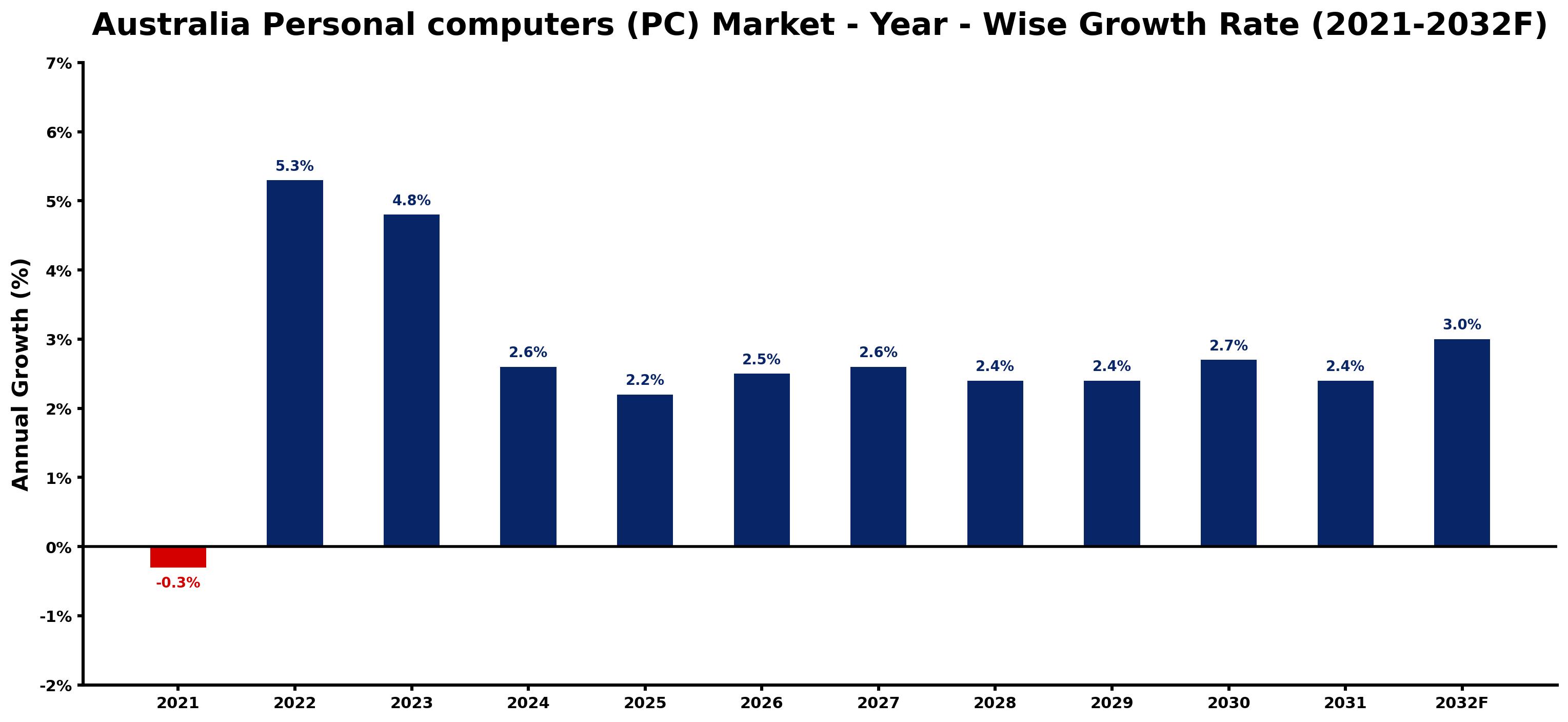
The table below presents the year wise growth rates along with the key drivers influencing the market
| Year | Growth Rate | Major Drivers |
| 2021 | -0.3% | Increased popularity of mobile devices shifted consumer preferences away from traditional personal computers. |
| 2022 | 5.3% | Increasing online education requirements caused a surge in student PC purchases. |
| 2023 | 4.8% | Cloud computing growth prompted businesses to upgrade outdated PC systems significantly. |
| 2024 | 2.6% | Consumer preferences began shifting towards high-performance gaming PCs and accessories. |
| 2025 | 2.2% | New digital infrastructure investments drove corporate demand for advanced computing solutions. |
| 2026 | 2.5% | Environmental sustainability concerns led to more energy-efficient PC technologies gaining traction. |
| 2027 | 2.6% | Emerging hybrid work models encouraged livelier PC sales in urban and suburban areas. |
| 2028 | 2.4% | Gaming and esports trends attracted younger demographics to invest in personal computers. |
| 2029 | 2.4% | Enhanced AI applications necessitated high-performance PCs for both businesses and consumers. |
| 2030 | 2.7% | Rising cybersecurity threats amplified the need for secure and updated personal computing devices. |
| 2031 | 2.4% | Growing popularity of virtual reality applications expanded the market for specialized PCs. |
| 2032 | 3.0% | Integration of Internet of Things devices increased demand for interconnected personal computers. |
Note - Market size estimations and growth projections presented in this report are based on 6Wresearch's advanced forecasting approach, validated with industry datasets as of June 2026.
Australia Personal computers (PC) Market Synopsis
The Australia Personal computers (PC) Market is projected to reach 2.5% and witness significant growth during the forecast period (2026-2032). The market's resilience is underscored by a rising preference for remote working solutions, increased engagement in gaming, and the widespread adoption of personal computers in educational contexts. Notably, both laptops and hybrid computing devices equipped with enhanced processing capabilities and advanced display technologies are capturing consumer interest. Critical influences such as cloud computing advancements and the integration of artificial intelligence into PC designs are also reshaping consumer preferences across various demographic segments.
Australia Personal computers (PC) Market Growth Drivers
Several factors are propelling the growth of the Australia Personal computers (PC) Market. The significant shift towards remote work and online education has resulted in heightened demand for personal computing devices. This trend is supplemented by:
- Increased digital transformation within sectors including education, healthcare, and corporate environments, promoting a higher rate of PC adoption.
- A surge in the gaming community, which has created a competitive demand for high-performance desktops and laptops, particularly those tailored for gaming.
- Government initiatives aiming to improve digital literacy among citizens, thereby boosting the number of households with personal computers.
- Innovation in high-performance computing technology, leading to more powerful and efficient PCs that serve both casual users and professionals alike.
- The rising trend of mobile and hybrid work solutions, which encourage users to invest in portable yet powerful personal computing devices.
Australia Personal computers (PC) Market Challenges and Restraints
Despite the positive outlook, the Australia Personal computers (PC) Market faces several challenges that could impede its growth trajectory. Among these challenges are:
- Global supply chain disruptions affecting the availability of components, particularly semiconductors, which are crucial for PC manufacturing.
- The ongoing semiconductor shortage that has led to delays in production and increased prices, impacting consumer affordability.
- Intense competition from well-established global brands, which limits market share opportunities for local manufacturers and retailers.
- Growing expectations for high-performance computing that escalate production costs, potentially deterring entry-level consumers.
- Environmental regulations related to electronic waste management, which necessitate additional investments in recycling and sustainable practices.
Australia Personal computers (PC) Market Investment Opportunities
The investment landscape within the Australia Personal computers (PC) Market is evolving, marked by burgeoning opportunities primarily driven by:
- The increasing demand for high-performance laptops, tailored for both gaming and professional use, creating avenues for innovation and market entry strategies.
- Expanding reliance on e-learning platforms, which necessitates the continuous enhancement of personal computing devices to meet educational requirements.
- Advancements in cloud computing technologies prompting significant investments in the development of PCs that seamlessly integrate with cloud-based solutions.
- The push towards AI-driven technological solutions fostering a demand for PCs that support machine learning and advanced data processing functionalities.
- Strategic partnerships and collaborations aimed at enhancing product offerings and tapping into new consumer segments within the PC market.
Australia Personal computers (PC) Market Government Investment and Initiatives
The role of government in the Australia Personal computers (PC) Market is paramount, with various policies and initiatives influencing its growth. The Australian government promotes the PC market through:
- Trade policies that facilitate the importation and sale of personal computers, ensuring compliance with national safety and quality standards.
- Cybersecurity regulations that protect consumers and businesses, thus building trust in personal computing solutions.
- Environmental standards aimed at promoting sustainability in the electronics sector, encouraging responsible disposal and recycling initiatives.
- Financial grants and funding for innovative technology development, boosting domestic manufacturers' abilities to compete in a global market.
- Programs aimed at improving digital literacy, empowering citizens to utilize technology effectively, thereby increasing demand for personal computing devices.
Australia Personal computers (PC) Market Latest Developments (May 2025 - June 2026)
Between May 2025 and June 2026, the Australia Personal computers (PC) Market has witnessed various developments reflecting shifts in consumer behavior and technological advancements. Notably, an increase in demand for cloud-integrated PCs has underscored the importance of adaptable computing solutions. Furthermore, the trend of remote work has solidified the reliance on high-performance laptops, resulting in a surge in innovative product offerings. Various government initiatives have also emphasized the need for digital inclusivity, further propelling the adoption of personal computers across different demographics.
Australia Personal computers (PC) Market - Key Attractiveness of the Report
- 10 Years of Market Numbers
- Historical Data Starting from 2022 to 2025
- Base Year: 2025
- Forecast Data until 2032
- Key Performance Indicators Impacting the Market
- Major Upcoming Developments and Projects
Key Highlights of the Report:
- Australia Personal computers (PC) Market Outlook
- Market Size of Australia Personal computers (PC) Market, 2025
- Forecast of Australia Personal computers (PC) Market, 2032
- Historical Data and Forecast of Australia Personal computers (PC) Revenues & Volume for the Period 2022-2032F
- Australia Personal computers (PC) Market Trend Evolution
- Australia Personal computers (PC) Market Drivers and Challenges
- Australia Personal computers (PC) Price Trends
- Australia Personal computers (PC) Porter's Five Forces
- Australia Personal computers (PC) Industry Life Cycle
- Historical Data and Forecast of Australia Personal computers (PC) Market Revenues & Volume By Product for the Period 2022-2032F
- Historical Data and Forecast of Australia Personal computers (PC) Market Revenues & Volume By Commercial Desktop for the Period 2022-2032F
- Historical Data and Forecast of Australia Personal computers (PC) Market Revenues & Volume By Commercial Notebook for the Period 2022-2032F
- Historical Data and Forecast of Australia Personal computers (PC) Market Revenues & Volume By Consumer Desktop for the Period 2022-2032F
- Historical Data and Forecast of Australia Personal computers (PC) Market Revenues & Volume By Consumer Notebook and Workstation for the Period 2022-2032F
- Historical Data and Forecast of Australia Personal computers (PC) Market Revenues & Volume By Distribution Channel for the Period 2022-2032F
- Historical Data and Forecast of Australia Personal computers (PC) Market Revenues & Volume By Online for the Period 2022-2032F
- Historical Data and Forecast of Australia Personal computers (PC) Market Revenues & Volume By Offline for the Period 2022-2032F
- Australia Personal computers (PC) Import Export Trade Statistics
- Market Opportunity Assessment By Product
- Market Opportunity Assessment By Distribution Channel
- Australia Personal computers (PC) Top Companies Market Share
- Australia Personal computers (PC) Competitive Benchmarking By Technical and Operational Parameters
- Australia Personal computers (PC) Company Profiles
- Australia Personal computers (PC) Key Strategic Recommendations






































