Australia Plastic Furniture Market Size Growth Rate
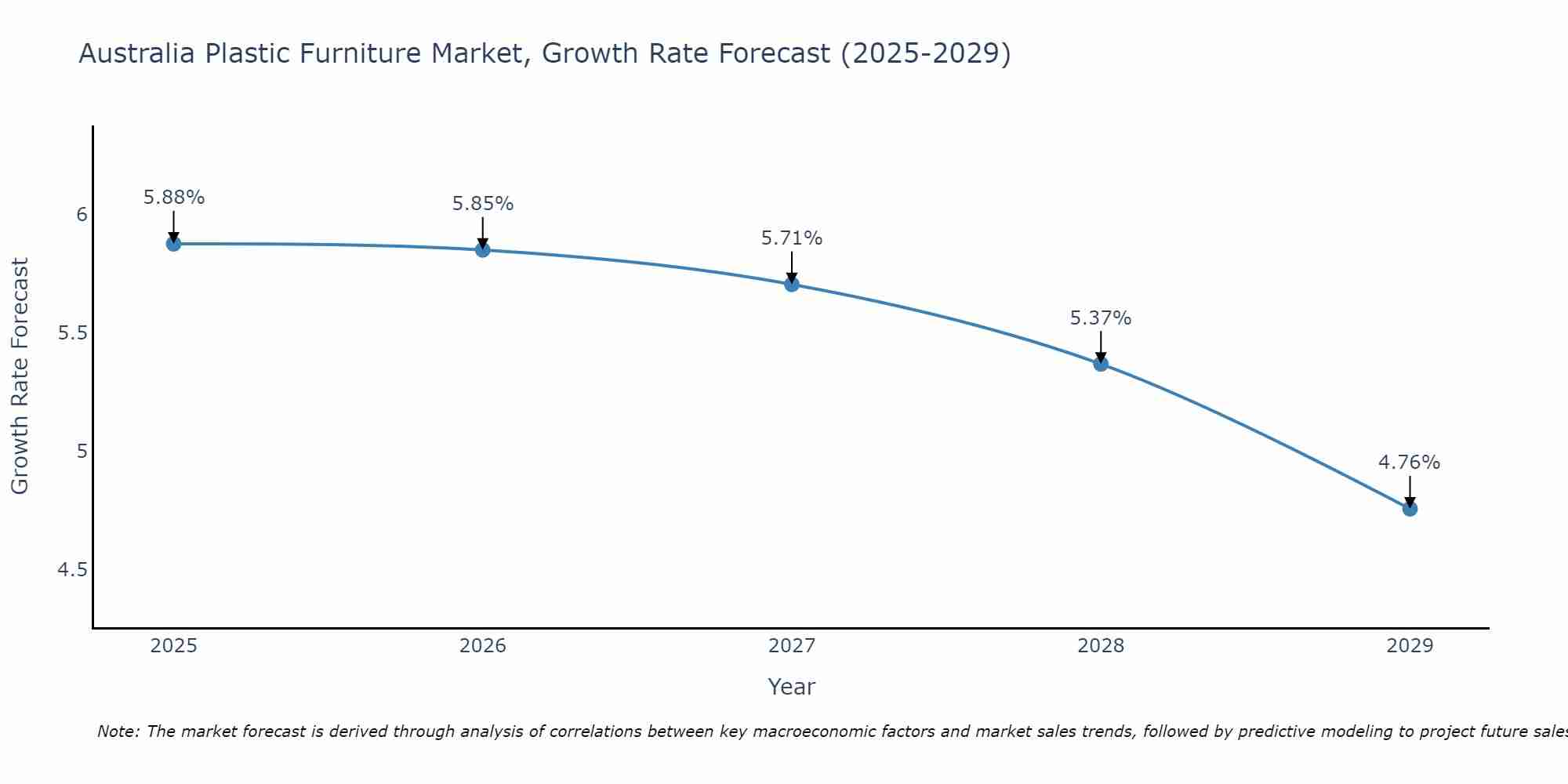
The Australia Plastic Furniture Market could see a tapering of growth rates over 2025 to 2029. Although the growth rate starts strong at 5.88% in 2025, it steadily loses momentum, ending at 4.76% by 2029.
Australia Plastic Furniture Market Synopsis
The plastic furniture market in Australia is expanding due to its affordability, lightweight design, and versatility. Demand for durable, UV-resistant, and recyclable plastic furniture is increasing in both residential and commercial sectors. The shift towards high-quality, aesthetically appealing plastic furniture solutions is driving innovation in the industry.
Drivers of the market
The demand for plastic furniture in Australia is growing due to its affordability, lightweight nature, and durability. The market is supported by increasing urbanization, a preference for low-maintenance furniture, and innovations in design and material quality. Sustainable plastic furniture made from recycled materials is gaining traction as consumers become more environmentally conscious. The hospitality and commercial sectors also contribute to demand, particularly for stackable and space-efficient furniture.
Challenges of the market
The plastic furniture market in Australia struggles with increasing environmental concerns and government regulations aimed at reducing plastic waste. Consumers are shifting towards sustainable alternatives, leading to declining demand for traditional plastic furniture. Competition from eco-friendly and recycled plastic furniture brands requires manufacturers to innovate and invest in sustainable materials. Additionally, fluctuating prices of raw materials like polyethylene and polypropylene impact production costs, while cheap imports from overseas markets create pricing challenges for domestic manufacturers.
Investment opportunities in the Market
Plastic furniture remains popular due to affordability, lightweight properties, and weather resistance. Investors can focus on recycled plastic furniture, modular designs, and expansion into commercial applications like cafes, schools, and offices.
Government Policy of the market
The plastic furniture market in Australia operates under product safety and environmental protection policies to ensure quality and sustainability. The government enforces compliance with Australian Standards (AS) for plastic durability, load-bearing capacity, and fire safety. Import regulations require foreign-made plastic furniture to meet stringent certification requirements before being sold in the market. Additionally, environmental policies encourage the use of recycled plastics in furniture production, aligning with Australias circular economy initiatives.
Key Highlights of the Report:
- Australia Plastic Furniture Market Outlook
- Market Size of Australia Plastic Furniture Market, 2024
- Forecast of Australia Plastic Furniture Market, 2031
- Historical Data and Forecast of Australia Plastic Furniture Revenues & Volume for the Period 2018 - 2031
- Australia Plastic Furniture Market Trend Evolution
- Australia Plastic Furniture Market Drivers and Challenges
- Australia Plastic Furniture Price Trends
- Australia Plastic Furniture Porter's Five Forces
- Australia Plastic Furniture Industry Life Cycle
- Historical Data and Forecast of Australia Plastic Furniture Market Revenues & Volume By Distribution Channel for the Period 2018 - 2031
- Historical Data and Forecast of Australia Plastic Furniture Market Revenues & Volume By Online for the Period 2018 - 2031
- Historical Data and Forecast of Australia Plastic Furniture Market Revenues & Volume By Offline for the Period 2018 - 2031
- Historical Data and Forecast of Australia Plastic Furniture Market Revenues & Volume By Application for the Period 2018 - 2031
- Historical Data and Forecast of Australia Plastic Furniture Market Revenues & Volume By Residential for the Period 2018 - 2031
- Historical Data and Forecast of Australia Plastic Furniture Market Revenues & Volume By Commercial for the Period 2018 - 2031
- Australia Plastic Furniture Import Export Trade Statistics
- Market Opportunity Assessment By Distribution Channel
- Market Opportunity Assessment By Application
- Australia Plastic Furniture Top Companies Market Share
- Australia Plastic Furniture Competitive Benchmarking By Technical and Operational Parameters
- Australia Plastic Furniture Company Profiles
- Australia Plastic Furniture Key Strategic Recommendations






































