Australia Pliers Market Summary
The australia pliers market was estimated at USD 245 Million in 2025 and is projected to reach USD 289 Million by 2032, growing at a CAGR of 2.4% from 2026 to 2032.
Australia Pliers Market Year-wise Growth Rate and Key Drivers
This graph highlights how the Australia Pliers Market has steadily grown over the past five years, supported by major growth factors.
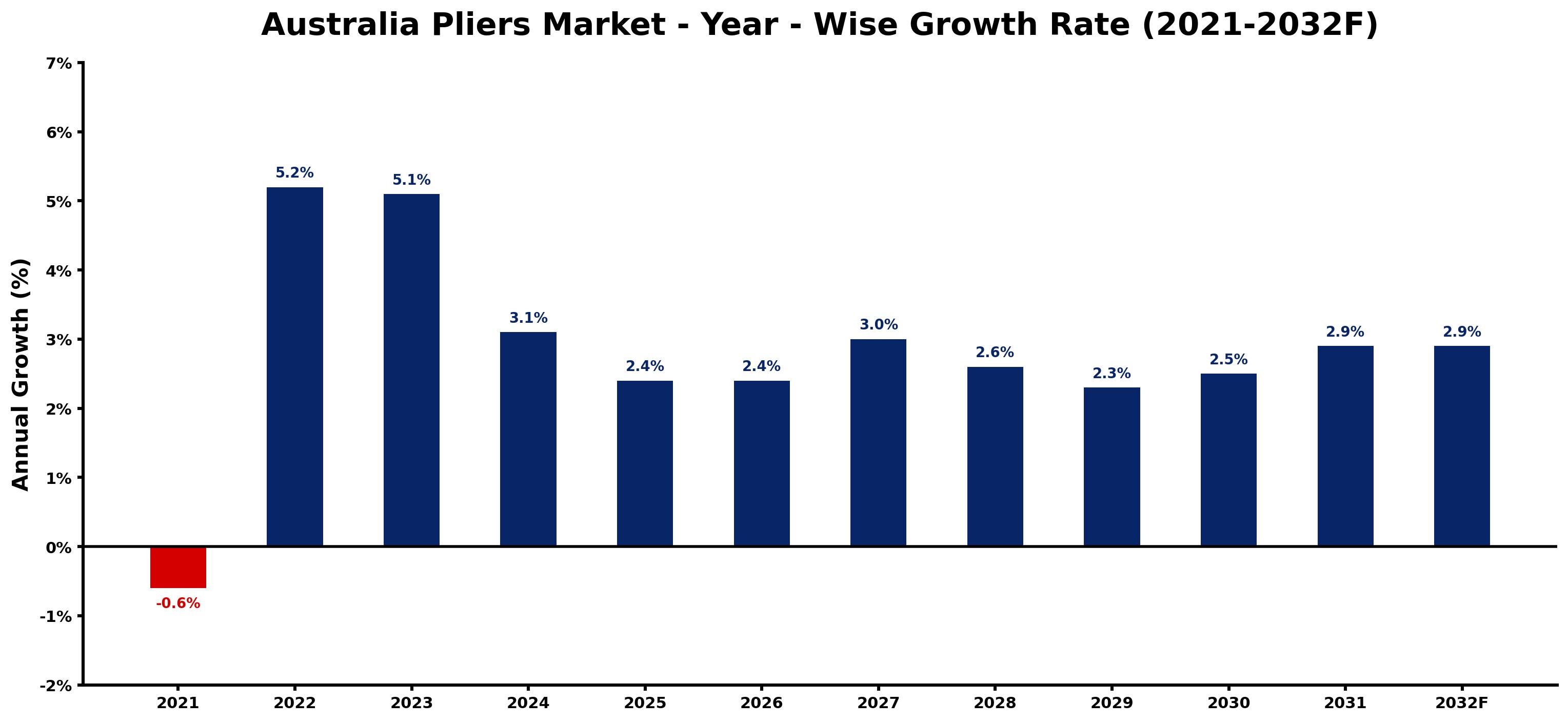
The table below presents the year wise growth rates along with the key drivers influencing the market
| Year | Growth Rate | Major Drivers |
| 2021 | -0.6% | Supply chain disruptions caused by global logistics challenges negatively impacted availability and increased costs for plier manufacturers. |
| 2022 | 5.2% | Manufacturers emphasized ergonomic designs, appealing to professionals and DIY enthusiasts alike. |
| 2023 | 5.1% | Local construction activities surged, increasing demand for reliable hand tools across sectors. |
| 2024 | 3.1% | E-commerce platforms expanded, making pliers more accessible to remote Australian customers. |
| 2025 | 2.4% | Emerging DIY trends prompted younger consumers to invest in quality hand tools. |
| 2026 | 2.4% | Infrastructure projects gained momentum, necessitating durable tools for various applications. |
| 2027 | 3.0% | Sustainable materials emerged, giving eco-conscious consumers more choices in tool selection. |
| 2028 | 2.6% | Technological innovations introduced smart tools, attracting tech-savvy professionals to upgrade. |
| 2029 | 2.3% | Skilled labor shortages pushed companies to invest in reliable tools for efficiency. |
| 2030 | 2.5% | Urbanization trends increased, highlighting the need for compact and versatile pliers. |
| 2031 | 2.9% | Work-from-home dynamics fueled DIY renovations, boosting pliers sales across urban regions. |
| 2032 | 2.9% | Industry collaborations focused on quality standards, enhancing consumer trust in brands. |
Note - Market size estimations and growth projections presented in this report are based on 6Wresearch's advanced forecasting approach, validated with industry datasets as of June 2026.
Australia Pliers Market Synopsis
The Australia Pliers Market is projected to reach 2.4% and witness significant growth during the forecast period (2026-2032). This growth is primarily driven by the expanding construction, automotive, and DIY sectors, which are increasingly demanding high-quality and durable hand tools. As professionals and hobbyists seek ergonomically designed pliers, the market is experiencing a surge in innovation, including the introduction of insulated pliers for electrical applications and multifunctional tool designs that are geared toward meeting diverse user needs.
Australia Pliers Market Growth Drivers
The Australia Pliers Market is bolstered by several key factors that are shaping its growth trajectory:
- The rising popularity of do-it-yourself (DIY) projects has been a significant driver, as more consumers are engaging in home improvement and repair tasks. This trend is creating a robust demand for reliable hand tools.
- An increase in construction projects across Australia is contributing to heightened demand for pliers, particularly among professionals in the building and electrical sectors, who require high-performance tools.
- The automotive industry is evolving, with mechanics and technicians seeking tools that combine efficiency with safety. As such, high-quality pliers are essential in maintenance and repair tasks.
- Innovations in tool design, such as ergonomic grips and multifunctionality, not only improve user comfort but also enhance efficiency, driving adoption among both professional and DIY users.
- The increasing emphasis on safety, particularly for electrical work, has led to a higher demand for insulated pliers, further expanding the market's reach.
Australia Pliers Market Challenges and Restraints
While the Australia Pliers Market is experiencing growth, it also faces several challenges that could hinder its progress:
- Local manufacturers are struggling to compete with low-cost imported tools, which often undercut prices, thereby intensifying market competition.
- Fluctuating raw material costs, particularly for steel, can significantly impact production expenses and, consequently, profitability for manufacturers in the sector.
- The growing capabilities and popularity of power tools are shifting consumer preferences away from manual pliers, posing a risk to traditional hand tool sales.
- The rapid pace of technological advancement requires constant innovation from manufacturers, which can be resource-intensive and may not always align with market demands.
- Safety regulations that govern tool design and production can impose additional costs and requirements that manufacturers must navigate effectively.
Australia Pliers Market Investment Opportunities
The Australia Pliers Market presents various investment opportunities that can be leveraged by forward-thinking companies aiming to capitalize on industry trends:
- Investing in high-quality, durable pliers with ergonomic designs can cater to the growing segment of professional users and serious DIY enthusiasts, enhancing brand loyalty.
- There is a significant opportunity in developing insulated pliers for electrical applications, as safety remains a top priority across various industries.
- Innovative designs that integrate multiple functionalities could attract a broader range of users, providing an edge in a competitive market.
- The expansion of online retail channels for hand tools presents a lucrative avenue for reaching consumers directly, especially as e-commerce continues to grow.
- Collaboration with educational institutions to promote the importance of high-quality tools in training programs can foster brand recognition and loyalty among future professionals.
Australia Pliers Market Government Investment and Initiatives
Government policy plays a crucial role in shaping the landscape of the Australia Pliers Market. Regulatory frameworks focusing on industrial tool safety ensure that manufacturers adhere to stringent standards for material durability and electrical insulation. The government is committed to enforcing compliance, which helps maintain quality control over tools available in the market. Additionally, public spending initiatives aimed at promoting the construction and automotive sectors further stimulate growth in the pliers market. Trade policies regulating imports ensure that substandard tools are not available, which protects consumers and supports local manufacturers.
Australia Pliers Market Latest Developments (May 2025 - June 2026)
Between May 2025 and June 2026, the Australia Pliers Market witnessed several notable developments that indicate a dynamic industry direction. Innovations in tool design have intensified, with manufacturers increasingly focusing on ergonomic features and multifunctionality. There has also been a noticeable shift toward online sales channels, responding to changing consumer purchasing behaviors. Furthermore, collaborations between manufacturers and design engineers have led to the creation of tools that address specific industry needs, such as enhanced safety and efficiency in electrical applications. Market players are actively seeking to differentiate their products by incorporating sustainable materials and practices into their production processes, acknowledging the growing consumer demand for eco-friendliness.
Australia Pliers Market - Key Attractiveness of the Report
- 10 Years of Market Numbers
- Historical Data Starting from 2022 to 2025
- Base Year: 2025
- Forecast Data until 2032
- Key Performance Indicators Impacting the Market
- Major Upcoming Developments and Projects
Key Highlights of the Report:
- Australia Pliers Market Outlook
- Market Size of Australia Pliers Market, 2025
- Forecast of Australia Pliers Market, 2032
- Historical Data and Forecast of Australia Pliers Revenues & Volume for the Period 2022-2032F
- Australia Pliers Market Trend Evolution
- Australia Pliers Market Drivers and Challenges
- Australia Pliers Price Trends
- Australia Pliers Porter's Five Forces
- Australia Pliers Industry Life Cycle
- Historical Data and Forecast of Australia Pliers Market Revenues & Volume By Types for the Period 2022-2032F
- Historical Data and Forecast of Australia Pliers Market Revenues & Volume By Cutting pliers for the Period 2022-2032F
- Historical Data and Forecast of Australia Pliers Market Revenues & Volume By Crimping pliers for the Period 2022-2032F
- Historical Data and Forecast of Australia Pliers Market Revenues & Volume By Linesman?s Pliers for the Period 2022-2032F
- Historical Data and Forecast of Australia Pliers Market Revenues & Volume By Locking Pliers for the Period 2022-2032F
- Historical Data and Forecast of Australia Pliers Market Revenues & Volume By Needle-Nose Pliers for the Period 2022-2032F
- Historical Data and Forecast of Australia Pliers Market Revenues & Volume By Water-Pump Pliers for the Period 2022-2032F
- Historical Data and Forecast of Australia Pliers Market Revenues & Volume By Diagonal Pliers for the Period 2022-2032F
- Historical Data and Forecast of Australia Cutting pliers Pliers Market Revenues & Volume By Others for the Period 2022-2032F
- Historical Data and Forecast of Australia Pliers Market Revenues & Volume By Applications for the Period 2022-2032F
- Historical Data and Forecast of Australia Pliers Market Revenues & Volume By Industrial for the Period 2022-2032F
- Historical Data and Forecast of Australia Pliers Market Revenues & Volume By Automotive professional mechanic for the Period 2022-2032F
- Historical Data and Forecast of Australia Pliers Market Revenues & Volume By Electrician for the Period 2022-2032F
- Historical Data and Forecast of Australia Pliers Market Revenues & Volume By General maintenance for the Period 2022-2032F
- Australia Pliers Import Export Trade Statistics
- Market Opportunity Assessment By Types
- Market Opportunity Assessment By Applications
- Australia Pliers Top Companies Market Share
- Australia Pliers Competitive Benchmarking By Technical and Operational Parameters
- Australia Pliers Company Profiles
- Australia Pliers Key Strategic Recommendations






































