Australia Ploughing and Cultivating Machinery Market Size, Share & Growth Rate
The Australia Ploughing and Cultivating Machinery Market was estimated at USD 129 Million in 2025 and is projected to reach USD 151 Million by 2032, growing at a CAGR of 2.3% from 2026 to 2032. This growth trajectory is primarily driven by advancements in precision agriculture techniques and an increasing shift toward mechanized farming methods. Enhanced efficiency demands, combined with government support for modern farming practices, are further underpinning this positive outlook for the market.
Australia Ploughing and Cultivating Machinery Market Year-wise Growth Rate and Key Drivers
This graph highlights how the Australia Ploughing and Cultivating Machinery Market has steadily grown over the years, supported by major growth factors.
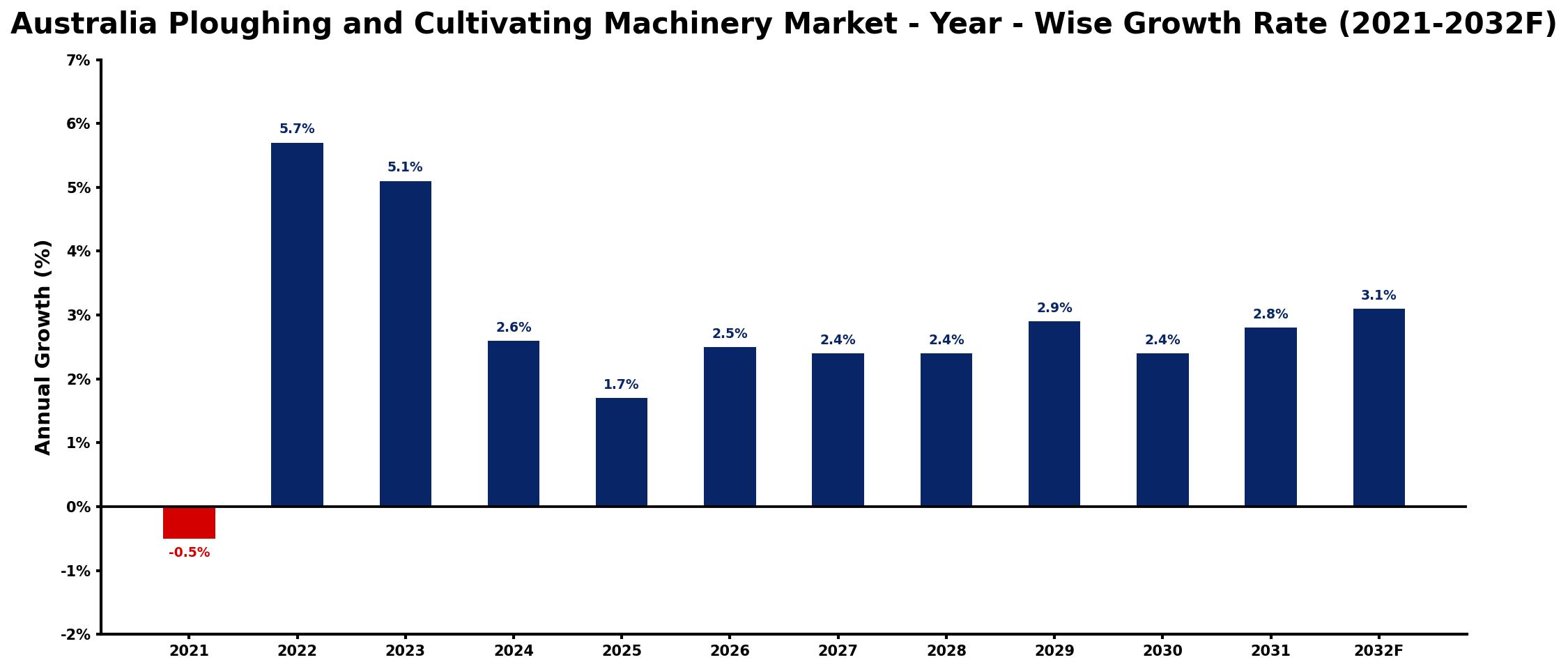
The table below presents the year‑wise growth rates along with the key drivers influencing the market
| Year | Growth Rate | Major Drivers |
| 2021 | -0.5% | decreased agricultural investment levels |
| 2022 | 5.7% | rising demand for automation solutions |
| 2023 | 5.1% | increased focus on sustainable practices |
| 2024 | 2.6% | growing precision agriculture adoption |
| 2025 | 1.7% | expansion of export markets globally |
| 2026 | 2.5% | advancements in technology integration |
| 2027 | 2.4% | increased farm consolidation trends |
| 2028 | 2.4% | surge in organic farming practices |
| 2029 | 2.9% | government incentives for modernization |
| 2030 | 2.4% | rising consumer demand for efficiency |
| 2031 | 2.8% | expanding industrial usage applications |
| 2032 | 3.1% | growth in renewable energy applications |
Note: Market size estimations and growth projections presented in this report are based on 6Wresearch's proprietary forecasting methodology, utilizing the latest available industry data, government publications, and primary research inputs.
Australia Ploughing and Cultivating Machinery Market Synopsis
In Australia, the adoption of GPS-enabled and automated ploughing and cultivating machinery is becoming increasingly prevalent, allowing farmers to optimize their operations significantly. The integration of technology not only boosts productivity but also ensures that farmers can respond effectively to the complex challenges posed by modern agriculture.
Furthermore, the market is benefiting from the expansion of the agricultural sector, which continues to seek innovative solutions to improve efficiency. However, barriers such as high initial investment costs and limited access to financing options pose challenges for many farmers looking to modernize their equipment.
Australia Ploughing and Cultivating Machinery Market Key Takeaways
- The market is projected to grow steadily, driven by technological advancements in farming.
- Government initiatives play a crucial role in promoting the adoption of precision agriculture.
- High costs and financing limitations are significant barriers to market entry for many farmers.
- Automated and GPS-guided machinery is increasingly sought after for enhanced productivity.
- Investment opportunities exist for those focusing on durable and efficient agricultural equipment.
Evaluation of Restraints in Australia Ploughing and Cultivating Machinery Market
Several real constraints hinder the growth of the Australia Ploughing and Cultivating Machinery Market. The primary issue lies in the high initial investment required for modern ploughing and cultivating machinery, which deters many farmers from upgrading. Additionally, access to financial resources is limited, particularly for smaller operators who may not have the capital needed to invest in advanced machinery. Furthermore, unpredictable weather patterns and ongoing soil degradation pose significant risks to farming productivity, impacting demand for new equipment.
Australia Ploughing and Cultivating Machinery Market Trends
Current trends in the Australia Ploughing and Cultivating Machinery Market indicate a strong shift toward automation and precision technologies. Farmers are increasingly leveraging data-driven insights to optimize their operations, driving demand for sophisticated machinery that incorporates these advancements. Sustainability is another key trend, as growers look for equipment that reduces environmental impact while maintaining high productivity levels. Additionally, the customization of machinery for specific farming operations is gaining traction, allowing for greater flexibility and efficiency.
Australia Ploughing and Cultivating Machinery Market Opportunities
Significant investment opportunities exist in the Australia Ploughing and Cultivating Machinery Market, particularly in advanced technology solutions that enhance efficiency. With growing mechanization, there is strong demand for equipment such as automated and GPS-guided ploughing systems. Moreover, as farmers increasingly adopt precision agriculture practices, innovations in machinery that support these initiatives will likely see accelerated growth. Entrepreneurs and investors can tap into this lucrative sector by focusing on cutting-edge technology and durable machinery tailored to the unique needs of Australian farmers.
Government Initiatives in the Australia Ploughing and Cultivating Machinery Market
The Australian government supports the agricultural sector through various initiatives designed to promote the modernization of farming equipment. Subsidies, tax benefits, and grants aimed at enhancing farming efficiency play a crucial role in encouraging the adoption of advanced machinery. Additionally, policies that favor precision farming and provide incentives for local manufacturing help to ensure that farmers have access to cost-effective, high-quality equipment, ultimately fostering a more competitive market environment.
Future Insights of the Australia Ploughing and Cultivating Machinery Market
Looking ahead to the 2026-2032 period, the Australia Ploughing and Cultivating Machinery Market is poised for steady growth, bolstered by continuous advancements in technology and a sustained focus on efficiency in farming operations. The ongoing transition toward precision agriculture is expected to further amplify demand for sophisticated machinery. As more farmers recognize the value of mechanization and automated systems, the market is likely to evolve, presenting new avenues for investment and innovation that align with emerging agricultural practices.
Australia Ploughing and Cultivating Machinery Market Latest Developments (2025 - 2026)
The ploughing and cultivating machinery sector in Australia is witnessing several significant developments aimed at enhancing operational efficiency and sustainability. Manufacturers are increasingly focusing on integrating advanced technologies into their machinery offerings, such as artificial intelligence and machine learning for better precision farming. There is also a noticeable trend towards environmentally friendly practices, with innovations in machinery that reduce carbon footprints while maintaining productivity. Furthermore, industry collaboration is emerging as stakeholders seek to share knowledge and resources, driving further improvements across the sector.
Australia Ploughing and Cultivating Machinery Market - Key Attractiveness of the Report
- 10 Years of Market Numbers
- Historical Data Starting from 2022 to 2025
- Base Year: 2025
- Forecast Data until 2032
- Key Performance Indicators Impacting the Market
- Major Upcoming Developments and Projects
Key Highlights of the Report:
- Australia Ploughing and Cultivating Machinery Market Outlook
- Market Size of Australia Ploughing and Cultivating Machinery Market, 2025
- Forecast of Australia Ploughing and Cultivating Machinery Market, 2032
- Historical Data and Forecast of Australia Ploughing and Cultivating Machinery Revenues & Volume for the Period 2022-2032F
- Australia Ploughing and Cultivating Machinery Market Trend Evolution
- Australia Ploughing and Cultivating Machinery Market Drivers and Challenges
- Australia Ploughing and Cultivating Machinery Price Trends
- Australia Ploughing and Cultivating Machinery Porter's Five Forces
- Australia Ploughing and Cultivating Machinery Industry Life Cycle
- Historical Data and Forecast of Australia Ploughing and Cultivating Machinery Market Revenues & Volume By Type for the Period 2022-2032F
- Historical Data and Forecast of Australia Ploughing and Cultivating Machinery Market Revenues & Volume By Ploughs for the Period 2022-2032F
- Historical Data and Forecast of Australia Ploughing and Cultivating Machinery Market Revenues & Volume By Harrows for the Period 2022-2032F
- Historical Data and Forecast of Australia Ploughing and Cultivating Machinery Market Revenues & Volume By Others for the Period 2022-2032F
- Historical Data and Forecast of Australia Ploughing and Cultivating Machinery Market Revenues & Volume By Application for the Period 2022-2032F
- Historical Data and Forecast of Australia Ploughing and Cultivating Machinery Market Revenues & Volume By Soil Loosening for the Period 2022-2032F
- Historical Data and Forecast of Australia Ploughing and Cultivating Machinery Market Revenues & Volume By Clod Size Reduction for the Period 2022-2032F
- Historical Data and Forecast of Australia Ploughing and Cultivating Machinery Market Revenues & Volume By Clod Sorting for the Period 2022-2032F
- Historical Data and Forecast of Australia Ploughing and Cultivating Machinery Market Revenues & Volume By Others for the Period 2022-2032F
- Australia Ploughing and Cultivating Machinery Import Export Trade Statistics
- Market Opportunity Assessment By Type
- Market Opportunity Assessment By Application
- Australia Ploughing and Cultivating Machinery Top Companies Market Share
- Australia Ploughing and Cultivating Machinery Competitive Benchmarking By Technical and Operational Parameters
- Australia Ploughing and Cultivating Machinery Company Profiles
- Australia Ploughing and Cultivating Machinery Key Strategic Recommendations






































