Australia Processed Vegetables and Fruits Market: Import Trend Analysis
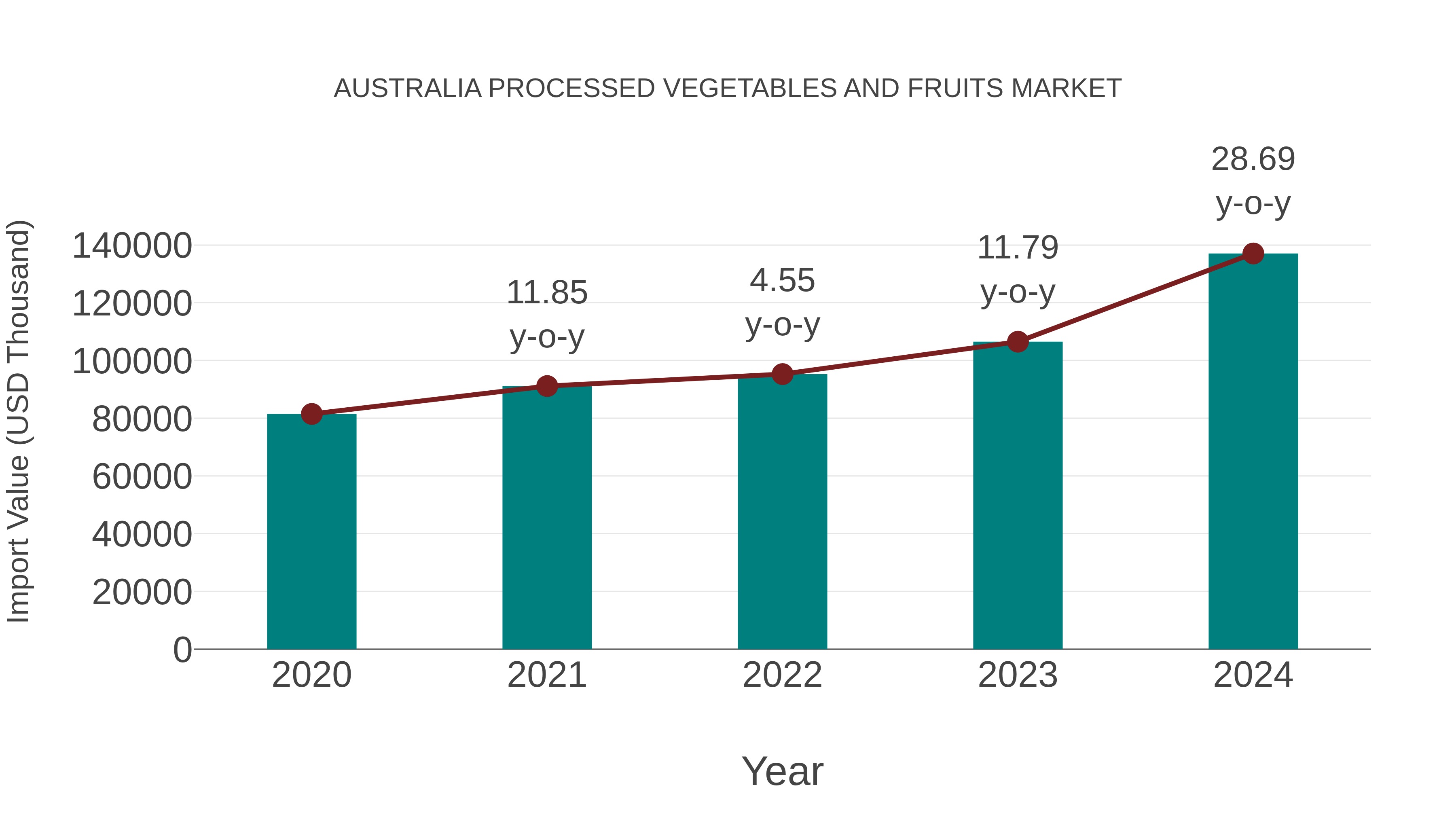
In the Australia processed vegetables and fruits market, the import trend exhibited notable growth from 2023 to 2024, with a growth rate of 28.69%. The compound annual growth rate (CAGR) for the period 2020-2024 stood at 13.89%. This surge in imports could be attributed to evolving consumer preferences towards convenience foods and an increase in demand for a diverse range of processed fruits and vegetables.
Australia Processed Vegetables And Fruits Market Overview
Australias processed vegetables and fruits market is well-established, offering a wide variety of canned, frozen, pickled, and dried produce. Key drivers include urban lifestyles, year-round availability, and increasing demand for convenience foods. Domestic production is complemented by imports, with supply chains optimized for long shelf-life and minimal nutrient loss. Health trends, export opportunities in Asia, and government support for agri-processing infrastructure are shaping the future of this market.
Trends of the market
The processed vegetables and fruits market in Australia is growing due to increasing urbanization and demand for quick meal solutions. Consumers prefer frozen, canned, dried, and pureed options, with a noticeable lean toward preservative-free and organic choices. Advances in cold chain logistics and food preservation technologies are also enhancing product quality and shelf life.
Challenges of the market
This market struggles with issues like limited shelf life, high energy costs for refrigeration, and supply chain disruptions, especially from climatic events such as droughts and floods. Competition from cheaper imports also affects profitability for local processors. Furthermore, the increasing demand for organic and additive-free products means companies must invest in more advanced processing technologies, which raises costs.
Investment opportunities in the Market
The processed vegetables and fruits market in Australia offers a range of investment opportunities, particularly in the frozen and organic segments. With the increasing preference for ready-to-eat meals, there is potential for companies that provide high-quality, nutritious, and convenient vegetable and fruit options. Additionally, investing in modern cold storage facilities and advanced processing technologies can improve product quality and reduce costs, offering a competitive edge in this expanding market.
Government Policy of the market
This market is shaped by robust food safety legislation, including compliance with the Australia New Zealand Food Standards Code. Government support is provided through infrastructure grants and export development assistance, which promote innovation and access to international markets. However, sustainability mandates, including packaging waste reduction targets and emission controls, compel companies to invest in greener technologies, increasing operational costs. Trade agreements also open competition from international suppliers, sometimes putting local businesses at a disadvantage.
Key Highlights of the Report:
- Australia Processed Vegetables and Fruits Market Outlook
- Market Size of Australia Processed Vegetables and Fruits Market, 2025
- Forecast of Australia Processed Vegetables and Fruits Market, 2032
- Historical Data and Forecast of Australia Processed Vegetables and Fruits Revenues & Volume for the Period 2022 - 2032F
- Australia Processed Vegetables and Fruits Market Trend Evolution
- Australia Processed Vegetables and Fruits Market Drivers and Challenges
- Australia Processed Vegetables and Fruits Price Trends
- Australia Processed Vegetables and Fruits Porter's Five Forces
- Australia Processed Vegetables and Fruits Industry Life Cycle
- Historical Data and Forecast of Australia Processed Vegetables and Fruits Market Revenues & Volume By Operation Type for the Period 2022 - 2032F
- Historical Data and Forecast of Australia Processed Vegetables and Fruits Market Revenues & Volume By Automatic for the Period 2022 - 2032F
- Historical Data and Forecast of Australia Processed Vegetables and Fruits Market Revenues & Volume By Semi-Automatic for the Period 2022 - 2032F
- Historical Data and Forecast of Australia Processed Vegetables and Fruits Market Revenues & Volume By Type for the Period 2022 - 2032F
- Historical Data and Forecast of Australia Processed Vegetables and Fruits Market Revenues & Volume By Pre-Processing for the Period 2022 - 2032F
- Historical Data and Forecast of Australia Processed Vegetables and Fruits Market Revenues & Volume By Peeling/Inspection/Slicing for the Period 2022 - 2032F
- Historical Data and Forecast of Australia Processed Vegetables and Fruits Market Revenues & Volume By Washing & Dewatering for the Period 2022 - 2032F
- Historical Data and Forecast of Australia Processed Vegetables and Fruits Market Revenues & Volume By Fillers for the Period 2022 - 2032F
- Historical Data and Forecast of Australia Processed Vegetables and Fruits Market Revenues & Volume By Packaging & Handling for the Period 2022 - 2032F
- Historical Data and Forecast of Australia Processed Vegetables and Fruits Market Revenues & Volume By Seasoning Systems for the Period 2022 - 2032F
- Historical Data and Forecast of Australia Processed Vegetables and Fruits Market Revenues & Volume By Material for the Period 2022 - 2032F
- Historical Data and Forecast of Australia Processed Vegetables and Fruits Market Revenues & Volume By Fruits for the Period 2022 - 2032F
- Historical Data and Forecast of Australia Processed Vegetables and Fruits Market Revenues & Volume By Vegetables for the Period 2022 - 2032F
- Historical Data and Forecast of Australia Processed Vegetables and Fruits Market Revenues & Volume By Product Type for the Period 2022 - 2032F
- Historical Data and Forecast of Australia Processed Vegetables and Fruits Market Revenues & Volume By Fresh for the Period 2022 - 2032F
- Historical Data and Forecast of Australia Processed Vegetables and Fruits Market Revenues & Volume By Freshly Cut for the Period 2022 - 2032F
- Historical Data and Forecast of Australia Processed Vegetables and Fruits Market Revenues & Volume By Canned for the Period 2022 - 2032F
- Historical Data and Forecast of Australia Processed Vegetables and Fruits Market Revenues & Volume By Frozen for the Period 2022 - 2032F
- Historical Data and Forecast of Australia Processed Vegetables and Fruits Market Revenues & Volume By Dried & dehydrated for the Period 2022 - 2032F
- Historical Data and Forecast of Australia Processed Vegetables and Fruits Market Revenues & Volume By Convenience for the Period 2022 - 2032F
- Australia Processed Vegetables and Fruits Import Export Trade Statistics
- Market Opportunity Assessment By Operation Type
- Market Opportunity Assessment By Type
- Market Opportunity Assessment By Fillers
- Market Opportunity Assessment By Material
- Market Opportunity Assessment By Product Type
- Australia Processed Vegetables and Fruits Top Companies Market Share
- Australia Processed Vegetables and Fruits Competitive Benchmarking By Technical and Operational Parameters
- Australia Processed Vegetables and Fruits Company Profiles
- Australia Processed Vegetables and Fruits Key Strategic Recommendations






































