Australia Railway Platform Security Market Size & Growth Rate (2026-2032)
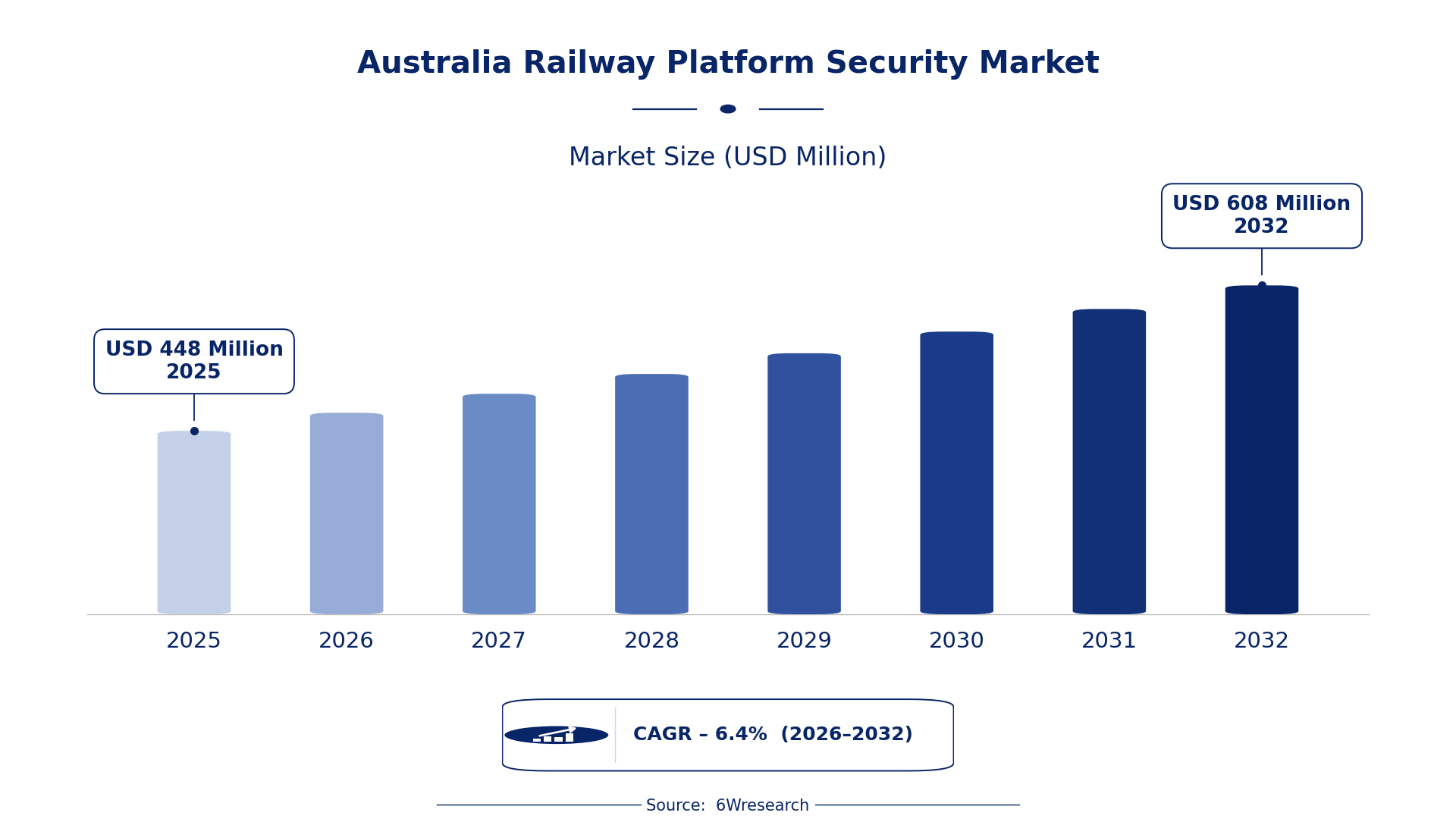
The Australia Railway Platform Security Market was estimated at USD 448 Million in 2025 and is projected to reach USD 608 Million by 2032, growing at a CAGR of 6.4% from 2026 to 2032.
Australia Railway Platform Security Market Synopsis
The railway platform security market in Australia is witnessing a notable shift towards advanced technology integration. As passenger safety becomes a paramount concern, railway authorities are increasingly adopting cutting-edge surveillance and access control systems to enhance security measures across transit hubs.
The growing demand for AI-powered solutions, such as facial recognition and smart CCTV systems, is driving innovation in this space. This transformation is not just about technology; it's about a commitment to improving incident response and overall commuter safety in a rapidly urbanizing environment.
Australia Railway Platform Security Market Year-wise Growth Rate and Key Drivers
This graph illustrates the annual growth rates of the Australia Railway Platform Security Market from 2021 to 2032, highlighting a steady upward trajectory and projected expansion over the forecast period.
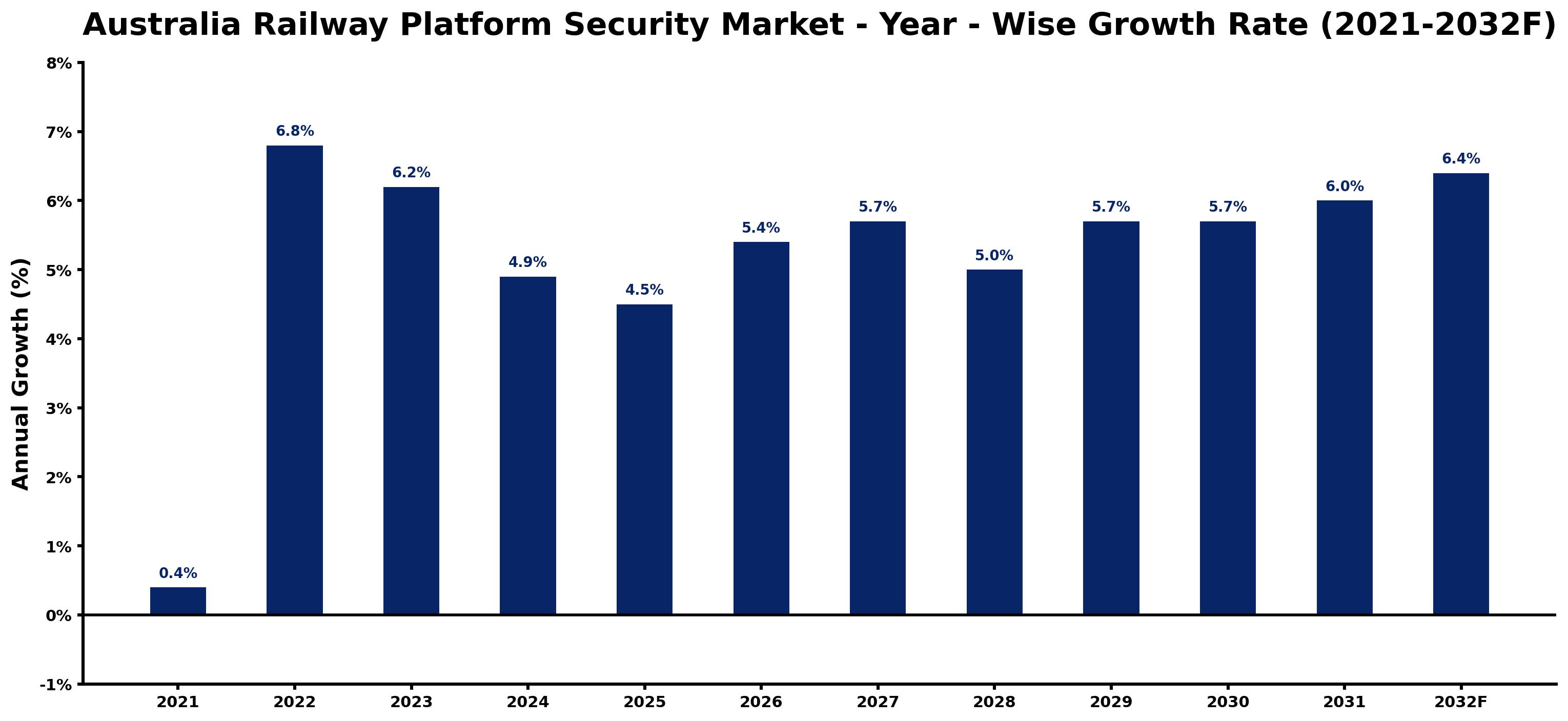
The table below presents the year‑wise growth rates along with the key drivers influencing the market
| Year | Growth Rate | Major Drivers |
| 2021 | 0.4% | Increased funding from Australian Infrastructure Investment Program |
| 2022 | 6.8% | Adoption of new security technologies in transport corridors |
| 2023 | 6.2% | National Rail Safety Strategy improving platform safety standards |
| 2024 | 4.9% | Rising passenger concerns post-pandemic driving security upgrades |
| 2025 | 4.5% | Collaborations with local cybersecurity firms enhancing platform security |
| 2026 | 5.4% | Government incentives for public transport security enhancements |
| 2027 | 5.7% | Growing urban population increasing public transit security needs |
| 2028 | 5.0% | Implementation of biometrics in fare safety checks |
| 2029 | 5.7% | Investment in advanced surveillance systems across major cities |
| 2030 | 5.7% | Strengthening regulations on public transport safety protocols |
| 2031 | 6.0% | Increased government budgets for rail infrastructure security improvements |
| 2032 | 6.4% | Public awareness campaigns highlighting platform security importance |
Note: Market size estimations and growth projections presented in this report are based on 6Wresearch's proprietary forecasting methodology, utilizing the latest available industry data, government publications, and primary research inputs.
Australia Railway Platform Security Market Key Takeaways
Below are some of the specific key takeaways from the market, including:
- The market is experiencing a shift towards AI and real-time monitoring for enhanced security.
- Regulatory frameworks are shaping the implementation of security measures across railway platforms.
- Investment opportunities lie in the development of integrated security solutions for public transport systems.
- Growing urbanization is leading to increased passenger traffic, necessitating improved security infrastructure.
- Challenges remain in balancing costs with the need for advanced surveillance technology.
Evaluation of Restraints in Australia Railway Platform Security Market
Despite the promising growth trajectory, the Australia Railway Platform Security Market faces notable restraints. High costs associated with the deployment of advanced surveillance systems pose a significant barrier to entry for many operators. Additionally, the complexity of integrating new technologies with existing railway infrastructure complicates implementation efforts.
Regulatory compliance adds another layer of challenge, as operators must navigate privacy concerns while ensuring passenger data protection. This delicate balance often slows down the adoption of innovative solutions, thereby limiting market potential.
Australia Railway Platform Security Market Trends
Recent trends in the Australia Railway Platform Security Market highlight a strong pivot towards AI-driven technologies. The integration of machine learning algorithms into surveillance systems is enhancing incident detection and response times. on top of that, there is a marked increase in the deployment of smart CCTV systems that offer real-time analytics to security personnel.
Another trend is the emphasis on crowd management solutions, driven by rising passenger volumes. Authorities are recognizing the necessity of scalable systems that can adapt to varying crowd densities, ensuring security without compromising efficiency.
Australia Railway Platform Security Market Opportunities
Investment opportunities within the Australia Railway Platform Security Market are abundant, particularly in the development of AI-based surveillance systems. As urbanization continues to rise, there is a critical need for systems that can monitor and manage large crowds efficiently.
on top of that, collaborating with railway authorities and security firms presents a strategic avenue for enhancing market positioning. Expanding into interconnected public transport networks also opens doors for innovative solutions that integrate various security measures across different transit modalities.
Government Initiatives in the Australia Railway Platform Security Market
Government policy plays a crucial role in shaping the Australia Railway Platform Security Market. Regulatory frameworks, such as the Rail Safety National Law and the Work Health and Safety Act 2011, mandate the implementation of effective surveillance and emergency response systems. These regulations not only prioritize passenger safety but also drive market growth by encouraging investment in advanced security technologies.
- A national digital infrastructure upgrade programme was recently completed, enhancing surveillance capabilities across major railway stations.
- Currently underway is a review of existing security regulations to ensure compliance with modern technology standards, aiming for implementation in late 2025.
- A planned public-private initiative is expected to expand security technology investments by 2028, focusing on integrated systems for urban transport networks.
- New guidelines for passenger data protection were introduced in 2023, reinforcing the importance of compliance in security measures.
- Funding for advanced surveillance technology was allocated in 2024, supporting the rollout of smart CCTV systems across transit hubs.
Future Insights of the Australia Railway Platform Security Market
Looking ahead to 2026-2032, the Australia Railway Platform Security Market is set for significant evolution. The increasing integration of AI and machine learning into security systems will transform incident management, creating a more responsive environment for passenger safety.
As passenger traffic continues to rise, the demand for sophisticated security solutions that can efficiently manage larger crowds will only intensify. Strategic investments and collaborations will be key in developing innovative technologies that address these needs while ensuring regulatory compliance.
Australia Railway Platform Security Market Latest Developments
In the last year, the Australia Railway Platform Security Market has seen a flurry of activity aimed at enhancing security measures across transit systems. This momentum reflects a growing recognition of the importance of passenger safety in public transport environments.
- A major technology vendor initiated a project in early 2025 to upgrade existing surveillance systems with AI-driven analytics, improving real-time response capabilities.
- In Q1 2025, a leading regional operator launched a pilot programme for smart CCTV systems, currently underway and showing promising results in incident detection.
- Plans for a comprehensive security technology rollout are expected to begin in the second half of 2026, focusing on integrating various surveillance systems.
- A collaborative initiative with state transport agencies was completed in late 2024, aiming to enhance data sharing protocols among security systems.
- By mid-2025, an upgrade of access control systems across major railway platforms is anticipated to be implemented, improving overall passenger safety.
Australia Railway Platform Security Market - Key Attractiveness of the Report
- 10 Years of Market Numbers
- Historical Data Starting from 2022 to 2025
- Base Year: 2025
- Forecast Data until 2032
- Key Performance Indicators Impacting the Market
- Major Upcoming Developments and Projects
Key Highlights of the Report:
- Australia Railway Platform Security Market Outlook
- Market Size of Australia Railway Platform Security Market, 2025
- Forecast of Australia Railway Platform Security Market, 2032
- Historical Data and Forecast of Australia Railway Platform Security Revenues & Volume for the Period 2022-2032F
- Australia Railway Platform Security Market Trend Evolution
- Australia Railway Platform Security Market Drivers and Challenges
- Australia Railway Platform Security Price Trends
- Australia Railway Platform Security Porter's Five Forces
- Australia Railway Platform Security Industry Life Cycle
- Historical Data and Forecast of Australia Railway Platform Security Market Revenues & Volume By Components for the Period 2022-2032F
- Historical Data and Forecast of Australia Railway Platform Security Market Revenues & Volume By Solutions for the Period 2022-2032F
- Historical Data and Forecast of Australia Railway Platform Security Market Revenues & Volume By Services for the Period 2022-2032F
- Historical Data and Forecast of Australia Railway Platform Security Market Revenues & Volume By Applications for the Period 2022-2032F
- Historical Data and Forecast of Australia Railway Platform Security Market Revenues & Volume By Subways for the Period 2022-2032F
- Historical Data and Forecast of Australia Railway Platform Security Market Revenues & Volume By Trains for the Period 2022-2032F
- Australia Railway Platform Security Import Export Trade Statistics
- Market Opportunity Assessment By Components
- Market Opportunity Assessment By Applications
- Australia Railway Platform Security Top Companies Market Share
- Australia Railway Platform Security Competitive Benchmarking By Technical and Operational Parameters
- Australia Railway Platform Security Company Profiles
- Australia Railway Platform Security Key Strategic Recommendations






































