Australia Red Clover Market: Import Trend Analysis
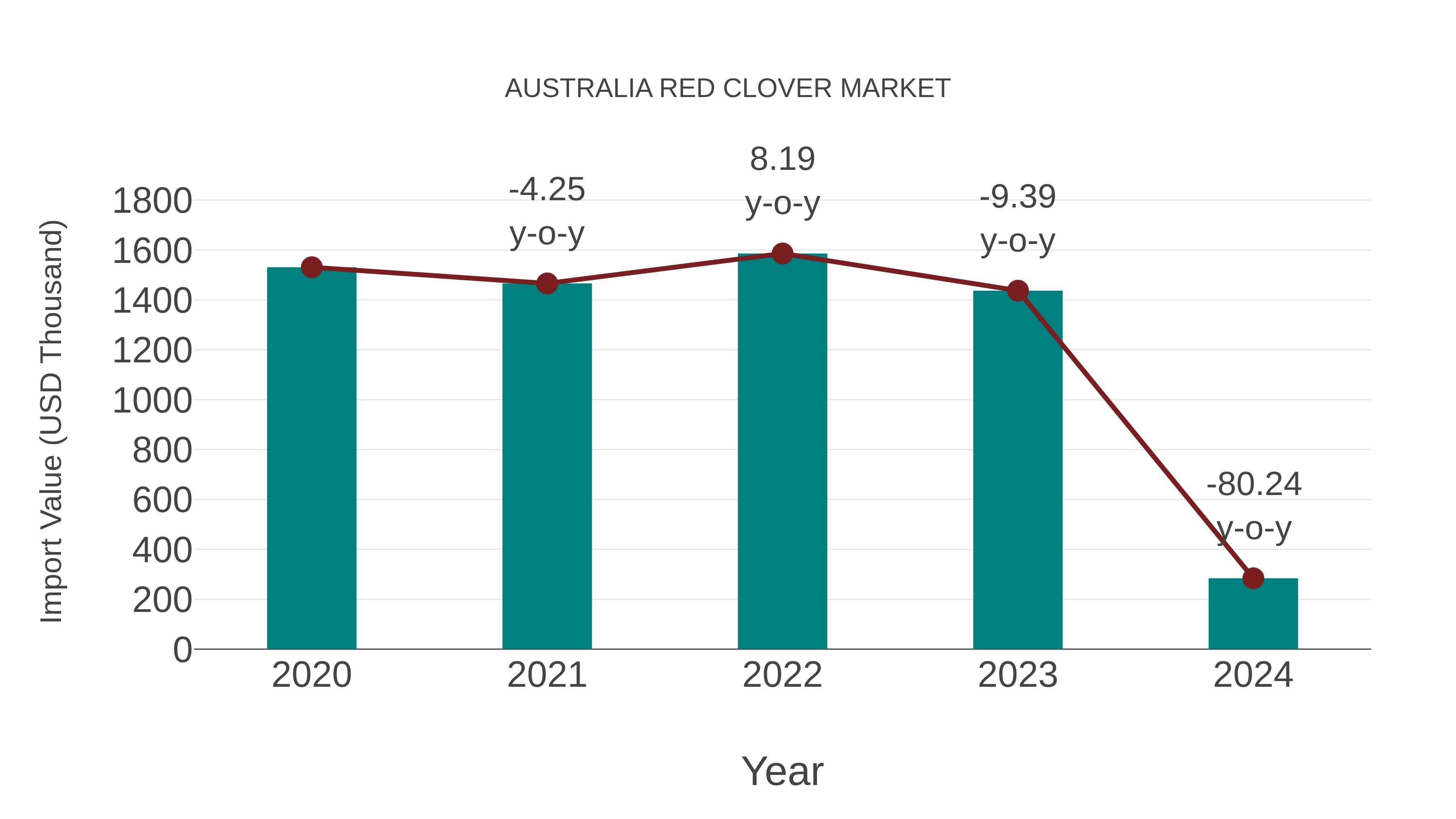
Australia`s import trend for the red clover market experienced a significant decline from 2023 to 2024, with a growth rate of -80.24%. The compound annual growth rate (CAGR) for the period 2020-2024 was -34.37%. This decline could be attributed to shifting demand patterns or changes in trade policies affecting the market stability.
Australia Red Clover Market Highlights
| Report Name | Australia Red Clover Market |
| Forecast period | 2025-2031 |
| CAGR | 11% |
| Growing Sector | Agriculture |
Topic Covered in Australia Red Clover Market Report
Australia Red Clover Market Report thoroughly covers the market by Forms and by Application. The market provides an unbiased and detailed analysis of the ongoing market trends, opportunities/high growth areas, and market drivers. This would help the stakeholders devise and align their market strategies according to the current and future market dynamics.
Australia Red Clover Market Synopsis
Australia Red Clover Market is poised for growth as the agriculture industry continues to prioritize sustainable practices, animal nutrition, and soil enrichment. The Australia Red Clover Market is a dynamic sector driven by various factors influencing the production, consumption, and trade of red clover within the country. Red clover is used as an aromatic ingredient in food in the food and beverage industries and imparts its therapeutic benefits when infused with tea. These favourable factors are expected to influence the market growth of red clover positively.
According to 6Wresearch, Australia Red clover market size is expected to grow at a CAGR of 11% in the year 2025-2031. The Australian red clover market is driven by a myriad of factors that underscore its evolving agricultural practice and market demand, setting a robust framework for growth and expansion. Central to its market drivers is the escalating recognition of red clover’s benefits in rotational cropping systems, especially its role in improving soil health through nitrogen fixation, thereby reducing reliance on synthetic fertilizers. Additionally, the surge in organic farming practices across Australia has amplified the demand for red clover, both as a forage crop and a green manure, aligning with the increasing consumer preference for organic and sustainably produced food products. The livestock sector also plays a pivotal role in driving demand for red clover, given its high protein content and digestibility, which is key to enhancing milk production and meat quality. Furthermore, the expanding research and development efforts aimed at breeding more resilient and high-yielding red clover varieties have significantly contributed to the Australia Red clover market Growth, by improving adaptability to various Australian climates and resistance to pests and diseases.
Conversely, the challenges confronting the Australian red clover market are multifaceted, stemming from both environmental and economic factors. Climatic variability poses a significant threat, with extreme weather conditions such as droughts and floods affecting crop yields and quality. This vulnerability necessitates continuous investment in research and development to breed more resilient strains, adding to the costs for farmers and potentially limiting the market’s expansion. Additionally, the competition from alternative forage and cover crops, which may offer superior drought tolerance or require less maintenance, further intensifies the market’s challenges. The global market dynamics also play a crucial role, where fluctuations in international demand and prices can impact profitability and market stability for Australian red clover producers. Addressing these challenges requires a concerted effort from industry stakeholders, government agencies, and research institutions to develop innovative solutions that enhance the crop's resilience, marketability, and overall contribution to the agricultural sector.
Australia Red Clover Market: Key Players
The key players in the Red Clover market in Australia are Seed Company,Clover Corporation,Green Clover Farms,Red Clover Agri-Enterprises,Harvest Fresh,Nutri-Clover Pty Ltd,AusFodder Group.These key players play vital roles in the Australia Red Clover Market by ensuring the availability of quality red clover products, promoting sustainable agricultural practices, and meeting the diverse needs of farmers, livestock producers, and consumers within the red clover industry.
Government Policy for the market
The Australia government provides subsidies and financial incentives to farmers and agricultural businesses engaged in the cultivation of red clover and other crops. These support schemes aim to boost production, improve farm viability, and enhance agricultural sustainability. Government initiatives focus on environmental conservation, land stewardship, and biodiversity preservation, which are crucial for sustainable red clover cultivation. Programs promoting soil health, water management, and carbon sequestration benefit red clover growers by fostering eco-friendly farming practices.The government sets quality control standards and certification requirements for red clover seeds, hay, and forage products to ensure product safety, nutritional quality, and compliance with industry benchmarks. Adherence to these standards is essential for maintaining market credibility and consumer trust.
Future Insights of the Market
The use of red clover in livestock feed formulations is projected to expand due to its nutritional benefits, including high protein content and isoflavones. As farmers prioritize animal health and productivity, red clover is set to play a more significant role in dairy and beef cattle diets, contributing to enhanced livestock performance. The increasing focus on natural supplements, herbal remedies, and functional foods is anticipated to drive consumer demand for red clover products. Red clover's potential health benefits, such as supporting hormone balance and menopausal symptoms, may lead to a surge in demand for red clover-based dietary supplements and health products. The Australia Red Clover Market is expected to witness diversification in product offerings, with new formulations, value-added products, and niche market segments emerging. Innovations in red clover processing, extraction methods, and product development could open doors to novel applications in the food, pharmaceutical, and cosmetic industries and these factors would lead to rise in Australia Red clover market Share.
Market Segmentation by Forms
According to Dhaval, Research Manager, 6Wresearch, the processed form of Australian red clover is expected to witness significant growth in the coming years. This can be attributed to the increasing demand for red clover extract in various industries, including cosmetics, pharmaceuticals, and food and beverage. The use of red clover extract as a natural ingredient in these products has gained popularity due to its many health benefits and sustainable sourcing.
Market Segmentation by Applications
The agriculture segment is expected to grow in the Australia red clover Industry, as it is the primary use of this crop. Red clover is a valuable forage and cover crop, providing high-quality nutrition for grazing livestock and improving soil health through nitrogen fixation. With increasing demand for sustainable farming practices and the growing popularity of regenerative agriculture, there is an opportunity for red clover to play a larger role in the agricultural sector. Additionally, the use of red clover as a cover crop can also help mitigate the impact of climate change on crop production, making it an attractive option for farmers looking for resilient solutions.
Key attractiveness of the report
- 10 Years Market Numbers.
- Historical Data Starting from 2021 to 2024.
- Base Year: 2024.
- Forecast Data until 2031.
- Key Performance Indicators Impacting the Market.
- Major Upcoming Developments and Projects.
Key Highlights of the Report:
- Australia Red Clover Market Outlook
- Market Size of Australia Red Clover Market, 2025
- Forecast of Australia Red Clover Market, 2032
- Historical Data and Forecast of Australia Red Clover Revenues & Volume for the Period 2022-2032F
- Australia Red Clover Market Trend Evolution
- Australia Red Clover Market Drivers and Challenges
- Australia Red Clover Price Trends
- Australia Red Clover Porter's Five Forces
- Australia Red Clover Industry Life Cycle
- Historical Data and Forecast of Australia Red Clover Market Revenues & Volume By Forms for the Period 2022-2032F
- Historical Data and Forecast of Australia Red Clover Market Revenues & Volume By Raw for the Period 2022-2032F
- Historical Data and Forecast of Australia Red Clover Market Revenues & Volume By Processed for the Period 2022-2032F
- Historical Data and Forecast of Australia Red Clover Market Revenues & Volume By Applications for the Period 2022-2032F
- Historical Data and Forecast of Australia Red Clover Market Revenues & Volume By Cosmetics And Personal Care for the Period 2022-2032F
- Historical Data and Forecast of Australia Red Clover Market Revenues & Volume By Pharmaceuticals for the Period 2022-2032F
- Historical Data and Forecast of Australia Red Clover Market Revenues & Volume By Food And Beverage for the Period 2022-2032F
- Historical Data and Forecast of Australia Red Clover Market Revenues & Volume By Animal Feed for the Period 2022-2032F
- Historical Data and Forecast of Australia Red Clover Market Revenues & Volume By Agriculture for the Period 2022-2032F
- Historical Data and Forecast of Australia Red Clover Market Revenues & Volume By Others for the Period 2022-2032F
- Australia Red Clover Import Export Trade Statistics
- Market Opportunity Assessment By Forms
- Market Opportunity Assessment By Applications
- Australia Red Clover Top Companies Market Share
- Australia Red Clover Competitive Benchmarking By Technical and Operational Parameters
- Australia Red Clover Company Profiles
- Australia Red Clover Key Strategic Recommendations
Market Covered
The report offers a comprehensive study of the subsequent market segments:
By Forms
- Raw
- Processed
By Applications
- Cosmetics And Personal Care
- Pharmaceuticals
- Food And Beverag
- Animal Feed
- Agriculture






































