Australia Refrigerated Incubators Market: Import Trend Analysis
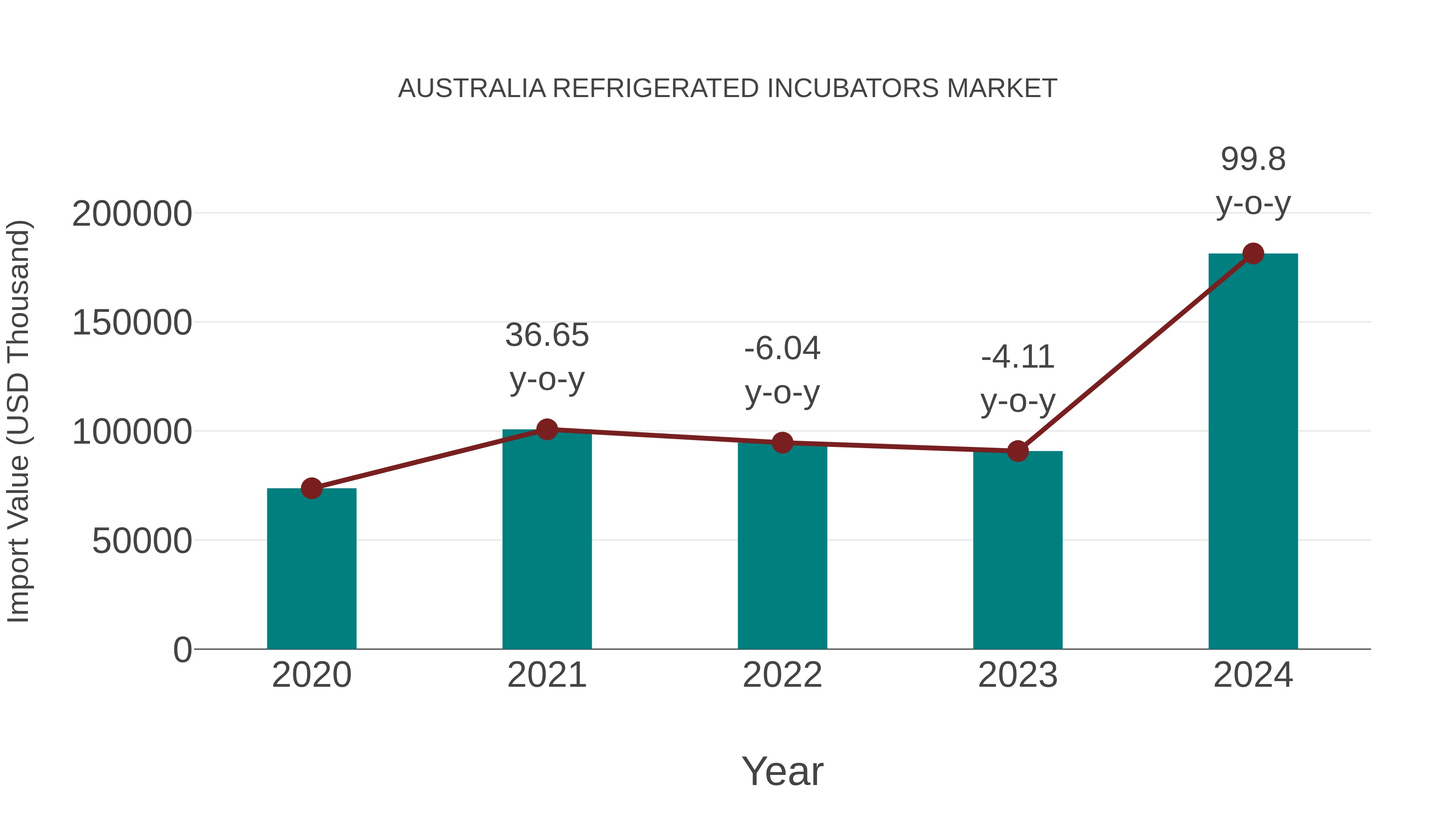
Australia`s import trend for refrigerated incubators saw significant growth, with a 99.8% increase from 2023 to 2024 and a compound annual growth rate (CAGR) of 25.24% from 2020 to 2024. This surge in imports can be attributed to a notable shift in demand towards advanced refrigeration technologies in various industries.
Australia Refrigerated Incubators Market Overview
The Australia Refrigerated Incubators Market serves scientific research institutions, pharmaceutical companies, and healthcare providers by providing controlled environments for sample storage and experimentation. Demand is driven by increasing research activities, advancements in biotechnology, and the need for reliable preservation of biological samples. Market growth is supported by innovations in temperature control technology, energy-efficient models, and the expanding life sciences sector in Australia. Stringent quality and safety standards also influence product development.
Drivers of the market
The Refrigerated Incubators Market in Australia is growing steadily due to increased research activities in life sciences, biotechnology, and pharmaceutical sectors. The demand for precise temperature control in cell culture, drug testing, and biological sample storage drives this growth. Innovations such as energy-efficient refrigeration systems and improved user interfaces enhance performance and usability. The expansion of academic and private research institutions along with government funding supports market development.
Challenges of the market
The refrigerated incubators market in Australia is challenged by the high cost of advanced incubator models that integrate sophisticated temperature control and monitoring systems. Limited awareness and adoption in smaller healthcare facilities or laboratories restrict market expansion. Additionally, stringent regulatory standards for medical and laboratory equipment increase time to market and compliance costs. Maintenance and calibration requirements for refrigerated incubators add to operational challenges.
Investment opportunities in the Market
The Australia Refrigerated Incubators Market shows promising potential driven by growing biopharmaceutical research, clinical laboratories, and biotechnology industries requiring precise temperature control for sample preservation. Increasing investments in life sciences research and the rising number of hospitals and diagnostic centers highlight the demand for advanced refrigerated incubators. Opportunities lie in developing energy-efficient, user-friendly, and technologically advanced incubators capable of maintaining stringent temperature conditions for sensitive biological samples. Australias focus on healthcare innovation and research infrastructure strengthens the outlook for investors in this niche market segment.
Government Policy of the market
The refrigerated incubators market is influenced by government health and research funding policies that support medical and scientific research infrastructure. Regulatory agencies set safety and performance standards for incubators used in healthcare and laboratories. Government grants and public health initiatives drive the adoption of advanced refrigerated incubators, enhancing capabilities in neonatal care and research environments.
Key Highlights of the Report:
- Australia Refrigerated Incubators Market Outlook
- Market Size of Australia Refrigerated Incubators Market, 2025
- Forecast of Australia Refrigerated Incubators Market, 2032
- Historical Data and Forecast of Australia Refrigerated Incubators Revenues & Volume for the Period 2022 - 2032F
- Australia Refrigerated Incubators Market Trend Evolution
- Australia Refrigerated Incubators Market Drivers and Challenges
- Australia Refrigerated Incubators Price Trends
- Australia Refrigerated Incubators Porter's Five Forces
- Australia Refrigerated Incubators Industry Life Cycle
- Historical Data and Forecast of Australia Refrigerated Incubators Market Revenues & Volume By Type for the Period 2022 - 2032F
- Historical Data and Forecast of Australia Refrigerated Incubators Market Revenues & Volume By Below 50 l for the Period 2022 - 2032F
- Historical Data and Forecast of Australia Refrigerated Incubators Market Revenues & Volume By 51 to 200 l for the Period 2022 - 2032F
- Historical Data and Forecast of Australia Refrigerated Incubators Market Revenues & Volume By 201 to 750 l for the Period 2022 - 2032F
- Historical Data and Forecast of Australia Refrigerated Incubators Market Revenues & Volume By 751 to 1,500 l for the Period 2022 - 2032F
- Historical Data and Forecast of Australia Refrigerated Incubators Market Revenues & Volume By Above 1,501 l for the Period 2022 - 2032F
- Historical Data and Forecast of Australia Refrigerated Incubators Market Revenues & Volume By End User for the Period 2022 - 2032F
- Historical Data and Forecast of Australia Refrigerated Incubators Market Revenues & Volume By Hospitals for the Period 2022 - 2032F
- Historical Data and Forecast of Australia Refrigerated Incubators Market Revenues & Volume By Research Laboratories and Academic Institutes for the Period 2022 - 2032F
- Historical Data and Forecast of Australia Refrigerated Incubators Market Revenues & Volume By Pharmaceutical and Biotechnology Companies for the Period 2022 - 2032F
- Australia Refrigerated Incubators Import Export Trade Statistics
- Market Opportunity Assessment By Type
- Market Opportunity Assessment By End User
- Australia Refrigerated Incubators Top Companies Market Share
- Australia Refrigerated Incubators Competitive Benchmarking By Technical and Operational Parameters
- Australia Refrigerated Incubators Company Profiles
- Australia Refrigerated Incubators Key Strategic Recommendations






































