Australia Retail And Wholesale Market Size, Share & Growth Rate
The Australia Retail And Wholesale Market was estimated at USD 219 Million in 2025 and is projected to reach USD 297 Million by 2032, growing at a CAGR of 4.4% from 2026 to 2032. This growth trajectory is bolstered by rising consumer spending and an ever-increasing shift towards e-commerce, which continues to reshape the retail landscape. Factors such as improved supply chain efficiency and the burgeoning demand for fast-moving consumer goods are pivotal in supporting this upward trend.
Australia Retail And Wholesale Market Year-wise Growth Rate and Key Drivers
This graph highlights how the Australia Retail And Wholesale Market has steadily grown over the years, supported by major growth factors.
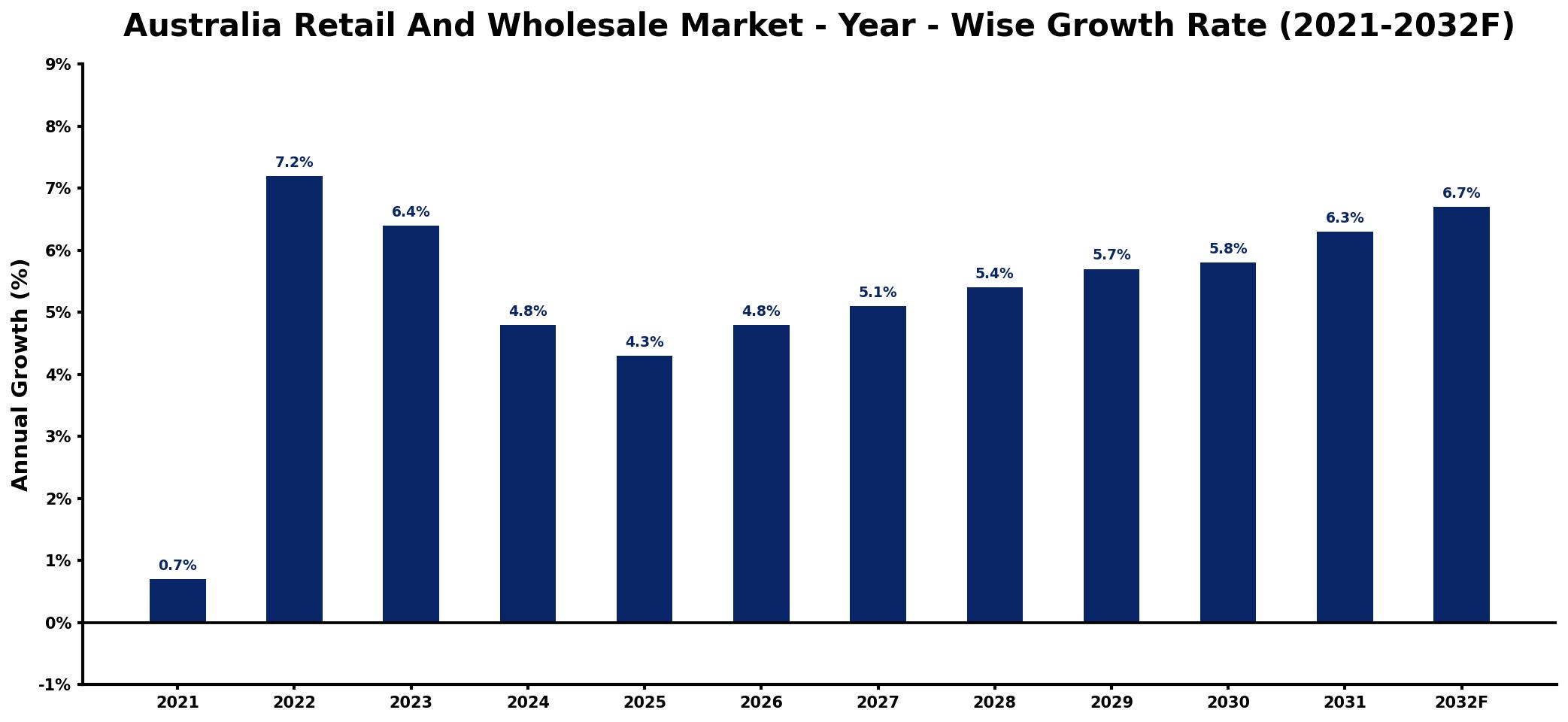
The table below presents the year‑wise growth rates along with the key drivers influencing the market
| Year | Growth Rate | Major Drivers |
| 2021 | 0.7% | E-commerce adoption among consumers |
| 2022 | 7.2% | Increase in disposable incomes |
| 2023 | 6.4% | Expansion of online marketplaces |
| 2024 | 4.8% | Rising consumer confidence levels |
| 2025 | 4.3% | Growth in mobile shopping trends |
| 2026 | 4.8% | Enhancements in logistics infrastructure |
| 2027 | 5.1% | Investment in digital payment solutions |
| 2028 | 5.4% | Surge in sustainable product demand |
| 2029 | 5.7% | improved raw material availability |
| 2030 | 5.8% | increased capital investment inflows |
| 2031 | 6.3% | increased overall sector activity |
| 2032 | 6.7% | Growth of personalized shopping experiences |
Note: Market size estimations and growth projections presented in this report are based on 6Wresearch's proprietary forecasting methodology, utilizing the latest available industry data, government publications, and primary research inputs.
Australia Retail And Wholesale Market Synopsis
In recent years, the Australia Retail And Wholesale Market has experienced significant momentum, with a noticeable shift towards online shopping and a demand for sustainable products. However, as consumer preferences evolve, traditional retail formats are challenged to adapt to maintain relevance. The market is poised for a transformative phase, propelled by innovations in digital platforms and consumer engagement strategies.
Looking ahead, the retail and wholesale landscape in Australia will be shaped by a convergence of digital transformation and the prioritization of customer experience. This evolving consumer behavior, alongside rising operational costs, will require businesses to be agile and adaptive to remain competitive in an increasingly saturated market.
Australia Retail And Wholesale Market Key Takeaways
- The market is driven by increasing consumer expenditure and a robust e-commerce sector.
- Emerging trends include a strong emphasis on sustainability and the demand for locally sourced products.
- Operational costs and global supply chain issues present ongoing challenges that need to be addressed.
- Investment opportunities abound in enhancing supply chain efficiency and digital transformation initiatives.
- The Australian government's supportive policies foster a conducive environment for local businesses.
Evaluation of Restraints in Australia Retail And Wholesale Market
The Australia Retail And Wholesale Market is currently facing notable restraints that hinder its potential growth. Chief among these are escalating operational costs, including rent and wages, which place pressure on profit margins. Additionally, fierce competition from e-commerce platforms intensifies the need for differentiation among brick-and-mortar retailers. The fluctuating dynamics of global trade further complicate supply chain stability, affecting overall market profitability. Addressing these challenges will require strategic planning and an adaptive business approach.
Australia Retail And Wholesale Market Trends
A significant trend shaping the Australia Retail And Wholesale Market is the rapid adoption of digital technologies, facilitating seamless online-to-offline (O2O) shopping experiences. Consumers increasingly value convenience and personalized shopping journeys, pushing retailers to invest in advanced data analytics and customer relationship management systems. Moreover, the growing emphasis on eco-friendly practices is prompting businesses to align their offerings with consumer demand for sustainable and ethically sourced products, reinforcing brand loyalty.
Australia Retail And Wholesale Market Opportunities
The landscape of the Australia Retail And Wholesale Market offers a plethora of genuine growth opportunities, particularly in the e-commerce sphere. Innovations in payment solutions and warehousing automation are set to enhance operational efficiency significantly. Businesses can capitalize on the increasing consumer preference for direct-to-consumer (DTC) models, enabling tighter brand-customer connections. Moreover, efforts to streamline inventory management processes could lead to substantial cost savings and improved market competitiveness.
Government Initiatives in the Australia Retail And Wholesale Market
The Australian government plays a crucial role in supporting the Retail And Wholesale Market through various initiatives aimed at fostering local businesses. Programs such as small business grants and tax incentives for digital transformation encourage enterprises to innovate and adapt to market demands. Additionally, strict enforcement of regulations related to consumer protection, product labeling, and data privacy ensures a fair trading environment, enhancing consumer trust and market integrity.
Future Insights of the Australia Retail And Wholesale Market
From 2026 to 2032, the Australia Retail And Wholesale Market is expected to undergo significant evolution, primarily driven by technological advancements and changing consumer expectations. With a projected CAGR of 4.4%, businesses that effectively harness digital platforms and prioritize sustainability will likely emerge as market leaders. The ongoing refinement of supply chain processes and the integration of innovative technologies will play a pivotal role in shaping future market dynamics and enhancing operational efficiencies.
Australia Retail And Wholesale Market Latest Developments (2025 - 2026)
In recent months, the Australia Retail And Wholesale Market has seen a focus on enhancing consumer engagement through digital channels. Companies are investing heavily in improving their online presence and diversifying their product offerings to meet shifting consumer preferences. Additionally, sustainability initiatives have become increasingly prominent, with many retailers prioritizing eco-friendly practices as a core aspect of their business models.
Australia Retail And Wholesale Market - Key Attractiveness of the Report
- 10 Years of Market Numbers
- Historical Data Starting from 2022 to 2025
- Base Year: 2025
- Forecast Data until 2032
- Key Performance Indicators Impacting the Market
- Major Upcoming Developments and Projects
Key Highlights of the Report:
- Australia Retail And Wholesale Market Outlook
- Market Size of Australia Retail And Wholesale Market, 2025
- Forecast of Australia Retail And Wholesale Market, 2032
- Historical Data and Forecast of Australia Retail And Wholesale Revenues & Volume for the Period 2022-2032F
- Australia Retail And Wholesale Market Trend Evolution
- Australia Retail And Wholesale Market Drivers and Challenges
- Australia Retail And Wholesale Price Trends
- Australia Retail And Wholesale Porter's Five Forces
- Australia Retail And Wholesale Industry Life Cycle
- Historical Data and Forecast of Australia Retail And Wholesale Market Revenues & Volume By Type for the Period 2022-2032F
- Historical Data and Forecast of Australia Retail And Wholesale Market Revenues & Volume By Retail for the Period 2022-2032F
- Historical Data and Forecast of Australia Retail And Wholesale Market Revenues & Volume By Wholesale for the Period 2022-2032F
- Historical Data and Forecast of Australia Retail And Wholesale Market Revenues & Volume By Ownership for the Period 2022-2032F
- Historical Data and Forecast of Australia Retail And Wholesale Market Revenues & Volume By Retail Chain/Wholesale Chain for the Period 2022-2032F
- Historical Data and Forecast of Australia Retail And Wholesale Market Revenues & Volume By Independent Retailer/Independent Wholesalers for the Period 2022-2032F
- Historical Data and Forecast of Australia Retail And Wholesale Market Revenues & Volume By Price Range for the Period 2022-2032F
- Historical Data and Forecast of Australia Retail And Wholesale Market Revenues & Volume By Premium for the Period 2022-2032F
- Historical Data and Forecast of Australia Retail And Wholesale Market Revenues & Volume By Mid-Range for the Period 2022-2032F
- Historical Data and Forecast of Australia Retail And Wholesale Market Revenues & Volume By Economy for the Period 2022-2032F
- Historical Data and Forecast of Australia Retail And Wholesale Market Revenues & Volume By Distribution Channel for the Period 2022-2032F
- Historical Data and Forecast of Australia Retail And Wholesale Market Revenues & Volume By Supermarkets/Hypermarkets for the Period 2022-2032F
- Historical Data and Forecast of Australia Retail And Wholesale Market Revenues & Volume By Convenience Stores for the Period 2022-2032F
- Historical Data and Forecast of Australia Retail And Wholesale Market Revenues & Volume By Department Stores for the Period 2022-2032F
- Historical Data and Forecast of Australia Retail And Wholesale Market Revenues & Volume By Specialty Stores for the Period 2022-2032F
- Australia Retail And Wholesale Import Export Trade Statistics
- Market Opportunity Assessment By Type
- Market Opportunity Assessment By Ownership
- Market Opportunity Assessment By Price Range
- Market Opportunity Assessment By Distribution Channel
- Australia Retail And Wholesale Top Companies Market Share
- Australia Retail And Wholesale Competitive Benchmarking By Technical and Operational Parameters
- Australia Retail And Wholesale Company Profiles
- Australia Retail And Wholesale Key Strategic Recommendations






































