Australia Shaving and Hair Removal Products Market Summary
The australia shaving and hair removal products market was estimated at USD 211 Million in 2025 and is projected to reach USD 285 Million by 2032, growing at a CAGR of 4.8% from 2026 to 2032.
Australia Shaving and Hair Removal Products Market Year-wise Growth Rate and Key Drivers
This graph highlights how the Australia Shaving and Hair Removal Products Market has steadily grown over the past five years, supported by major growth factors.
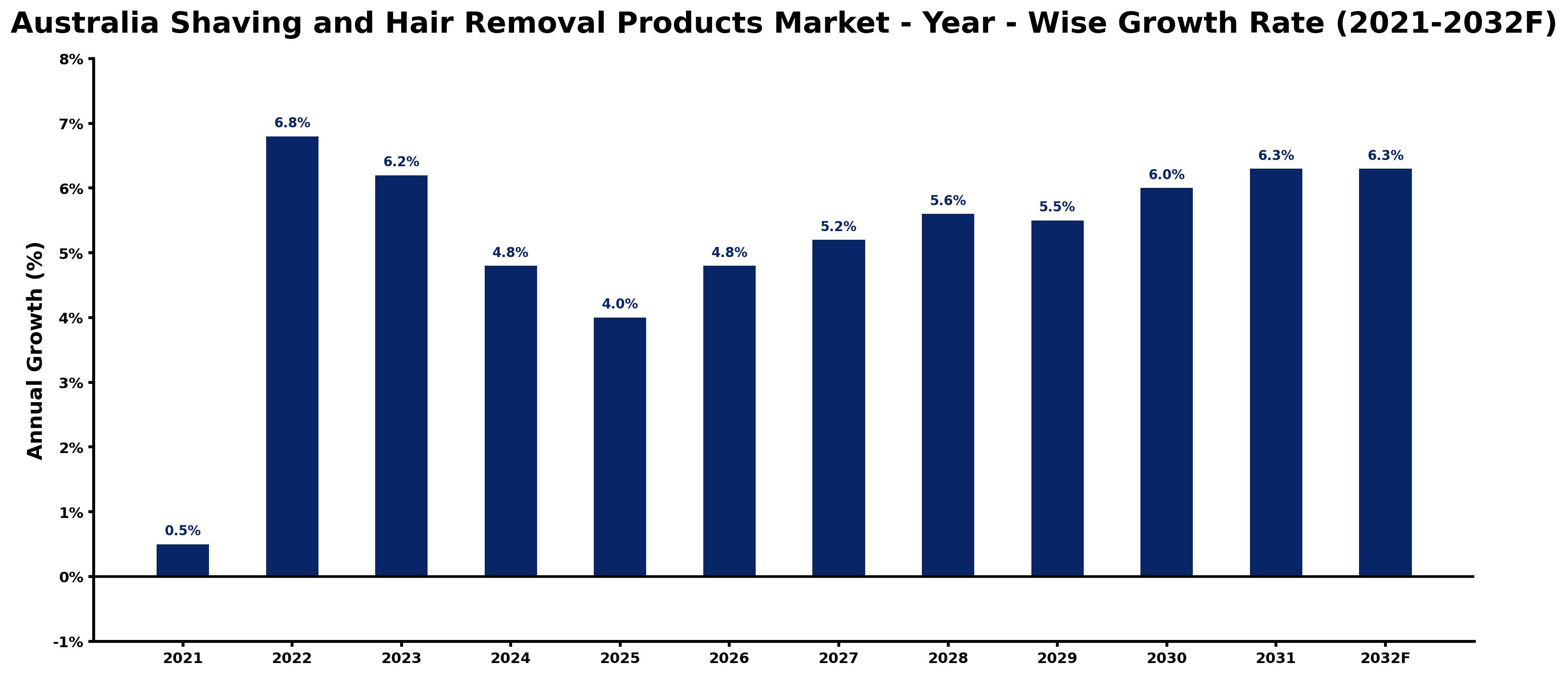
The table below presents the year wise growth rates along with the key drivers influencing the market
| Year | Growth Rate | Major Drivers |
| 2021 | 0.5% | Post-lockdown retail projects highlight a shift towards personal grooming habits. |
| 2022 | 6.8% | Innovative products enhance convenience, attracting a broader consumer base. |
| 2023 | 6.2% | Sustainability trends prompt brands to launch eco-friendly shaving options. |
| 2024 | 4.8% | Online shopping growth provides accessible platforms for diverse grooming solutions. |
| 2025 | 4.0% | Increased focus on self-care aligns with greater spending on grooming products. |
| 2026 | 4.8% | Emerging male grooming trends drive significant interest in niche products. |
| 2027 | 5.2% | Regional climate impacts influence preferences for specific hair removal methods. |
| 2028 | 5.6% | Health and wellness integration into grooming routines reshapes consumer choices. |
| 2029 | 5.5% | Social media campaigns amplify brand visibility and encourage new trial behaviors. |
| 2030 | 6.0% | Technological innovations streamline product development and enhance user experience. |
| 2031 | 6.3% | Shifting demographics reveal younger consumers favoring personalized grooming solutions. |
| 2032 | 6.3% | Collaborative partnerships among brands create unique product offerings for consumers. |
Note - Market size estimations and growth projections presented in this report are based on 6Wresearch's advanced forecasting approach, validated with industry datasets as of June 2026.
Australia Shaving and Hair Removal Products Market Synopsis
The Australia Shaving and Hair Removal Products Market is projected to reach 4.8% and witness significant growth during the forecast period (2026-2032). This market reflects the diverse preferences and grooming habits of Australian consumers, driven by increased attention to personal care and hygiene. The scope of the market includes a comprehensive array of products, such as razors, shaving creams, and depilatory solutions, underscoring the evolving attitudes towards grooming as an essential aspect of self-care.
Australia Shaving and Hair Removal Products Market Growth Drivers
The expansion of the Australia Shaving and Hair Removal Products Market can be attributed to several key growth drivers:
- Changing grooming habits among consumers have fueled growth, as Australians increasingly prioritize personal grooming as part of their daily routines.
- The rising trend of self-care is influencing consumer choices, leading to a higher demand for a diverse range of shaving and hair removal products tailored to individual needs.
- Innovations in product formulations and design are catering to evolving consumer preferences, including the integration of sustainable and eco-friendly practices into product development.
- The influence of beauty standards and grooming trends is prompting consumers to seek products that align with contemporary aesthetics, further driving market growth.
- The emergence of specialized products that address various hair types and textures is expanding the market potential and appealing to a broader demographic.
Australia Shaving and Hair Removal Products Market Trends and Opportunities
The Australia Shaving and Hair Removal Products Market is witnessing dynamic trends that present significant opportunities:
- The adoption of sustainable practices, including biodegradable packaging and cruelty-free formulations, appeals to environmentally conscious consumers.
- The increasing popularity of at-home hair removal technologies, such as laser devices, is reshaping consumer approaches to hair management and creating new market segments.
- The rise of online retail and e-commerce platforms provides brands with the opportunity to reach a wider audience, increasing market accessibility and convenience for consumers.
- Customization and personalization options are becoming prevalent, allowing consumers to select products that align with their unique grooming preferences and skin types.
- As grooming becomes increasingly associated with self-expression, brands that align their messaging with inclusivity and diversity stand to resonate strongly with consumers.
Australia Shaving and Hair Removal Products Market Challenges and Restraints
Despite the positive growth trajectory, the Australia Shaving and Hair Removal Products Market faces several challenges:
- The rapid evolution of beauty standards requires brands to continually adapt and innovate, posing challenges for companies in maintaining relevance.
- Increasing consumer demand for sustainable practices compels companies to invest in eco-friendly packaging and ingredient sourcing, which can raise production costs.
- Competition from alternative hair removal methods, such as at-home laser solutions, threatens traditional product markets, necessitating strategic differentiation.
- Consumer preferences may shift quickly, making it imperative for brands to stay ahead of trends and consumer expectations to secure market share.
- Navigating regulatory changes related to consumer safety and ingredient disclosure poses ongoing challenges for manufacturers in ensuring compliance.
Australia Shaving and Hair Removal Products Market Government Investment and Initiatives
The Australian government plays an active role in shaping the regulatory landscape of the shaving and hair removal products market. Key initiatives include:
- Implementation of robust safety regulations and standards that ensure consumer protection, focusing on the safety and efficacy of grooming products.
- Promotion of transparency in product labeling and ingredient disclosure, allowing consumers to make informed choices about the products they use.
- Support for sustainability initiatives aimed at reducing environmental impacts associated with product manufacturing and disposal.
- Encouragement of innovation within the industry through grants and funding programs aimed at developing new and improved hair removal technologies.
- Collaboration with industry stakeholders to address challenges related to consumer safety and promote best practices within the market.
Australia Shaving and Hair Removal Products Market Latest Developments (May 2025 - June 2026)
Recent developments within the Australia Shaving and Hair Removal Products Market reflect a period of innovation and adaptation:
- Brands have increasingly focused on reformulating products to incorporate natural ingredients, aligning with consumer demands for cleaner and safer grooming options.
- The introduction of new technologies in at-home hair removal devices has expanded consumer choice and encouraged home grooming practices.
- Sustainability commitments have become more pronounced, with brands launching initiatives aimed at both product sustainability and eco-conscious packaging solutions.
- Social media and influencer marketing have significantly influenced consumer purchasing decisions, prompting brands to engage in collaborative campaigns to enhance brand visibility.
- The market has witnessed increased collaborations between beauty brands and wellness influencers, positioning grooming products within the broader context of self-care and wellness.
Australia Shaving and Hair Removal Products Market - Key Attractiveness of the Report
- 10 Years of Market Numbers
- Historical Data Starting from 2022 to 2025
- Base Year: 2025
- Forecast Data until 2032
- Key Performance Indicators Impacting the Market
- Major Upcoming Developments and Projects
Q1: What factors are driving growth in the Australia Shaving and Hair Removal Products Market?A1: Growth is primarily driven by changing grooming habits, increased focus on personal hygiene, and the influence of evolving beauty standards.
Q2: How are sustainability trends impacting the market?A2: Brands are increasingly adopting sustainable practices, which include eco-friendly packaging and cruelty-free formulations to meet consumer demand.
Q3: What are the major challenges facing the Australia Shaving and Hair Removal Products Market?A3: Key challenges include adapting to rapid shifts in beauty standards, maintaining compliance with regulatory changes, and navigating competition from alternative hair removal methods.
Q4: What role does government policy play in this market?A4: Government policy ensures consumer safety and promotes transparency, encouraging practices that benefit both consumers and the environment.
Key Highlights of the Report:
- Australia Shaving and Hair Removal Products Market Outlook
- Market Size of Australia Shaving and Hair Removal Products Market, 2025
- Forecast of Australia Shaving and Hair Removal Products Market, 2032
- Historical Data and Forecast of Australia Shaving and Hair Removal Products Revenues & Volume for the Period 2022-2032F
- Australia Shaving and Hair Removal Products Market Trend Evolution
- Australia Shaving and Hair Removal Products Market Drivers and Challenges
- Australia Shaving and Hair Removal Products Price Trends
- Australia Shaving and Hair Removal Products Porter's Five Forces
- Australia Shaving and Hair Removal Products Industry Life Cycle
- Historical Data and Forecast of Australia Shaving and Hair Removal Products Market Revenues & Volume By Product Types for the Period 2022-2032F
- Historical Data and Forecast of Australia Shaving and Hair Removal Products Market Revenues & Volume By Shave Gels for the Period 2022-2032F
- Historical Data and Forecast of Australia Shaving and Hair Removal Products Market Revenues & Volume By Shave Foams for the Period 2022-2032F
- Historical Data and Forecast of Australia Shaving and Hair Removal Products Market Revenues & Volume By Shaving and Hair Removal Creams for the Period 2022-2032F
- Historical Data and Forecast of Australia Shaving and Hair Removal Products Market Revenues & Volume By Sprays for the Period 2022-2032F
- Historical Data and Forecast of Australia Shaving and Hair Removal Products Market Revenues & Volume By Lotions for the Period 2022-2032F
- Historical Data and Forecast of Australia Shaving and Hair Removal Products Market Revenues & Volume By Waxes for the Period 2022-2032F
- Historical Data and Forecast of Australia Shaving and Hair Removal Products Market Revenues & Volume By Wax Strips for the Period 2022-2032F
- Historical Data and Forecast of Australia Shaving and Hair Removal Products Market Revenues & Volume By End-Users for the Period 2022-2032F
- Historical Data and Forecast of Australia Shaving and Hair Removal Products Market Revenues & Volume By Salon for the Period 2022-2032F
- Historical Data and Forecast of Australia Shaving and Hair Removal Products Market Revenues & Volume By Personal Use for the Period 2022-2032F
- Australia Shaving and Hair Removal Products Import Export Trade Statistics
- Market Opportunity Assessment By Product Types
- Market Opportunity Assessment By End-Users
- Australia Shaving and Hair Removal Products Top Companies Market Share
- Australia Shaving and Hair Removal Products Competitive Benchmarking By Technical and Operational Parameters
- Australia Shaving and Hair Removal Products Company Profiles
- Australia Shaving and Hair Removal Products Key Strategic Recommendations






































