Australia Talc and Steatite Market: Import Trend Analysis
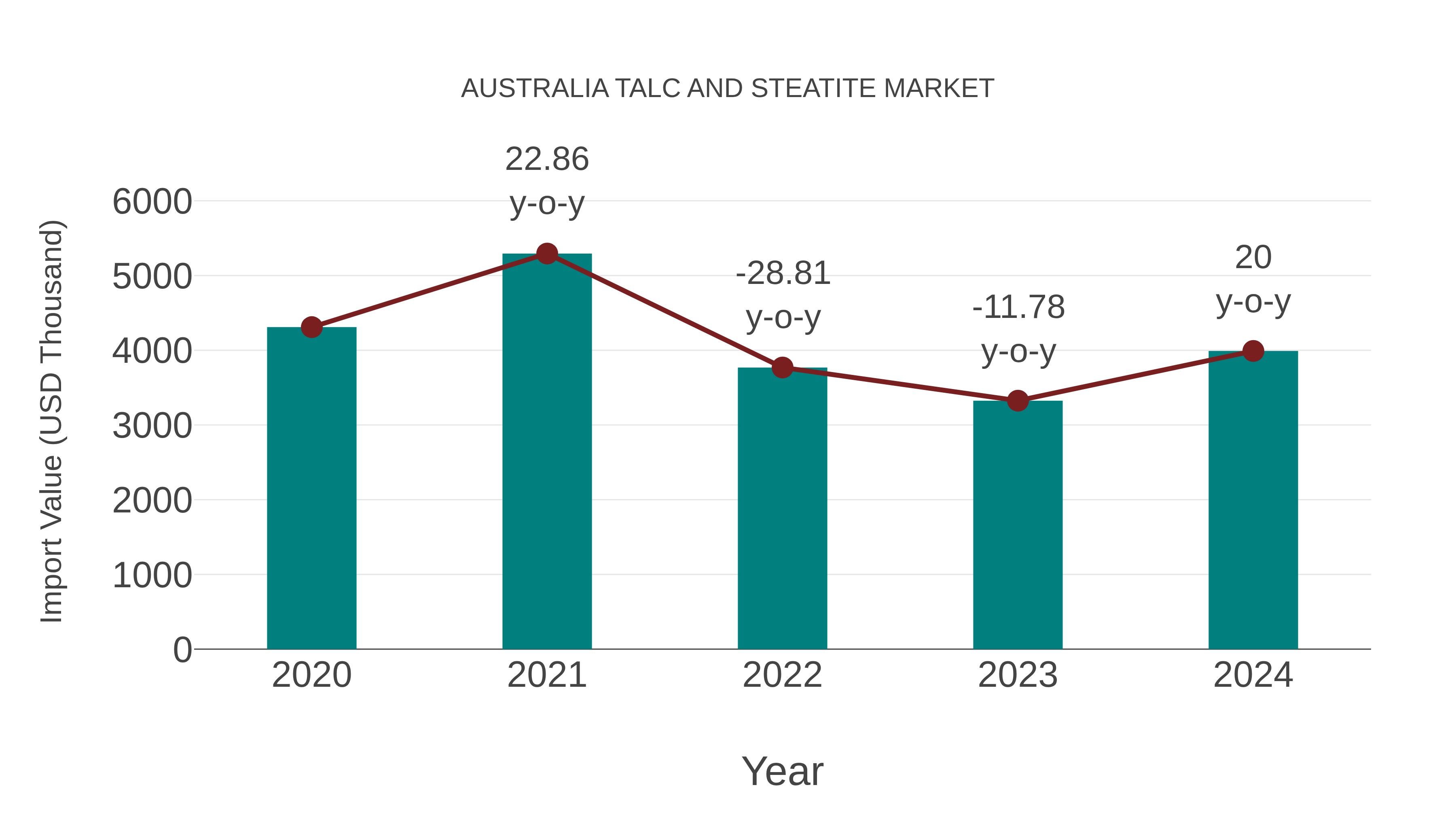
In the Australia talc and steatite market, imports experienced a growth rate of 20.0% from 2023 to 2024, contrasting with a negative compound annual growth rate (CAGR) of -1.9% for the period 2020-2024. This shift in import momentum could be attributed to evolving demand dynamics or adjustments in trade policies impacting market stability.
Australia Talc And Steatite Market Overview
Australia talc and steatite market is significant, with the mineral being utilized in various industries such as ceramics, plastics, and cosmetics. The market`s growth is fueled by the country`s abundant natural resources and the increasing demand for talc-based products both domestically and internationally.
Drivers of the market
The Australia market for talc and steatite is primarily driven by the growing demand from the industrial sector. Talc, known for its lubricating and anti-stick properties, finds applications in various industries including plastics, ceramics, paper, and cosmetics. Steatite, valued for its electrical insulation properties, is extensively used in electrical components manufacturing, contributing to the market`s growth.
Challenges of the market
In the Australia talc and steatite market, a significant challenge arises from the fluctuating demand from end-user industries such as ceramics, plastics, and paper. Economic uncertainties, coupled with shifting consumer preferences and regulatory changes, pose challenges for producers and suppliers in forecasting demand and managing inventory effectively.
Government Policy of the market
The Australia government has implemented policies addressing the extraction, processing, and exportation of talc and steatite minerals. These policies focus on environmental protection, workplace safety, and sustainable resource management. Regulatory bodies such as the Department of Industry, Science, Energy and Resources monitor activities in this market to ensure compliance with environmental regulations and promote responsible mining practices.
Key Highlights of the Report:
- Australia Talc and Steatite Market Outlook
- Market Size of Australia Talc and Steatite Market, 2025
- Forecast of Australia Talc and Steatite Market, 2032
- Historical Data and Forecast of Australia Talc and Steatite Revenues & Volume for the Period 2022-2032F
- Australia Talc and Steatite Market Trend Evolution
- Australia Talc and Steatite Market Drivers and Challenges
- Australia Talc and Steatite Price Trends
- Australia Talc and Steatite Porter's Five Forces
- Australia Talc and Steatite Industry Life Cycle
- Historical Data and Forecast of Australia Talc and Steatite Market Revenues & Volume By Product Type for the Period 2022-2032F
- Historical Data and Forecast of Australia Talc and Steatite Market Revenues & Volume By Crushed for the Period 2022-2032F
- Historical Data and Forecast of Australia Talc and Steatite Market Revenues & Volume By Powdered for the Period 2022-2032F
- Australia Talc and Steatite Import Export Trade Statistics
- Market Opportunity Assessment By Product Type
- Australia Talc and Steatite Top Companies Market Share
- Australia Talc and Steatite Competitive Benchmarking By Technical and Operational Parameters
- Australia Talc and Steatite Company Profiles
- Australia Talc and Steatite Key Strategic Recommendations






































