Australia Telecom Services Market Size, Share & Growth Rate
The Australia Telecom Services Market was estimated at USD 103 Million in 2025 and is projected to reach USD 120 Million by 2032, growing at a CAGR of 2.2% from 2026 to 2032. This growth trajectory is primarily fueled by the escalating demand for data-driven services, spurred by the proliferation of smartphones and the rising popularity of streaming platforms and online gaming. Furthermore, advancements in technology, such as the rollout of 5G networks, are reshaping consumer expectations and paving the way for innovative telecom solutions.
Australia Telecom Services Market Year-wise Growth Rate and Key Drivers
This graph highlights how the Australia Telecom Services Market has steadily grown over the years, supported by major growth factors.
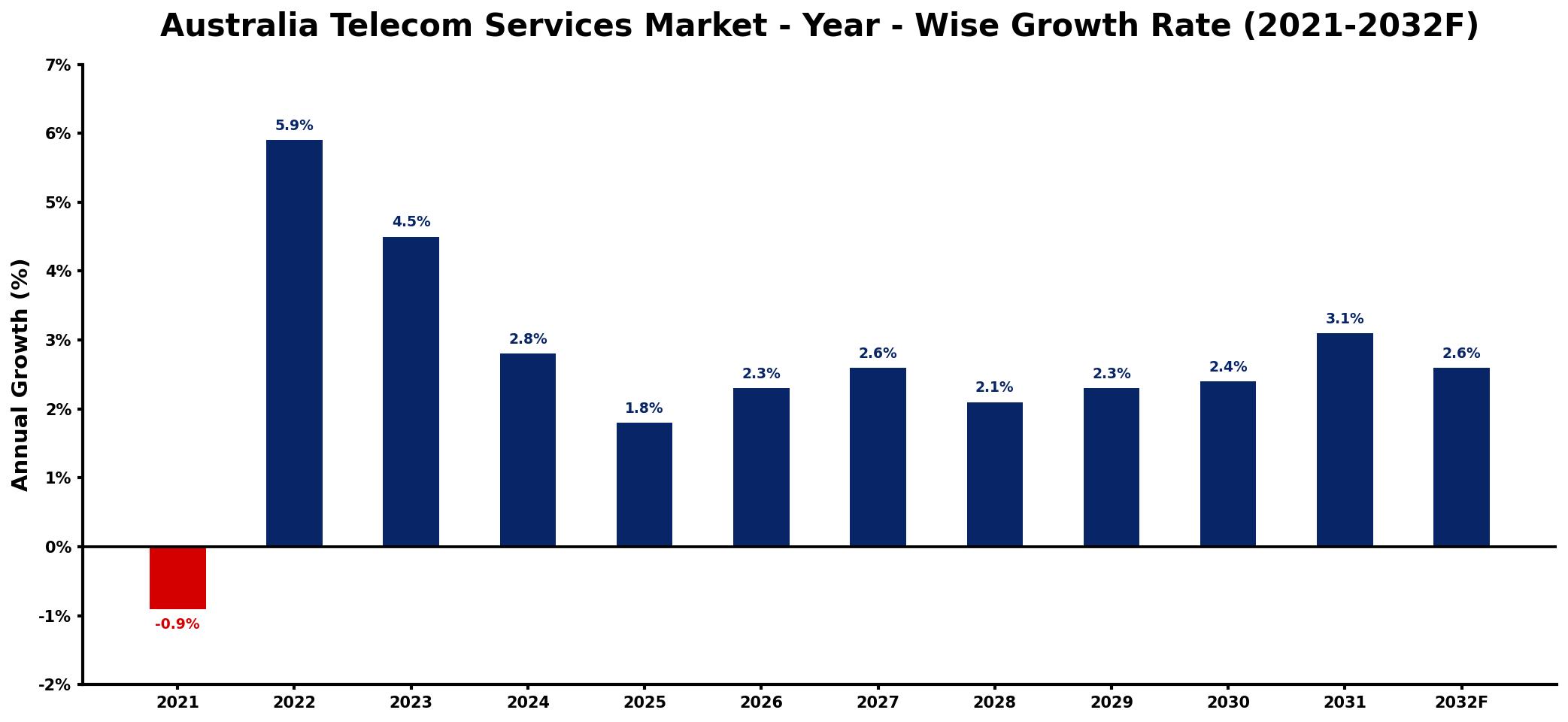
The table below presents the year‑wise growth rates along with the key drivers influencing the market
| Year | Growth Rate | Major Drivers |
| 2021 | -0.9% | decrease in consumer spending power |
| 2022 | 5.9% | rise in mobile data usage |
| 2023 | 4.5% | increased demand for broadband |
| 2024 | 2.8% | expansion of 5G networks |
| 2025 | 1.8% | growth in cloud computing adoption |
| 2026 | 2.3% | increased investment in infrastructure |
| 2027 | 2.6% | surge in IoT applications |
| 2028 | 2.1% | rising demand for streaming content |
| 2029 | 2.3% | increased pharmaceutical industry usage |
| 2030 | 2.4% | increased production capacity utilization |
| 2031 | 3.1% | increased focus on cybersecurity |
| 2032 | 2.6% | rising adoption of digital payments |
Note: Market size estimations and growth projections presented in this report are based on 6Wresearch's proprietary forecasting methodology, utilizing the latest available industry data, government publications, and primary research inputs.
Australia Telecom Services Market Synopsis
As Australia solidifies its position as a leader in digital connectivity, the telecom services market is at the forefront of this evolution. The sector is marked by fierce competition among providers striving to offer comprehensive service packages, while consumer behavior increasingly leans towards high-bandwidth applications that cater to mobile lifestyles.
In this dynamic environment, operators are continuously adapting to technological innovations and shifts in consumer preferences. The focus on enhancing customer experience and expanding infrastructure has become pivotal for telecom companies aiming to maintain their competitive edge in a rapidly changing market landscape.
Australia Telecom Services Market Key Takeaways
- The market is driven by a strong demand for data services fueled by mobile technology advancements.
- 5G technology is anticipated to play a crucial role in expanding service capabilities and revenue streams.
- Competitive pressures compel operators to innovate and improve customer engagement strategies.
- Government regulations are promoting fair competition and infrastructure development across the country.
- The integration of IoT and smart technologies presents new avenues for service providers.
Evaluation of Restraints in Australia Telecom Services Market
Despite the promising growth outlook, the Australia telecom services market faces certain restraints that may impede its full potential. The highly competitive landscape often leads to price wars, squeezing margins for operators and creating a challenging environment for profitability. Furthermore, the rapid pace of technological change necessitates constant investment in infrastructure, which can strain resources. Shifts in consumer preferences toward bundled services also challenge telecom providers to adapt quickly or risk losing market share.
Australia Telecom Services Market Trends
The ongoing shift toward cloud-based services is transforming the telecommunications landscape, as businesses seek greater flexibility and scalability in their operations. Additionally, the rising trend of remote work is prompting demand for reliable connectivity and enhanced cybersecurity measures. On the consumer side, subscription-based models for premium content and services are gaining traction, reflecting a broader change in how Australians engage with telecom offerings.
Australia Telecom Services Market Opportunities
As the market evolves, significant opportunities arise particularly in the realms of 5G applications and the Internet of Things (IoT). With the potential for augmented reality and smart city solutions on the horizon, telecom providers have a chance to leverage new technologies for revenue generation. Moreover, the increasing need for digital solutions among businesses presents telecom operators with avenues to deliver tailored services, further solidifying their market position.
Government Initiatives in the Australia Telecom Services Market
The Australian government continues to play an active role in shaping the telecom landscape through policies that encourage competition and innovation. Initiatives aimed at expanding infrastructure in rural areas ensure equitable access to services, fostering digital inclusion. Additionally, regulations are being put in place to support the transition to advanced technologies, enabling a forward-looking approach to the evolving telecommunications environment.
Future Insights of the Australia Telecom Services Market
Looking ahead to the period from 2026 to 2032, the Australia telecom services market is expected to undergo transformative changes driven by ongoing technological advancements and shifting consumer preferences. The full-scale deployment of 5G networks will likely unlock new applications and enhance the customer experience, while the proliferation of IoT devices will foster a deeper integration of telecom services into daily life. Emphasis on sustainable practices and digital transformation across industries will further shape market dynamics, positioning telecom operators as key enablers of future growth.
Australia Telecom Services Market Latest Developments (2025 - 2026)
Recent months have seen a surge in investment toward infrastructure upgrades as telecom operators aim to enhance service quality and expand coverage. Efforts to adopt 5G technology are accelerating, with various initiatives aimed at rolling out high-speed networks in urban and underserved areas. Additionally, partnerships between telecom companies and tech firms are emerging to develop next-generation solutions, reflecting a collaborative approach to addressing evolving customer demands.
Australia Telecom Services Market - Key Attractiveness of the Report
- 10 Years of Market Numbers
- Historical Data Starting from 2022 to 2025
- Base Year: 2025
- Forecast Data until 2032
- Key Performance Indicators Impacting the Market
- Major Upcoming Developments and Projects
Key Highlights of the Report:
- Australia Telecom Services Market Outlook
- Market Size of Australia Telecom Services Market, 2025
- Forecast of Australia Telecom Services Market, 2032
- Historical Data and Forecast of Australia Telecom Services Revenues & Volume for the Period 2022-2032F
- Australia Telecom Services Market Trend Evolution
- Australia Telecom Services Market Drivers and Challenges
- Australia Telecom Services Price Trends
- Australia Telecom Services Porter's Five Forces
- Australia Telecom Services Industry Life Cycle
- Historical Data and Forecast of Australia Telecom Services Market Revenues & Volume By Service Type for the Period 2022-2032F
- Historical Data and Forecast of Australia Telecom Services Market Revenues & Volume By Fixed Voice Services for the Period 2022-2032F
- Historical Data and Forecast of Australia Telecom Services Market Revenues & Volume By Fixed Internet Access Services for the Period 2022-2032F
- Historical Data and Forecast of Australia Telecom Services Market Revenues & Volume By Mobile Voice Services for the Period 2022-2032F
- Historical Data and Forecast of Australia Telecom Services Market Revenues & Volume By Mobile Data Services for the Period 2022-2032F
- Historical Data and Forecast of Australia Telecom Services Market Revenues & Volume By Pay-TV Services for the Period 2022-2032F
- Historical Data and Forecast of Australia Telecom Services Market Revenues & Volume By Machine-to-Machine (Mobile IoT) Services for the Period 2022-2032F
- Historical Data and Forecast of Australia Telecom Services Market Revenues & Volume By Transmission for the Period 2022-2032F
- Historical Data and Forecast of Australia Telecom Services Market Revenues & Volume By Wireline for the Period 2022-2032F
- Historical Data and Forecast of Australia Telecom Services Market Revenues & Volume By Wireless for the Period 2022-2032F
- Historical Data and Forecast of Australia Telecom Services Market Revenues & Volume By End-use for the Period 2022-2032F
- Historical Data and Forecast of Australia Telecom Services Market Revenues & Volume By Consumer/Residential for the Period 2022-2032F
- Historical Data and Forecast of Australia Telecom Services Market Revenues & Volume By Business for the Period 2022-2032F
- Australia Telecom Services Import Export Trade Statistics
- Market Opportunity Assessment By Service Type
- Market Opportunity Assessment By Transmission
- Market Opportunity Assessment By End-use
- Australia Telecom Services Top Companies Market Share
- Australia Telecom Services Competitive Benchmarking By Technical and Operational Parameters
- Australia Telecom Services Company Profiles
- Australia Telecom Services Key Strategic Recommendations






































