Australia Telemedicine Market Size, Share & Growth Rate
The Australia Telemedicine Market was estimated at USD 182 Million in 2025 and is projected to reach USD 214 Million by 2032, growing at a CAGR of 2.3% from 2026 to 2032. This upward trajectory is largely fueled by the surge in digital health solutions that improve patient accessibility, particularly for those in rural and underserved regions. Moreover, the recent global health crises have highlighted the critical need for efficient remote healthcare options, propelling the acceptance and integration of telemedicine services across various demographics.
Australia Telemedicine Market Year-wise Growth Rate and Key Drivers
This graph highlights how the Australia Telemedicine Market has steadily grown over the years, supported by major growth factors.
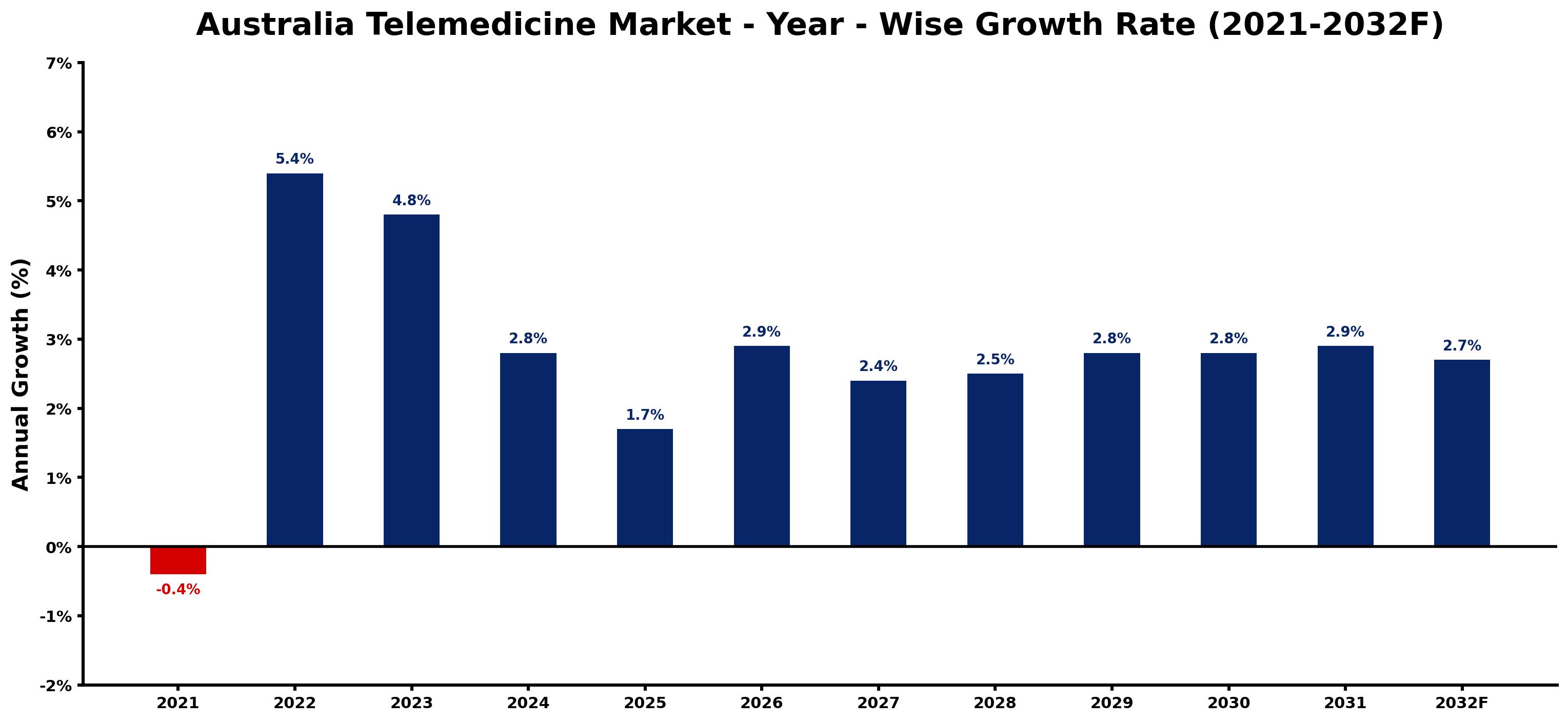
The table below presents the year‑wise growth rates along with the key drivers influencing the market
| Year | Growth Rate | Major Drivers |
| 2021 | -0.4% | Increasing smart city development projects |
| 2022 | 5.4% | Growing renewable energy integration projects |
| 2023 | 4.8% | Government infrastructure modernization initiatives |
| 2024 | 2.8% | Expansion of manufacturing activities |
| 2025 | 1.7% | Growing renewable energy integration projects |
| 2026 | 2.9% | Rising electricity demand across industries |
| 2027 | 2.4% | Growing renewable energy integration projects |
| 2028 | 2.5% | Increasing industrial automation investments |
| 2029 | 2.8% | Expansion of commercial construction activities |
| 2030 | 2.8% | Increasing industrial infrastructure investments |
| 2031 | 2.9% | Rapid growth in telecom and data center sectors |
| 2032 | 2.7% | Growing renewable energy integration projects |
Note - Market size estimations and growth projections presented in this report are based on 6Wresearch’s advanced forecasting approach, validated with industry datasets as of June 2026.
Australia Telemedicine Market Synopsis
A significant factor driving the Australia Telemedicine Market is the integration of advanced technologies such as artificial intelligence and data analytics, which enhance the quality of remote consultations and diagnostics. This shift enables healthcare providers to offer more personalized care while streamlining operations and improving patient outcomes.
Additionally, the ongoing digitization of healthcare systems, coupled with government initiatives aimed at expanding telehealth access, has created an environment conducive to innovation. As more healthcare professionals adopt telemedicine solutions, patient confidence and usage rates continue to rise, underscoring the transformative potential of this market.
Australia Telemedicine Market Key Takeaways
- The market is driven by increasing digital health adoption, especially in remote areas.
- COVID-19 has significantly accelerated the transition to virtual care solutions.
- Government policies are fostering innovation and investment in telemedicine technologies.
- Challenges include regulatory barriers and disparities in digital literacy.
- Growing demand for remote patient monitoring and telehealth services is evident.
Evaluation of Restraints in Australia Telemedicine Market
Despite its promising growth trajectory, the Australia Telemedicine Market faces several restraints that could impede its potential. Regulatory barriers, particularly those surrounding patient privacy and data security, present significant challenges for both providers and consumers. Furthermore, the disparity in internet connectivity, especially in rural regions, limits access to telemedicine services. Addressing these issues requires collaboration between healthcare providers, technology firms, and government agencies to create a more conducive environment for widespread adoption.
Australia Telemedicine Market Trends
Current trends in the Australia Telemedicine Market include the rise of integrated platforms that combine various health services in a single interface, enhancing user experience. There is also an increasing focus on mental health teletherapy, driven by the growing awareness of mental health issues exacerbated by the pandemic. Additionally, advancements in wearable health technology are fostering a new wave of remote patient monitoring solutions that allow for real-time health tracking, thereby increasing engagement and compliance.
Australia Telemedicine Market Opportunities
The opportunities for growth within the Australia Telemedicine Market are abundant. Investment in telemedicine infrastructure is set to escalate, with significant opportunities for innovation in mobile health applications and virtual care models. Moreover, as aging populations increasingly seek efficient healthcare delivery, there exists a ripe market for tailored telehealth solutions catering specifically to geriatric care. Collaborations between public health sectors and private technology firms can yield innovative services that meet diverse healthcare needs.
Government Initiatives in the Australia Telemedicine Market
The Australian government is actively promoting telemedicine through various initiatives aimed at improving access to healthcare services across the nation. Policies are being implemented to expand telehealth services in rural and underserved regions while ensuring patient privacy and provider accountability. Additionally, the government is investing in the interoperability of telemedicine platforms, facilitating better communication and coordination among healthcare providers to ensure quality care delivery remotely.
Future Insights of the Australia Telemedicine Market
Looking ahead to 2026-2032, the Australia Telemedicine Market is expected to evolve significantly. Continuous advancements in technology will likely enhance service delivery, with AI and machine learning playing crucial roles in diagnostics and patient management. As telemedicine becomes increasingly ingrained in standard healthcare practices, patient and provider familiarity with these technologies will pave the way for improved health outcomes. Overall, this market is poised for sustained growth, driven by ongoing innovations and a broader acceptance of telehealth solutions.
Australia Telemedicine Market Latest Developments (May 2025 - June 2026)
Recent developments in the Australia Telemedicine Market include an uptick in partnerships between healthcare providers and tech companies aimed at enhancing telehealth platforms. There has been an emphasis on improving user experience and data security measures as telemedicine gains traction in mainstream healthcare. Furthermore, awareness campaigns by health organizations have effectively encouraged patients to utilize remote care services, thus reinforcing the demand for telehealth across diverse populations.
Australia Telemedicine Market - Key Attractiveness of the Report
- 10 Years of Market Numbers
- Historical Data Starting from 2022 to 2025
- Base Year: 2025
- Forecast Data until 2032
- Key Performance Indicators Impacting the Market
- Major Upcoming Developments and Projects
Key Highlights of the Report:
- Australia Telemedicine Market Outlook
- Market Size of Australia Telemedicine Market, 2025
- Forecast of Australia Telemedicine Market, 2032
- Historical Data and Forecast of Australia Telemedicine Revenues & Volume for the Period 2022-2032F
- Australia Telemedicine Market Trend Evolution
- Australia Telemedicine Market Drivers and Challenges
- Australia Telemedicine Price Trends
- Australia Telemedicine Porter's Five Forces
- Australia Telemedicine Industry Life Cycle
- Historical Data and Forecast of Australia Telemedicine Market Revenues & Volume By Types for the Period 2022-2032F
- Historical Data and Forecast of Australia Telemedicine Market Revenues & Volume By Tele Hospitals for the Period 2022-2032F
- Historical Data and Forecast of Australia Telemedicine Market Revenues & Volume By Tele Homes for the Period 2022-2032F
- Historical Data and Forecast of Australia Telemedicine Market Revenues & Volume By mHealth (Mobile Health) for the Period 2022-2032F
- Historical Data and Forecast of Australia Telemedicine Market Revenues & Volume By Component for the Period 2022-2032F
- Historical Data and Forecast of Australia Telemedicine Market Revenues & Volume By Product for the Period 2022-2032F
- Historical Data and Forecast of Australia Telemedicine Market Revenues & Volume By Services for the Period 2022-2032F
- Australia Telemedicine Import Export Trade Statistics
- Market Opportunity Assessment By Types
- Market Opportunity Assessment By Component
- Australia Telemedicine Top Companies Market Share
- Australia Telemedicine Competitive Benchmarking By Technical and Operational Parameters
- Australia Telemedicine Company Profiles
- Australia Telemedicine Key Strategic Recommendations






































