Global Telemedicine Market Highlights
| Market Size (2025) | USD 97.2 Billion |
| Forecast Size (2032) | USD 215.3 Billion |
| CAGR | 5.50% |
| Base Year | 2025 |
| Forecast Period | 2026-2032 |
| Largest Region | North America |
| Fastest Growing Region | Asia |
| Largest Segment | mHealth (Mobile Health) |
| Fastest Growing Segment | Tele Hospitals |
| Leading Companies | Teladoc Health, Amwell, Doximity, MDLIVE, Doctor on Demand |
Global Telemedicine Market Size & Growth Rate (2026-2032)
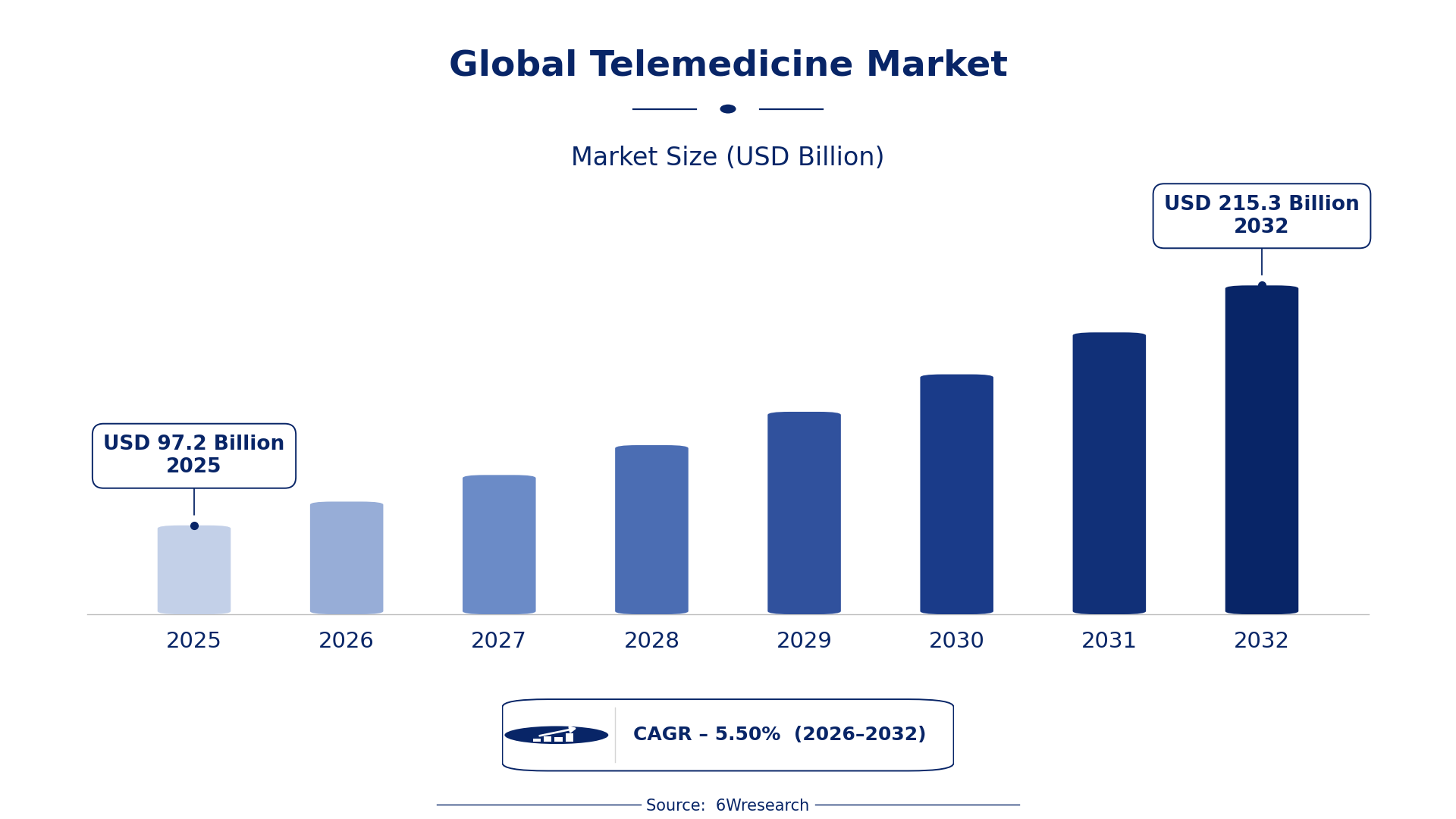
The Global Telemedicine Market was estimated at USD 97.2 Billion in 2025 and is projected to reach USD 215.3 Billion by 2032, growing at a CAGR of 5.50% from 2026 to 2032.
Global Telemedicine Market Synopsis
The Global Telemedicine Market is undergoing a transformative change fueled by the integration of advanced technology and a significant shift in patient care dynamics. Stakeholders are increasingly recognizing the importance of remote healthcare solutions amidst escalating healthcare costs and aging populations. This heightened recognition underscores the essential role of telemedicine in enhancing patient access and care continuity.
As patient preferences evolve toward convenience and accessibility, the demand for telemedicine services, particularly via mobile applications, is surging. Moreover, the rise in chronic diseases necessitates continuous monitoring and consultations, strengthening the case for innovative telehealth solutions. This burgeoning sector is distinctive, not merely as an adjunct to traditional healthcare, but as a crucial component of holistic patient management.
Global Telemedicine Market Year-wise Growth Rate and Key Drivers
This graph illustrates the annual growth rates of the Global Telemedicine Market from 2022 to 2032, highlighting a steady upward trajectory and projected expansion over the forecast period.
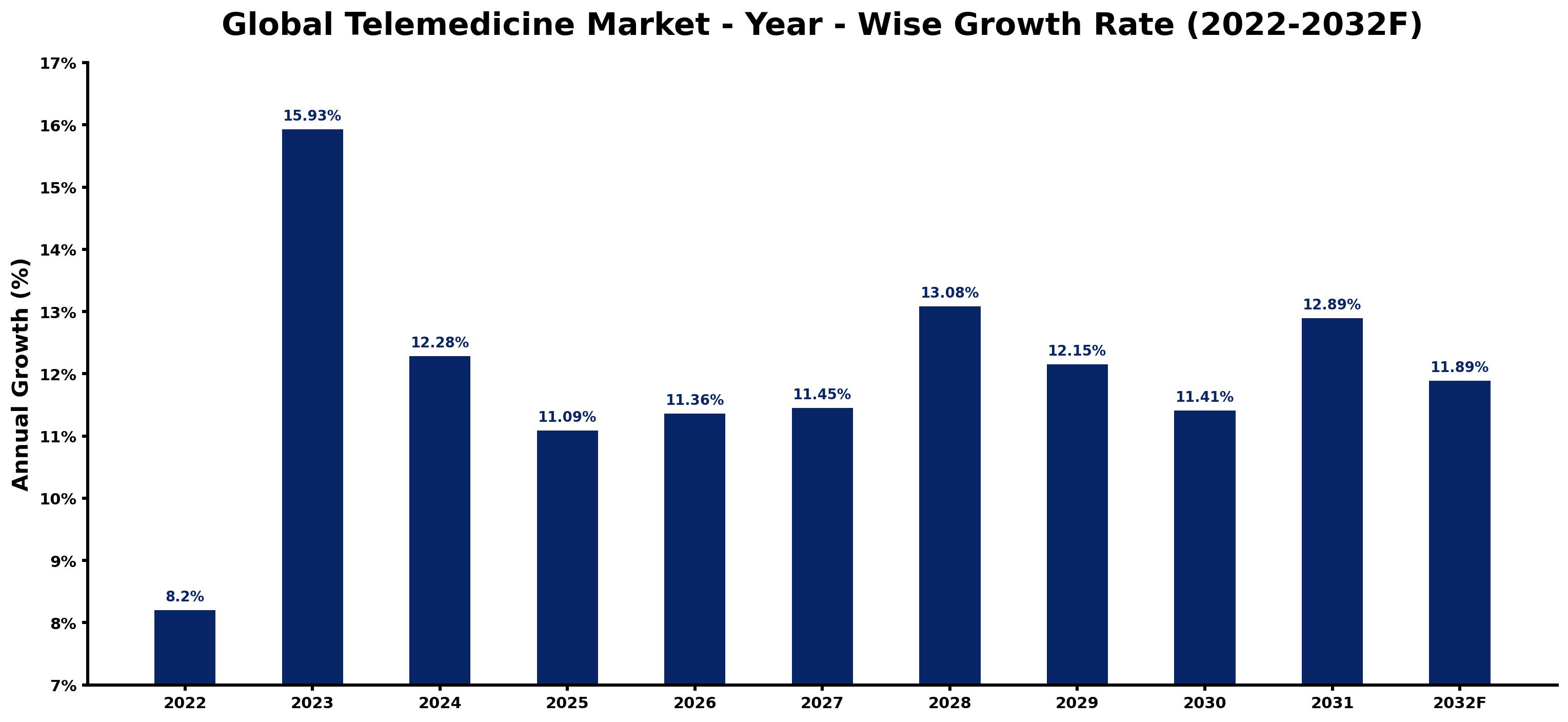
The table below presents the year‑wise growth rates along with the key drivers influencing the market
| Year | Growth Rate (%) | Major Drivers |
| 2022 | 8.2 | Hospital infrastructure costs stabilizing enable increased investments in telemedicine initiatives. |
| 2023 | 15.93 | Telehealth platforms are becoming increasingly popular among patients seeking remote consultations. |
| 2024 | 12.28 | Stringent regulatory approvals establish a conducive environment for telemedicine services. |
| 2025 | 11.09 | A shift toward biosensor technology enhances remote patient monitoring capabilities in telemedicine. |
| 2026 | 11.36 | Increased chronic disease management needs drive wider adoption of telemedicine solutions. |
| 2027 | 11.45 | Expanding clinical trial pipelines improves telemedicine integration within healthcare systems. |
| 2028 | 13.08 | Patients are increasingly opting for telehealth platforms due to enhanced accessibility and convenience. |
| 2029 | 12.15 | Rising demand for diagnostic imaging simplifies workflow dynamics in telemedicine practices. |
| 2030 | 11.41 | As sustainability initiatives gain traction, telemedicine reduces the need for physical visits. |
| 2031 | 12.89 | Investors are channeling funds into telemedicine startups focused on innovative healthcare solutions. |
| 2032 | 11.89 | In North America, the expansion of telemedicine services drives significant growth opportunities. |
Note - Market size estimations and growth projections presented in this report are based on 6Wresearch's proprietary research methodology, combining internal industry data, secondary research, and primary validation, updated periodically to reflect current market conditions. As markets evolve rapidly, figures for certain industries may vary slightly and are intended as informed estimates rather than absolute figures. For the most current market sizing, we recommend validating figures with a 6Wresearch analyst.
Global Telemedicine Market Key Takeaways
Below are some of the specific key takeaways from the market, including:
- The mHealth sector holds the largest market share, driven by mobile app utilization to increase access to healthcare services.
- Tele Hospitals recorded a CAGR of 6% from 2026 to 2032, reflecting their growing importance in remote patient management.
- North America is the largest region in the telemedicine market, accounting for nearly 48% share in 2025, owing to its advanced healthcare infrastructure.
- Companies like Teladoc and Amwell continue to lead with innovative service offerings, establishing a competitive advantage through technology integration.
Evaluation of Restraints in Global Telemedicine Market
Despite the positive outlook, certain restraints challenge the Global Telemedicine Market's expansion. Regulatory barriers and compliance costs present significant hurdles. For instance, healthcare providers often face expenses up to $200,000 associated with implementing telemedicine software and ensuring compliance with HIPAA regulations. Furthermore, limited reimbursement policies can deter providers from fully adopting telehealth solutions. For example, although Medicare expanded reimbursements for remote patient monitoring, many private insurers lag in offering comparable reimbursement schemes, limiting broader service uptake.
Global Telemedicine Market Trends
Two notable trends are reshaping the operational landscape of the Global Telemedicine Market. First, the integration of AI in diagnostics through telemedicine platforms is improving service quality and efficiency. A notable example includes the partnership between IBM Watson Health and Amwell to enhance patient diagnosis accuracy and streamline consultation processes. Moreover, an observable shift toward value-based care models prompts healthcare organizations to prioritize patient outcomes over service volume, further justifying telemedicine's role in holistic care management. Additionally, the evolution in consumer behavior is compelling healthcare providers to develop omnichannel approaches that blend digital and physical consultations, driven by a growing expectation for personalized healthcare experiences.
Global Telemedicine Market Opportunities
Specific revenue opportunities are emerging in various sectors of telemedicine. The continued advancement in wearable technologies for health monitoring signals exciting prospects. Companies like Fitbit are exploring partnerships with telehealth firms to integrate real-time health data into healthcare services, improving patient engagement and adherence. Additionally, the implementation of telehealth services in mental health care is set to grow, with the global mental health software market projected to exceed $4.2 billion by 2026. The integration of telemedicine in mental health services can bridge gaps in access, empowering patients and providers alike.
Global Telemedicine Market by Types
The Global Telemedicine Market is predominantly led by the mHealth (Mobile Health) segment, which commanded approximately 50% share in 2025. This high share is attributed to increasing smartphone penetration and the rising preference for apps that offer health services at the user's convenience. In contrast, the fastest-growing segment is Tele Hospitals, expected to achieve a CAGR of 6.5% from 2026 to 2032. This growth can be linked to heightened demand for comprehensive healthcare services and specialized consultations that traditional hospitals can offer remotely, enhancing overall patient experience.
Global Telemedicine Market by Component
In the Global Telemedicine Market, the Services segment is the largest, accounting for around 65% share in 2025. The preference for services stems from the need for ongoing patient-provider interaction and continuous care management. Conversely, the fastest-growing segment is projected to be Products, with a CAGR of 7% from 2026 to 2032. The growth in products reflects the increasing reliance on telemedicine technologies and solutions that enable remote diagnosis and monitoring, supported by advancements in medical device technologies.
Global Telemedicine Market by Region
North America remains the largest region in the Global Telemedicine Market, with approximately 48% share in 2025, attributed to a robust healthcare infrastructure and significant investment in health technologies. Meanwhile, Asia is emerging as the fastest-growing region, with a CAGR of 7.5% from 2026 to 2032. This rapid growth can be attributed to increasing internet penetration in rural areas and supportive government policies aimed at enhancing healthcare access through digital platforms.
Government Initiatives in the Global Telemedicine Market
The regulatory landscape for the Global Telemedicine Market is actively evolving, with various government initiatives helping to facilitate its growth. Policymakers are recognizing the vital role telemedicine plays in improving public health outcomes, leading to increased support through funding and regulatory adjustments.
- Centers for Medicare & Medicaid Services (CMS), Telehealth Services Expansion Program, December 2020 - This initiative aims to enhance reimbursement for telehealth services to encourage adoption among healthcare providers.
- U.S. Department of Health and Human Services (HHS), COVID-19 Telehealth Program, March 2020 - This funding program allocated $200 million to bolster telehealth infrastructure amidst the pandemic, supporting healthcare providers in scaling services.
- National Institute of Health (NIH), Telehealth Research Initiative, 2021 - This ongoing research initiative is focused on assessing the effectiveness and efficiency of telehealth interventions in diverse healthcare settings.
- European Commission, EU Health Action Plan for 2021-2027, February 2021 - This planned initiative aims to invest significantly in digital health solutions, promoting telemedicine across member states to enhance healthcare access and quality.
Future Insights of the Global Telemedicine Market
The Global Telemedicine Market is on the brink of substantial change as consumer expectations evolve towards integrated healthcare solutions. With companies like Teladoc Health expanding their range of services through AI and data analytics, the market is likely to witness a shift towards predictive healthcare. By 2032, the focus will increasingly be on real-time health integrations, which will enhance patient-provider interactions, thereby streamlining care management and improving health outcomes across demographic segments.
Global Telemedicine Market Latest Developments
Recent developments in the Global Telemedicine Market reflect strategic moves by leading companies to enhance service offerings and technological capabilities. These advancements are crucial for remaining competitive in a rapidly evolving landscape.
- Teladoc Health recently expanded its mental health services to include virtual therapy options, targeting increased accessibility, especially post-pandemic, with rollout completed by early 2024.
- Amwell announced an upcoming partnership with a major healthcare provider to implement an integrated telehealth platform in Q3 2023, aimed at improving chronic disease management.
- Doximity is enhancing its referral network capabilities, expected to launch features in mid-2024 that streamline the process for specialists, thereby improving patient navigation and care continuity.
- MDLIVE has introduced a new mobile app feature for pediatric care, set for a full release by the end of 2023, focused on parental control and monitoring, enhancing user engagement.
Global Telemedicine Market Key Players and Industry Positioning
The competitive structure of the Global Telemedicine Market is moderately consolidated, with several key players dominating while also facing challenges from emerging companies. Leading firms leverage advanced technology and data analytics to enhance patient access and streamline care delivery, positioning themselves strategically for future growth.
| Leading Company | Core Strength | Strategic Focus |
|---|---|---|
| Teladoc Health | Market leader in virtual care | Expansion of mental health services |
| Amwell | Robust partnership network | Integrated care solutions for chronic diseases |
| Doximity | Professional networking platform for physicians | Strengthening referral capabilities |
| MDLIVE | Strong focus on telehealth for urgent care | Enhancing pediatric telehealth options |
| Doctor on Demand | Integrated mental health services | Expanding corporate wellness programs |
This competitive diversity within the Global Telemedicine Market underscores the dynamic landscape, where continuous technological advancements and strategic initiatives will shape future trajectories.
Key Attractiveness of the Report
- 10 Years of Market Numbers
- Historical Data Starting from 2022 to 2025
- Base Year: 2025
- Forecast Data until 2032
- Key Performance Indicators Impacting the Market
- Major Upcoming Developments and Projects
Key Highlights of the Report:
- Global Telemedicine Market Outlook
- Market Size of Global Telemedicine Market, 2025
- Forecast of Global Telemedicine Market, 2032
- Historical Data and Forecast of Global Telemedicine Revenues & Volume for the Period 2022-2032
- Global Telemedicine Market Trend Evolution
- Global Telemedicine Market Drivers and Challenges
- Global Telemedicine Price Trends
- Global Telemedicine Porter's Five Forces
- Global Telemedicine Industry Life Cycle
- Historical Data and Forecast of Global Telemedicine Market Revenues & Volume
- Historical Data and Forecast of Global Telemedicine Market Revenues & Volume By Types for the Period 2022-2032
- Historical Data and Forecast of Global Telemedicine Market Revenues & Volume By Tele Hospitals for the Period 2022-2032
- Historical Data and Forecast of Global Telemedicine Market Revenues & Volume By Tele Homes for the Period 2022-2032
- Historical Data and Forecast of Global Telemedicine Market Revenues & Volume By mHealth (Mobile Health) for the Period 2022-2032
- Historical Data and Forecast of Global Telemedicine Market Revenues & Volume By Component for the Period 2022-2032
- Historical Data and Forecast of Global Telemedicine Market Revenues & Volume By Product for the Period 2022-2032
- Historical Data and Forecast of Global Telemedicine Market Revenues & Volume By Services for the Period 2022-2032
- Historical Data and Forecast of North America Telemedicine Market Revenues & Volume By Types for the Period 2022-2032
- Historical Data and Forecast of North America Telemedicine Market Revenues & Volume By Tele Hospitals for the Period 2022-2032
- Historical Data and Forecast of North America Telemedicine Market Revenues & Volume By Tele Homes for the Period 2022-2032
- Historical Data and Forecast of North America Telemedicine Market Revenues & Volume By mHealth (Mobile Health) for the Period 2022-2032
- Historical Data and Forecast of North America Telemedicine Market Revenues & Volume By Component for the Period 2022-2032
- Historical Data and Forecast of North America Telemedicine Market Revenues & Volume By Product for the Period 2022-2032
- Historical Data and Forecast of North America Telemedicine Market Revenues & Volume By Services for the Period 2022-2032
- Historical Data and Forecast of United States of America Telemedicine Market Revenues & Volume for the Period 2022-2032
- Historical Data and Forecast of Canada Telemedicine Market Revenues & Volume for the Period 2022-2032
- Historical Data and Forecast of Rest of North America Telemedicine Market Revenues & Volume for the Period 2022-2032
- Historical Data and Forecast of Latin America (LATAM) Telemedicine Market Revenues & Volume By Types for the Period 2022-2032
- Historical Data and Forecast of Latin America (LATAM) Telemedicine Market Revenues & Volume By Tele Hospitals for the Period 2022-2032
- Historical Data and Forecast of Latin America (LATAM) Telemedicine Market Revenues & Volume By Tele Homes for the Period 2022-2032
- Historical Data and Forecast of Latin America (LATAM) Telemedicine Market Revenues & Volume By mHealth (Mobile Health) for the Period 2022-2032
- Historical Data and Forecast of Latin America (LATAM) Telemedicine Market Revenues & Volume By Component for the Period 2022-2032
- Historical Data and Forecast of Latin America (LATAM) Telemedicine Market Revenues & Volume By Product for the Period 2022-2032
- Historical Data and Forecast of Latin America (LATAM) Telemedicine Market Revenues & Volume By Services for the Period 2022-2032
- Historical Data and Forecast of Brazil Telemedicine Market Revenues & Volume for the Period 2022-2032
- Historical Data and Forecast of Mexico Telemedicine Market Revenues & Volume for the Period 2022-2032
- Historical Data and Forecast of Argentina Telemedicine Market Revenues & Volume for the Period 2022-2032
- Historical Data and Forecast of Rest of LATAM Telemedicine Market Revenues & Volume for the Period 2022-2032
- Historical Data and Forecast of Asia Telemedicine Market Revenues & Volume By Types for the Period 2022-2032
- Historical Data and Forecast of Asia Telemedicine Market Revenues & Volume By Tele Hospitals for the Period 2022-2032
- Historical Data and Forecast of Asia Telemedicine Market Revenues & Volume By Tele Homes for the Period 2022-2032
- Historical Data and Forecast of Asia Telemedicine Market Revenues & Volume By mHealth (Mobile Health) for the Period 2022-2032
- Historical Data and Forecast of Asia Telemedicine Market Revenues & Volume By Component for the Period 2022-2032
- Historical Data and Forecast of Asia Telemedicine Market Revenues & Volume By Product for the Period 2022-2032
- Historical Data and Forecast of Asia Telemedicine Market Revenues & Volume By Services for the Period 2022-2032
- Historical Data and Forecast of China Telemedicine Market Revenues & Volume for the Period 2022-2032
- Historical Data and Forecast of India Telemedicine Market Revenues & Volume for the Period 2022-2032
- Historical Data and Forecast of Japan Telemedicine Market Revenues & Volume for the Period 2022-2032
- Historical Data and Forecast of Rest of Asia Telemedicine Market Revenues & Volume for the Period 2022-2032
- Historical Data and Forecast of Africa Telemedicine Market Revenues & Volume By Types for the Period 2022-2032
- Historical Data and Forecast of Africa Telemedicine Market Revenues & Volume By Tele Hospitals for the Period 2022-2032
- Historical Data and Forecast of Africa Telemedicine Market Revenues & Volume By Tele Homes for the Period 2022-2032
- Historical Data and Forecast of Africa Telemedicine Market Revenues & Volume By mHealth (Mobile Health) for the Period 2022-2032
- Historical Data and Forecast of Africa Telemedicine Market Revenues & Volume By Component for the Period 2022-2032
- Historical Data and Forecast of Africa Telemedicine Market Revenues & Volume By Product for the Period 2022-2032
- Historical Data and Forecast of Africa Telemedicine Market Revenues & Volume By Services for the Period 2022-2032
- Historical Data and Forecast of South Africa Telemedicine Market Revenues & Volume for the Period 2022-2032
- Historical Data and Forecast of Nigeria Telemedicine Market Revenues & Volume for the Period 2022-2032
- Historical Data and Forecast of Egypt Telemedicine Market Revenues & Volume for the Period 2022-2032
- Historical Data and Forecast of Rest of Africa Telemedicine Market Revenues & Volume for the Period 2022-2032
- Historical Data and Forecast of Europe Telemedicine Market Revenues & Volume By Types for the Period 2022-2032
- Historical Data and Forecast of Europe Telemedicine Market Revenues & Volume By Tele Hospitals for the Period 2022-2032
- Historical Data and Forecast of Europe Telemedicine Market Revenues & Volume By Tele Homes for the Period 2022-2032
- Historical Data and Forecast of Europe Telemedicine Market Revenues & Volume By mHealth (Mobile Health) for the Period 2022-2032
- Historical Data and Forecast of Europe Telemedicine Market Revenues & Volume By Component for the Period 2022-2032
- Historical Data and Forecast of Europe Telemedicine Market Revenues & Volume By Product for the Period 2022-2032
- Historical Data and Forecast of Europe Telemedicine Market Revenues & Volume By Services for the Period 2022-2032
- Historical Data and Forecast of United Kingdom Telemedicine Market Revenues & Volume for the Period 2022-2032
- Historical Data and Forecast of France Telemedicine Market Revenues & Volume for the Period 2022-2032
- Historical Data and Forecast of Germany Telemedicine Market Revenues & Volume for the Period 2022-2032
- Historical Data and Forecast of Rest of Europe Telemedicine Market Revenues & Volume for the Period 2022-2032
- Historical Data and Forecast of Middle East Telemedicine Market Revenues & Volume By Types for the Period 2022-2032
- Historical Data and Forecast of Middle East Telemedicine Market Revenues & Volume By Tele Hospitals for the Period 2022-2032
- Historical Data and Forecast of Middle East Telemedicine Market Revenues & Volume By Tele Homes for the Period 2022-2032
- Historical Data and Forecast of Middle East Telemedicine Market Revenues & Volume By mHealth (Mobile Health) for the Period 2022-2032
- Historical Data and Forecast of Middle East Telemedicine Market Revenues & Volume By Component for the Period 2022-2032
- Historical Data and Forecast of Middle East Telemedicine Market Revenues & Volume By Product for the Period 2022-2032
- Historical Data and Forecast of Middle East Telemedicine Market Revenues & Volume By Services for the Period 2022-2032
- Historical Data and Forecast of Saudi Arabia Telemedicine Market Revenues & Volume for the Period 2022-2032
- Historical Data and Forecast of UAE Telemedicine Market Revenues & Volume for the Period 2022-2032
- Historical Data and Forecast of Turkey Telemedicine Market Revenues & Volume for the Period 2022-2032
- Historical Data and Forecast of Rest of Middle East Telemedicine Market Revenues & Volume for the Period 2022-2032
- Global Telemedicine Market - Key Performance Indicators
- Global Telemedicine Market - Import Export Trade Statistics
- Global Telemedicine Market - Opportunity Assessment By Countries
- Global Telemedicine Market - Opportunity Assessment By Types
- Global Telemedicine Market - Opportunity Assessment By Component
- Global Telemedicine Market - Top Companies Market Share
- Global Telemedicine Market - Top Companies Profiles
- Global Telemedicine Market - Comparison of Players in Technical and Operating Parameters
- Global Telemedicine Market - Strategic Recommendations
Markets Covered
The Global Telemedicine Market report provides a detailed analysis of the following market segments:
By Regions and Countries:
- North America
- Europe
- LATAM
- Middle East
- Asia
- Africa
By Types:
- Tele Hospitals
- Tele Homes
- mHealth (Mobile Health)
By Component:
- Product
- Services






































