Saudi Arabia Telemedicine Market Size, Share & Growth Rate
The Saudi Arabia Telemedicine Market was estimated at USD 240 Million in 2025 and is projected to reach USD 306 Million by 2032, growing at a CAGR of 3.5% from 2026 to 2032. This upward trajectory is fueled by the increasing need for efficient healthcare delivery, particularly in remote areas. Furthermore, governmental initiatives aimed at enhancing healthcare accessibility and the rising adoption of advanced telecommunications infrastructure play pivotal roles in shaping the market's future.
Saudi Arabia Telemedicine Market Year-wise Growth Rate and Key Drivers
This graph highlights how the Saudi Arabia Telemedicine Market has steadily grown over the years, supported by major growth factors.
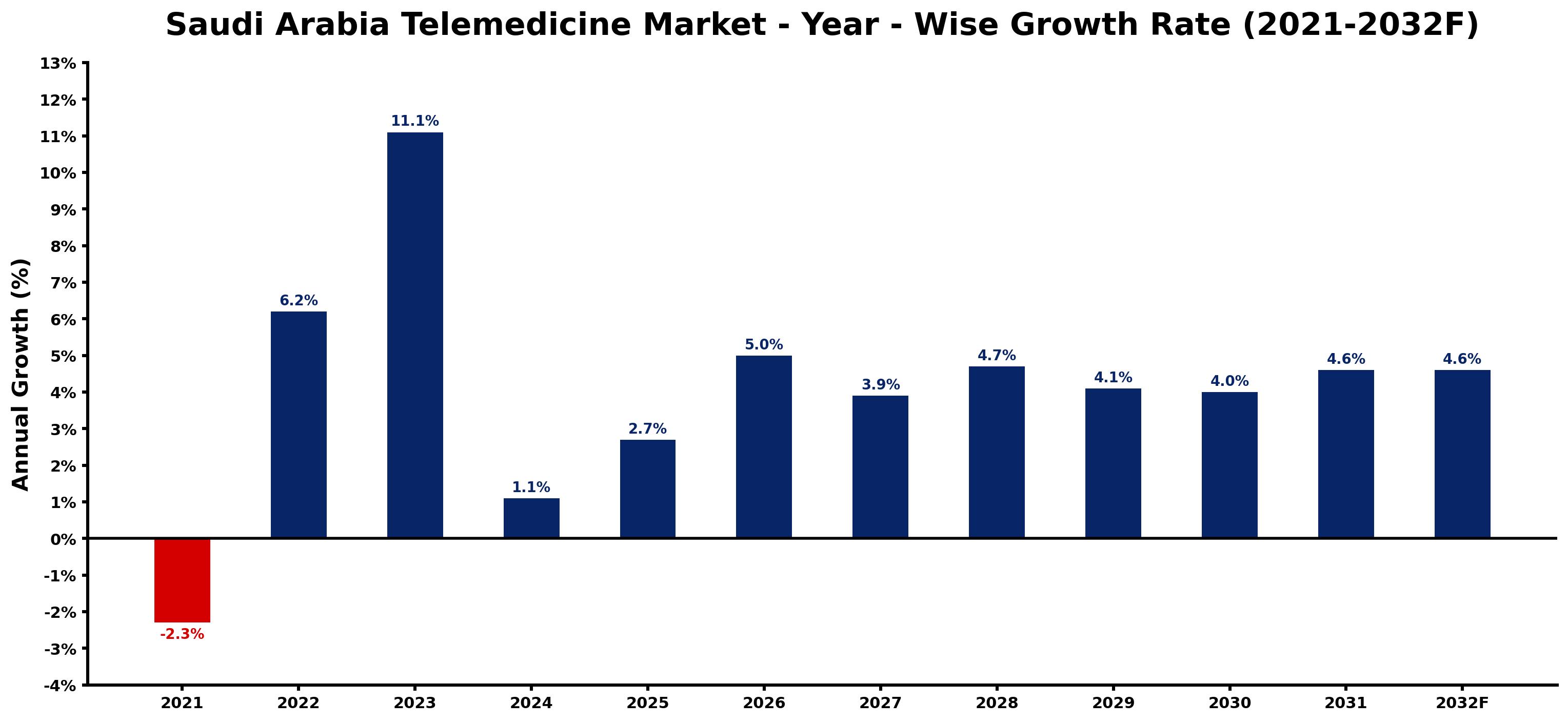
The table below presents the year‑wise growth rates along with the key drivers influencing the market
| Year | Growth Rate | Major Drivers |
| 2021 | -2.3% | Expansion of manufacturing activities |
| 2022 | 6.2% | Rising electricity demand across industries |
| 2023 | 11.1% | Rapid growth in telecom and data center sectors |
| 2024 | 1.1% | Rapid growth in telecom and data center sectors |
| 2025 | 2.7% | Rapid growth in telecom and data center sectors |
| 2026 | 5.0% | Rising electricity demand across industries |
| 2027 | 3.9% | Rapid growth in telecom and data center sectors |
| 2028 | 4.7% | Expansion of commercial construction activities |
| 2029 | 4.1% | Growing urbanization and commercial development |
| 2030 | 4.0% | Increasing smart city development projects |
| 2031 | 4.6% | Rapid growth in telecom and data center sectors |
| 2032 | 4.6% | Growing urbanization and commercial development |
Note - Market size estimations and growth projections presented in this report are based on 6Wresearch’s advanced forecasting approach, validated with industry datasets as of June 2026.
Saudi Arabia Telemedicine Market Synopsis
In recent years, the telemedicine landscape in Saudi Arabia has experienced a significant surge, driven largely by a paradigm shift toward digital healthcare solutions. As the demand for remote consultations and digital health services grows, it sets the stage for a more accessible and effective healthcare delivery model. This transformation is supported by an evolving regulatory framework and increasing investments in health technology.
Looking ahead, the Saudi Arabia Telemedicine Market is poised for further expansion as healthcare providers embrace innovative telehealth platforms. Enhanced internet penetration and growing technology literacy among the population will continue to propel adoption rates, ensuring a more equitable healthcare system across the region.
Saudi Arabia Telemedicine Market Key Takeaways
- Increased government support and favorable policies are accelerating the growth of telemedicine.
- High-speed internet and mobile technology advancements are crucial drivers of market adoption.
- The Covid-19 pandemic served as a significant catalyst for telemedicine usage.
- Access to healthcare services remains a primary concern, particularly in rural regions.
- Investments in healthcare technology are essential for the future development of telemedicine solutions.
Evaluation of Restraints in Saudi Arabia Telemedicine Market
While the potential for growth in the Saudi Arabia Telemedicine Market is evident, several restraints must be addressed for long-term sustainability. A lack of robust regulatory frameworks can hinder patient safety, raising concerns about data privacy and compliance. Additionally, uneven internet access across rural and urban areas presents a barrier to the widespread adoption of telemedicine services. Furthermore, varying levels of technological literacy among the population may limit engagement with telehealth platforms, necessitating targeted educational initiatives to bolster acceptance.
Saudi Arabia Telemedicine Market Trends
Current trends in the Saudi Arabia Telemedicine Market indicate a shift towards integrated telehealth solutions that combine remote monitoring, virtual consultations, and patient management systems. The increasing use of artificial intelligence and machine learning in telemedicine applications is enhancing diagnostic accuracy and patient engagement. Additionally, the rise of mobile health applications tailored for specific conditions indicates a growing demand for personalized healthcare delivery. As technology evolves, we anticipate a more seamless and efficient healthcare experience for users.
Saudi Arabia Telemedicine Market Opportunities
The burgeoning telemedicine sector in Saudi Arabia presents several investment opportunities, particularly in areas such as telehealth platforms and remote monitoring technologies. Startups focusing on specific healthcare needs, including chronic disease management and mental health, stand to benefit significantly. Additionally, collaborations between tech companies and healthcare providers can enhance service offerings and improve patient outcomes. With ongoing public health initiatives and investments in infrastructure, stakeholders have a unique opportunity to reshape the future of healthcare in the Kingdom.
Government Initiatives in the Saudi Arabia Telemedicine Market
The Saudi government has actively endorsed telemedicine as part of its Vision 2030 framework, aiming to enhance healthcare accessibility and quality. Various programs and policies have been introduced to promote telehealth services, with an emphasis on improving healthcare delivery in underserved regions. Public spending in health technology is also on the rise, demonstrating a commitment to fostering innovation and expanding the telemedicine ecosystem. These initiatives are designed to integrate telemedicine into the broader healthcare strategy, ensuring alignment with national health goals.
Future Insights of the Saudi Arabia Telemedicine Market
As we move into the later half of the decade, the Saudi Arabia Telemedicine Market is expected to continue on its upward path, bolstered by technological advancements and ongoing public support. The anticipated rise in digital health literacy among citizens will likely facilitate greater acceptance of telemedicine solutions. By 2032, we foresee a more interconnected healthcare ecosystem, where telemedicine plays a central role in promoting preventive care and enhancing patient experiences. This shift will redefine how healthcare is accessed and delivered in the Kingdom.
Saudi Arabia Telemedicine Market Latest Developments (May 2025 - June 2026)
The telemedicine landscape in Saudi Arabia has witnessed several notable developments recently. A surge in partnerships between healthcare providers and technology firms has led to the creation of innovative telehealth applications. Furthermore, national health initiatives have ramped up efforts to improve internet connectivity in rural regions, facilitating broader access to telemedicine services. As a result, healthcare facilities are increasingly integrating telehealth solutions into their service offerings, adapting to evolving patient needs and preferences.
Saudi Arabia Telemedicine Market - Key Attractiveness of the Report
- 10 Years of Market Numbers
- Historical Data Starting from 2022 to 2025
- Base Year: 2025
- Forecast Data until 2032
- Key Performance Indicators Impacting the Market
- Major Upcoming Developments and Projects
Key Highlights of the Report:
- Saudi Arabia Telemedicine Market Outlook
- Market Size of Saudi Arabia Telemedicine Market, 2025
- Forecast of Saudi Arabia Telemedicine Market, 2032
- Historical Data and Forecast of Saudi Arabia Telemedicine Revenues & Volume for the Period 2022-2032F
- Saudi Arabia Telemedicine Market Trend Evolution
- Saudi Arabia Telemedicine Market Drivers and Challenges
- Saudi Arabia Telemedicine Price Trends
- Saudi Arabia Telemedicine Porter's Five Forces
- Saudi Arabia Telemedicine Industry Life Cycle
- Historical Data and Forecast of Saudi Arabia Telemedicine Market Revenues & Volume By Types for the Period 2022-2032F
- Historical Data and Forecast of Saudi Arabia Telemedicine Market Revenues & Volume By Tele Hospitals for the Period 2022-2032F
- Historical Data and Forecast of Saudi Arabia Telemedicine Market Revenues & Volume By Tele Homes for the Period 2022-2032F
- Historical Data and Forecast of Saudi Arabia Telemedicine Market Revenues & Volume By mHealth (Mobile Health) for the Period 2022-2032F
- Historical Data and Forecast of Saudi Arabia Telemedicine Market Revenues & Volume By Component for the Period 2022-2032F
- Historical Data and Forecast of Saudi Arabia Telemedicine Market Revenues & Volume By Product for the Period 2022-2032F
- Historical Data and Forecast of Saudi Arabia Telemedicine Market Revenues & Volume By Services for the Period 2022-2032F
- Saudi Arabia Telemedicine Import Export Trade Statistics
- Market Opportunity Assessment By Types
- Market Opportunity Assessment By Component
- Saudi Arabia Telemedicine Top Companies Market Share
- Saudi Arabia Telemedicine Competitive Benchmarking By Technical and Operational Parameters
- Saudi Arabia Telemedicine Company Profiles
- Saudi Arabia Telemedicine Key Strategic Recommendations






































