Australia Toggle Clamps Market Size, Share & Growth Rate
The Australia Toggle Clamps Market was estimated at USD 226 Million in 2025 and is projected to reach USD 266 Million by 2032, growing at a CAGR of 2.4% from 2026 to 2032. This growth trajectory is strongly influenced by the increasing trends in industrial automation and precision engineering, particularly within woodworking, metalworking, and automotive sectors. The push for more ergonomic solutions and advanced toggle clamp designs underscores a market eager to adapt to evolving manufacturing needs.
Australia Toggle Clamps Market Year-wise Growth Rate and Key Drivers
This graph highlights how the Australia Toggle Clamps Market has steadily grown over the years, supported by major growth factors.
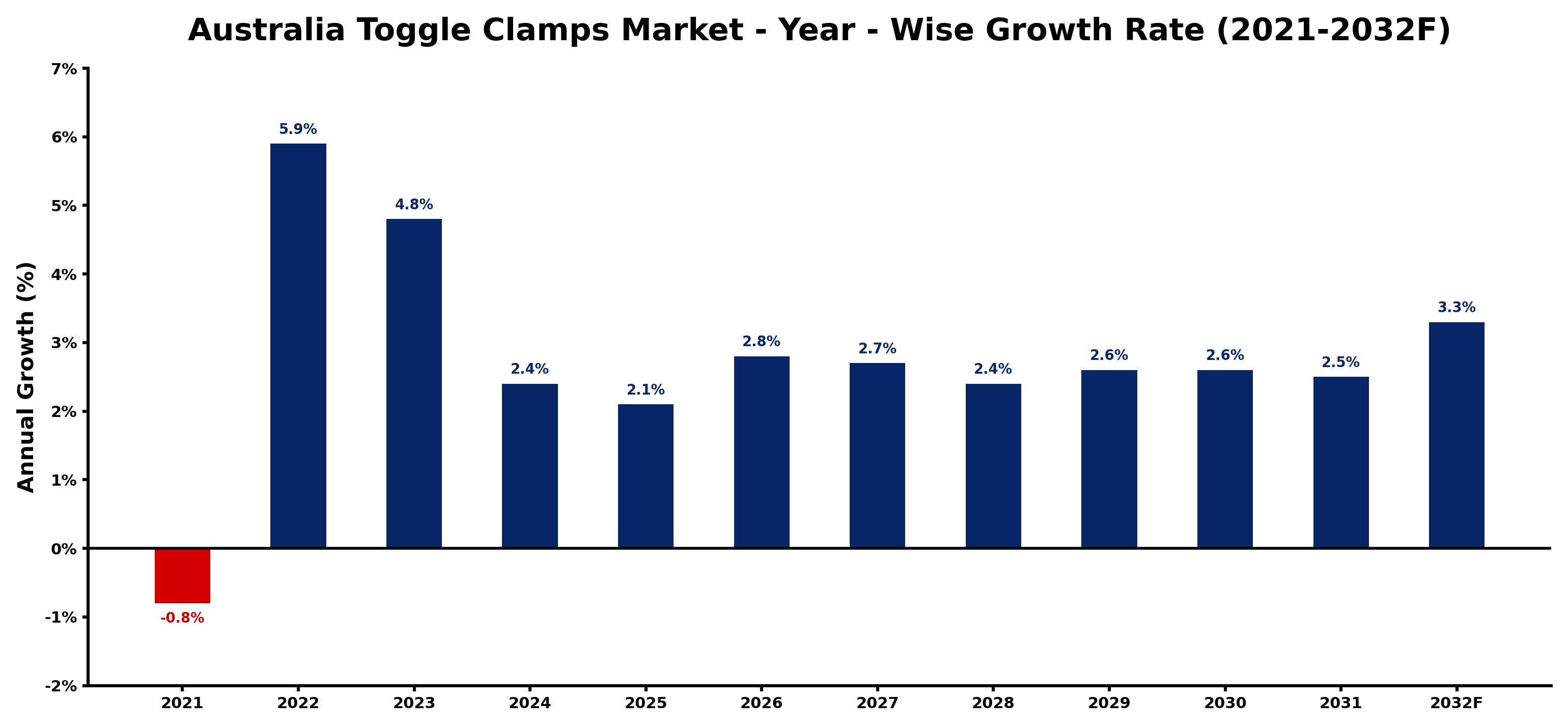
The table below presents the year‑wise growth rates along with the key drivers influencing the market
| Year | Growth Rate | Major Drivers |
| 2021 | -0.8% | Rapid growth in telecom and data center sectors |
| 2022 | 5.9% | Increasing smart city development projects |
| 2023 | 4.8% | Rapid growth in telecom and data center sectors |
| 2024 | 2.4% | Expansion of manufacturing activities |
| 2025 | 2.1% | Increasing industrial infrastructure investments |
| 2026 | 2.8% | Growing urbanization and commercial development |
| 2027 | 2.7% | Government infrastructure modernization initiatives |
| 2028 | 2.4% | Expansion of transportation and logistics networks |
| 2029 | 2.6% | Government infrastructure modernization initiatives |
| 2030 | 2.6% | Increasing smart city development projects |
| 2031 | 2.5% | Increasing adoption of advanced technologies |
| 2032 | 3.3% | Increasing industrial infrastructure investments |
Note - Market size estimations and growth projections presented in this report are based on 6Wresearch’s advanced forecasting approach, validated with industry datasets as of June 2026.
Australia Toggle Clamps Market Synopsis
In recent years, the Australian toggle clamps market has witnessed a substantial momentum driven by significant industrial advancements. However, the horizon indicates a steady pace of growth as businesses increasingly prioritize automation and ergonomic designs in their operations. This evolution reflects a market that is maturing yet remains ripe for innovation.
As the demand for precision and reliability escalates across various industries, toggle clamps are positioned as essential tools in securing workpieces during critical processes like machining and welding. This not only speaks to their current utility but also hints at their indispensable role in future manufacturing landscapes.
Australia Toggle Clamps Market Key Takeaways
- The market is experiencing growth due to trends in industrial automation and demand for precision engineering tools.
- Ergonomic designs and advanced functionalities are becoming key differentiators in the toggle clamps market.
- Compliance with government regulations ensures product safety and workplace efficiency, bolstering market stability.
- Despite competition from alternative clamping solutions, toggle clamps continue to be integral in various applications.
- The projected growth from USD 226 Million in 2025 to USD 266 Million by 2032 indicates a robust market potential.
Evaluation of Restraints in Australia Toggle Clamps Market
While the Australia toggle clamps market is expanding, it faces certain restraints that can influence its growth trajectory. The competition from alternative clamping solutions poses a significant challenge, as businesses often weigh different options that may provide comparable functionality at potentially lower costs. Additionally, the rapid pace of technological advancements necessitates continuous innovation in toggle clamp designs, which can strain resources for manufacturers striving to keep pace. Furthermore, meeting the diverse precision and reliability requirements across various industries complicates product development and market entry for new players.
Australia Toggle Clamps Market Trends
Current trends in the Australia toggle clamps market reveal a strong shift toward automation and integrated manufacturing solutions. Companies are increasingly adopting smart technology to enhance the functionality of toggle clamps, integrating sensors and controls to optimize clamping operations. Additionally, ergonomic designs with quick-release mechanisms are in demand, catering to a workforce that values comfort and efficiency. These advancements not only improve safety but also enhance productivity in various industrial applications.
Australia Toggle Clamps Market Opportunities
The future presents numerous opportunities for growth within the Australia toggle clamps market. Manufacturers that innovate around advanced materials and smart technology can capture significant market share. Moreover, expanding into sectors such as robotics and aerospace, where precision clamping is critical, offers lucrative prospects. Additionally, capitalizing on the rising demand for custom solutions tailored to specific industry needs can position companies favorably against competitors.
Government Initiatives in the Australia Toggle Clamps Market
Government policies in Australia play a pivotal role in shaping the toggle clamps market landscape. Regulations aimed at enhancing product safety and quality standards ensure that toggle clamps comply with established performance specifications, thereby promoting workplace safety and operational efficiency. Public spending directed towards infrastructure and manufacturing enhancements creates a favorable environment for market growth, encouraging innovation and competitiveness among local manufacturers.
Future Insights of the Australia Toggle Clamps Market
Looking ahead to 2026-2032, the Australia toggle clamps market is expected to continue its upward trajectory, fueled by ongoing industrial advancements and the increasing integration of automation. The demand for high-precision clamping solutions will persist as industries evolve to meet higher productivity and efficiency standards. Companies that focus on sustainable practices and smart manufacturing will likely lead the charge, ensuring that they remain ahead in a highly competitive landscape.
Australia Toggle Clamps Market Latest Developments (May 2025 - June 2026)
In the recent months, the Australia toggle clamps market has seen a flurry of activity as companies align their strategies with advancements in automation technology. There has been a noticeable increase in R&D investments aimed at developing more efficient and ergonomic clamp designs. Furthermore, collaborations between manufacturers and tech firms have emerged, focusing on integrating smart features into toggle clamps, enhancing their functionality and appeal in modern manufacturing environments.
Australia Toggle Clamps Market - Key Attractiveness of the Report
- 10 Years of Market Numbers
- Historical Data Starting from 2022 to 2025
- Base Year: 2025
- Forecast Data until 2032
- Key Performance Indicators Impacting the Market
- Major Upcoming Developments and Projects
Key Highlights of the Report:
- Australia Toggle Clamps Market Outlook
- Market Size of Australia Toggle Clamps Market, 2025
- Forecast of Australia Toggle Clamps Market, 2032
- Historical Data and Forecast of Australia Toggle Clamps Revenues & Volume for the Period 2022-2032F
- Australia Toggle Clamps Market Trend Evolution
- Australia Toggle Clamps Market Drivers and Challenges
- Australia Toggle Clamps Price Trends
- Australia Toggle Clamps Porter's Five Forces
- Australia Toggle Clamps Industry Life Cycle
- Historical Data and Forecast of Australia Toggle Clamps Market Revenues & Volume By Product Type for the Period 2022-2032F
- Historical Data and Forecast of Australia Toggle Clamps Market Revenues & Volume By Horizontal Toggle Clamps for the Period 2022-2032F
- Historical Data and Forecast of Australia Toggle Clamps Market Revenues & Volume By Vertical Toggle Clamps for the Period 2022-2032F
- Historical Data and Forecast of Australia Toggle Clamps Market Revenues & Volume By Application for the Period 2022-2032F
- Historical Data and Forecast of Australia Toggle Clamps Market Revenues & Volume By Assembly Technology for the Period 2022-2032F
- Historical Data and Forecast of Australia Toggle Clamps Market Revenues & Volume By Clamping Technology for the Period 2022-2032F
- Historical Data and Forecast of Australia Toggle Clamps Market Revenues & Volume By Tool Construction for the Period 2022-2032F
- Historical Data and Forecast of Australia Toggle Clamps Market Revenues & Volume By Fixture Construction for the Period 2022-2032F
- Australia Toggle Clamps Import Export Trade Statistics
- Market Opportunity Assessment By Product Type
- Market Opportunity Assessment By Application
- Australia Toggle Clamps Top Companies Market Share
- Australia Toggle Clamps Competitive Benchmarking By Technical and Operational Parameters
- Australia Toggle Clamps Company Profiles
- Australia Toggle Clamps Key Strategic Recommendations






































