Australia Trimethyl Pentanediol Monoisobutyrate Market (2026-2032) Outlook | Forecast, Size, Share, Analysis, Value, Growth, Trends, Companies, Revenue & Industry
Market Forecast By Application (Latex Paints, Solvents, Others) And Competitive Landscape
| Product Code: ETC350555 | Publication Date: Aug 2022 | Updated Date: Jul 2026 | Product Type: Market Research Report | |
| Publisher: 6Wresearch | Author: Shubham Padhi | No. of Pages: 75 | No. of Figures: 35 | No. of Tables: 20 |
Australia Trimethyl Pentanediol Monoisobutyrate Market Size, Share & Growth Rate
The Australia Trimethyl Pentanediol Monoisobutyrate Market was estimated at USD 114 Million in 2025 and is projected to reach USD 135 Million by 2032, growing at a CAGR of 2.4% from 2026 to 2032. This growth is largely attributed to the increasing demand for high-performance coatings and adhesives, particularly within the construction and automotive sectors. The push for sustainable products further accentuates the need for low-VOC formulations, which are facilitated by trimethyl pentanediol monoisobutyrates desirable properties.
Australia Trimethyl Pentanediol Monoisobutyrate Market Year-wise Growth Rate and Key Drivers
This graph highlights how the Australia Trimethyl Pentanediol Monoisobutyrate Market has steadily grown over the years, supported by major growth factors.
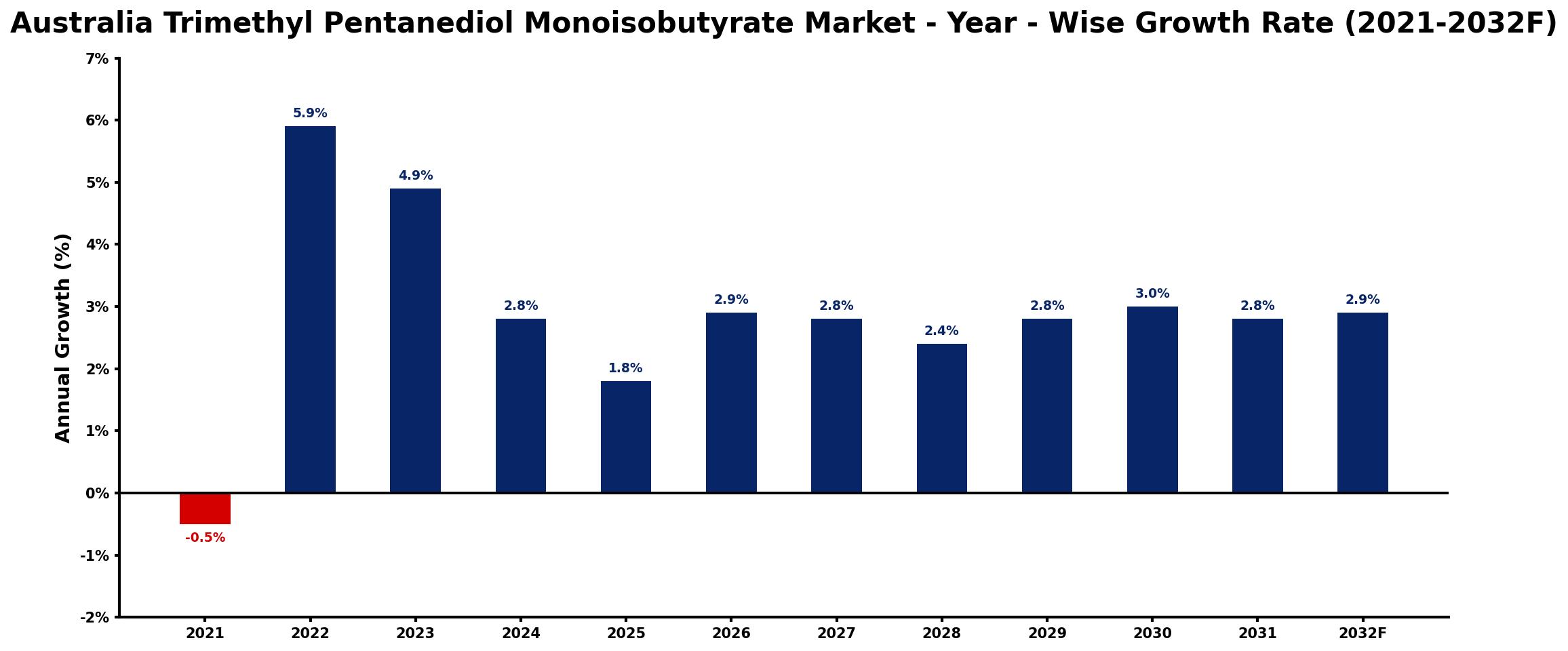
The table below presents the year‑wise growth rates along with the key drivers influencing the market
| Year | Growth Rate | Major Drivers |
| 2021 | -0.5% | decreased industrial demand for solvents |
| 2022 | 5.9% | rising demand in automotive coatings |
| 2023 | 4.9% | growth in personal care products |
| 2024 | 2.8% | expansion of construction projects |
| 2025 | 1.8% | increased investments in manufacturing |
| 2026 | 2.9% | surge in eco-friendly alternatives |
| 2027 | 2.8% | higher demand in food packaging |
| 2028 | 2.4% | growing commercial sector adoption |
| 2029 | 2.8% | increased usage in adhesives sector |
| 2030 | 3.0% | improved raw material availability |
| 2031 | 2.8% | rising interest in specialty chemicals |
| 2032 | 2.9% | increased focus on sustainable practices |
Note: Market size estimations and growth projections presented in this report are based on 6Wresearch's proprietary forecasting methodology, utilizing the latest available industry data, government publications, and primary research inputs.
Australia Trimethyl Pentanediol Monoisobutyrate Market Synopsis
The most significant factor shaping the Australia Trimethyl Pentanediol Monoisobutyrate Market is the rising demand for eco-friendly and effective solvents in coatings, inks, and adhesives. Manufacturers are actively reformulating their products to align with environmental standards, enhancing the compound's attractiveness.
Additionally, its advantageous characteristics, including high solubility and low volatility, position trimethyl pentanediol monoisobutyrate as a preferred choice among formulators. As regulatory pressures increase for safer chemical products, the market is likely to continue its upward trajectory.
Australia Trimethyl Pentanediol Monoisobutyrate Market Key Takeaways
- The market is projected to grow steadily, driven by the increasing adoption of low-VOC and eco-friendly products.
- High-performance coatings and adhesives in construction and automotive industries significantly influence market dynamics.
- Regulatory frameworks emphasize the importance of compliance with safety and environmental standards.
- Manufacturers face challenges related to production scalability and maintaining quality amid fluctuating demand.
- Continual innovations in formulation are pivotal in sustaining market growth and responding to consumer preferences.
Evaluation of Restraints in Australia Trimethyl Pentanediol Monoisobutyrate Market
Despite the promising growth trajectory, the Australia Trimethyl Pentanediol Monoisobutyrate Market is hindered by certain restraints. The niche nature of the compound leads to limited applications, which can stifle broader market penetration. Manufacturers often grapple with challenges related to production scaling, particularly during periods of demand fluctuation. Additionally, the presence of substitute products can pose competition, impacting the market's overall viability. Maintaining consistent quality while also managing production costs remains a critical focus for industry stakeholders.
Australia Trimethyl Pentanediol Monoisobutyrate Market Trends
Several trends are currently shaping the Australia Trimethyl Pentanediol Monoisobutyrate Market. There is a strong movement towards the development of formulations that meet green chemistry standards, reflecting a growing consumer preference for sustainable products. Innovations in product development are also emerging, as manufacturers seek to enhance the performance characteristics of their offerings. Furthermore, digital technologies are increasingly being incorporated in production processes, allowing for improved efficiency and product consistency.
Australia Trimethyl Pentanediol Monoisobutyrate Market Opportunities
The opportunities in the Australia Trimethyl Pentanediol Monoisobutyrate Market are abundant. There is significant potential for expansion in the automotive and construction sectors, where high-performance adhesives and coatings are essential. As environmental regulations continue to tighten, businesses that prioritize the development of low-VOC products stand to benefit. Additionally, the rise of online platforms for product distribution offers avenues for reaching new customers and markets.
Government Initiatives in the Australia Trimethyl Pentanediol Monoisobutyrate Market
Government policies in Australia play a crucial role in shaping the Trimethyl Pentanediol Monoisobutyrate Market. Regulations focus on ensuring chemical safety and compliance, impacting production, importation, and usage across various industries, including paints and coatings. Additionally, there are initiatives aimed at promoting research and development for safer chemical alternatives, which can enhance the market's growth potential and sustainability.
Future Insights of the Australia Trimethyl Pentanediol Monoisobutyrate Market
Looking ahead to 2026-2032, the Australia Trimethyl Pentanediol Monoisobutyrate Market is expected to evolve significantly. With the growing emphasis on environmental responsibility, manufacturers will likely continue to innovate and reformulate their offerings. The push for high-performance products in the construction and automotive sectors will remain a primary driver, while advancements in technology will further enhance production efficiency. Overall, the market is poised for steady growth as it adapts to changing consumer preferences and regulatory landscapes.
Australia Trimethyl Pentanediol Monoisobutyrate Market Latest Developments (2025 - 2026)
Recent developments in the Australia Trimethyl Pentanediol Monoisobutyrate Market indicate a trend towards increased collaboration among manufacturers to innovate low-VOC formulations. Additionally, there is a noticeable shift towards sustainability, with more companies prioritizing environmentally friendly practices. The focus on compliance with chemical safety regulations is also intensifying, leading to advancements in monitoring technologies and quality assurance processes within the industry.
Australia Trimethyl Pentanediol Monoisobutyrate Market - Key Attractiveness of the Report
- 10 Years of Market Numbers
- Historical Data Starting from 2022 to 2025
- Base Year: 2025
- Forecast Data until 2032
- Key Performance Indicators Impacting the Market
- Major Upcoming Developments and Projects
Key Highlights of the Report:
- Australia Trimethyl Pentanediol Monoisobutyrate Market Outlook
- Market Size of Australia Trimethyl Pentanediol Monoisobutyrate Market, 2025
- Forecast of Australia Trimethyl Pentanediol Monoisobutyrate Market, 2032
- Historical Data and Forecast of Australia Trimethyl Pentanediol Monoisobutyrate Revenues & Volume for the Period 2022-2032F
- Australia Trimethyl Pentanediol Monoisobutyrate Market Trend Evolution
- Australia Trimethyl Pentanediol Monoisobutyrate Market Drivers and Challenges
- Australia Trimethyl Pentanediol Monoisobutyrate Price Trends
- Australia Trimethyl Pentanediol Monoisobutyrate Porter's Five Forces
- Australia Trimethyl Pentanediol Monoisobutyrate Industry Life Cycle
- Historical Data and Forecast of Australia Trimethyl Pentanediol Monoisobutyrate Market Revenues & Volume By Application for the Period 2022-2032F
- Historical Data and Forecast of Australia Trimethyl Pentanediol Monoisobutyrate Market Revenues & Volume By Latex Paints for the Period 2022-2032F
- Historical Data and Forecast of Australia Trimethyl Pentanediol Monoisobutyrate Market Revenues & Volume By Solvents for the Period 2022-2032F
- Historical Data and Forecast of Australia Trimethyl Pentanediol Monoisobutyrate Market Revenues & Volume By Others for the Period 2022-2032F
- Australia Trimethyl Pentanediol Monoisobutyrate Import Export Trade Statistics
- Market Opportunity Assessment By Application
- Australia Trimethyl Pentanediol Monoisobutyrate Top Companies Market Share
- Australia Trimethyl Pentanediol Monoisobutyrate Competitive Benchmarking By Technical and Operational Parameters
- Australia Trimethyl Pentanediol Monoisobutyrate Company Profiles
- Australia Trimethyl Pentanediol Monoisobutyrate Key Strategic Recommendations
Frequently Asked Questions About the Market Study (FAQs):
The market is estimated at USD 114 Million in 2025 and is projected to grow to USD 135 Million by 2032, achieving a CAGR of 2.4% during the period from 2026 to 2032.
Manufacturers are increasingly focusing on developing eco-friendly formulations, particularly low-VOC products, to comply with stringent environmental regulations while also catering to consumer preferences.
The construction and automotive sectors are the primary drivers of demand, particularly due to their requirements for high-performance coatings and adhesives.
One major challenge is the niche nature of trimethyl pentanediol monoisobutyrate, which leads to limited applications and scalability issues during demand fluctuations. Additionally, maintaining quality and managing production costs are ongoing concerns.
Yes, current trends include a strong push for sustainable formulations, innovations in product development, and the integration of digital technologies into production processes, all of which are shaping market dynamics.
6Wresearch actively monitors the Australia Trimethyl Pentanediol Monoisobutyrate Market and publishes its comprehensive annual report, highlighting emerging trends, growth drivers, revenue analysis, and forecast outlook. Our insights help businesses to make data-backed strategic decisions with ongoing market dynamics. Our analysts track relevent industries related to the Australia Trimethyl Pentanediol Monoisobutyrate Market, allowing our clients with actionable intelligence and reliable forecasts tailored to emerging regional needs.
Yes, we provide customisation as per your requirements. To learn more, feel free to contact us on sales@6wresearch.com
1 Executive Summary |
2 Introduction |
2.1 Key Highlights of the Report |
2.2 Report Description |
2.3 Market Scope & Segmentation |
2.4 Research Methodology |
2.5 Assumptions |
3 Australia Trimethyl Pentanediol Monoisobutyrate Market Overview |
3.1 Australia Country Macro Economic Indicators |
3.2 Australia Trimethyl Pentanediol Monoisobutyrate Market Revenues & Volume, 2022 & 2032F |
3.3 Australia Trimethyl Pentanediol Monoisobutyrate Market - Industry Life Cycle |
3.4 Australia Trimethyl Pentanediol Monoisobutyrate Market - Porter's Five Forces |
3.5 Australia Trimethyl Pentanediol Monoisobutyrate Market Revenues & Volume Share, By Application, 2022 & 2032F |
4 Australia Trimethyl Pentanediol Monoisobutyrate Market Dynamics |
4.1 Impact Analysis |
4.2 Market Drivers |
4.2.1 Increasing demand for environmentally friendly and sustainable chemicals |
4.2.2 Growing adoption of trimethyl pentanediol monoisobutyrate in various industries such as paints and coatings, adhesives, and sealants |
4.2.3 Technological advancements leading to improved product quality and performance |
4.3 Market Restraints |
4.3.1 Fluctuating raw material prices impacting the production cost of trimethyl pentanediol monoisobutyrate |
4.3.2 Stringent regulations and compliance requirements in the chemical industry |
5 Australia Trimethyl Pentanediol Monoisobutyrate Market Trends |
6 Australia Trimethyl Pentanediol Monoisobutyrate Market, By Types |
6.1 Australia Trimethyl Pentanediol Monoisobutyrate Market, By Application |
6.1.1 Overview and Analysis |
6.1.2 Australia Trimethyl Pentanediol Monoisobutyrate Market Revenues & Volume, By Application, 2022-2032F |
6.1.3 Australia Trimethyl Pentanediol Monoisobutyrate Market Revenues & Volume, By Latex Paints, 2022-2032F |
6.1.4 Australia Trimethyl Pentanediol Monoisobutyrate Market Revenues & Volume, By Solvents, 2022-2032F |
6.1.5 Australia Trimethyl Pentanediol Monoisobutyrate Market Revenues & Volume, By Others, 2022-2032F |
7 Australia Trimethyl Pentanediol Monoisobutyrate Market Import-Export Trade Statistics |
7.1 Australia Trimethyl Pentanediol Monoisobutyrate Market Export to Major Countries |
7.2 Australia Trimethyl Pentanediol Monoisobutyrate Market Imports from Major Countries |
8 Australia Trimethyl Pentanediol Monoisobutyrate Market Key Performance Indicators |
8.1 Research and development spending on new applications and formulations of trimethyl pentanediol monoisobutyrate |
8.2 Number of patents filed for innovations related to trimethyl pentanediol monoisobutyrate |
8.3 Rate of adoption of trimethyl pentanediol monoisobutyrate in new industries or applications |
8.4 Sustainability initiatives and certifications related to the production and use of trimethyl pentanediol monoisobutyrate |
8.5 Level of investment in marketing and promotion activities to create awareness and demand for trimethyl pentanediol monoisobutyrate |
9 Australia Trimethyl Pentanediol Monoisobutyrate Market - Opportunity Assessment |
9.1 Australia Trimethyl Pentanediol Monoisobutyrate Market Opportunity Assessment, By Application, 2022 & 2032F |
10 Australia Trimethyl Pentanediol Monoisobutyrate Market - Competitive Landscape |
10.1 Australia Trimethyl Pentanediol Monoisobutyrate Market Revenue Share, By Companies, 2025 |
10.2 Australia Trimethyl Pentanediol Monoisobutyrate Market Competitive Benchmarking, By Operating and Technical Parameters |
11 Company Profiles |
12 Recommendations |
13 Disclaimer |
Global Go To Market Strategy - 2030
Export potential enables firms to identify high-growth global markets with greater confidence by combining advanced trade intelligence with a structured quantitative methodology. The framework analyzes emerging demand trends and country-level import patterns while integrating macroeconomic and trade datasets such as GDP and population forecasts, bilateral import–export flows, tariff structures, elasticity differentials between developed and developing economies, geographic distance, and import demand projections. Using weighted trade values from 2020–2024 as the base period to project country-to-country export potential for 2030, these inputs are operationalized through calculated drivers such as gravity model parameters, tariff impact factors, and projected GDP per-capita growth. Through an analysis of hidden potentials, demand hotspots, and market conditions that are most favorable to success, this method enables firms to focus on target countries, maximize returns, and global expansion with data, backed by accuracy.
By factoring in the projected importer demand gap that is currently unmet and could be potential opportunity, it identifies the potential for the Exporter (Country) among 190 countries, against the general trade analysis, which identifies the biggest importer or exporter.
To discover high-growth global markets and optimize your business strategy:
Click Here
Pricing
- Single User License$ 1,995
- Department License$ 2,400
- Site License$ 3,120
- Global License$ 3,795

Leadership Perspectives from Industry Events
Search
Thought Leadership and Analyst Meet





Our Clients








6WResearch In News
- India Air Conditioner Market Set for Strong Rebound in 2026 After Weather-Led Correction and GST-Driven Recovery: 6Wresearch
- ADAS in India: How Automatic Emergency Braking, Blind Spot Detection & Driver Monitoring are Transforming Road Safety
- Doha a strategic location for EV manufacturing hub: IPA Qatar
- Demand for luxury TVs surging in the GCC, says Samsung
- Empowering Growth: The Thriving Journey of Bangladesh’s Cable Industry
- Demand for luxury TVs surging in the GCC, says Samsung
Latest Reports
- Nicaragua RPG Gaming Market (2026-2032)
- New Zealand RPG Gaming Market (2026-2032)
- Netherlands RPG Gaming Market (2026-2032)
- Nauru RPG Gaming Market (2026-2032)
- Namibia RPG Gaming Market (2026-2032)
- Mozambique RPG Gaming Market (2026-2032)
- Montenegro RPG Gaming Market (2026-2032)
- Mongolia RPG Gaming Market (2026-2032)
- Monaco RPG Gaming Market (2026-2032)
- Micronesia RPG Gaming Market (2026-2032)
Industry Events and Analyst Meet

EV India Expo 2026

HIMTEX 2026

India Refining Summit 2026

India EV Show 2026

EV tech India Expo 2026
Whitepaper
- Middle East & Africa Commercial Security Market Click here to view more.
- Middle East & Africa Fire Safety Systems & Equipment Market Click here to view more.
- GCC Drone Market Click here to view more.
- Middle East Lighting Fixture Market Click here to view more.
- GCC Physical & Perimeter Security Market Click here to view more.


