Austria Radar Systems Market: Import Trend Analysis
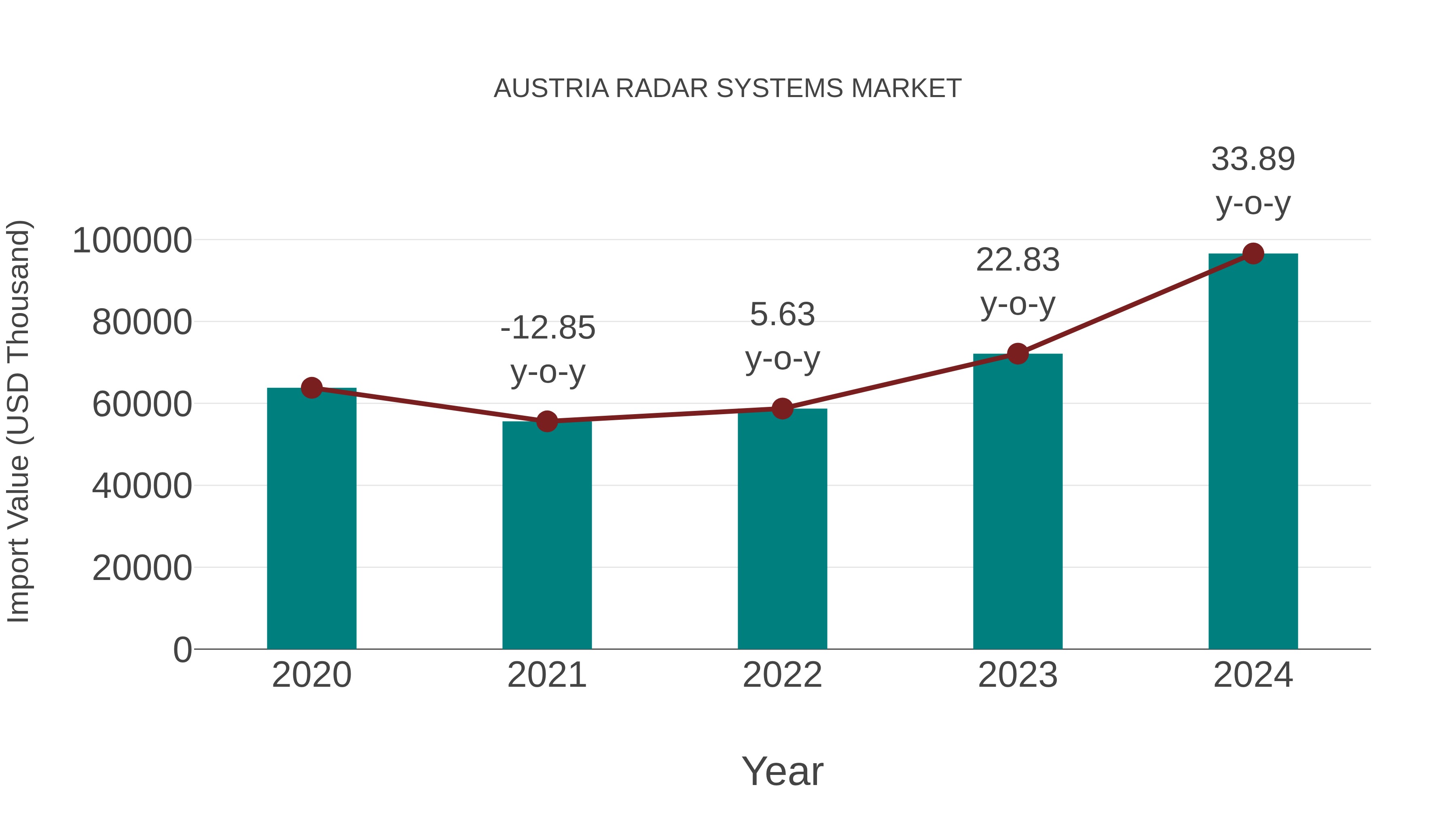
The Austria radar systems market witnessed a steady increase in imports from 2020 to 2024. The compound annual growth rate (CAGR) from 2020 to 2024 stood at 10.92%. Notably, the year-on-year growth rate spiked to 33.89% in 2024, indicating a significant surge in imported radar systems during that year.
Austria Radar Systems Market Overview
Similar to the broader radar market, the radar systems market in Austria focuses on integrated solutions for various applications. Innovations in radar technology, such as phased array and solid-state radars, enhance performance and reliability, driving market growth. The defense sector remains a major consumer of advanced radar systems.
Drivers of the market
The radar systems market in Austria benefits from the growing defense budget and the need for advanced surveillance and reconnaissance systems. The increasing adoption of radar systems in air traffic control, maritime navigation, and automotive safety applications also drives the market. Technological innovations, including the development of multifunctional radar systems and the integration of AI and machine learning, further enhance market growth. The presence of leading defense contractors and strong government support contribute to the market`s expansion.
Challenges of the market
In the radar systems market, one of the main challenges is the high cost associated with the development and deployment of advanced radar technologies. The market also requires significant investment in research and development to keep pace with rapid technological advancements. Additionally, ensuring compatibility and integration with existing systems can be complex and costly. Regulatory hurdles and the need to comply with international standards can further complicate market operations. The competitive landscape is also intense, with major global players dominating the market, making it difficult for local companies to establish a foothold.
Government Policy of the market
The Austrian radar systems market benefits from government initiatives aimed at strengthening the country`s defense capabilities. Policies include funding for research and development, collaboration with European defense agencies, and procurement of cutting-edge radar systems for the Austrian Armed Forces. Additionally, civilian applications such as air traffic control and weather monitoring are supported by regulatory frameworks ensuring system reliability and performance.
Key Highlights of the Report:
- Austria Radar Systems Market Outlook
- Market Size of Austria Radar Systems Market, 2025
- Forecast of Austria Radar Systems Market, 2032
- Historical Data and Forecast of Austria Radar Systems Revenues & Volume for the Period 2022-2032F
- Austria Radar Systems Market Trend Evolution
- Austria Radar Systems Market Drivers and Challenges
- Austria Radar Systems Price Trends
- Austria Radar Systems Porter`s Five Forces
- Austria Radar Systems Industry Life Cycle
- Historical Data and Forecast of Austria Radar Systems Market Revenues & Volume By Type for the Period 2022-2032F
- Historical Data and Forecast of Austria Radar Systems Market Revenues & Volume By Continuous Wave RADAR Systems for the Period 2022-2032F
- Historical Data and Forecast of Austria Radar Systems Market Revenues & Volume By Pulsated Wave RADAR Systems for the Period 2022-2032F
- Historical Data and Forecast of Austria Radar Systems Market Revenues & Volume By Application for the Period 2022-2032F
- Historical Data and Forecast of Austria Radar Systems Market Revenues & Volume By Airborne for the Period 2022-2032F
- Historical Data and Forecast of Austria Radar Systems Market Revenues & Volume By Land-based for the Period 2022-2032F
- Historical Data and Forecast of Austria Radar Systems Market Revenues & Volume By Naval for the Period 2022-2032F
- Historical Data and Forecast of Austria Radar Systems Market Revenues & Volume By End-user Industry for the Period 2022-2032F
- Historical Data and Forecast of Austria Radar Systems Market Revenues & Volume By Aviation for the Period 2022-2032F
- Historical Data and Forecast of Austria Radar Systems Market Revenues & Volume By Maritime Applications for the Period 2022-2032F
- Historical Data and Forecast of Austria Radar Systems Market Revenues & Volume By Automotive for the Period 2022-2032F
- Historical Data and Forecast of Austria Radar Systems Market Revenues & Volume By Military & Defense for the Period 2022-2032F
- Austria Radar Systems Import Export Trade Statistics
- Market Opportunity Assessment By Type
- Market Opportunity Assessment By Application
- Market Opportunity Assessment By End-user Industry
- Austria Radar Systems Top Companies Market Share
- Austria Radar Systems Competitive Benchmarking By Technical and Operational Parameters
- Austria Radar Systems Company Profiles
- Austria Radar Systems Key Strategic Recommendations






































