Global Radar Systems Market Highlights
| Market Size (2025) | USD 36.5 Billion |
| Forecast Size (2032) | USD 57.3 Billion |
| CAGR | 15.18% |
| Base Year | 2025 |
| Forecast Period | 2026-2032 |
| Largest Region | North America |
| Fastest Growing Region | Asia-Pacific |
| Largest Segment | Continuous Wave RADAR Systems |
| Fastest Growing Segment | Pulsated Wave RADAR Systems |
| Leading Companies | Lockheed Martin, Raytheon Technologies, Northrop Grumman, Thales Group, BAE Systems |
Global Radar Systems Market Size & Growth Rate (2026-2032)
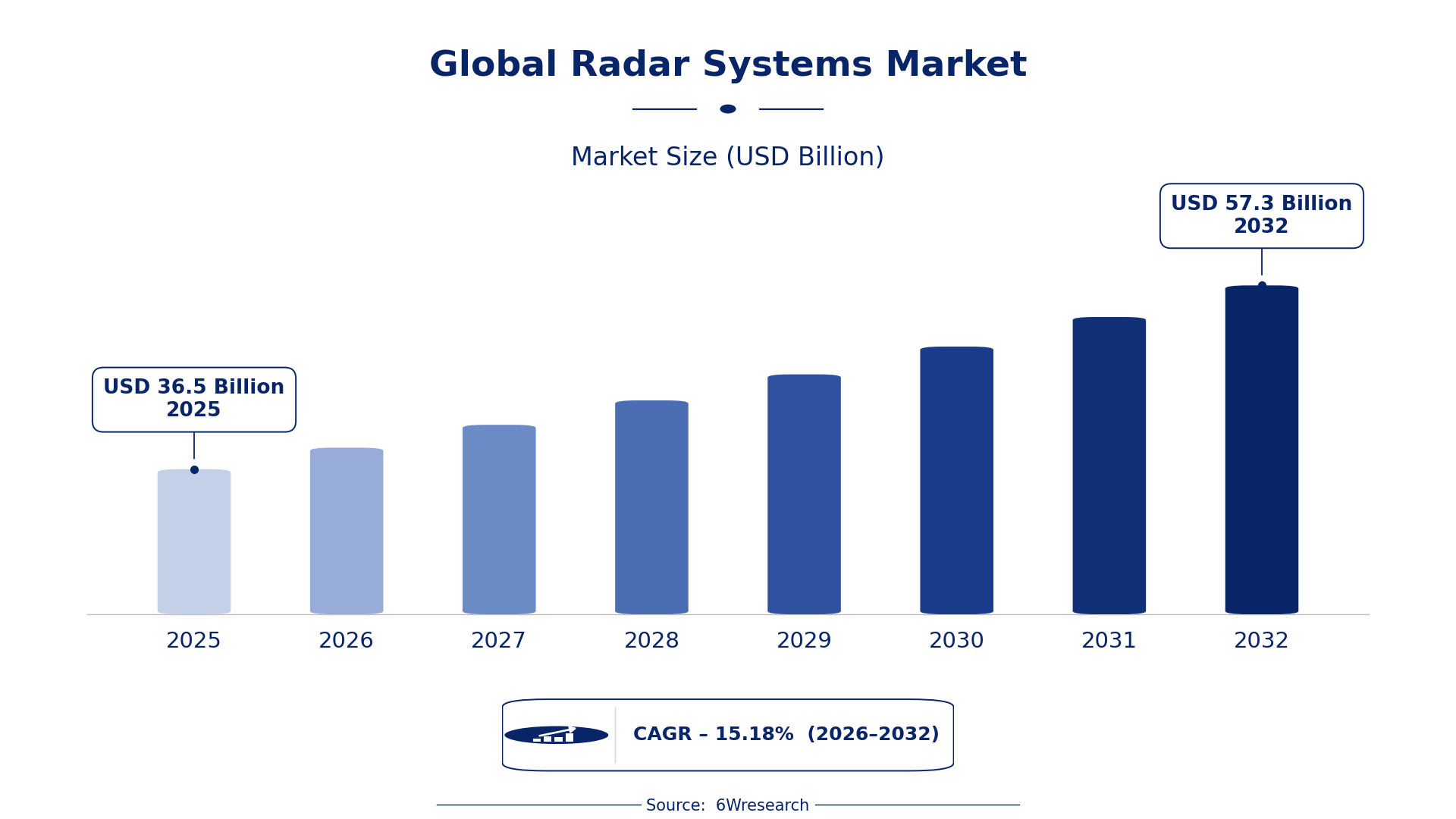
The Global Radar Systems Market was estimated at USD 36.5 Billion in 2025 and is projected to reach USD 57.3 Billion by 2032, growing at a CAGR of 15.18% from 2026 to 2032.
Global Radar Systems Market Synopsis
The Global Radar Systems Market is undergoing structural transformation fueled by escalating defense budgets and enhanced surveillance requirements across various sectors. Notably, industries such as aerospace and military are directly influencing demand, as nations increasingly invest in advanced radar technologies to bolster national security and ensure safety in air traffic management.
Recent advancements in radar technology, including phased array radar and synthetic aperture radar, offer unprecedented accuracy and target tracking capabilities. These innovations create a marked distinction between the Global Radar Systems Market and adjacent sectors, underscoring its importance in the broader defense and surveillance frameworks.
Global Radar Systems Market Year-wise Growth Rate and Key Drivers
This graph illustrates the annual growth rates of the Global Radar Systems Market from 2022 to 2032, highlighting a steady upward trajectory and projected expansion over the forecast period.
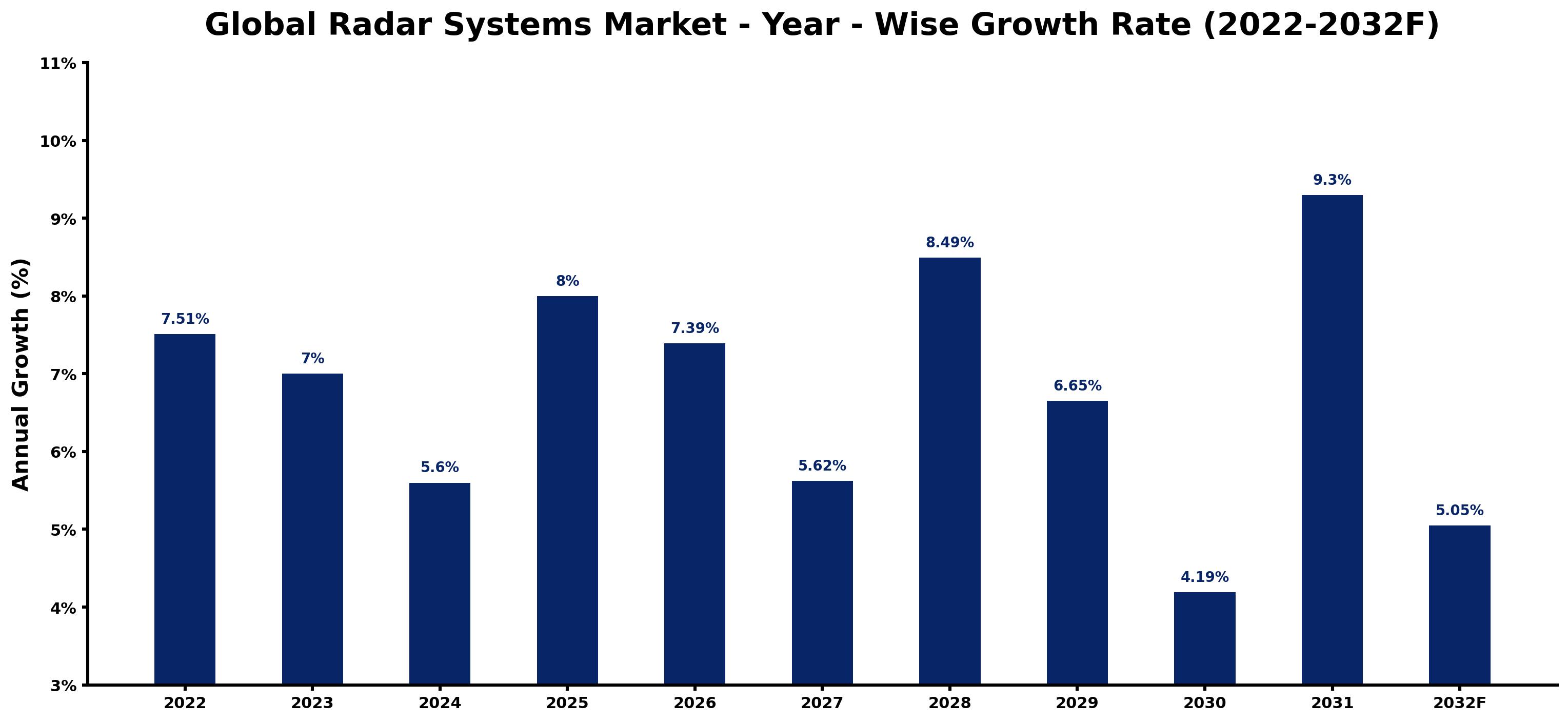
The table below presents the year‑wise growth rates along with the key drivers influencing the market
| Year | Growth Rate (%) | Major Drivers |
| 2022 | 7.51 | Establishing efficient supply chain dynamics enhances production of advanced radar systems. |
| 2023 | 7 | In the defense sector, a competitive landscape shift advances radar system technologies. |
| 2024 | 5.6 | Military customers prioritize sustainable radar systems to meet ESG compliance and requirements. |
| 2025 | 8 | UAV systems integration necessitates skilled workforce development for radar system proficiency. |
| 2026 | 7.39 | Adopting advanced composite materials leads to lightweight yet effective radar systems. |
| 2027 | 5.62 | As defense procurement cycles evolve, military demand for sophisticated radar systems increases. |
| 2028 | 8.49 | Rapid regional expansion in Asia-Pacific drives global radar systems adoption and usage. |
| 2029 | 6.65 | A shift toward radar system miniaturization transforms aerial surveillance capabilities and applications. |
| 2030 | 4.19 | Regulators enforce stricter compliance, prompting upgrades in existing radar systems technology. |
| 2031 | 9.3 | Defense contractors engage in strategic M&A to enhance capabilities in radar system development. |
| 2032 | 5.05 | Increasing raw material costs limit production, influencing pricing dynamics in radar systems. |
Note - Market size estimations and growth projections presented in this report are based on 6Wresearch's proprietary research methodology, combining internal industry data, secondary research, and primary validation, updated periodically to reflect current market conditions. As markets evolve rapidly, figures for certain industries may vary slightly and are intended as informed estimates rather than absolute figures. For the most current market sizing, we recommend validating figures with a 6Wresearch analyst.
Global Radar Systems Market Key Takeaways
Below are some of the specific key takeaways from the market, including:
- North America commands a substantial market share of approximately 45% in 2025, supported by robust defense expenditures by the U.S. government.
- The Asia-Pacific region is poised to grow rapidly, with a projected CAGR of 20% from 2026 to 2032, largely driven by China and India’s military modernization initiatives.
- Continuous Wave RADAR Systems hold the largest segment share of around 60% in 2025, attributed to their efficiency in airborne applications.
- Raytheon Technologies reported over $25 billion in defense sales for 2022, largely supported by radar system contracts, indicating strong market alignments.
- Pulsated Wave RADAR Systems are projected to grow at a CAGR of 17% from 2026 to 2032, driven by increasing applications in automotive safety systems.
Evaluation of Restraints in Global Radar Systems Market
The Global Radar Systems Market faces several noteworthy challenges that could impede growth. High initial investment costs remain a significant barrier, with advanced radar systems often exceeding $1 million per unit. Furthermore, regulatory hurdles associated with spectrum allocation limit operational capabilities and can delay project timelines dramatically. For example, the Federal Communications Commission (FCC) has stringent regulations in place that can restrict new radar technology deployments, complicating expansion efforts, particularly in the U.S. market.
Global Radar Systems Market Trends
A notable trend in the Global Radar Systems Market is the increasing integration of artificial intelligence (AI) into radar systems, significantly enhancing analytical capabilities. Companies such as Lockheed Martin are employing AI algorithms to improve target recognition and autonomy in defense applications, a necessity for modern warfare. For instance, their AI-based radar systems have demonstrated improved detection rates by up to 30% compared to conventional systems, effectively transforming operational efficacy.
Moreover, the development of gallium nitride (GaN) technology has catalyzed advancements in radar reliability and performance. This new material enables systems to operate at higher frequencies with improved thermal management, making them suitable for diverse applications, including aerospace and missile guidance. The ongoing investment in research and development by firms like Northrop Grumman indicates a dedicated push towards maintaining technological superiority, ensuring they stay ahead in a competitive market.
Global Radar Systems Market Opportunities
The Global Radar Systems Market presents numerous revenue opportunities, especially in emerging sectors such as autonomous vehicles and border security. For example, companies like Thales Group are investing in integrated radar solutions tailored for smart city infrastructures, which are projected to be worth approximately $100 billion globally by 2025. This immense growth potential is further enhanced by government initiatives aimed at enhancing urban safety and traffic management.
Additionally, increased collaborations between defense companies and tech firms are expected to yield innovative radar solutions capable of multi-functionality. For example, combining radar systems with IoT technologies allows real-time data sharing and analytics, thus opening up applications beyond traditional military uses, tapping directly into sectors like disaster management and environmental monitoring.
Global Radar Systems Market by Type
In the Global Radar Systems Market, Continuous Wave RADAR Systems lead with a significant share of approximately 60% in 2025, primarily due to their effectiveness in air traffic control applications. Conversely, Pulsated Wave RADAR Systems are noted as the fastest-growing segment, with an estimated CAGR of 17% from 2026 to 2032, driven by advancements in automotive safety and autonomous navigation technologies. The superior performance in essential applications ensures a favorable market positioning for both segments, aligning with global shifts towards safety and efficiency.
Global Radar Systems Market by Application
Among various applications in the Global Radar Systems Market, Airborne systems hold the largest market share, estimated at 55% in 2025 due to their critical role in national defense and surveillance missions. Land-based systems, however, are identified as the fastest-growing segment, projecting a CAGR of 18% from 2026 to 2032, driven by increasing demand in security and border control measures. The performance advantages of airborne systems in operational deployments coupled with the heightened requirements for land security delineate the current market dynamics.
Global Radar Systems Market by End-user Industry
The military & defense sector leads the Global Radar Systems Market, commanding approximately 70% of the share in 2025 largely due to extensive defense spending and modernization efforts by governments worldwide. In contrast, the aviation industry is the fastest-growing end-user, expected to see a CAGR of 19% from 2026 to 2032, spurred by advancements in air traffic management and safety technologies. The critical nature of radar applications within these industries underscores their strategic significance and robustness in meeting operational mandates.
Global Radar Systems Market by Region
As of 2025, North America is the largest region in the Global Radar Systems Market, accounting for approximately 45% of the overall market share, driven by the substantial defense budgets of the United States and Canada. Meanwhile, the Asia-Pacific region is projected to be the fastest-growing, with an expected CAGR of 20% from 2026 to 2032, fueled by military modernization programs in China and India, along with increasing investments in surveillance technologies across various sectors.
Government Initiatives in the Global Radar Systems Market
The regulatory landscape surrounding the Global Radar Systems Market is rapidly evolving, characterized by governmental policies aimed at enhancing technological development and national security. These initiatives are pivotal in enabling infrastructure growth, funding research, and fostering public-private partnerships within the sector.
- U.S. Department of Defense, Defense Innovation Unit, "Project Convergence," launched in 2020. This initiative promotes the integration of advanced technologies, enhancing military capabilities and interoperability, benefiting radar system applications.
- European Commission, Horizon Europe, launched in 2021. With a budget of €95.5 billion, this program supports research and innovation in defense technologies, pushing advancements in radar capabilities and increasing cooperation among member states.
- Indian Ministry of Defence, "Make in India Initiative," announced in 2014; focuses on boosting indigenous radar manufacturing, providing financial support and incentives to local businesses to enhance production capabilities.
- U.K. Ministry of Defence, Integrated Review 2021, emphasizes investment in emerging technologies, including radar systems, to ensure updated capabilities for surveillance and defense operations through strategic funding.
- Chinese Ministry of Industry and Information Technology, "Made in China 2025," initiated in 2015, aims to make China a global manufacturing powerhouse, including the development of advanced radar systems, fostering national security enhancements.
Future Insights of the Global Radar Systems Market
The trajectory of the Global Radar Systems Market is increasingly oriented toward AI integration and advanced data analytics, enhancing operational capabilities. With projected advancements in synthetic aperture radar and phased array systems, expected to show enhanced target resolution by at least 25% by 2032, companies like Northrop Grumman are focusing on R&D investments. Such developments are not only expected to increase efficiency in military applications but also to expand radar utility in civilian arenas, such as disaster management and smart infrastructure, aligning with broader technological shifts.
Global Radar Systems Market Latest Developments
Several recent developments within the Global Radar Systems Market illustrate the strategic maneuvers of leading companies to strengthen their positions and capabilities.
- In June 2023, Lockheed Martin announced the launch of an advanced radar system designed for integrated air and missile defense, enhancing operational efficiency for military applications in North America.
- Raytheon Technologies secured a significant contract in January 2023 for the development of next-generation radar systems for the U.S. Navy, which bolsters its position in the naval defense sector and enhances its long-term growth forecast.
- Northrop Grumman revealed its latest radar technology aimed at autonomous vehicles in February 2023, opening new avenues for its applications in the automotive sector and aligning with global transportation safety trends.
- Thales Group recently initiated an ambitious R&D program in March 2023 focused on GaN technology for improved radar performance, underscoring its commitment to innovation in both military and civilian radar systems.
Global Radar Systems Market Key Players and Industry Positioning
The competitive landscape of the Global Radar Systems Market is consolidated, characterized by several dominant players who are investing heavily in R&D to maintain technological advantages and market share. These companies are actively exploring strategic alliances and expansion opportunities across various regions, ensuring robust positioning amidst increasing global defense spending.
| Leading Company | Core Strength | Strategic Focus |
|---|---|---|
| Lockheed Martin | Expertise in integrated defense systems | Focusing on R&D for advanced radar technologies |
| Raytheon Technologies | Strong naval and air defense capabilities | Expanding into emerging naval radar applications |
| Northrop Grumman | Leadership in autonomous radar solutions | Innovating for automotive and defense sectors |
| Thales Group | Advantages in civil and military radar applications | Investing in smart city radar solutions |
| BAE Systems | Robust capabilities in electronic warfare | Pushing advancements in multi-spectral radar systems |
These companies are well-positioned to capture emerging opportunities as new applications for radar technology continue to unfold, particularly in non-defense sectors.
Key Attractiveness of the Report
- 10 Years of Market Numbers
- Historical Data Starting from 2022 to 2025
- Base Year: 2025
- Forecast Data until 2032
- Key Performance Indicators Impacting the Market
- Major Upcoming Developments and Projects
Key Highlights of the Report:
- Global Radar Systems Market Outlook
- Market Size of Global Radar Systems Market, 2025
- Forecast of Global Radar Systems Market, 2032
- Historical Data and Forecast of Global Radar Systems Revenues & Volume for the Period 2022-2032
- Global Radar Systems Market Trend Evolution
- Global Radar Systems Market Drivers and Challenges
- Global Radar Systems Price Trends
- Global Radar Systems Porter's Five Forces
- Global Radar Systems Industry Life Cycle
- Historical Data and Forecast of Global Radar Systems Market Revenues & Volume
- Historical Data and Forecast of Global Radar Systems Market Revenues & Volume By Type for the Period 2022-2032
- Historical Data and Forecast of Global Radar Systems Market Revenues & Volume By Continuous Wave RADAR Systems for the Period 2022-2032
- Historical Data and Forecast of Global Radar Systems Market Revenues & Volume By Pulsated Wave RADAR Systems for the Period 2022-2032
- Historical Data and Forecast of Global Radar Systems Market Revenues & Volume By Application for the Period 2022-2032
- Historical Data and Forecast of Global Radar Systems Market Revenues & Volume By Airborne for the Period 2022-2032
- Historical Data and Forecast of Global Radar Systems Market Revenues & Volume By Land-based for the Period 2022-2032
- Historical Data and Forecast of Global Radar Systems Market Revenues & Volume By Naval for the Period 2022-2032
- Historical Data and Forecast of Global Radar Systems Market Revenues & Volume By End-user Industry for the Period 2022-2032
- Historical Data and Forecast of Global Radar Systems Market Revenues & Volume By Aviation for the Period 2022-2032
- Historical Data and Forecast of Global Radar Systems Market Revenues & Volume By Maritime Applications for the Period 2022-2032
- Historical Data and Forecast of Global Radar Systems Market Revenues & Volume By Automotive for the Period 2022-2032
- Historical Data and Forecast of Global Radar Systems Market Revenues & Volume By Military & Defense for the Period 2022-2032
- Historical Data and Forecast of North America Radar Systems Market Revenues & Volume By Type for the Period 2022-2032
- Historical Data and Forecast of North America Radar Systems Market Revenues & Volume By Continuous Wave RADAR Systems for the Period 2022-2032
- Historical Data and Forecast of North America Radar Systems Market Revenues & Volume By Pulsated Wave RADAR Systems for the Period 2022-2032
- Historical Data and Forecast of North America Radar Systems Market Revenues & Volume By Application for the Period 2022-2032
- Historical Data and Forecast of North America Radar Systems Market Revenues & Volume By Airborne for the Period 2022-2032
- Historical Data and Forecast of North America Radar Systems Market Revenues & Volume By Land-based for the Period 2022-2032
- Historical Data and Forecast of North America Radar Systems Market Revenues & Volume By Naval for the Period 2022-2032
- Historical Data and Forecast of North America Radar Systems Market Revenues & Volume By End-user Industry for the Period 2022-2032
- Historical Data and Forecast of North America Radar Systems Market Revenues & Volume By Aviation for the Period 2022-2032
- Historical Data and Forecast of North America Radar Systems Market Revenues & Volume By Maritime Applications for the Period 2022-2032
- Historical Data and Forecast of North America Radar Systems Market Revenues & Volume By Automotive for the Period 2022-2032
- Historical Data and Forecast of North America Radar Systems Market Revenues & Volume By Military & Defense for the Period 2022-2032
- Historical Data and Forecast of United States of America Radar Systems Market Revenues & Volume for the Period 2022-2032
- Historical Data and Forecast of Canada Radar Systems Market Revenues & Volume for the Period 2022-2032
- Historical Data and Forecast of Rest of North America Radar Systems Market Revenues & Volume for the Period 2022-2032
- Historical Data and Forecast of Latin America (LATAM) Radar Systems Market Revenues & Volume By Type for the Period 2022-2032
- Historical Data and Forecast of Latin America (LATAM) Radar Systems Market Revenues & Volume By Continuous Wave RADAR Systems for the Period 2022-2032
- Historical Data and Forecast of Latin America (LATAM) Radar Systems Market Revenues & Volume By Pulsated Wave RADAR Systems for the Period 2022-2032
- Historical Data and Forecast of Latin America (LATAM) Radar Systems Market Revenues & Volume By Application for the Period 2022-2032
- Historical Data and Forecast of Latin America (LATAM) Radar Systems Market Revenues & Volume By Airborne for the Period 2022-2032
- Historical Data and Forecast of Latin America (LATAM) Radar Systems Market Revenues & Volume By Land-based for the Period 2022-2032
- Historical Data and Forecast of Latin America (LATAM) Radar Systems Market Revenues & Volume By Naval for the Period 2022-2032
- Historical Data and Forecast of Latin America (LATAM) Radar Systems Market Revenues & Volume By End-user Industry for the Period 2022-2032
- Historical Data and Forecast of Latin America (LATAM) Radar Systems Market Revenues & Volume By Aviation for the Period 2022-2032
- Historical Data and Forecast of Latin America (LATAM) Radar Systems Market Revenues & Volume By Maritime Applications for the Period 2022-2032
- Historical Data and Forecast of Latin America (LATAM) Radar Systems Market Revenues & Volume By Automotive for the Period 2022-2032
- Historical Data and Forecast of Latin America (LATAM) Radar Systems Market Revenues & Volume By Military & Defense for the Period 2022-2032
- Historical Data and Forecast of Brazil Radar Systems Market Revenues & Volume for the Period 2022-2032
- Historical Data and Forecast of Mexico Radar Systems Market Revenues & Volume for the Period 2022-2032
- Historical Data and Forecast of Argentina Radar Systems Market Revenues & Volume for the Period 2022-2032
- Historical Data and Forecast of Rest of LATAM Radar Systems Market Revenues & Volume for the Period 2022-2032
- Historical Data and Forecast of Asia Radar Systems Market Revenues & Volume By Type for the Period 2022-2032
- Historical Data and Forecast of Asia Radar Systems Market Revenues & Volume By Continuous Wave RADAR Systems for the Period 2022-2032
- Historical Data and Forecast of Asia Radar Systems Market Revenues & Volume By Pulsated Wave RADAR Systems for the Period 2022-2032
- Historical Data and Forecast of Asia Radar Systems Market Revenues & Volume By Application for the Period 2022-2032
- Historical Data and Forecast of Asia Radar Systems Market Revenues & Volume By Airborne for the Period 2022-2032
- Historical Data and Forecast of Asia Radar Systems Market Revenues & Volume By Land-based for the Period 2022-2032
- Historical Data and Forecast of Asia Radar Systems Market Revenues & Volume By Naval for the Period 2022-2032
- Historical Data and Forecast of Asia Radar Systems Market Revenues & Volume By End-user Industry for the Period 2022-2032
- Historical Data and Forecast of Asia Radar Systems Market Revenues & Volume By Aviation for the Period 2022-2032
- Historical Data and Forecast of Asia Radar Systems Market Revenues & Volume By Maritime Applications for the Period 2022-2032
- Historical Data and Forecast of Asia Radar Systems Market Revenues & Volume By Automotive for the Period 2022-2032
- Historical Data and Forecast of Asia Radar Systems Market Revenues & Volume By Military & Defense for the Period 2022-2032
- Historical Data and Forecast of China Radar Systems Market Revenues & Volume for the Period 2022-2032
- Historical Data and Forecast of India Radar Systems Market Revenues & Volume for the Period 2022-2032
- Historical Data and Forecast of Japan Radar Systems Market Revenues & Volume for the Period 2022-2032
- Historical Data and Forecast of Rest of Asia Radar Systems Market Revenues & Volume for the Period 2022-2032
- Historical Data and Forecast of Africa Radar Systems Market Revenues & Volume By Type for the Period 2022-2032
- Historical Data and Forecast of Africa Radar Systems Market Revenues & Volume By Continuous Wave RADAR Systems for the Period 2022-2032
- Historical Data and Forecast of Africa Radar Systems Market Revenues & Volume By Pulsated Wave RADAR Systems for the Period 2022-2032
- Historical Data and Forecast of Africa Radar Systems Market Revenues & Volume By Application for the Period 2022-2032
- Historical Data and Forecast of Africa Radar Systems Market Revenues & Volume By Airborne for the Period 2022-2032
- Historical Data and Forecast of Africa Radar Systems Market Revenues & Volume By Land-based for the Period 2022-2032
- Historical Data and Forecast of Africa Radar Systems Market Revenues & Volume By Naval for the Period 2022-2032
- Historical Data and Forecast of Africa Radar Systems Market Revenues & Volume By End-user Industry for the Period 2022-2032
- Historical Data and Forecast of Africa Radar Systems Market Revenues & Volume By Aviation for the Period 2022-2032
- Historical Data and Forecast of Africa Radar Systems Market Revenues & Volume By Maritime Applications for the Period 2022-2032
- Historical Data and Forecast of Africa Radar Systems Market Revenues & Volume By Automotive for the Period 2022-2032
- Historical Data and Forecast of Africa Radar Systems Market Revenues & Volume By Military & Defense for the Period 2022-2032
- Historical Data and Forecast of South Africa Radar Systems Market Revenues & Volume for the Period 2022-2032
- Historical Data and Forecast of Nigeria Radar Systems Market Revenues & Volume for the Period 2022-2032
- Historical Data and Forecast of Egypt Radar Systems Market Revenues & Volume for the Period 2022-2032
- Historical Data and Forecast of Rest of Africa Radar Systems Market Revenues & Volume for the Period 2022-2032
- Historical Data and Forecast of Europe Radar Systems Market Revenues & Volume By Type for the Period 2022-2032
- Historical Data and Forecast of Europe Radar Systems Market Revenues & Volume By Continuous Wave RADAR Systems for the Period 2022-2032
- Historical Data and Forecast of Europe Radar Systems Market Revenues & Volume By Pulsated Wave RADAR Systems for the Period 2022-2032
- Historical Data and Forecast of Europe Radar Systems Market Revenues & Volume By Application for the Period 2022-2032
- Historical Data and Forecast of Europe Radar Systems Market Revenues & Volume By Airborne for the Period 2022-2032
- Historical Data and Forecast of Europe Radar Systems Market Revenues & Volume By Land-based for the Period 2022-2032
- Historical Data and Forecast of Europe Radar Systems Market Revenues & Volume By Naval for the Period 2022-2032
- Historical Data and Forecast of Europe Radar Systems Market Revenues & Volume By End-user Industry for the Period 2022-2032
- Historical Data and Forecast of Europe Radar Systems Market Revenues & Volume By Aviation for the Period 2022-2032
- Historical Data and Forecast of Europe Radar Systems Market Revenues & Volume By Maritime Applications for the Period 2022-2032
- Historical Data and Forecast of Europe Radar Systems Market Revenues & Volume By Automotive for the Period 2022-2032
- Historical Data and Forecast of Europe Radar Systems Market Revenues & Volume By Military & Defense for the Period 2022-2032
- Historical Data and Forecast of United Kingdom Radar Systems Market Revenues & Volume for the Period 2022-2032
- Historical Data and Forecast of France Radar Systems Market Revenues & Volume for the Period 2022-2032
- Historical Data and Forecast of Germany Radar Systems Market Revenues & Volume for the Period 2022-2032
- Historical Data and Forecast of Rest of Europe Radar Systems Market Revenues & Volume for the Period 2022-2032
- Historical Data and Forecast of Middle East Radar Systems Market Revenues & Volume By Type for the Period 2022-2032
- Historical Data and Forecast of Middle East Radar Systems Market Revenues & Volume By Continuous Wave RADAR Systems for the Period 2022-2032
- Historical Data and Forecast of Middle East Radar Systems Market Revenues & Volume By Pulsated Wave RADAR Systems for the Period 2022-2032
- Historical Data and Forecast of Middle East Radar Systems Market Revenues & Volume By Application for the Period 2022-2032
- Historical Data and Forecast of Middle East Radar Systems Market Revenues & Volume By Airborne for the Period 2022-2032
- Historical Data and Forecast of Middle East Radar Systems Market Revenues & Volume By Land-based for the Period 2022-2032
- Historical Data and Forecast of Middle East Radar Systems Market Revenues & Volume By Naval for the Period 2022-2032
- Historical Data and Forecast of Middle East Radar Systems Market Revenues & Volume By End-user Industry for the Period 2022-2032
- Historical Data and Forecast of Middle East Radar Systems Market Revenues & Volume By Aviation for the Period 2022-2032
- Historical Data and Forecast of Middle East Radar Systems Market Revenues & Volume By Maritime Applications for the Period 2022-2032
- Historical Data and Forecast of Middle East Radar Systems Market Revenues & Volume By Automotive for the Period 2022-2032
- Historical Data and Forecast of Middle East Radar Systems Market Revenues & Volume By Military & Defense for the Period 2022-2032
- Historical Data and Forecast of Saudi Arabia Radar Systems Market Revenues & Volume for the Period 2022-2032
- Historical Data and Forecast of UAE Radar Systems Market Revenues & Volume for the Period 2022-2032
- Historical Data and Forecast of Turkey Radar Systems Market Revenues & Volume for the Period 2022-2032
- Historical Data and Forecast of Rest of Middle East Radar Systems Market Revenues & Volume for the Period 2022-2032
- Global Radar Systems Market - Key Performance Indicators
- Global Radar Systems Market - Import Export Trade Statistics
- Global Radar Systems Market - Opportunity Assessment By Countries
- Global Radar Systems Market - Opportunity Assessment By Type
- Global Radar Systems Market - Opportunity Assessment By Application
- Global Radar Systems Market - Opportunity Assessment By End-user Industry
- Global Radar Systems Market - Top Companies Market Share
- Global Radar Systems Market - Top Companies Profiles
- Global Radar Systems Market - Comparison of Players in Technical and Operating Parameters
- Global Radar Systems Market - Strategic Recommendations
Markets Covered
The Global Radar Systems Market report provides a detailed analysis of the following market segments:
By Regions and Countries:
- North America
- Europe
- LATAM
- Middle East
- Asia
- Africa
By Type:
- Continuous Wave RADAR Systems
- Pulsated Wave RADAR Systems
By Application:
- Airborne
- Land-based
- Naval
By End-user Industry:
- Aviation
- Maritime Applications
- Automotive
- Military & Defense






































