Saudi Arabia Radar Systems Market Size, Share & Growth Rate
The Saudi Arabia Radar Systems Market was estimated at USD 166 Million in 2025 and is projected to reach USD 213 Million by 2032, growing at a CAGR of 3.6% from 2026 to 2032. This growth trajectory is primarily driven by significant investments in defense and security infrastructure, which have heightened the demand for advanced surveillance systems. Additionally, the need for modernized air traffic control and enhanced maritime safety solutions further amplifies the market potential, reflecting Saudi Arabia's strategic vision for national security and operational efficiency.
Saudi Arabia Radar Systems Market Year-wise Growth Rate and Key Drivers
This graph highlights how the Saudi Arabia Radar Systems Market has steadily grown over the years, supported by major growth factors.
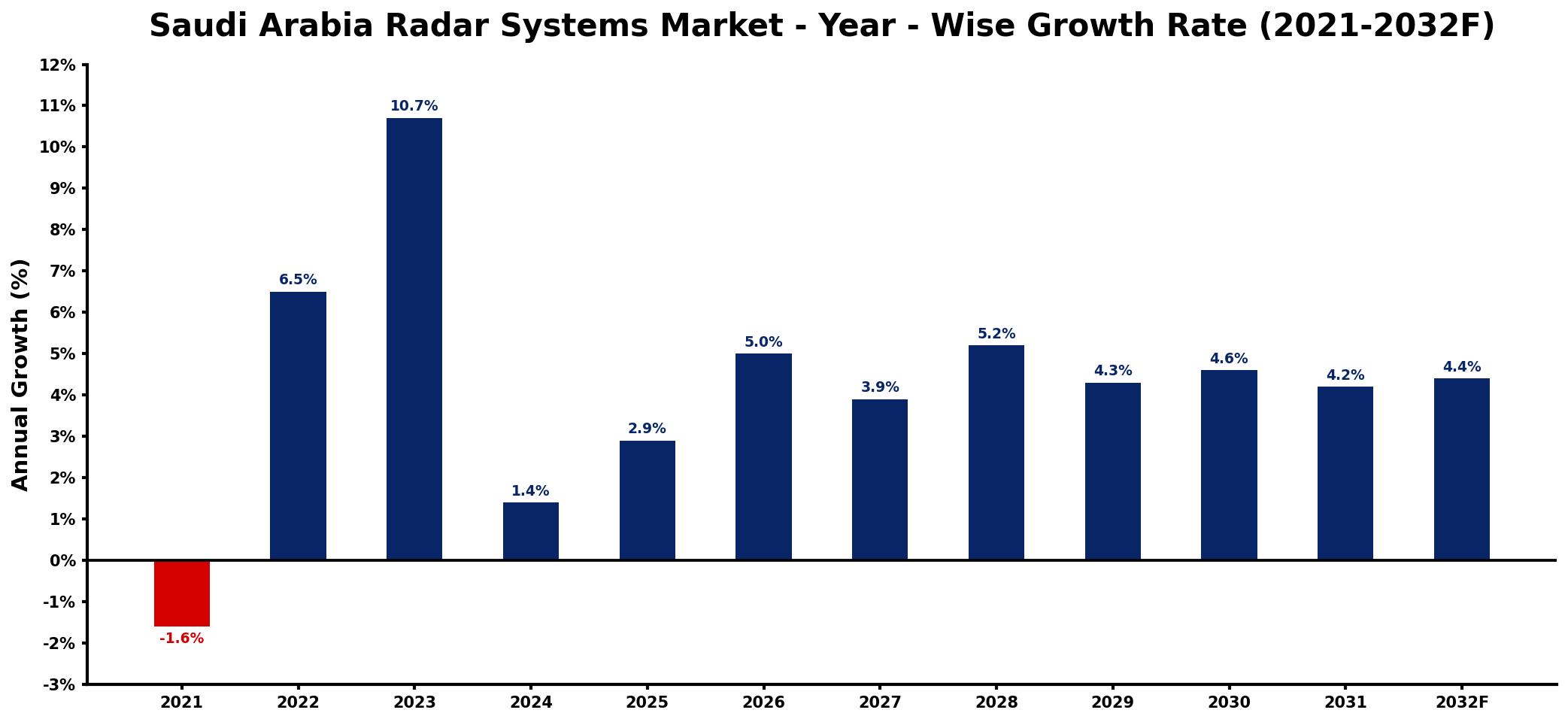
The table below presents the year‑wise growth rates along with the key drivers influencing the market
| Year | Growth Rate | Major Drivers |
| 2021 | -1.6% | Decreased defense spending globally |
| 2022 | 6.5% | Increased military modernization efforts |
| 2023 | 10.7% | Rising regional security concerns |
| 2024 | 1.4% | growing regional consumption patterns |
| 2025 | 2.9% | Growing demand for surveillance technology |
| 2026 | 5.0% | Investment in advanced technologies |
| 2027 | 3.9% | stronger distribution network expansion |
| 2028 | 5.2% | Emergence of new defense projects |
| 2029 | 4.3% | Focus on homeland security initiatives |
| 2030 | 4.6% | Enhanced research and development funding |
| 2031 | 4.2% | growing emerging market penetration |
| 2032 | 4.4% | Diversification of military capabilities |
Note: Market size estimations and growth projections presented in this report are based on 6Wresearch's proprietary forecasting methodology, utilizing the latest available industry data, government publications, and primary research inputs.
Saudi Arabia Radar Systems Market Synopsis
In recent years, the Saudi Arabia radar systems market has become increasingly vital for ensuring national security and enhancing operational capabilities across various sectors. With its strategic geographical location, the country is focusing on modernizing its defense, aviation, and maritime surveillance systems, creating a robust demand for advanced radar technology.
The demand for radar systems is further bolstered by the growing need for reliable weather forecasting and navigation solutions. As industries place greater emphasis on safety and efficiency, the integration of sophisticated radar technologies becomes indispensable, leading to the evolution of versatile systems capable of meeting diverse operational requirements.
Saudi Arabia Radar Systems Market Key Takeaways
- The market is driven by significant investments in defense and security infrastructure.
- Technological advancements enhance the capabilities of radar systems, facilitating improved detection and tracking.
- There is a growing demand for radar solutions across various applications, including aviation and maritime safety.
- Government initiatives play a crucial role in shaping the market landscape.
- COVID-19 initially impacted installations, but demand has rebounded with easing restrictions.
Evaluation of Restraints in Saudi Arabia Radar Systems Market
The Saudi Arabia radar systems market faces challenges primarily rooted in the increasing complexity of modern radar technologies. As applications expand from defense to diverse sectors, the design of systems that can reliably operate across varying terrains and weather conditions becomes a significant hurdle. Furthermore, the integration of radar technologies into new platforms, such as autonomous vehicles, necessitates advancements in cost-effective and compact solutions. Consequently, these factors could slow down the pace of market growth if not effectively addressed by stakeholders in the industry.
Saudi Arabia Radar Systems Market Trends
Current trends in the Saudi Arabia radar systems market include a significant shift toward phased-array radar technology, which offers improved resolution and real-time data processing capabilities. Additionally, there is an increasing emphasis on integrating artificial intelligence and machine learning algorithms, enabling better analysis and predictive capabilities. As industries seek to enhance situational awareness and operational efficiency, the demand for multi-functional radar systems that can cater to various applications is also on the rise.
Saudi Arabia Radar Systems Market Opportunities
Opportunities in the Saudi Arabia radar systems market are abundant, particularly in sectors like maritime surveillance and border control, where enhanced monitoring capabilities are critical. The ongoing modernization of aviation infrastructure presents further avenues for growth, particularly as air travel rebounds post-pandemic. Furthermore, the push for autonomous vehicle technologies creates a demand for compact and advanced radar systems, positioning the market for future innovations and investments.
Government Initiatives in the Saudi Arabia Radar Systems Market
The Saudi government has demonstrated a strong commitment to bolstering its defense capabilities, which includes substantial funding for radar system development and upgrades. Initiatives focused on enhancing national security and improving public safety are driving investments into modern radar technologies. Additionally, policies aimed at fostering local manufacturing and technological advancements further support market growth, aligning with the countrys broader vision for economic diversification and technological self-sufficiency.
Future Insights of the Saudi Arabia Radar Systems Market
Looking ahead to 2026-2032, the Saudi Arabia radar systems market is set to evolve significantly, driven by innovations in radar technology and increasing demand for sophisticated applications. As the nation continues to modernize its infrastructure, investments in advanced radar systems will play a critical role in shaping its defense and surveillance capabilities. Moreover, the integration of smart technologies is expected to enhance the functionality of radar systems, positioning the market for substantial growth and adaptation to future challenges.
Saudi Arabia Radar Systems Market Latest Developments (2025 - 2026)
Recent industry developments indicate a shift towards increased collaboration between public and private sectors to advance radar technology. Initiatives promoting research and development are gaining momentum, with pilot projects focusing on innovative radar solutions for various applications. Additionally, there has been a notable emphasis on sustainability and cost-effectiveness in radar system designs, reflecting the evolving priorities within the market.
Saudi Arabia Radar Systems Market - Key Attractiveness of the Report
- 10 Years of Market Numbers
- Historical Data Starting from 2022 to 2025
- Base Year: 2025
- Forecast Data until 2032
- Key Performance Indicators Impacting the Market
- Major Upcoming Developments and Projects
Key Highlights of the Report:
- Saudi Arabia Radar Systems Market Outlook
- Market Size of Saudi Arabia Radar Systems Market, 2025
- Forecast of Saudi Arabia Radar Systems Market, 2032
- Historical Data and Forecast of Saudi Arabia Radar Systems Revenues & Volume for the Period 2022-2032F
- Saudi Arabia Radar Systems Market Trend Evolution
- Saudi Arabia Radar Systems Market Drivers and Challenges
- Saudi Arabia Radar Systems Price Trends
- Saudi Arabia Radar Systems Porter's Five Forces
- Saudi Arabia Radar Systems Industry Life Cycle
- Historical Data and Forecast of Saudi Arabia Radar Systems Market Revenues & Volume By Type for the Period 2022-2032F
- Historical Data and Forecast of Saudi Arabia Radar Systems Market Revenues & Volume By Continuous Wave RADAR Systems for the Period 2022-2032F
- Historical Data and Forecast of Saudi Arabia Radar Systems Market Revenues & Volume By Pulsated Wave RADAR Systems for the Period 2022-2032F
- Historical Data and Forecast of Saudi Arabia Radar Systems Market Revenues & Volume By Application for the Period 2022-2032F
- Historical Data and Forecast of Saudi Arabia Radar Systems Market Revenues & Volume By Airborne for the Period 2022-2032F
- Historical Data and Forecast of Saudi Arabia Radar Systems Market Revenues & Volume By Land-based for the Period 2022-2032F
- Historical Data and Forecast of Saudi Arabia Radar Systems Market Revenues & Volume By Naval for the Period 2022-2032F
- Historical Data and Forecast of Saudi Arabia Radar Systems Market Revenues & Volume By End-user Industry for the Period 2022-2032F
- Historical Data and Forecast of Saudi Arabia Radar Systems Market Revenues & Volume By Aviation for the Period 2022-2032F
- Historical Data and Forecast of Saudi Arabia Radar Systems Market Revenues & Volume By Maritime Applications for the Period 2022-2032F
- Historical Data and Forecast of Saudi Arabia Radar Systems Market Revenues & Volume By Automotive for the Period 2022-2032F
- Historical Data and Forecast of Saudi Arabia Radar Systems Market Revenues & Volume By Military & Defense for the Period 2022-2032F
- Saudi Arabia Radar Systems Import Export Trade Statistics
- Market Opportunity Assessment By Type
- Market Opportunity Assessment By Application
- Market Opportunity Assessment By End-user Industry
- Saudi Arabia Radar Systems Top Companies Market Share
- Saudi Arabia Radar Systems Competitive Benchmarking By Technical and Operational Parameters
- Saudi Arabia Radar Systems Company Profiles
- Saudi Arabia Radar Systems Key Strategic Recommendations






































