Azerbaijan Advertising Market Size, Share & Growth Rate
The Azerbaijan Advertising Market was estimated at USD 775 Million in 2025 and is projected to reach USD 1285 Million by 2032, growing at a CAGR of 7.5% from 2026 to 2032. This impressive growth trajectory is primarily fueled by rising disposable incomes, increased consumer spending, and a robust economy that fosters advertising investments across various sectors. As brands recognize the need to connect with an increasingly tech-savvy population, the shift towards digital platforms has become a significant driver of market expansion.
Azerbaijan Advertising Market Year-wise Growth Rate and Key Drivers
This graph highlights how the Azerbaijan Advertising Market has steadily grown over the years, supported by major growth factors.
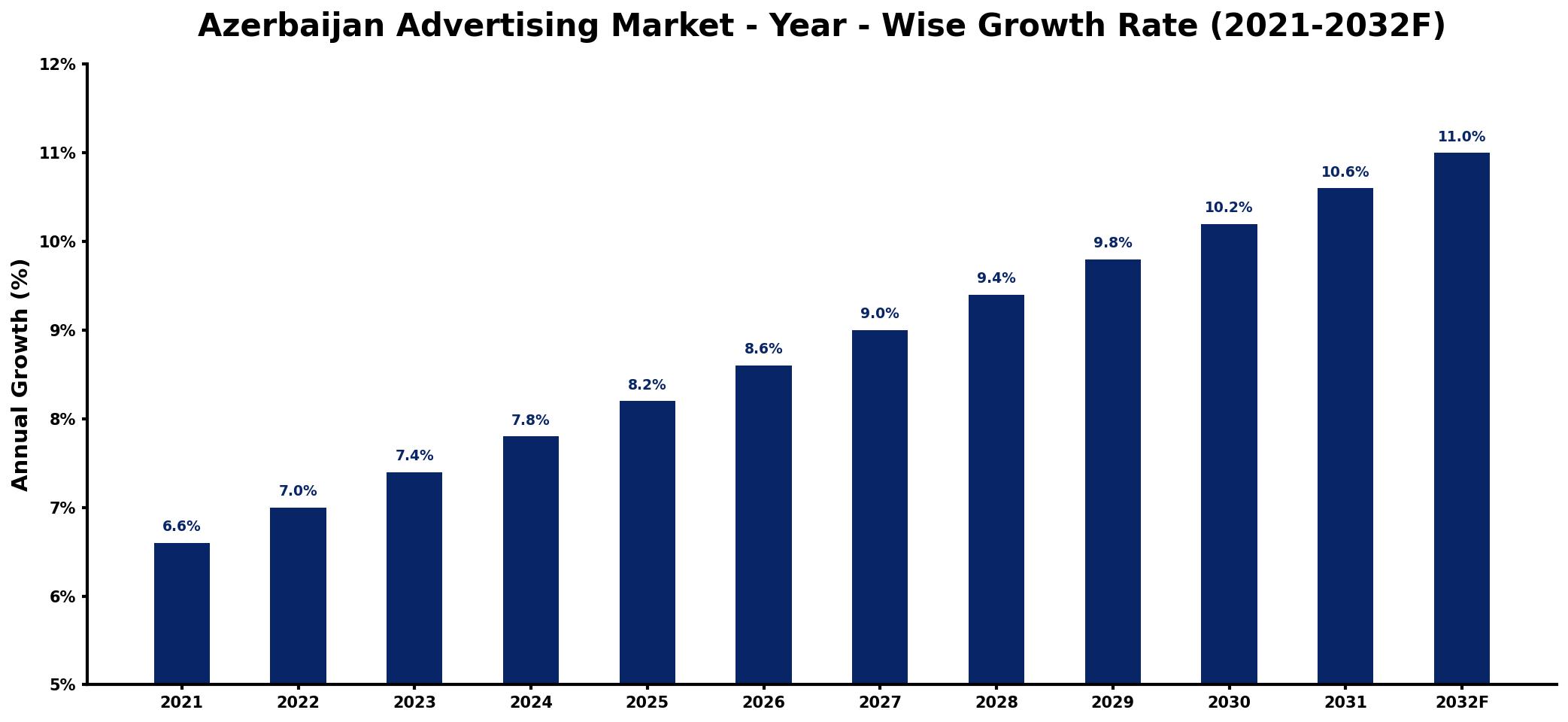
The table below presents the year‑wise growth rates along with the key drivers influencing the market
| Year | Growth Rate | Major Drivers |
| 2021 | 6.6% | Rising digital media consumption trends |
| 2022 | 7.0% | Increased investment in content creation |
| 2023 | 7.4% | Expansion of e-commerce platforms |
| 2024 | 7.8% | Growing interest in influencer marketing |
| 2025 | 8.2% | rising demand from electronics |
| 2026 | 8.6% | Emergence of programmatic buying technology |
| 2027 | 9.0% | Increase in local brand collaborations |
| 2028 | 9.4% | Surge in video marketing adoption |
| 2029 | 9.8% | Adoption of augmented reality experiences |
| 2030 | 10.2% | Growth in data analytics capabilities |
| 2031 | 10.6% | Strengthening of social media presence |
| 2032 | 11.0% | Development of personalized marketing solutions |
Note: Market size estimations and growth projections presented in this report are based on 6Wresearch's proprietary forecasting methodology, utilizing the latest available industry data, government publications, and primary research inputs.
Azerbaijan Advertising Market Synopsis
In recent years, Azerbaijan's advertising landscape has undergone a noteworthy transformation. Traditional media channels, including television and print, continue to dominate; however, the surge in digital advertising signifies a pivotal shift in how brands engage consumers. Internet penetration is steadily increasing, opening avenues for innovative marketing strategies.
Major sectors such as telecommunications, finance, and retail are leading contributors to advertising expenditure. A diverse mix of local and international agencies operates in this vibrant market, emphasizing creative approaches that cater to a growing consumer base. However, government regulations also shape advertising practices, particularly in sensitive industries like alcohol and tobacco.
Azerbaijan Advertising Market Key Takeaways
- Strong growth anticipated in the digital advertising sector, driven by increased internet usage.
- Traditional advertising channels, including television and print, remain influential but are gradually ceding ground to digital strategies.
- Advertising expenditures are heavily concentrated in the telecommunications, finance, and retail sectors.
- Government regulations are stringent, particularly around specific industries, influencing advertising approaches.
- Local and international agencies continue to innovate to capture the attention of a diverse consumer base.
Evaluation of Restraints in Azerbaijan Advertising Market
Despite the promising growth, the Azerbaijan advertising market grapples with certain restraints that hinder its potential. A notable concern is the limited diversity of media outlets, which can stifle competition and diminish the innovation necessary for a thriving market. Furthermore, the industry faces challenges with audience measurement accuracy, impacting the effectiveness of campaigns and the trust advertisers place in the data. The predominance of a few major players can lead to a less competitive landscape, ultimately affecting creativity and pricing strategies. Additionally, cultural sensitivities and language barriers complicate the development of effective advertising campaigns, necessitating a nuanced understanding of the local market dynamics.
Azerbaijan Advertising Market Trends
The Azerbaijan Advertising Market is currently witnessing a pronounced shift towards digital advertising, where brands increasingly emphasize social media platforms and online engagement. As internet penetration rates rise, advertisers are investing more in digital campaigns that allow for precise targeting and real-time interaction with consumers. Influencer marketing has also gained traction, with brands leveraging popular figures to connect with audiences authentically. Moreover, experiential marketing is on the rise, as companies aim to create immersive experiences that foster brand loyalty and engagement. These trends reflect a broader move towards innovative, tech-driven strategies that cater to the evolving preferences of the Azerbaijani consumer.
Azerbaijan Advertising Market Opportunities
Investors and advertisers are presented with several compelling opportunities within the Azerbaijan Advertising Market. The escalating interest in digital advertising, spurred by increasing internet accessibility and smartphone usage, makes it an attractive sector for investment. Services such as social media marketing, search engine advertising, and display advertising are poised for growth as brands seek to enhance their online presence. Additionally, the out-of-home advertising market is expanding, with opportunities arising from billboards, transit ads, and digital signage. As consumer spending continues to rise, there is a demand for innovative advertising solutions that resonate with a diverse audience, making this market a fertile ground for both local and international investment.
Government Initiatives in the Azerbaijan Advertising Market
The regulatory framework governing the Azerbaijan advertising market is primarily outlined in the Advertising Law, which establishes guidelines for ethical advertising practices. The State Advertising Agency is responsible for monitoring compliance with these regulations, promoting transparency and fair competition within the industry. Moreover, the government is committed to ensuring that advertisements are truthful and not misleading, particularly in sectors like tobacco and alcohol, to protect public health. These policies aim to create a balanced advertising environment that supports both advertisers and consumer rights.
Future Insights of the Azerbaijan Advertising Market
Looking ahead to 2026-2032, the Azerbaijan Advertising Market is set for continued growth, driven by factors such as ongoing digitalization and rising consumer incomes. A young, tech-savvy demographic indicates a significant shift towards online and mobile advertising, providing advertisers with new methods to reach their target audiences effectively. As the Azerbaijani economy diversifies and foreign investments increase, the demand for advertising across various sectors is likely to rise, creating additional opportunities for creative promotional strategies. Nonetheless, industry players must remain vigilant in navigating regulatory challenges and fluctuating economic conditions to fully capitalize on the market's growth potential.
Azerbaijan Advertising Market Latest Developments (2025 - 2026)
The advertising industry in Azerbaijan has seen significant developments recently, particularly regarding digital initiatives. Companies are increasingly adopting technology-driven approaches, focusing on personalized advertising and enhanced consumer engagement through digital platforms. Additionally, there's been a rise in collaborative projects between local agencies and international brands, fostering innovation and creativity in campaign development. As the government continues to emphasize ethical advertising practices, businesses are adapting their strategies to align with regulatory requirements while meeting evolving consumer expectations.
Azerbaijan Advertising Market - Key Attractiveness of the Report
- 10 Years of Market Numbers
- Historical Data Starting from 2022 to 2025
- Base Year: 2025
- Forecast Data until 2032
- Key Performance Indicators Impacting the Market
- Major Upcoming Developments and Projects
Key Highlights of the Report:
- Azerbaijan Advertising Market Outlook
- Market Size of Azerbaijan Advertising Market, 2025
- Forecast of Azerbaijan Advertising Market, 2032
- Historical Data and Forecast of Azerbaijan Advertising Revenues & Volume for the Period 2022-2032F
- Azerbaijan Advertising Market Trend Evolution
- Azerbaijan Advertising Market Drivers and Challenges
- Azerbaijan Advertising Price Trends
- Azerbaijan Advertising Porter's Five Forces
- Azerbaijan Advertising Industry Life Cycle
- Historical Data and Forecast of Azerbaijan Advertising Market Revenues & Volume By Type for the Period 2022-2032F
- Historical Data and Forecast of Azerbaijan Advertising Market Revenues & Volume By Television for the Period 2022-2032F
- Historical Data and Forecast of Azerbaijan Advertising Market Revenues & Volume By Print (Newspaper and Magazine) for the Period 2022-2032F
- Historical Data and Forecast of Azerbaijan Advertising Market Revenues & Volume By Radio for the Period 2022-2032F
- Historical Data and Forecast of Azerbaijan Advertising Market Revenues & Volume By Outdoor for the Period 2022-2032F
- Historical Data and Forecast of Azerbaijan Advertising Market Revenues & Volume By Internet (Search, Display, Classified, Video) for the Period 2022-2032F
- Historical Data and Forecast of Azerbaijan Advertising Market Revenues & Volume By Mobile for the Period 2022-2032F
- Historical Data and Forecast of Azerbaijan Advertising Market Revenues & Volume By Cinema for the Period 2022-2032F
- Azerbaijan Advertising Import Export Trade Statistics
- Market Opportunity Assessment By Type
- Azerbaijan Advertising Top Companies Market Share
- Azerbaijan Advertising Competitive Benchmarking By Technical and Operational Parameters
- Azerbaijan Advertising Company Profiles
- Azerbaijan Advertising Key Strategic Recommendations






































