Azerbaijan Algorithmic Trading Market Size & Growth Rate (2026-2032)
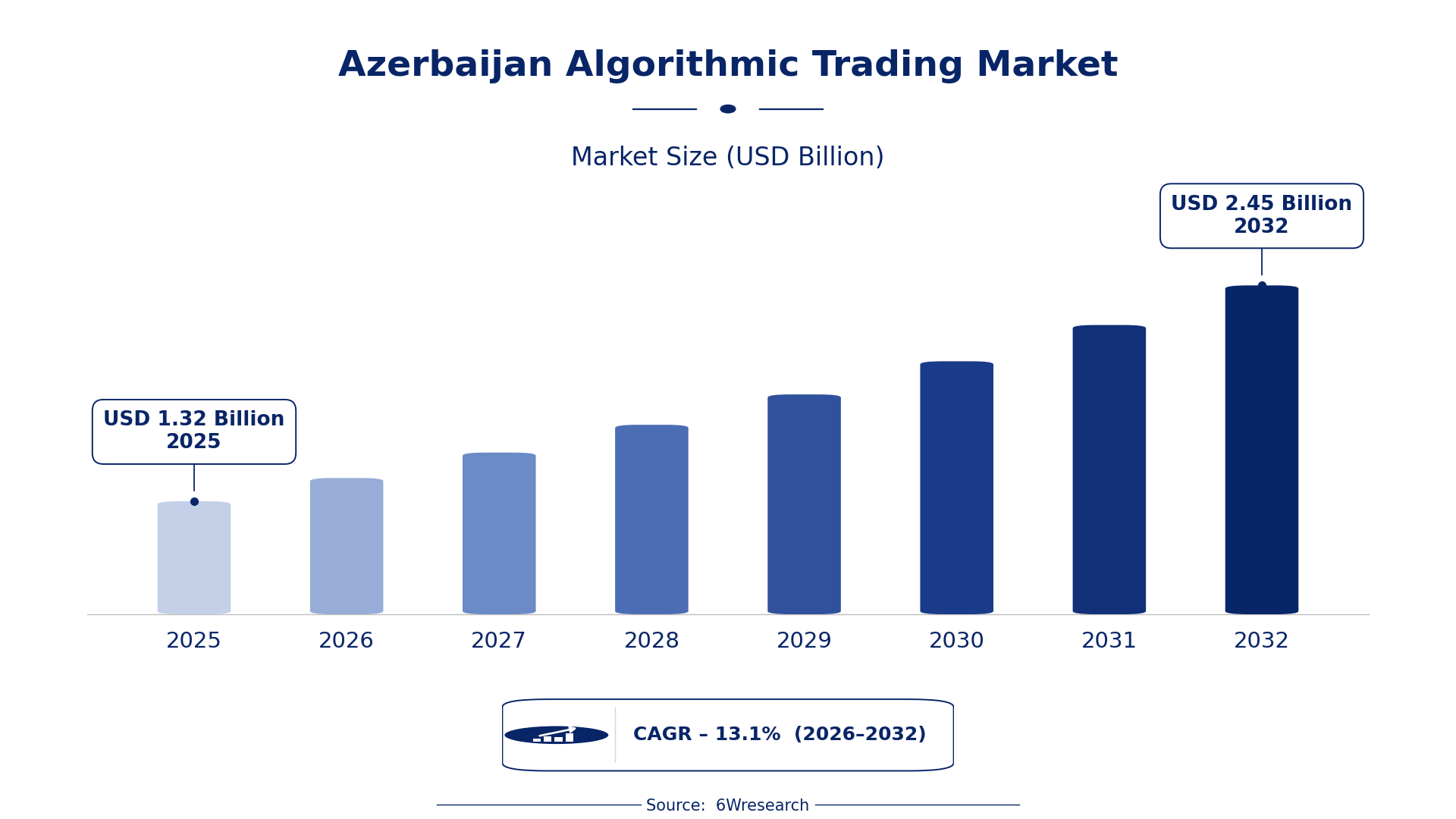
The Azerbaijan Algorithmic Trading Market was estimated at USD 1319 Million in 2025 and is projected to reach USD 2453 Million by 2032, growing at a CAGR of 13.1% from 2026 to 2032.
Azerbaijan Algorithmic Trading Market Synopsis
The increasing adoption of automated trading strategies is the dominant force currently shaping the Azerbaijan Algorithmic Trading Market. Market participants are increasingly recognizing the need for efficient trade execution, which is driving investments in algorithmic trading solutions.
As technological advancements continue to unfold, traders in Azerbaijan are integrating sophisticated algorithms and artificial intelligence into their operations. This evolution not only enhances trading performance but also improves liquidity and minimizes risks, setting the stage for a robust market environment.
Azerbaijan Algorithmic Trading Market Year-wise Growth Rate and Key Drivers
This graph illustrates the annual growth rates of the Azerbaijan Algorithmic Trading Market from 2021 to 2032, highlighting a steady upward trajectory and projected expansion over the forecast period.
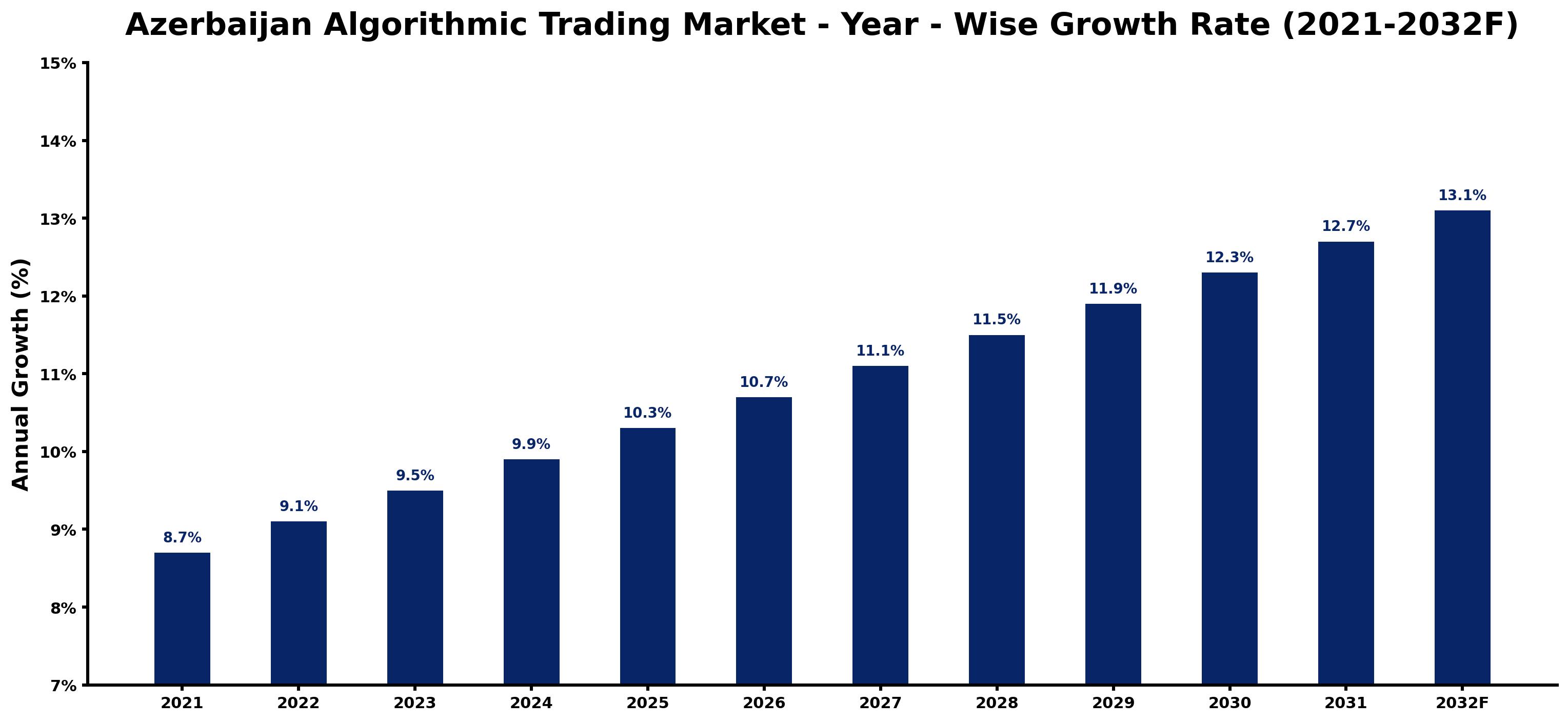
The table below presents the year‑wise growth rates along with the key drivers influencing the market
| Year | Growth Rate | Major Drivers |
| 2021 | 8.7% | Baku Stock Exchange enhancing digital trading platforms |
| 2022 | 9.1% | Local fintech startups innovating algorithmic trading solutions |
| 2023 | 9.5% | Government pushing for digital financial services modernization |
| 2024 | 9.9% | Increased smartphone penetration facilitating trading app usage |
| 2025 | 10.3% | Young population driving demand for investment technologies |
| 2026 | 10.7% | Foreign investment increasing in Azerbaijan's tech startups |
| 2027 | 11.1% | Regulatory support for cryptocurrency trading mechanisms |
| 2028 | 11.5% | Integration of AI improving trading strategies and efficiency |
| 2029 | 11.9% | Educational programs promoting algorithmic trading knowledge |
| 2030 | 12.3% | Emergence of local hedge funds utilizing advanced algorithms |
| 2031 | 12.7% | Blockchain adoption enhancing transaction security in trading |
| 2032 | 13.1% | International partnerships fostering knowledge exchange in trading tech |
Note: Market size estimations and growth projections presented in this report are based on 6Wresearch's proprietary forecasting methodology, utilizing the latest available industry data, government publications, and primary research inputs.
Azerbaijan Algorithmic Trading Market Key Takeaways
Below are some of the specific key takeaways from the market, including:
- Algorithmic trading is gaining traction among various market participants, including financial institutions and individual traders.
- The integration of advanced algorithms and machine learning is transforming trading strategies, making them more effective.
- Regulatory frameworks are evolving to support algorithmic trading while ensuring market integrity.
- Investment opportunities abound, particularly in algorithmic trading software and services.
- Challenges such as limited technological infrastructure remain barriers to market expansion.
Evaluation of Restraints in Azerbaijan Algorithmic Trading Market
The Azerbaijan Algorithmic Trading Market faces several limitations that hinder its potential. A primary concern is the existing technological infrastructure, which is insufficient for executing advanced algorithmic strategies. High-speed internet connectivity remains inconsistent, impacting trade execution and data analysis. on top of that, the regulatory environment surrounding algorithmic trading is still developing, often lacking clarity, which creates uncertainties for investors. Compounding these issues is the scarcity of skilled professionals proficient in algorithmic trading and quantitative analysis, which further impedes the market's growth trajectory.Azerbaijan Algorithmic Trading Market Trends
Key trends are emerging within the Azerbaijan Algorithmic Trading Market that are reshaping how trading is conducted. There is a notable shift toward the use of advanced algorithms designed for faster execution and improved decision-making. The incorporation of artificial intelligence and machine learning techniques is becoming standard, allowing traders to harness predictive analytics for better outcomes. on top of that, customizable algorithmic trading platforms are gaining popularity, enabling users to tailor their strategies to meet specific trading needs. The regulatory landscape is also becoming increasingly focused on transparency and fairness, promoting a healthier trading environment.Azerbaijan Algorithmic Trading Market Opportunities
Investment prospects in the Azerbaijan Algorithmic Trading Market are promising, particularly for technology-savvy investors. The expanding financial sector is ripe for sophisticated algorithmic trading solutions, presenting opportunities in software development and service provision. Establishing partnerships with local financial institutions could facilitate the integration of algorithmic trading capabilities. Additionally, creating dedicated algorithmic trading funds represents a strategic avenue for capitalizing on the region's evolving market dynamics.Government Initiatives in the Azerbaijan Algorithmic Trading Market
The Azerbaijani government is actively fostering the growth of the Algorithmic Trading Market through various regulatory and policy initiatives. The State Securities Committee oversees the development of this sector, emphasizing the need for transparency, fairness, and efficiency in trading practices. Such government backing is crucial for creating a conducive environment for investors and traders alike.
- A regulatory framework introduced in 2025 establishes licensing requirements and risk management protocols for algorithmic trading firms.
- A national digital infrastructure upgrade program is currently underway to enhance internet connectivity and technological resources across the financial sector.
- A recently completed initiative focuses on promoting technological innovation within financial institutions to encourage the adoption of algorithmic trading practices.
- A planned public-private partnership aims to develop training programs for professionals in algorithmic trading and quantitative analysis.
- Ongoing discussions are focused on refining regulations to adapt to the latest trading technologies and methodologies.
Future Insights of the Azerbaijan Algorithmic Trading Market
Looking ahead to 2026-2032, the Azerbaijan Algorithmic Trading Market is set for substantial growth. The ongoing technological integration into trading strategies will likely drive increased algorithmic trading activity. Advancements in artificial intelligence and data analytics will enhance decision-making processes, allowing traders to capitalize on market opportunities more effectively. With improvements in regulatory frameworks and infrastructure, market participants can expect to leverage algorithmic trading for greater efficiency and liquidity, positioning Azerbaijan as a competitive player in the global financial arena.Azerbaijan Algorithmic Trading Market Latest Developments
Recent activity within the Azerbaijan Algorithmic Trading Market indicates a strong momentum toward modernization and technology adoption. Over the past year, several initiatives and developments have taken shape, reflecting an increasing commitment to enhancing trading capabilities and infrastructure.
- A leading technology vendor launched an advanced algorithmic trading platform in early 2025, designed to provide traders with customizable solutions.
- An initiative that began in mid-2025 aims to establish a centralized database for market data to support algorithmic trading strategies.
- In Q4 2025, a major financial institution partnered with a local tech firm to integrate machine learning capabilities into its trading operations.
- A planned rollout expected to begin in early 2026 will introduce training programs focused on algorithmic trading skills for financial professionals.
- A recently completed public workshop in late 2025 highlighted the benefits of algorithmic trading, attracting interest from local investors.
Azerbaijan Algorithmic Trading Market - Key Attractiveness of the Report
- 10 Years of Market Numbers
- Historical Data Starting from 2022 to 2025
- Base Year: 2025
- Forecast Data until 2032
- Key Performance Indicators Impacting the Market
- Major Upcoming Developments and Projects
Key Highlights of the Report:
- Azerbaijan Algorithmic Trading Market Outlook
- Market Size of Azerbaijan Algorithmic Trading Market, 2025
- Forecast of Azerbaijan Algorithmic Trading Market, 2032
- Historical Data and Forecast of Azerbaijan Algorithmic Trading Revenues & Volume for the Period 2022-2032F
- Azerbaijan Algorithmic Trading Market Trend Evolution
- Azerbaijan Algorithmic Trading Market Drivers and Challenges
- Azerbaijan Algorithmic Trading Price Trends
- Azerbaijan Algorithmic Trading Porter's Five Forces
- Azerbaijan Algorithmic Trading Industry Life Cycle
- Historical Data and Forecast of Azerbaijan Algorithmic Trading Market Revenues & Volume By Trading Type for the Period 2022-2032F
- Historical Data and Forecast of Azerbaijan Algorithmic Trading Market Revenues & Volume By Foreign Exchange (FOREX) for the Period 2022-2032F
- Historical Data and Forecast of Azerbaijan Algorithmic Trading Market Revenues & Volume By Stock Markets for the Period 2022-2032F
- Historical Data and Forecast of Azerbaijan Algorithmic Trading Market Revenues & Volume By Exchange-Traded Fund (ETF) for the Period 2022-2032F
- Historical Data and Forecast of Azerbaijan Algorithmic Trading Market Revenues & Volume By Bonds for the Period 2022-2032F
- Historical Data and Forecast of Azerbaijan Algorithmic Trading Market Revenues & Volume By Cryptocurrencies for the Period 2022-2032F
- Historical Data and Forecast of Azerbaijan Algorithmic Trading Market Revenues & Volume By Others for the Period 2022-2032F
- Historical Data and Forecast of Azerbaijan Algorithmic Trading Market Revenues & Volume By Deployment Mode for the Period 2022-2032F
- Historical Data and Forecast of Azerbaijan Algorithmic Trading Market Revenues & Volume By Cloud for the Period 2022-2032F
- Historical Data and Forecast of Azerbaijan Algorithmic Trading Market Revenues & Volume By On-premises for the Period 2022-2032F
- Historical Data and Forecast of Azerbaijan Algorithmic Trading Market Revenues & Volume By Component for the Period 2022-2032F
- Historical Data and Forecast of Azerbaijan Algorithmic Trading Market Revenues & Volume By Solutions for the Period 2022-2032F
- Historical Data and Forecast of Azerbaijan Algorithmic Trading Market Revenues & Volume By Services for the Period 2022-2032F
- Historical Data and Forecast of Azerbaijan Algorithmic Trading Market Revenues & Volume By Enterprise Size for the Period 2022-2032F
- Historical Data and Forecast of Azerbaijan Algorithmic Trading Market Revenues & Volume By Small and Medium-sized Enterprises (SMEs) for the Period 2022-2032F
- Historical Data and Forecast of Azerbaijan Algorithmic Trading Market Revenues & Volume By Large Enterprises for the Period 2022-2032F
- Azerbaijan Algorithmic Trading Import Export Trade Statistics
- Market Opportunity Assessment By Trading Type
- Market Opportunity Assessment By Deployment Mode
- Market Opportunity Assessment By Component
- Market Opportunity Assessment By Enterprise Size
- Azerbaijan Algorithmic Trading Top Companies Market Share
- Azerbaijan Algorithmic Trading Competitive Benchmarking By Technical and Operational Parameters
- Azerbaijan Algorithmic Trading Company Profiles
- Azerbaijan Algorithmic Trading Key Strategic Recommendations






































