Azerbaijan Aviation Market Size, Share & Growth Rate
The Azerbaijan Aviation Market was estimated at USD 1036 Million in 2025 and is projected to reach USD 1927 Million by 2032, growing at a CAGR of 9.3% from 2026 to 2032. This robust trajectory is propelled by rising air travel demand, both internationally and domestically, reflecting a growing middle class and enhanced connectivity. Government initiatives to boost airport infrastructure and expand regional influence significantly contribute to this optimistic forecast.
Azerbaijan Aviation Market Year-wise Growth Rate and Key Drivers
This graph highlights how the Azerbaijan Aviation Market has steadily grown over the years, supported by major growth factors.
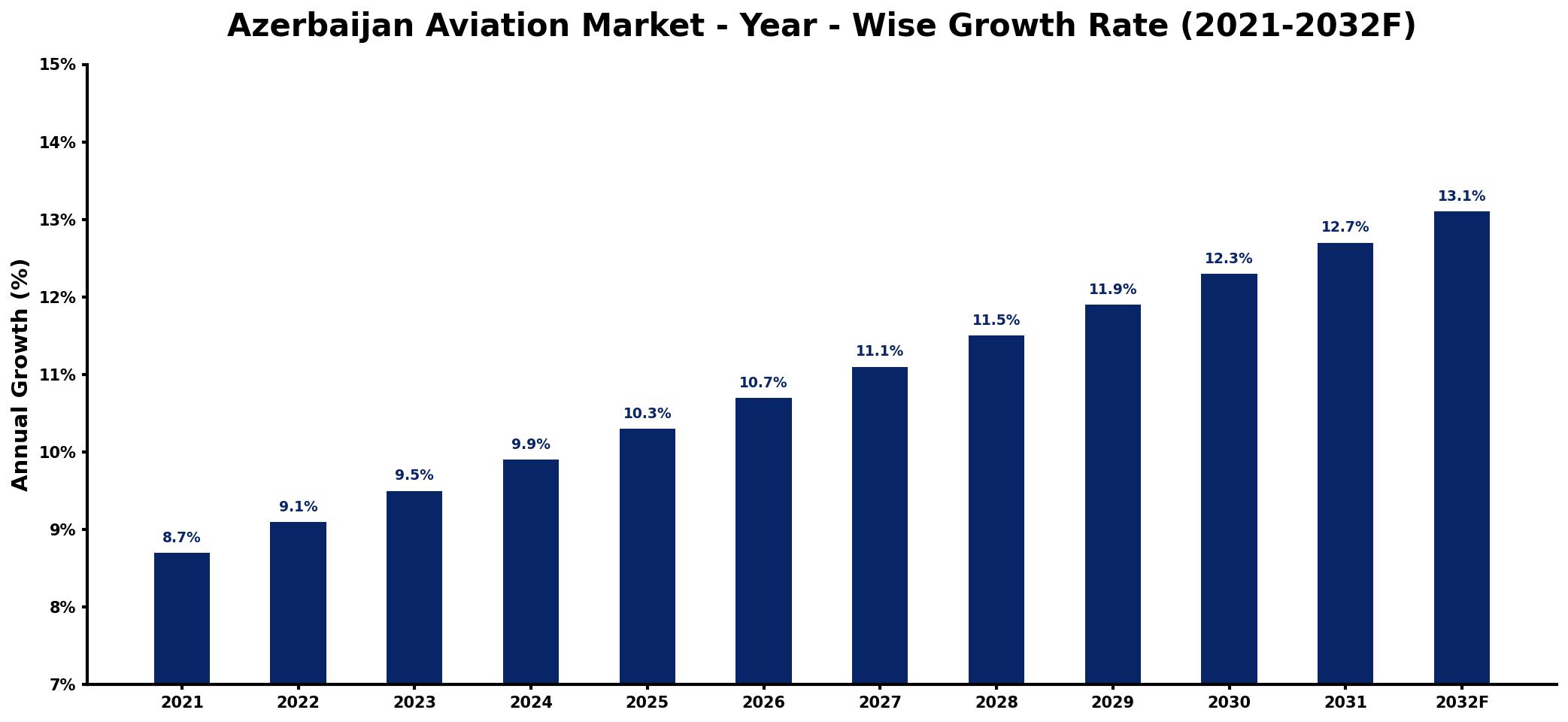
The table below presents the year‑wise growth rates along with the key drivers influencing the market
| Year | Growth Rate | Major Drivers |
| 2021 | 8.7% | Increased tourism and travel demand |
| 2022 | 9.1% | Expansion of international flight routes |
| 2023 | 9.5% | Growing cargo transport opportunities |
| 2024 | 9.9% | Investment in airport infrastructure projects |
| 2025 | 10.3% | Rising disposable income levels |
| 2026 | 10.7% | Development of new airline partnerships |
| 2027 | 11.1% | Emergence of low-cost carriers |
| 2028 | 11.5% | Enhanced regional connectivity initiatives |
| 2029 | 11.9% | Boost in business travel activities |
| 2030 | 12.3% | Advancements in sustainable fuel technologies |
| 2031 | 12.7% | Improvement in passenger experience services |
| 2032 | 13.1% | growing automotive sector requirements |
Note: Market size estimations and growth projections presented in this report are based on 6Wresearch's proprietary forecasting methodology, utilizing the latest available industry data, government publications, and primary research inputs.
Azerbaijan Aviation Market Synopsis
In recent years, the Azerbaijan aviation market has emerged as a key player at the crossroads of Europe and Asia, facilitating increased transit traffic and reinforcing its strategic importance in global air travel. The government's commitment to modernizing airport infrastructure, exemplified by developments at Baku Heydar Aliyev International Airport, has set the stage for enhanced operational capacities.
Azerbaijan Airlines (AZAL), the national carrier, has been pivotal in expanding international connections, offering a wide range of routes. However, despite these advancements, the market is navigating challenges such as regional competition and regulatory constraints that could impact its growth potential.
Azerbaijan Aviation Market Key Takeaways
- The market is projected to nearly double in size from 2025 to 2032, indicating strong growth potential.
- Government investments in airport infrastructure are crucial for maintaining competitive advantage.
- A surge in the number of operating airlines reflects increased demand for diverse travel options.
- The strategic geographical location enhances Azerbaijan's role as a transit hub.
- Challenges related to competition and regulatory issues remain significant considerations.
Evaluation of Restraints in Azerbaijan Aviation Market
Despite its promising growth trajectory, the Azerbaijan aviation market faces a set of restraints that could inhibit progress. Limited infrastructure development across several regional airports presents a challenge in accommodating growing air travel demand. Furthermore, fierce competition from established regional hubs in Turkey and the UAE complicates market dynamics, as these countries offer more extensive networks and superior service quality. Regulatory hurdles, including air traffic rights and safety compliance, add another layer of complexity. Moreover, geopolitical tensions in the region can adversely affect airline operations and route optimization, making it crucial for stakeholders to navigate these obstacles strategically.
Azerbaijan Aviation Market Trends
Several trends are shaping the Azerbaijan aviation market, with a pronounced increase in air travel demand being the most prominent. The influx of low-cost carriers has diversified service offerings and expanded route networks, catering to both business and leisure travelers. Additionally, a rising emphasis on sustainability within aviation is prompting local airlines to consider eco-friendly practices and modern fleet upgrades. Technological advancements in aviation services, such as digital ticketing and enhanced passenger experiences, are also becoming pivotal in attracting more travelers.
Azerbaijan Aviation Market Opportunities
Investment opportunities abound in the Azerbaijan aviation sector, particularly in airport and cargo facility development aimed at solidifying the nations position as a regional hub. There is potential for fleet modernization through the procurement of advanced aircraft, which can enhance operational efficiency. Investing in maintenance, repair, and overhaul (MRO) services also represents a lucrative avenue, given the increasing demand for such capabilities in the region. Strategic partnerships with local airlines can further leverage tourism initiatives and enhance air travel connectivity.
Government Initiatives in the Azerbaijan Aviation Market
The Azerbaijani government has enacted several supportive policies aimed at bolstering the aviation market. Notably, initiatives include promoting Baku Heydar Aliyev International Airport as a key regional hub and facilitating the establishment of Azerbaijan Airlines as the national flag carrier. Significant public investments in infrastructure development are also evident, with new projects such as Ganja International Airport. To further attract international airlines, the government is working to liberalize the aviation market and ensure compliance with international safety and security standards, fostering a competitive and efficient operational environment.
Future Insights of the Azerbaijan Aviation Market
Looking ahead to 2026-2032, the Azerbaijan aviation market is set for significant advancement. Growth in both passenger and cargo segments is anticipated, driven by ongoing infrastructure upgrades and a commitment to enhancing operational efficiencies. The governments focus on tourism development is likely to further boost air travel. However, stakeholders must remain vigilant of regional competition and global economic fluctuations that may impact overall growth. As the market evolves, prioritizing customer experience and service quality will be essential for maintaining competitiveness.
Azerbaijan Aviation Market Latest Developments (2025 - 2026)
In the last year, the Azerbaijan aviation industry has witnessed a strategic shift towards enhancing service quality and expanding route networks. Investments in airport infrastructure have been prioritized, with ongoing projects aimed at improving passenger experience. Collaboration with foreign airlines is on the rise, aimed at bolstering international connections and increasing overall market share. Efforts to modernize the fleet and integrate sustainable practices are also gaining momentum, reflecting a broader trend towards innovation in the aviation sector.
Azerbaijan Aviation Market - Key Attractiveness of the Report
- 10 Years of Market Numbers
- Historical Data Starting from 2022 to 2025
- Base Year: 2025
- Forecast Data until 2032
- Key Performance Indicators Impacting the Market
- Major Upcoming Developments and Projects
Key Highlights of the Report:
- Azerbaijan Aviation Market Outlook
- Market Size of Azerbaijan Aviation Market, 2025
- Forecast of Azerbaijan Aviation Market, 2032
- Historical Data and Forecast of Azerbaijan Aviation Revenues & Volume for the Period 2022-2032F
- Azerbaijan Aviation Market Trend Evolution
- Azerbaijan Aviation Market Drivers and Challenges
- Azerbaijan Aviation Price Trends
- Azerbaijan Aviation Porter's Five Forces
- Azerbaijan Aviation Industry Life Cycle
- Historical Data and Forecast of Azerbaijan Aviation Market Revenues & Volume By Type for the Period 2022-2032F
- Historical Data and Forecast of Azerbaijan Aviation Market Revenues & Volume By Commercial Aviation for the Period 2022-2032F
- Historical Data and Forecast of Azerbaijan Aviation Market Revenues & Volume By Military Aviation for the Period 2022-2032F
- Historical Data and Forecast of Azerbaijan Aviation Market Revenues & Volume By General Aviation for the Period 2022-2032F
- Azerbaijan Aviation Import Export Trade Statistics
- Market Opportunity Assessment By Type
- Azerbaijan Aviation Top Companies Market Share
- Azerbaijan Aviation Competitive Benchmarking By Technical and Operational Parameters
- Azerbaijan Aviation Company Profiles
- Azerbaijan Aviation Key Strategic Recommendations






































