Global Aviation Market Highlights
| Market Size (2025) | USD 822 Billion |
| Forecast Size (2032) | USD 1150 Billion |
| CAGR | 5.00% |
| Base Year | 2025 |
| Forecast Period | 2026-2032 |
| Largest Region | North America |
| Fastest Growing Region | Asia |
| Largest Segment | Commercial Aviation |
| Fastest Growing Segment | Military Aviation |
| Leading Companies | Boeing, Airbus, Lockheed Martin, Bombardier, Embraer |
Global Aviation Market Size & Growth Rate (2026-2032)
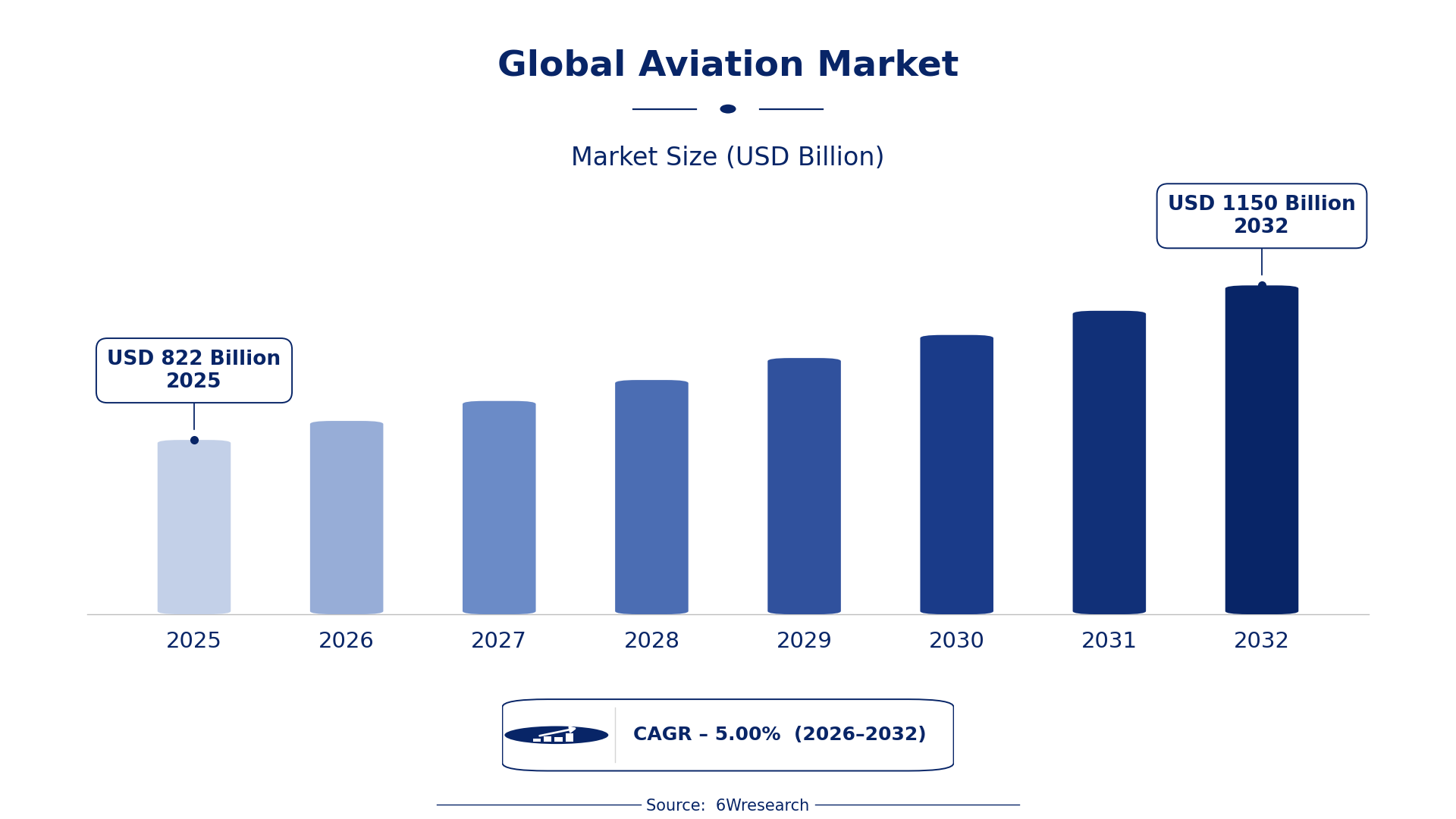
The Global Aviation Market was estimated at USD 822 Billion in 2025 and is projected to reach USD 1150 Billion by 2032, growing at a CAGR of 5.00% from 2026 to 2032.
Global Aviation Market Synopsis
The Global Aviation Market is currently navigating a substantial transformation, influenced by rising air travel demand in both established and emerging economies. A significant influx of low-cost carriers is reshaping competitive dynamics, enabling broader access to air travel and fostering innovation in service models.
Sustainability initiatives are particularly pressing in light of regulatory shifts and consumer preferences. Airlines are increasingly investing in fuel-efficient aircraft and sustainable aviation fuels, positioning themselves to attract environmentally conscious travelers and comply with evolving regulations.
Global Aviation Market Year-wise Growth Rate and Key Drivers
This graph illustrates the annual growth rates of the Global Aviation Market from 2022 to 2032, highlighting a steady upward trajectory and projected expansion over the forecast period.
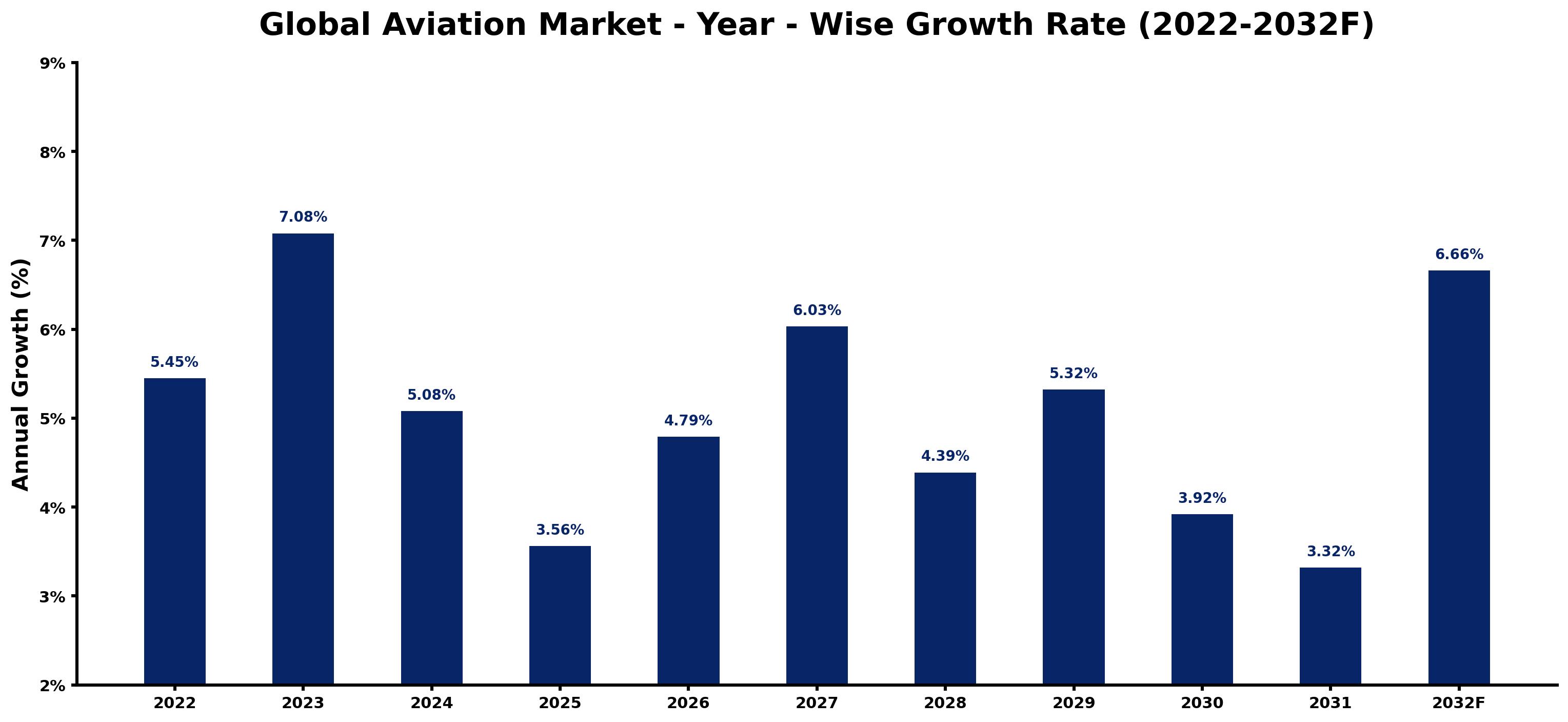
The table below presents the year‑wise growth rates along with the key drivers influencing the market
| Year | Growth Rate (%) | Major Drivers |
| 2022 | 5.45 | Sustainability initiatives are driving investment in green aviation technologies and practices. |
| 2023 | 7.08 | As avionics technology advances, increased safety features enhance passenger confidence in aviation. |
| 2024 | 5.08 | In North America, disruptions in MRO services have influenced airline operational strategies. |
| 2025 | 3.56 | Regulators are mandating stricter safety compliance, prompting upgrades in aircraft systems. |
| 2026 | 4.79 | UAV systems are enabling regional expansion for cargo delivery in remote areas. |
| 2027 | 6.03 | Commercial airlines are prioritizing investments in composite materials for weight reduction. |
| 2028 | 4.39 | The rise of electric propulsion systems is reshaping preferences among airlines for sustainability. |
| 2029 | 5.32 | Government contracts for defense procurement are creating opportunities for aerospace manufacturers. |
| 2030 | 3.92 | While raw material costs fluctuate, aerodynamic airframe design innovations continue to drive efficiency. |
| 2031 | 3.32 | Increasing consolidation in the aerospace sector enables more stable supply chain dynamics. |
| 2032 | 6.66 | A shift toward advanced training programs enhances the skills of the aviation workforce. |
Note - Market size estimations and growth projections presented in this report are based on 6Wresearch's proprietary research methodology, combining internal industry data, secondary research, and primary validation, updated periodically to reflect current market conditions. As markets evolve rapidly, figures for certain industries may vary slightly and are intended as informed estimates rather than absolute figures. For the most current market sizing, we recommend validating figures with a 6Wresearch analyst.
Global Aviation Market Key Takeaways
Below are some of the specific key takeaways from the market, including:
- As of 2025, the North American region is expected to dominate the market with an approximate share of 48%.
- The military aviation segment is projected to grow at a CAGR of 7.5% from 2026 to 2032, driven by increased defense budgets globally.
- Airbus delivered 566 commercial aircraft in 2022, reinforcing its commitment to enhancing fleet efficiency.
- Lockheed Martin reported a significant contract with the U.S. Department of Defense worth $2.5 billion in 2023, focusing on advanced military aircraft technology.
- The aerospace manufacturing sector continues to attract investments, with an estimated $10 billion allocated for new facilities in the U.S. through 2025.
Evaluation of Restraints in Global Aviation Market
The Global Aviation Market faces notable challenges, including stringent regulatory requirements that demand significant financial investment from airlines. For example, compliance with the International Civil Aviation Organization (ICAO) standards requires an estimated investment of $35 billion over the next decade for emissions reduction technologies. This burden can restrict operational flexibility and affect profitability, particularly for smaller carriers that may lack sufficient capital to meet these escalated requirements.
Global Aviation Market Trends
Several transformative trends are shaping the Global Aviation Market. One critical focus is on digitalization; airlines like Delta Air Lines are implementing advanced data analytics platforms to optimize flight operations and enhance customer experiences. In 2022 alone, Delta invested $1.3 billion in technology upgrades.
Another trend involves advancements in aircraft technology, particularly in the development of electric and hybrid aircraft. Boeing’s ecoDemonstrator program emphasizes sustainable aviation technology, actively testing new designs and innovations to improve fuel efficiency. For instance, the latest model initiated its testing phase in late 2022.
Global Aviation Market Opportunities
The Global Aviation Market presents multiple lucrative opportunities. Emerging technologies in sustainable aviation fuels (SAFs) are garnering attention, with projects like the World Economic Forum’s “Clean Skies for Tomorrow” initiative aiming for 10% SAF in jet fuel by 2030, potentially reshaping fuel consumption patterns.
Additionally, increased defense spending is fueling growth in the military aviation segment. For example, the Pentagon's $773 billion budget for fiscal year 2023 earmarks significant portions for next-generation aircraft, driving demand for both legacy and advanced military vessels.
Global Aviation Market by Type
Commercial Aviation remains the largest segment of the Global Aviation Market, commanding a share of approximately 52% in 2025. Meanwhile, Military Aviation is identified as the fastest-growing category, with an anticipated CAGR of 7.5% from 2026 to 2032. This demand is fueled by the increasing geopolitical tensions and the necessity for advanced defense systems.
Global Aviation Market by Region
North America is projected to be the largest region in the Global Aviation Market, representing an estimated 48% share in 2025. In contrast, Asia is recognized as the fastest-growing region, expected to exhibit a CAGR of 6.5% from 2026 to 2032. This surge can largely be attributed to rapid urbanization, increasing disposable incomes, and the rising middle classes in countries like India and China.
Government Initiatives in the Global Aviation Market
The regulatory environment surrounding the Global Aviation Market is dynamic, characterized by various government initiatives aimed at bolstering safety, efficiency, and sustainability. These policies are not only supporting industry growth but are also aligning aviation infrastructure with modern demands.
- U.S. Department of Transportation, Federal Aviation Administration (FAA) Modernization Program, launched in 2021, focused on advancing air traffic management technologies.
- European Union, European Green Deal, initiated in 2020, aims to reduce aviation emissions by 55% by 2030, encouraging the use of sustainable fuel sources.
- Indian Directorate General of Civil Aviation (DGCA) announced the National Aviation Policy in 2022, supporting the enhancement of regional connectivity and private sector engagement.
- International Civil Aviation Organization (ICAO), Carbon Offsetting and Reduction Scheme for International Aviation (CORSIA) directive established in 2021, mandates airlines to offset carbon emissions from international flights.
Future Insights of the Global Aviation Market
In the coming years, the Global Aviation Market is expected to undergo significant structural changes driven by advancements in sustainable technologies and regulatory pressures. Companies are likely to invest heavily in electric and hybrid aircraft, reflecting a trend towards decarbonization. For instance, Boeing's ecoDemonstrator program is set to explore several innovative aircraft technologies through 2032, which aligns with broader industry objectives to meet emissions targets. This evolution in aircraft design and fuel technology will play a crucial role in defining competitive positioning and enhancing operational efficiencies.
Global Aviation Market Latest Developments
Recent advancements showcase how leading companies are strategically maneuvering within the market to bolster their positions.
- In early 2023, Airbus announced its investment in a new manufacturing facility in Alabama, which is expected to enhance its production capacity and reduce lead times for commercial aircraft deliveries.
- Lockheed Martin is currently engaged in the development of a next-generation military aircraft with expected completion in 2025, aimed at integrating cutting-edge technology for enhanced performance and survivability.
- Recently, Boeing completed its first successful test flight of a hybrid-electric aircraft prototype as part of its ecoDemonstrator program, set to provide crucial data for sustainable aviation solutions.
- Bombardier is reportedly finalizing a long-term agreement with a major airline to provide specialized regional jets for their growing fleet, expected to enhance Bombardier’s market presence by late 2024.
Global Aviation Market Key Players and Industry Positioning
The competitive structure of the Global Aviation Market is characterized by a mix of consolidated and fragmented segments, with dominant players holding significant market shares in both commercial and military aviation. These companies are not only competing on technological grounds but also on sustainability initiatives and regulatory compliance, shaping the future of the industry.
| Leading Company | Core Strength | Strategic Focus |
|---|---|---|
| Boeing | Expertise in commercial and defense aerospace | Sustainability through innovative aviation technologies |
| Airbus | Global leader in commercial aircraft manufacturing | Expanding production capacity and new market outreach |
| Lockheed Martin | Strong presence in military aviation and defense | Advanced research in next-gen aircraft technologies |
| Bombardier | Focus on regional jets and specialized aviation solutions | Enhancing service offerings through strategic partnerships |
| Embraer | Expertise in commercial and business jets | Leveraging innovation for product differentiation |
As these companies continue to refine their strategies, the interplay between technological advancements and market demand will dictate the competitive landscape, ensuring ongoing evolution in the Global Aviation Market.
Key Attractiveness of the Report
- 10 Years of Market Numbers
- Historical Data Starting from 2022 to 2025
- Base Year: 2025
- Forecast Data until 2032
- Key Performance Indicators Impacting the Market
- Major Upcoming Developments and Projects
Key Highlights of the Report:
- Global Aviation Market Outlook
- Market Size of Global Aviation Market, 2025
- Forecast of Global Aviation Market, 2032
- Historical Data and Forecast of Global Aviation Revenues & Volume for the Period 2022-2032
- Global Aviation Market Trend Evolution
- Global Aviation Market Drivers and Challenges
- Global Aviation Price Trends
- Global Aviation Porter's Five Forces
- Global Aviation Industry Life Cycle
- Historical Data and Forecast of Global Aviation Market Revenues & Volume
- Historical Data and Forecast of Global Aviation Market Revenues & Volume By Type for the Period 2022-2032
- Historical Data and Forecast of Global Aviation Market Revenues & Volume By Commercial Aviation for the Period 2022-2032
- Historical Data and Forecast of Global Aviation Market Revenues & Volume By Military Aviation for the Period 2022-2032
- Historical Data and Forecast of Global Aviation Market Revenues & Volume By General Aviation for the Period 2022-2032
- Historical Data and Forecast of North America Aviation Market Revenues & Volume By Type for the Period 2022-2032
- Historical Data and Forecast of North America Aviation Market Revenues & Volume By Commercial Aviation for the Period 2022-2032
- Historical Data and Forecast of North America Aviation Market Revenues & Volume By Military Aviation for the Period 2022-2032
- Historical Data and Forecast of North America Aviation Market Revenues & Volume By General Aviation for the Period 2022-2032
- Historical Data and Forecast of United States of America Aviation Market Revenues & Volume for the Period 2022-2032
- Historical Data and Forecast of Canada Aviation Market Revenues & Volume for the Period 2022-2032
- Historical Data and Forecast of Rest of North America Aviation Market Revenues & Volume for the Period 2022-2032
- Historical Data and Forecast of Latin America (LATAM) Aviation Market Revenues & Volume By Type for the Period 2022-2032
- Historical Data and Forecast of Latin America (LATAM) Aviation Market Revenues & Volume By Commercial Aviation for the Period 2022-2032
- Historical Data and Forecast of Latin America (LATAM) Aviation Market Revenues & Volume By Military Aviation for the Period 2022-2032
- Historical Data and Forecast of Latin America (LATAM) Aviation Market Revenues & Volume By General Aviation for the Period 2022-2032
- Historical Data and Forecast of Brazil Aviation Market Revenues & Volume for the Period 2022-2032
- Historical Data and Forecast of Mexico Aviation Market Revenues & Volume for the Period 2022-2032
- Historical Data and Forecast of Argentina Aviation Market Revenues & Volume for the Period 2022-2032
- Historical Data and Forecast of Rest of LATAM Aviation Market Revenues & Volume for the Period 2022-2032
- Historical Data and Forecast of Asia Aviation Market Revenues & Volume By Type for the Period 2022-2032
- Historical Data and Forecast of Asia Aviation Market Revenues & Volume By Commercial Aviation for the Period 2022-2032
- Historical Data and Forecast of Asia Aviation Market Revenues & Volume By Military Aviation for the Period 2022-2032
- Historical Data and Forecast of Asia Aviation Market Revenues & Volume By General Aviation for the Period 2022-2032
- Historical Data and Forecast of China Aviation Market Revenues & Volume for the Period 2022-2032
- Historical Data and Forecast of India Aviation Market Revenues & Volume for the Period 2022-2032
- Historical Data and Forecast of Japan Aviation Market Revenues & Volume for the Period 2022-2032
- Historical Data and Forecast of Rest of Asia Aviation Market Revenues & Volume for the Period 2022-2032
- Historical Data and Forecast of Africa Aviation Market Revenues & Volume By Type for the Period 2022-2032
- Historical Data and Forecast of Africa Aviation Market Revenues & Volume By Commercial Aviation for the Period 2022-2032
- Historical Data and Forecast of Africa Aviation Market Revenues & Volume By Military Aviation for the Period 2022-2032
- Historical Data and Forecast of Africa Aviation Market Revenues & Volume By General Aviation for the Period 2022-2032
- Historical Data and Forecast of South Africa Aviation Market Revenues & Volume for the Period 2022-2032
- Historical Data and Forecast of Nigeria Aviation Market Revenues & Volume for the Period 2022-2032
- Historical Data and Forecast of Egypt Aviation Market Revenues & Volume for the Period 2022-2032
- Historical Data and Forecast of Rest of Africa Aviation Market Revenues & Volume for the Period 2022-2032
- Historical Data and Forecast of Europe Aviation Market Revenues & Volume By Type for the Period 2022-2032
- Historical Data and Forecast of Europe Aviation Market Revenues & Volume By Commercial Aviation for the Period 2022-2032
- Historical Data and Forecast of Europe Aviation Market Revenues & Volume By Military Aviation for the Period 2022-2032
- Historical Data and Forecast of Europe Aviation Market Revenues & Volume By General Aviation for the Period 2022-2032
- Historical Data and Forecast of United Kingdom Aviation Market Revenues & Volume for the Period 2022-2032
- Historical Data and Forecast of France Aviation Market Revenues & Volume for the Period 2022-2032
- Historical Data and Forecast of Germany Aviation Market Revenues & Volume for the Period 2022-2032
- Historical Data and Forecast of Rest of Europe Aviation Market Revenues & Volume for the Period 2022-2032
- Historical Data and Forecast of Middle East Aviation Market Revenues & Volume By Type for the Period 2022-2032
- Historical Data and Forecast of Middle East Aviation Market Revenues & Volume By Commercial Aviation for the Period 2022-2032
- Historical Data and Forecast of Middle East Aviation Market Revenues & Volume By Military Aviation for the Period 2022-2032
- Historical Data and Forecast of Middle East Aviation Market Revenues & Volume By General Aviation for the Period 2022-2032
- Historical Data and Forecast of Saudi Arabia Aviation Market Revenues & Volume for the Period 2022-2032
- Historical Data and Forecast of UAE Aviation Market Revenues & Volume for the Period 2022-2032
- Historical Data and Forecast of Turkey Aviation Market Revenues & Volume for the Period 2022-2032
- Historical Data and Forecast of Rest of Middle East Aviation Market Revenues & Volume for the Period 2022-2032
- Global Aviation Market - Key Performance Indicators
- Global Aviation Market - Import Export Trade Statistics
- Global Aviation Market - Opportunity Assessment By Countries
- Global Aviation Market - Opportunity Assessment By Type
- 0
- Global Aviation Market - Top Companies Market Share
- Global Aviation Market - Top Companies Profiles
- Global Aviation Market - Comparison of Players in Technical and Operating Parameters
- Global Aviation Market - Strategic Recommendations
Markets Covered
The Global Aviation Market report provides a detailed analysis of the following market segments:
By Regions and Countries:
- North America
- Europe
- LATAM
- Middle East
- Asia
- Africa
By Type:
- Commercial Aviation
- Military Aviation
- General Aviation






































